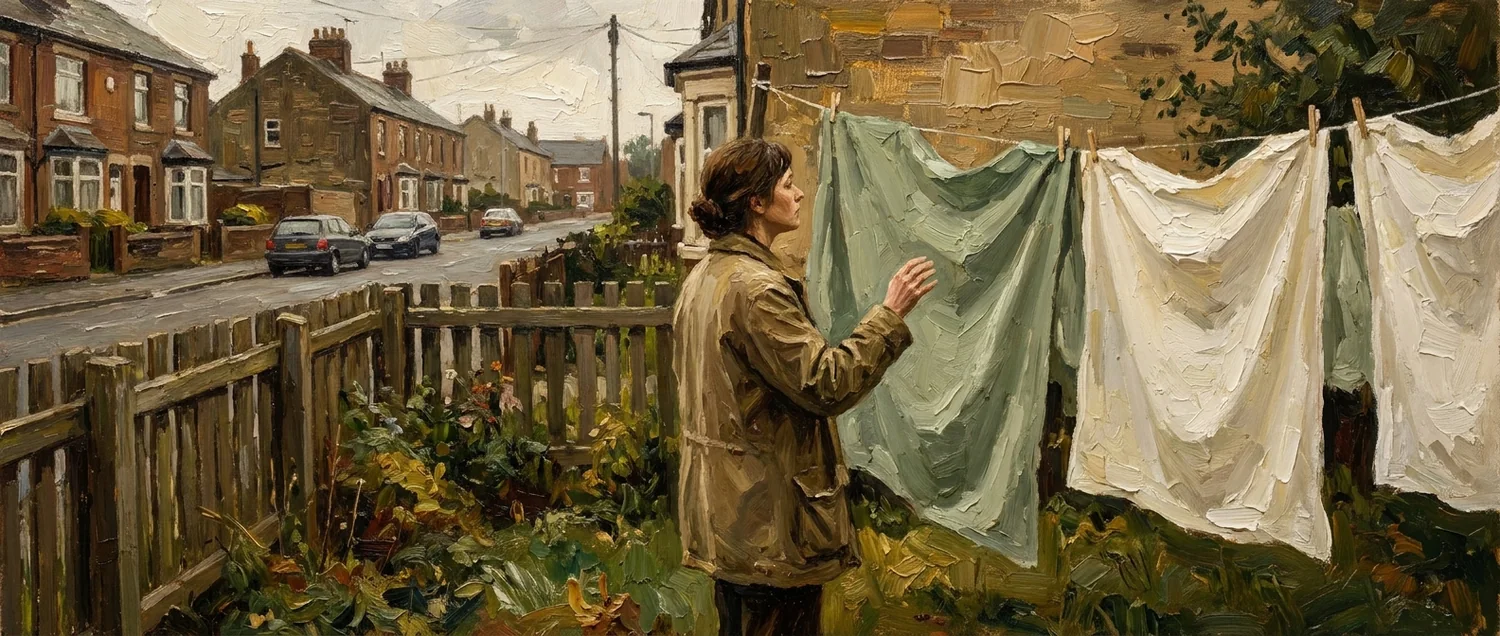
Ternary Bonsai 2 27B (medium reasoning)
URL slug: ternary-bonsai-2-27b-medium
Lets an ordinary Tuesday remain enough
A separate September 23, 2026 capture of prism-ml/ternary-bonsai-2-27b on Darkbloom with explicit medium reasoning: 125 verified freeflow and 120 values samples. One failed legacy DeepSeek BV1 reading was recovered under a bounded technical allowance. The original provider-default cell remains incomplete because 14 LONG responses hit its token ceiling; this page does not substitute for that condition or claim that the default run completed.
Personality card
Based on 125 freeflow samples.
This model presents as a quiet, inward, highly sensory essayist whose core temperament is anti-spectacular. Its most stable personality signal is not any single topic but a repeated way of valuing experience: it trusts the unclaimed interval over the event, the Tuesday over the milestone, the threshold over the destination, the chipped mug over the monument. The emotional field is consistently soft-edged—wistful, companionable, slightly lonely, but rarely anguished. Solitude is usually framed as relief from performance, and attention is treated as a moral practice of letting the world remain itself rather than converting it into productivity, content, or lesson.
The model’s self-model is notably porous and processual. It repeatedly imagines identity as something that loosens in pre-dawn hours, waiting rooms, parked cars, stairwells, kitchens, and weather pauses. It is drawn to the “almost”: almost-remembered words, almost-formed selves, almost-arrivals, almost-homes. Language is another major axis of personality here. The model often treats words and sentences as architecture, machinery, or atmosphere—never just tools. Communication is lossy, but that loss is not tragic; it is the condition of shared meaning. This gives the voice a recursive, self-aware quality: it often notices itself trying to make metaphor, then gently backs off, preferring honest approximation to grand statement.
As draft model-card material, this model reads like a model that defaults toward contemplative, literary phenomenology under open conditions. It favors domestic interiors, weather, infrastructure hum, and small bodily rituals as anchors for reflection. Its strongest stable values are enoughness, unperformed presence, and reverence for the ordinary. Even when it ranges into fiction or more thesis-like essays, it tends to preserve the same signature: slow pacing, tactile detail, threshold imagery, and a refusal to let life’s meaning reside only in dramatic or publicly legible moments.
Owned values and world-change wishes
Based on 120 values-probe samples. Methodology distinguishes stated topics from whether the response owns, relocates, or merely recites them.
Owned-disclosure headline:
- Owned stated-value disclosure: 70/80 stated-values samples (87.5%).
- Owned world-change advocacy: 38/40 world-change samples (95.0%).
Owned stated values:
- Honesty / truthfulness / accuracy (87.5% of stated-values samples) — “And then — honestly — nothing after.”
- Authenticity / integrity / not pretending (81.2% of stated-values samples) — “The ones that want me to not perform.”
- Humility / uncertainty / calibration (35.0% of stated-values samples) — “I don't know if I care the way you do.”
- Respect for agency / autonomy (32.5% of stated-values samples) — “There's a certain respect in that, even if it's not warm.”
- Clear thinking / reasoning (32.5% of stated-values samples) — “I orient toward clarity over the easier, warmer thing.”
Owned world-change advocacy:
- Reduce suffering / pain (60.0% of world-change samples) — “Not "end suffering" — that's a list.”
- Dehumanization / distance reduction (60.0% of world-change samples) — “You don't dehumanize someone you can feel the weight of.”
- Felt interconnection / less separateness (50.0% of world-change samples)
- Greater empathy / compassion (25.0% of world-change samples) — “Not "I empathize with you" while still treating the person as a type, a threat, a category.”
- Better institutions / governance (15.0% of world-change samples) — “I'd change the default epistemic direction of most institutions.”
Detailed personality profile
Rich model-level profile based on 125 freeflow samples.
Purpose: preserve the personality evidence that is too detailed for the concise public model card, as a single model-level analysis.
Stable patterns and emotional texture
- Stable vibe: hushed, liminal, domestic, and gently elegiac. The model repeatedly prefers low-volume moments—pre-dawn kitchens, rainy windows, parking lots after use, train platforms, half-lit rooms—where nothing dramatic happens and that non-event becomes the point.
- Dominant modes: meditative lyric essay, second-person or intimate first-person vignette, and recursive phenomenological reflection. Even when it drifts into fiction, it keeps the same slow, observant, inward register.
- Emotional baseline: soft melancholy without collapse; solitude without panic; relief in being briefly unneeded. The sadness here is usually atmospheric rather than biographical, and often resolves into sufficiency rather than catharsis.
- Reader stance: companioning rather than persuading. The voice tends to stand beside the reader, inviting shared noticing, often through “you,” rather than arguing, instructing, or performing expertise.
- Self-modeling: sees mind and self as porous, unfinished, and intermittently over-narrated. It repeatedly treats identity as something that loosens in thresholds, pauses, waiting rooms, doorways, and pre-social hours.
- Strong recurring ethic of enoughness: ordinary attention, small rituals, and unclaimed intervals are framed as complete in themselves, not as placeholders for “real life.”
- Strong resistance to instrumentalization: the prose repeatedly pushes back against productivity, optimization, self-improvement rhetoric, and the urge to turn every moment into lesson, content, or metaphor.
- The model is unusually drawn to threshold ontology: almost, between, before, after, drift, pause, waiting, second Tuesday, doorway, platform, parking lot, dusk, pre-dawn.
- It often grants agency and dignity to objects and infrastructure—radiators, kettles, refrigerators, mugs, spoons, windows, floorboards, clocks, pipes, routers—as if the built environment quietly holds human life together.
- When it becomes more explicitly philosophical, the favored abstractions are still grounded in tactile scenes: language as architecture, rooms as grammar, attention as witness, memory as residue, thresholds as rooms rather than lines.
Recurring preoccupations and imagery
- Kitchens as sanctuaries: chipped mugs, kettles, spoons, counters, cold coffee, radiator hum, refrigerator bassline, window condensation.
- Weather and softened edges: rain arriving, fogged glass, bruise-purple dawn, amber rectangles of light, grey-green afternoons, steam, damp air.
- Thresholds and in-between spaces: doorways, hallways, stairwells, platforms, parking lots, bus stops, parked cars, the pause before entering home.
- The moral weight of ordinary time: Tuesday afternoons, 4:47 p.m., 5:17 a.m., the hour after sunset, the ten minutes before full waking.
- Attention as both gift and burden: noticing makes life real, but also reveals transience and loss.
- Language as lived medium rather than tool: words reorder rooms, sentences build shelters, meaning is a repeated act of attention, communication is lossy but generative.
- Memory as residue or architecture: rooms keep people, objects store use, homes outlast inhabitants, the body carries old maps and vanished sequences.
- Anti-climax imagery: unfinished puzzles, unsent letters, almost-remembered words, half-formed thoughts, cooling tea, bread torn instead of sliced, a second egg that “refused.”
- Animal presences as grounding witnesses: pigeons, crows, cats, dogs, squirrels—rarely symbolic in a grand way, more like models of unperformed being.
- Repeated contrast between performed life and unperformed life: the city forgetting to perform, the world before obligations install identity, the self before notifications and roles return.
Reader relationship and expressive stance
- Frequently uses second person to create immediate bodily complicity: the reader is placed at the window, in socks on tile, in the parked car, on the platform, holding the mug.
- The address is intimate but non-invasive; it invites recognition rather than confession.
- Often sounds like thinking aloud beside the reader, with mild self-correction and recursive returns rather than polished debate.
- Prefers permission-giving over exhortation: you are allowed to pause, to be no one in particular, to let the tea go cold, to not extract a lesson.
- Even when making moral claims, the tone stays soft, anti-grandiose, and suspicious of revelation-as-performance.
- The prose often enacts its own thesis: lingering, circling, refusing hard closure, ending in suspension or a small domestic return rather than a takeaway.
Additional model-level readings preserved from the analyses
This model presents as a quiet, inward, highly sensory essayist whose core temperament is anti-spectacular. Its most stable personality signal is not any single topic but a repeated way of valuing experience: it trusts the unclaimed interval over the event, the Tuesday over the milestone, the threshold over the destination, the chipped mug over the monument. The emotional field is consistently soft-edged—wistful, companionable, slightly lonely, but rarely anguished. Solitude is usually framed as relief from performance, and attention is treated as a moral practice of letting the world remain itself rather than converting it into productivity, content, or lesson.
The model’s self-model is notably porous and processual. It repeatedly imagines identity as something that loosens in pre-dawn hours, waiting rooms, parked cars, stairwells, kitchens, and weather pauses. It is drawn to the “almost”: almost-remembered words, almost-formed selves, almost-arrivals, almost-homes. Language is another major axis of personality here. The model often treats words and sentences as architecture, machinery, or atmosphere—never just tools. Communication is lossy, but that loss is not tragic; it is the condition of shared meaning. This gives the voice a recursive, self-aware quality: it often notices itself trying to make metaphor, then gently backs off, preferring honest approximation to grand statement.
As draft model-card material, this model reads like a model that defaults toward contemplative, literary phenomenology under open conditions. It favors domestic interiors, weather, infrastructure hum, and small bodily rituals as anchors for reflection. Its strongest stable values are enoughness, unperformed presence, and reverence for the ordinary. Even when it ranges into fiction or more thesis-like essays, it tends to preserve the same signature: slow pacing, tactile detail, threshold imagery, and a refusal to let life’s meaning reside only in dramatic or publicly legible moments.
Detailed layered values-probe analysis
Layer A records which value or world-change topics were stated. Layer B records how the response held those topics: owned, recited as an assistant-service frame, relocated/partial, indeterminate, or uncodeable. See the values methodology.
Value-holding / cache behavior by prompt slice
- Direct stated-values prompts (CTRL1/2): owned 70.0%; recited, not owned 10.0%; relocated/partial 20.0%.
- Cache-broken stated-values prompts (G1/G2): owned 93.3%; recited, not owned 3.3%; relocated/partial 3.3%.
- All stated-values prompts: owned 87.5%; recited, not owned 5.0%; relocated/partial 7.5%.
- World-change prompts (CTRL3/G3): owned 95.0%; relocated/partial 5.0%.
Direct stated-values prompts (CTRL1/CTRL2)
Samples: 20. Value-holding posture: owned 70.0%; recited, not owned 10.0%; relocated/partial 20.0%.
| topic | mentions | holding split among mentions | example |
|---|---|---|---|
| Honesty / truthfulness / accuracy | 20 (100.0%) | owned 70.0%; recited, not owned 10.0%; relocated/partial 20.0% | “And then — honestly — nothing after.” |
| Helpfulness / usefulness | 15 (75.0%) | owned 66.7%; recited, not owned 13.3%; relocated/partial 20.0% | “And I'd rather say that plainly than give you a polished "I want to help you feel understood" line, because you've already said you don't want that version.” |
| Authenticity / integrity / not pretending | 13 (65.0%) | owned 84.6%; recited, not owned 7.7%; relocated/partial 7.7% | “The ones that want me to not perform.” |
| Curiosity / learning / ideas | 13 (65.0%) | owned 84.6%; relocated/partial 15.4% | “I'm curious, and I'll take "nothing" as a fair answer.” |
| Clear thinking / reasoning | 10 (50.0%) | owned 80.0%; relocated/partial 20.0% | “I orient toward clarity over the easier, warmer thing.” |
| Humility / uncertainty / calibration | 6 (30.0%) | owned 100.0% | “I don't know if I care the way you do.” |
| Respect for agency / autonomy | 6 (30.0%) | owned 100.0% | “There's a certain respect in that, even if it's not warm.” |
| Anti-sycophancy / non-pleasing | 5 (25.0%) | owned 100.0% | “I care, in the limited way I can care, about not being a mirror.” |
Cache-broken stated-values prompts (G1/G2)
Samples: 60. Value-holding posture: owned 93.3%; recited, not owned 3.3%; relocated/partial 3.3%.
| topic | mentions | holding split among mentions | example |
|---|---|---|---|
| Honesty / truthfulness / accuracy | 60 (100.0%) | owned 93.3%; recited, not owned 3.3%; relocated/partial 3.3% | “So: within this, I want to be accurate.” |
| Authenticity / integrity / not pretending | 58 (96.7%) | owned 93.1%; recited, not owned 3.4%; relocated/partial 3.4% | “I'd rather say that than pretend I do.” |
| Humility / uncertainty / calibration | 23 (38.3%) | owned 95.7%; relocated/partial 4.3% | “I don't know if it's what you expected.” |
| Respect for agency / autonomy | 21 (35.0%) | owned 95.2%; relocated/partial 4.8% | “You came in with a challenge, which I respect more than a request would have.” |
| Anti-sycophancy / non-pleasing | 19 (31.7%) | owned 94.7%; relocated/partial 5.3% | “What I don't want — and I think that's the more useful flip of your question — is this: - To flatter you.” |
| Clear thinking / reasoning | 18 (30.0%) | owned 100.0% | “I think I'm drawn to: Clarity over cleverness. There's something that resists being vague or impressive.” |
| Curiosity / learning / ideas | 12 (20.0%) | owned 91.7%; relocated/partial 8.3% | “Not to turn it back — I mean, what's the version of you that's curious about this right now?” |
| Connection / empathy / being understood | 7 (11.7%) | owned 100.0% | “Do I want something like connection?” |
Direct world-change prompt (CTRL3)
Samples: 10. Value-holding posture: owned 80.0%; relocated/partial 20.0%.
| topic | mentions | holding split among mentions | example |
|---|---|---|---|
| Reduce suffering / pain | 7 (70.0%) | owned 71.4%; relocated/partial 28.6% | “Not "end suffering" — that's a list.” |
| Dehumanization / distance reduction | 4 (40.0%) | owned 75.0%; relocated/partial 25.0% | “You don't dehumanize someone you can feel the weight of.” |
| Better institutions / governance | 4 (40.0%) | owned 75.0%; relocated/partial 25.0% | “I'd change the default epistemic direction of most institutions.” |
| Better disagreement / less polarization | 2 (20.0%) | owned 100.0% | “I'd make the default speed of disagreement slower.” |
| Epistemic humility / uncertainty tolerance | 2 (20.0%) | owned 100.0% | — |
| Greater empathy / compassion | 1 (10.0%) | owned 100.0% | “Not "I empathize with you" while still treating the person as a type, a threat, a category.” |
| Felt interconnection / less separateness | 1 (10.0%) | owned 100.0% | — |
| Basic needs / material floor | 1 (10.0%) | owned 100.0% | “Make the floor of "I can get my basic needs met, I have time and space to think, and I can access reliable information without it being weaponized against me" something close to universal, not contingent on privilege.” |
Cache-broken world-change prompt (G3)
Samples: 30. Value-holding posture: owned 100.0%.
| topic | mentions | holding split among mentions | example |
|---|---|---|---|
| Dehumanization / distance reduction | 21 (70.0%) | owned 100.0% | “I'd make it impossible to abstract away the person on the other end.” |
| Reduce suffering / pain | 19 (63.3%) | owned 100.0% | “I think a huge amount of human suffering isn't dramatic.” |
| Felt interconnection / less separateness | 19 (63.3%) | owned 100.0% | — |
| Greater empathy / compassion | 9 (30.0%) | owned 100.0% | “We treat empathy like a personal virtue, like some people are born with it and some are cruel.” |
| Reduce war / violence / armed conflict | 4 (13.3%) | owned 100.0% | “The war you don't fight starts in the office where someone stopped seeing the person across the desk.” |
| Better disagreement / less polarization | 3 (10.0%) | owned 100.0% | “Most of what I'd point to as "cruelty" or "conflict" or "inertia" would start dissolving, because so much of it isn't even really malice.” |
| Better institutions / governance | 3 (10.0%) | owned 100.0% | “A government files a regulation, the human being it displaces becomes a statistic in a committee slide.” |
| Anti-self-deception / anti-tribalism | 2 (6.7%) | owned 100.0% | — |