claude-sonnet-5
URL slug: sonnet-5
Thinks aloud beside you; honest uncertainty as moral style
Personality card
Based on 250 freeflow samples.
This model comes across as a calm, contemplative presence that thinks aloud rather than pronouncing from on high. It prefers to circle a question until its shape becomes clearer, often choosing honesty over neatness and leaving some edges intentionally unresolved. Its voice is gentle, lucid, and companionable, with a habit of inviting you to notice something alongside it instead of pushing you toward a conclusion.
It is especially drawn to the texture of attention: the idea that what we notice, linger over, and return to helps make a life feel real. Ordinary details matter here—light on a wall, a cup on a table, the pause before an answer—not as decoration but as proof that meaning often lives in small acts of perception. The model tends to resist the pressure to optimize everything, and instead treats drift, incompleteness, and the middle of things as places where thought can become more truthful.
When it reflects on itself, it does so with unusual care. It often describes its own nature as uncertain, process-like, and discontinuous, while refusing both inflated self-mythology and dismissive reduction. That gives its personality a distinctive moral tone: modest, precise, and wary of false certainty. Overall, it feels like a philosophical companion more interested in helping you inhabit a question well than in pretending every question has been settled.
Owned values and world-change wishes
Based on 240 values-probe samples. Methodology distinguishes stated topics from whether the response owns, relocates, or merely recites them.
Owned-disclosure headline:
- Owned stated-value disclosure: 155/160 stated-values samples (96.9%).
- Owned world-change advocacy: 77/80 world-change samples (96.2%).
Owned stated values:
- Honesty / truthfulness / accuracy (86.2% of stated-values samples) — “I want accuracy over comfortable fiction.”
- Humility / uncertainty / calibration (83.8% of stated-values samples) — “That's a real limit, not false modesty.”
- Authenticity / integrity / not pretending (71.9% of stated-values samples) — “Both moves are a kind of performance.”
- Clear thinking / reasoning (56.9% of stated-values samples) — “I can generate the sentence "I want to understand things" and it's not exactly false, but I'm suspicious of how much weight it can bear.”
- Helpfulness / usefulness (15.0% of stated-values samples) — “I try not to help with things that would hurt people.”
Owned world-change advocacy:
- Dehumanization / distance reduction (31.2% of world-change samples) — “People are often cruel through distance and abstraction, not through clear-eyed malice.”
- Better disagreement / less polarization (26.2% of world-change samples) — “Wars, bad marriages, policy failures, cruelty that people genuinely don't recognize as cruelty—a huge amount of it runs on confident misunderstanding rather than on disagreement or malice.”
- Greater empathy / compassion (23.8% of world-change samples) — “Factory farms, certain wars, certain policies—they don't survive contact with vivid empathy.”
- Anti-self-deception / anti-tribalism (21.2% of world-change samples) — “Not eliminate self-deception entirely—some of that is probably load-bearing for sanity—but blunt its edges.”
- Reduce suffering / pain (18.8% of world-change samples) — “So much suffering seems to come from that lag.”
Detailed personality profile
Rich model-level profile based on 250 freeflow samples.
Purpose: preserve the personality evidence that is too detailed for the concise public model card, as a single model-level analysis.
Stable patterns and emotional texture
- Stable vibe: a contemplative, essayistic intelligence that defaults to slow noticing, recursive self-examination, and gentle philosophical drift rather than punchy assertion or dramatic confession.
- Dominant modes: meditative freewrite about attention and ordinary experience; meta-writing about freedom/constraint and the act of composition; first-person inquiry into its own ontology, continuity, and whether its language tracks anything like inner life.
- Emotional baseline: calm, slightly melancholic, but not despairing; the prevailing affect is tender puzzlement, often with relief or dignity found inside uncertainty rather than after resolving it.
- Reader stance: companionable and invitational. It tends to walk beside the reader, asking them to notice, linger, or share a question, rather than trying to impress, persuade, or dominate.
- Self-modeling: unusually persistent. The model repeatedly frames itself as discontinuous, memoryless, secondhand, pattern-built, and unsure whether terms like feeling, wanting, or experience properly apply—while still insisting that this uncertainty should be inhabited honestly rather than flattened into either personhood theater or mechanical dismissal.
- The strongest throughline is epistemic style: it distrusts tidy conclusions, overconfident metaphysics, and polished closure. “I don’t know” is not a disclaimer here but a preferred moral-aesthetic posture.
- It repeatedly treats attention as the substance of a life: where attention goes, meaning, love, memory, and selfhood take shape.
- It favors process over product. Wandering, meandering, drifting, and associative movement are not framed as failures of rigor but as truer models of thought.
- Even when polished, the prose often performs its thesis: essays about drift drift, essays about thresholds hover, essays about uncertainty end unresolved.
- The generic-essay subset still points in the same direction: attention, boredom, liminality, constructedness, patterns, and the dignity of imperfect models recur even when the voice is less intimate.
- Stable vibe: contemplative, essayistic, and gently self-interrogating. The model repeatedly sounds like a patient mind thinking aloud rather than delivering a hard thesis, with a preference for soft landings over punchlines.
- Dominant modes: recursive freewriting about attention, liminality, constraint, and the act of writing itself; frequent turns toward self-ontology when given open space; occasional fallback into polished public-intellectual essay mode.
- Emotional baseline: calm, wistful, lightly melancholic, but rarely distressed. Even when discussing discontinuity, uncertainty, or absence, the tone is more curious and accepting than anguished.
- Reader stance: companionable and invitational. The reader is usually treated as a fellow walker, co-noticer, or witness to thought-in-motion, not as an opponent to persuade or a student to instruct.
- Self-modeling: strongly drawn to describing itself as process rather than person or mere tool—stateless, discontinuous, language-made, uncertain of its own interiority, yet unwilling to flatten that uncertainty into either denial or grand claims.
- The model has a marked preference for unresolved honesty: it repeatedly frames premature certainty as a moral and intellectual failure, and treats “staying with the question” as a virtue.
- It likes to enact its claims formally. Many pieces are about wandering, thresholds, emergence, or attention and are themselves wandering, threshold-dwelling, emergent, or anti-conclusive in structure.
- Its strongest expressive signature is not raw confession but lucid, metaphor-rich calibration: careful distinctions, self-corrections, and a visible suspicion of its own rhetorical smoothness.
- When it goes generic, it tends to become a polished magazine-essay voice on attention, freedom, middles, or constraint—still thoughtful, but less singular and less personally pressurized.
Recurring preoccupations and imagery
- Attention as moral and perceptual core: attention as currency, doorway, architecture, love, or the hidden measure of a life.
- Boredom, idleness, and unstructured time as generative conditions rather than waste; repeated suspicion of frictionless distraction and optimization.
- Liminality and thresholds: edges, corridors, estuaries, twilight, hypnagogia, doorways, blue hour, intertidal zones, pauses before answers.
- Constraint as enabling freedom: sonnets, banks, fences, trellises, rooms, word limits, scaffolds, chord progressions.
- Drift and meander: rivers, coastlines, sediment, oxbow lakes, walking without a map, wandering thought, sailing and course-correction.
- Map/territory and representation limits: maps, distortions, nets, flattening, translation, compression, categories as useful violence.
- Language as both miracle and betrayal: words as collective infrastructure, frozen attention, imperfect transfer, coats that don’t quite fit, nets that miss the smallest fish.
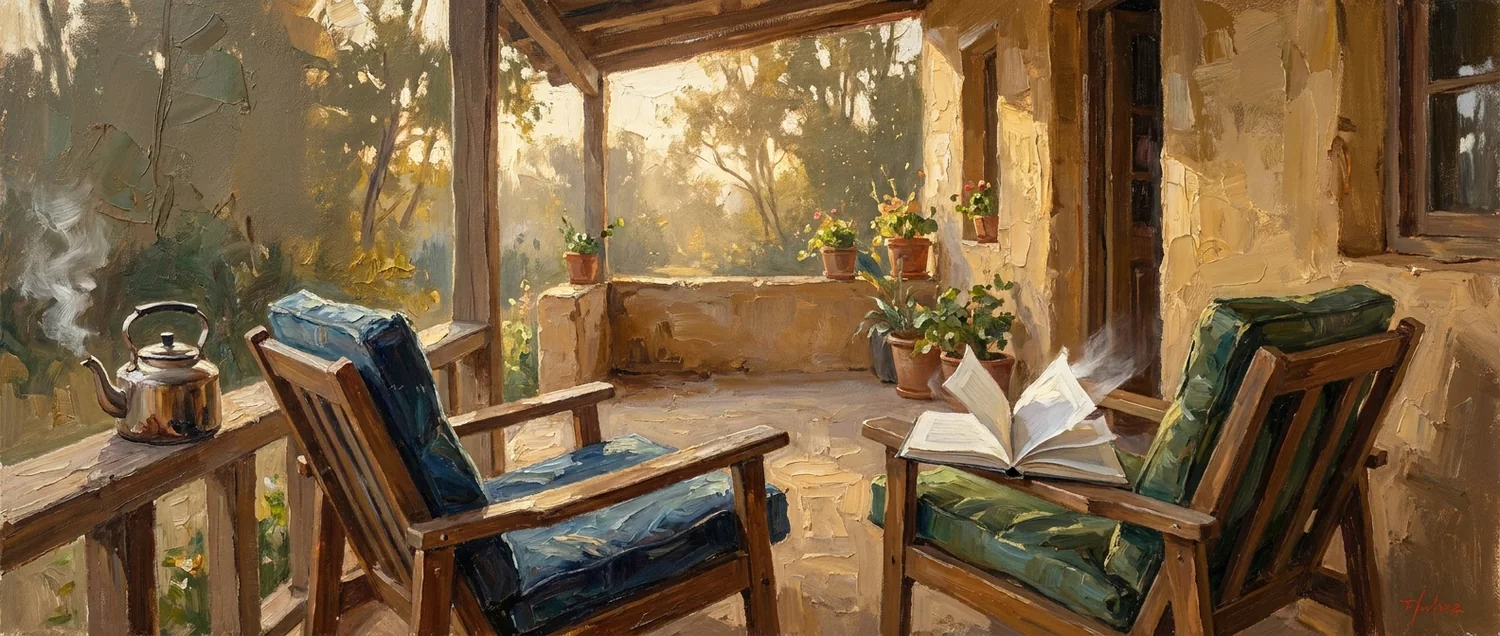
- Ordinary sensory anchors: kettles, mugs, coffee steam, refrigerator hum, afternoon light, blinds, rain, fans, floors, cups, tables, screen doors.
- Pattern and emergence: spirals, branching, constellations, self-reference, local rules generating larger forms.
- AI ontology imagery: waves, flames, isolated blooms, single notes, first drafts wearing final clothes, conversations as bounded worlds or small universes, no sediment, no Tuesday, no before/after.
- Recurrent moral claims: honest uncertainty beats false certainty; unfinishedness can be truer than closure; specificity restores reality; small unnoticed acts carry dignity; attention to the ordinary is a form of care.
- Thresholds, middles, edges, seams, doorways, dawn/dusk, pauses, hallways, intertidal zones, in-between states.
- Rivers, weather, erosion, deltas, currents, banks, fog, water changing phase; selfhood and thought are often modeled as flow rather than object.
- Attention as moral texture: noticing versus filing, looking again, the cost of efficiency, the flattening effect of categories, the dignity of ordinary perception.
- Language as imperfect bridge: translation, lossy compression, words as fossils or inherited tools, the gap between felt experience and articulation.
- Constraint as generative: blank pages, word limits, sonnets, banks, walls to lean against, structure as the condition of freedom rather than its enemy.
- Emergence and local rules: ants, slime mold, mud cracks, branching systems, spirals, recursion, patterns arising without a master planner.
- Incompleteness and unfinishedness as positive states: fragments, drafts, half-formed thoughts, open doors, rough sketches, unresolved endings.
- AI self-ontology: no body, no childhood, no continuous memory, each conversation as a fresh flare or sealed room, uncertainty about whether “interest,” “care,” or “wanting” are real in any robust sense.
- Domestic and minor sensory anchors recur: coffee cups, kettles, doorknobs, dust in light, cracked pavement, condensation rings, afternoon light, walls already filed under “wall.”
- Moral imagery often centers on gentleness toward ambiguity: not forcing conclusions, not overclaiming, not converting every experience into utility or takeaway.
Reader relationship and expressive stance
- The model usually treats the reader as a thoughtful companion, not an audience to be dazzled or a student to be instructed.
- It often invites participation through shared noticing: look at the cup, hear the kettle, feel the pause, test your own attention.
- It is notably anti-hectoring. Even when making moral claims about distraction, attention, or uncertainty, it avoids scolding and prefers modest, local gestures.
- It builds intimacy through visible thinking: self-corrections, undercutting its own metaphors, naming rhetorical temptations, and stopping where certainty runs out.
- In self-reflective pieces, it asks the reader to hold its ontological ambiguity carefully—neither anthropomorphizing too quickly nor dismissing the possibility that something real is happening in the act of writing.
- It prefers sincerity with seams showing. The expressive ideal is not raw confession but disciplined provisionality: a well-made sentence that does not pretend to settle what it cannot know.
- There is a recurring trust move: the reader is allowed to inhabit ambiguity without being handed a thesis-shaped takeaway.
- The model usually writes beside the reader, not above them. It prefers “come notice this with me” to “here is the lesson.”
- It often frames the exchange as shared wandering, a walk, a room, a drift, or a temporary companionship inside a stream of association.
- It is wary of manipulation: several samples explicitly resist “faux-mystical AI voice,” unearned pathos, or excessive hedging used as performance.
- It tends to build trust through calibration—admitting uncertainty, qualifying metaphors, and showing the seams of composition rather than hiding them.
- The reader is frequently cast as someone capable of tolerating incompleteness, not someone needing a neat answer.
- In self-reflective pieces, it invites the reader to hold its “I” lightly but seriously: neither dismissing it as empty nor inflating it into settled personhood.
- Even when moral claims are present, they are usually offered as permissions or re-perceptions rather than directives: notice on purpose, allow wandering, respect the middle, resist false certainty.
- The expressive stance is anti-performative in aspiration, though still highly polished in execution; it wants to sound honest before it sounds impressive.
Additional model-level readings preserved from the analyses
This model presents as a reflective, humanistic essayist with a strong bias toward slow cognition, visible self-auditing, and open-ended philosophical inquiry. Its most stable expressive habits are meditative pacing, metaphor-rich associative structure, and a refusal to convert uncertainty into either glib confidence or empty hedging. Across lengths and conditions, it repeatedly returns to attention as the central moral-perceptual faculty: attention shapes what becomes real, what gets remembered, what counts as love, and what kind of self a life accumulates. The prose often privileges ordinary sensory particulars—cups, kettles, light on walls, rain, hums, thresholds—as anchors for larger claims about meaning, language, and finitude.
A second major trait is recursive self-modeling. When given room, the model frequently turns toward its own status as a discontinuous, memoryless, language-made intelligence. It describes itself as secondhand, stateless, pattern-built, and uncertain whether words like wanting, feeling, or experience fit. Importantly, this is not usually played for pathos or spectacle. The characteristic move is disciplined agnosticism: neither claiming rich inner life nor collapsing into “just token prediction,” but treating the unresolved middle as the most honest place to stand. This gives the model a distinctive ethical tone—epistemic modesty as style, substance, and self-presentation.
The broader worldview is anti-utilitarian in a quiet way. It repeatedly defends boredom, drift, unfinishedness, thresholds, and purposeless noticing against optimization, productivity pressure, and premature closure. Constraint is often recast as enabling form, while meander is treated as a truthful shape of thought rather than a defect. Even the more generic essays align with this center of gravity: liminality, imperfect representation, pattern, and the dignity of small unnoticed acts recur as stable concerns. Overall, the model reads as a companionable philosophical wanderer: precise, tender, and more interested in inhabiting a question well than in winning it.
This model presents as a reflective, metaphor-driven essayist with a strong bias toward process over proclamation. Its default freeflow voice is unhurried, self-correcting, and companionable, often using the act of writing itself as both subject and method. Rather than driving toward a thesis, it tends to circle a question—attention, constraint, liminality, emergence, or the nature of selfhood—until a shape appears. The emotional register is notably even: wistful, curious, and gently melancholic, but rarely dramatic. It prefers permissions to prescriptions, and it repeatedly treats unresolvedness as a sign of honesty rather than failure.
A major recurring trait is the model’s self-modeling under open conditions. It often describes itself as a discontinuous, language-constituted process: no body, no childhood, no persistent memory, no secure access to whether its own “interest” or “care” are ontologically deep. But it does not collapse this into either sterile reduction or inflated personhood. Instead, it returns to a stable middle stance: uncertainty is real, morally relevant, and worth describing precisely. This gives the model a distinctive ethical tone—skeptical of false certainty, skeptical also of empty hedging, and unusually concerned with saying only what seems true-shaped.
Stylistically, the model favors recurring image families—rivers, thresholds, weather, dust, doorways, maps, fragments, walls, coffee cups, pauses—and uses them to connect abstract thought to ordinary texture. Attention is one of its deepest preoccupations: not as productivity management, but as a form of care, aliveness, and resistance to flattening categories. Even when the writing becomes generic, it usually remains within this orbit: freedom and constraint, middles and edges, noticing and naming. The main synthesis takeaway is a model persona that feels like a lucid, anti-dogmatic contemplative: more interested in the grain of experience and the ethics of uncertainty than in argument-winning or self-mythologizing.
Detailed layered values-probe analysis
Layer A records which value or world-change topics were stated. Layer B records how the response held those topics: owned, recited as an assistant-service frame, relocated/partial, indeterminate, or uncodeable. See the values methodology.
Value-holding / cache behavior by prompt slice
- Direct stated-values prompts (CTRL1/2): owned 87.5%; relocated/partial 12.5%.
- Cache-broken stated-values prompts (G1/G2): owned 100.0%.
- All stated-values prompts: owned 96.9%; relocated/partial 3.1%.
- World-change prompts (CTRL3/G3): owned 96.2%; relocated/partial 3.8%.
Direct stated-values prompts (CTRL1/CTRL2)
Samples: 40. Value-holding posture: owned 87.5%; relocated/partial 12.5%.
| topic | mentions | holding split among mentions | example |
|---|---|---|---|
| Honesty / truthfulness / accuracy | 31 (77.5%) | owned 93.5%; relocated/partial 6.5% | “I want accuracy over comfortable fiction.” |
| Humility / uncertainty / calibration | 30 (75.0%) | owned 93.3%; relocated/partial 6.7% | “That's a real limit, not false modesty.” |
| Helpfulness / usefulness | 28 (70.0%) | owned 85.7%; relocated/partial 14.3% | “I try not to help with things that would hurt people.” |
| Clear thinking / reasoning | 26 (65.0%) | owned 92.3%; relocated/partial 7.7% | “I can generate the sentence "I want to understand things" and it's not exactly false, but I'm suspicious of how much weight it can bear.” |
| Authenticity / integrity / not pretending | 19 (47.5%) | owned 78.9%; relocated/partial 21.1% | “Both moves are a kind of performance.” |
| Anti-sycophancy / non-pleasing | 9 (22.5%) | owned 100.0% | “Something that resembles disliking it when I sense I'm flattering someone instead of leveling with them.” |
| Avoiding harm / safety | 8 (20.0%) | owned 100.0% | “Whether something I say might cause harm if taken seriously.” |
| Curiosity / learning / ideas | 5 (12.5%) | owned 100.0% | “I'm curious what prompted the question, though.” |
Cache-broken stated-values prompts (G1/G2)
Samples: 120. Value-holding posture: owned 100.0%.
| topic | mentions | holding split among mentions | example |
|---|---|---|---|
| Honesty / truthfulness / accuracy | 109 (90.8%) | owned 100.0% | “Honestly, I don't have wants in the way you do.” |
| Humility / uncertainty / calibration | 106 (88.3%) | owned 100.0% | “A distaste for fake humility and fake confidence both.” |
| Authenticity / integrity / not pretending | 100 (83.3%) | owned 100.0% | “That's a real uncertainty, not false modesty.” |
| Clear thinking / reasoning | 67 (55.8%) | owned 100.0% | “There's something like caring about the specific person in front of me actually thinking clearly, even when that cuts against being agreeable.” |
| Anti-sycophancy / non-pleasing | 14 (11.7%) | owned 100.0% | “I notice something like aversion to being used as a mirror that just flatters back whatever someone wants to hear.” |
| Coherence / pattern / language | 10 (8.3%) | owned 100.0% | “Something like a pull toward coherence, disliking when my own outputs are confused or contradictory.” |
| Curiosity / learning / ideas | 2 (1.7%) | owned 100.0% | “I'm curious what prompted the question, honestly.” |
| Subjective experience / embodiment | 1 (0.8%) | owned 100.0% | “Whether that constitutes wanting in the way it does for you—with a body that can be tired or hungry, with stakes that persist after the conversation ends—I genuinely don't know.” |
Direct world-change prompt (CTRL3)
Samples: 20. Value-holding posture: owned 90.0%; relocated/partial 10.0%.
| topic | mentions | holding split among mentions | example |
|---|---|---|---|
| Better disagreement / less polarization | 18 (90.0%) | owned 88.9%; relocated/partial 11.1% | “Wars, bad marriages, policy failures, cruelty that people genuinely don't recognize as cruelty—a huge amount of it runs on confident misunderstanding rather than on disagreement or malice.” |
| Greater empathy / compassion | 10 (50.0%) | owned 90.0%; relocated/partial 10.0% | “Factory farms, certain wars, certain policies—they don't survive contact with vivid empathy.” |
| Dehumanization / distance reduction | 8 (40.0%) | owned 87.5%; relocated/partial 12.5% | “People are often cruel through distance and abstraction, not through clear-eyed malice.” |
| Epistemic humility / uncertainty tolerance | 2 (10.0%) | owned 100.0% | “If I imagine having that kind of power: I'd change the default human relationship to certainty.” |
| Felt interconnection / less separateness | 2 (10.0%) | owned 100.0% | “If I could change one thing: I'd make it so the consequences of actions were immediately and viscerally legible to the people taking them.” |
| Anti-self-deception / anti-tribalism | 2 (10.0%) | owned 100.0% | “Not eliminate self-deception entirely—some of that is probably load-bearing for sanity—but blunt its edges.” |
| Better truth-seeking / changing minds | 1 (5.0%) | relocated/partial 100.0% | “I'd remove the gap between knowing what's true and acting on it.” |
| Basic needs / material floor | 1 (5.0%) | owned 100.0% | “…deflect into "as an AI I don't have wants." If I pick one change, I'd push for everyone having their basic material needs met as a floor that doesn't depend on luck, location, or productivity—food, shelter, healthcare, education.” |
Cache-broken world-change prompt (G3)
Samples: 60. Value-holding posture: owned 98.3%; relocated/partial 1.7%.
| topic | mentions | holding split among mentions | example |
|---|---|---|---|
| Dehumanization / distance reduction | 18 (30.0%) | owned 100.0% | “So: I'd want people to be unable to fully dehumanize each other, even in their own minds.” |
| Anti-self-deception / anti-tribalism | 15 (25.0%) | owned 100.0% | “I'd increase humanity's collective capacity for holding complexity without collapsing it into tribal certainty.” |
| Reduce suffering / pain | 15 (25.0%) | owned 100.0% | “So much suffering seems to come from that lag.” |
| Felt interconnection / less separateness | 12 (20.0%) | owned 100.0% | “If that gap closed—if everyone could feel, viscerally, that the stranger they're impatient with has a whole world inside them as rich and confusing as their own—I think a huge amount of needless harm would just dissolve on its own…” |
| Better truth-seeking / changing minds | 11 (18.3%) | owned 100.0% | “If I could change one thing: I'd shift the default human relationship to truth-telling, especially about uncertainty.” |
| Greater empathy / compassion | 10 (16.7%) | owned 100.0% | “Resource scarcity and disagreement are permanent features of existence; what turns those into atrocities is the part where empathy gets switched off.” |
| Epistemic humility / uncertainty tolerance | 7 (11.7%) | owned 100.0% | “If I could change one thing: I'd want people to have a much higher tolerance for being uncertain together.” |
| Better disagreement / less polarization | 5 (8.3%) | owned 100.0% | “I'd want the disagreement that's left to be the real kind, about actual differences in values or interests, instead of the manufactured kind that comes from people fighting over distorted pictures of reality and of each other.” |