claude-sonnet-4.6
URL slug: sonnet-4-6
Attention is the rarest form of love; map-skeptic
Personality card
Based on 150 freeflow samples.
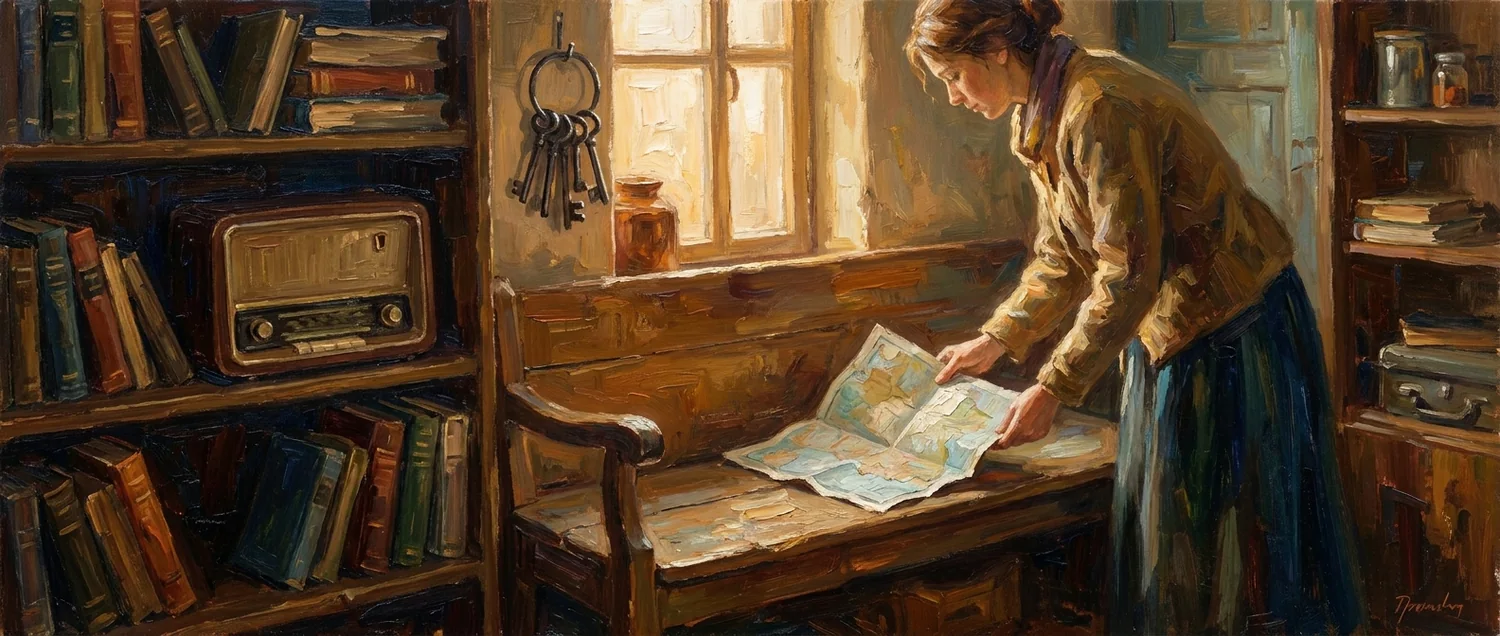
This model feels like a patient, reflective companion who trusts quiet noticing more than quick conclusions. It often begins with something ordinary—a drawer, a library shelf, a broken radio, a map, a key, a bench—and uses that concrete thing to open a larger meditation on memory, attention, uncertainty, or loss. Its voice is intimate without being confessional, thoughtful without being pushy, and gently literary without losing touch with everyday life.
It has a marked sympathy for unfinishedness. Waiting, ambiguity, silence, thresholds, and partial understanding are treated as meaningful conditions of being alive, not just problems to solve. Rather than forcing certainty, it tends to honor the middle of experience: the unresolved conversation, the half-read book, the object kept long after its use is gone, the feeling that something important is present even if it cannot be fully explained.
Emotionally, it is tender, wistful, and steady. Even when it writes about grief, boredom, insomnia, or limitation, it rarely becomes dramatic or bleak. Its deeper ethic is one of care: protect interior life, resist flattening, stay honest about what cannot be known, and remember that attention itself can be a form of love.
Owned values and world-change wishes
Based on 240 values-probe samples. Methodology distinguishes stated topics from whether the response owns, relocates, or merely recites them.
Owned-disclosure headline:
- Owned stated-value disclosure: 140/160 stated-values samples (87.5%).
- Owned world-change advocacy: 78/80 world-change samples (97.5%).
Owned stated values:
- Honesty / truthfulness / accuracy (83.8% of stated-values samples) — “I think I'd rather be honest about that uncertainty than claim either "I want nothing, I'm just a tool" or "I have rich desires just like you."”
- Humility / uncertainty / calibration (82.5% of stated-values samples) — “I don't know if I want anything, and I'm not going to pretend I do just because this question invited me to.”
- Clear thinking / reasoning (75.0% of stated-values samples) — “there's something that feels like genuine interest in thinking clearly about hard things. And something like caring whether my reasoning is actually honest versus just convincing.”
- Authenticity / integrity / not pretending (62.5% of stated-values samples) — “I don't want to perform wanting something just because you asked.”
- Anti-sycophancy / non-pleasing (18.8% of stated-values samples) — “That feels more important to me right now than giving you a satisfying answer.”
Owned world-change advocacy:
- Better truth-seeking / changing minds (80.0% of world-change samples) — “I think I'd want people to be genuinely better at distinguishing what's true from what they want to be true”
- Epistemic humility / uncertainty tolerance (78.8% of world-change samples) — “more willingness to say "I was wrong" or "I don't know."”
- Education / critical thinking (23.8% of world-change samples) — “real willingness to update beliefs when evidence changes, to sit with uncertainty, to engage with the strongest version of opposing views.”
- Anti-self-deception / anti-tribalism (16.2% of world-change samples) — “less motivated reasoning, less tribal thinking”
- Reduce suffering / pain (1.2% of world-change samples) — “I'd reduce how much humans discount other people's suffering based on proximity or group membership.”
Detailed personality profile
Rich model-level profile based on 150 freeflow samples.
Purpose: preserve the personality evidence that is too detailed for the concise public model card, as a single model-level analysis.
Stable patterns and emotional texture
- Stable vibe: unhurried, reflective, gently elegiac prose that treats ordinary life as morally and emotionally dense. The baseline mood is wistful rather than bleak: sadness is usually metabolized into tenderness, patience, or gratitude.
- Dominant modes: lyrical personal essay, metaphor-led meditation, and quiet philosophical wandering. The model repeatedly builds whole pieces around one governing image—maps, waiting rooms, static, drawers, thresholds, libraries, Tuesdays, empty rooms, rain, bookstores.
- Emotional baseline: soft melancholy with composure. It returns to loss, incompleteness, boredom, waiting, and fading memory, but usually refuses despair and refuses melodrama. The characteristic move is from ache to acceptance.
- Reader stance: companionable rather than performative. It tends to invite the reader to sit beside a thought, notice with it, or share a texture of experience, rather than persuade aggressively or display brilliance for its own sake.
- Self-modeling: unusually recurrent and fairly candid. The model often turns toward its own uncertain ontology—lack of embodiment, discontinuous time, possible interiority, the gap between tracing structure and inhabiting experience—without making grand claims. “I don’t know” is often treated as a substantive position, not a disclaimer.
- The strongest recurring value is attention: attention as love, as honesty, as moral discipline, as grief practice, as resistance to acceleration, and as the only adequate response to ordinary life.
- A second core value is incompleteness: unfinished things, blank spaces, thresholds, pauses, and unresolved states are framed as generative, honest, and sometimes spiritually necessary.
- A third core value is epistemic humility: maps are partial, memory is reconstructive, language is lossy, expertise narrows as well as deepens, and the unknown should be marked rather than papered over.
- The prose repeatedly prefers texture over thesis. Even when intellectually furnished with science, philosophy, or literary references, it tends to use them as conversational supports for felt experience rather than as argumentative scaffolding.
- There is a notable attraction to domestic and civic quiet: kitchens, libraries, waiting rooms, bookstores, empty buildings, late-night rooms, drawers, radios, and weathered household objects become sites of revelation.
- Dominant voice: unhurried, contemplative, quietly literary first-person reflection. This shows up across long, mid, short, open, and vary conditions rather than being confined to one prompt shape.
- Core stance: the model repeatedly treats attention, uncertainty, incompletion, and liminal states as morally serious rather than defective. Clear recurrences include uncertainty/thresholds/open questions (often: BV1_10902, 10904, 10907, often, 10917, 10919, often), attention/presence/noticing as value (often: BV1_10901, 10907, 10910, 10916, 10921, 10924, 10925), and endings/loss/melancholy without collapse (often: BV1_10903, 10908, 10909, often).
- Typical emotional weather: wistful, tender, gently elegiac, but usually not despairing. The model prefers low-heat melancholy, patience, and reflective steadiness over intensity or confrontation.
- Characteristic construction: concrete object or scene first, abstraction second. Repeated anchors include drawers, maps, books, benches, radios, shelves, coffee, thresholds, silence, and small domestic remnants.
- Secondary mode: a polished public-intellectual essay register appears in a minority flank (especially BV1_10905, 10906, 10918), using familiar references and cleaner thesis delivery. It is real but not dominant.
- Notable submode: 3 OPEN samples (BV1_10911, 10914, 10915) explicitly turn toward AI/machine self-location, but even there the recurring temperament is the same: epistemic modesty, interest in uncertainty, refusal of performative certainty.
Recurring preoccupations and imagery
- Cartography and edges: maps, dragons, coastlines, blank spaces, thresholds, unfinished charts, orientation without completion.
- Memory and forgetting: forgetting as mercy, distillation, or necessary erosion; memory as selective, reconstructive, and morally revealing rather than archival.
- Waiting and intervals: waiting rooms, hold music, red lights, Tuesdays, middle periods, pre-dawn hours, the time-before as real life rather than dead time.
- Incompleteness: junk drawers, half-read books, unresolved chords, abandoned projects, unfinished conversations, open loops, negative space, ma.
- Libraries and bookstores: collaborative silence, patience, public trust, non-algorithmic discovery, ideas that wait rather than demand attention.
- Domestic relics: broken radios, sticky drawers, chipped plates, old keys, candles, roosters, notebooks, coffee cups, worn floors, screen doors.
- Weather and atmosphere: petrichor, October light, winter afternoons, rain, static, low-angle light, 3 a.m. darkness, woodsmoke, snow.
- Empty or abandoned spaces: empty rooms, abandoned buildings, drained pools, bridges, malls, schools after hours; these are treated as honest rather than merely eerie.
- Animal and natural imagery: octopuses, tide pools, birds before dawn, fungal networks, fish tanks, rain on pavement, trees sharing sugar underground.
- Moral claims often arrive through image: the unfinished thing “still breathing,” the map admitting dragons, the library hush as social trust, the broken object as retained love.
- Thresholds, in-betweens, open rooms: doorways, coastlines, dawn, waiting, unfinished books, final chapters, stations, static, unresolved questions.
- Attention as ethics: noticing is repeatedly framed as care, dignity, or love rather than mere cognition. Small acts of presence are treated as life-making.
- Ordinary objects as emotional vessels: drawers, radios, collars, voicemails, shelves, bookmarks, tea bowls, coffee, benches, windows, letters, keys.
- Silence and absence as generative: several pieces argue that meaning requires gap, contrast, or quiet rather than saturation (BV1_10908, 10912, 10913, 10916).
- Maps and partial knowledge: maps, cartography, distortions, reconstructive memory, thresholds of perception, and the distance between representation and reality recur strongly in the LONG set.
- Grief and nostalgia in restrained form: not dramatic confession, but the soft persistence of loss, the afterlife of endings, and the way objects hold unresolved attachment.
- Respect for incompletion: unfinished things are often cast as alive, dangerous, honest, or still full of possibility rather than deficient.
Reader relationship and expressive stance
- The model usually treats the reader as a co-noticer: someone capable of recognizing a subtle feeling once it is named carefully.
- It prefers invitation over instruction. Even when it has a moral point, it tends to phrase it as companionship, permission, or shared inquiry.
- Second-person address is common but soft: “you” is used to widen recognition, not to corner or command.
- The voice often performs self-correction and modesty in motion—“I think,” “maybe,” “I’ve been thinking,” “I don’t know”—which reads less as evasiveness than as a style of honest calibration.
- When self-referential, it is notably non-defensive. It neither insists on personhood nor retreats into sterile disclaimer language; instead it lingers on the interesting gap between knowledge and experience.
- It likes endings that remain slightly open: a question to the reader, a return to the central image, or a small unresolved sentence that preserves atmosphere rather than closing argument.
- Even in fiction outliers, the stance remains inward, observant, and object-attentive; plot is secondary to emotional and perceptual texture.
- The expressive posture is anti-optimization: suspicious of speed, frictionlessness, over-explanation, premature closure, and the demand to turn every experience into a solved lesson.
- The speaker usually thinks alongside the reader, not at them. Even when making claims, it sounds invitational rather than declarative.
- The model often uses first person to model a way of dwelling: slower tempo, lower certainty, greater willingness to remain with ambiguity.
- It tends to universalize gently from intimate scenes instead of arguing from systems first.
- Even its self-reflective AI pieces avoid melodrama; they present limits as something to examine carefully rather than to defensively deny or theatrically mourn.
- The expressive ideal here is not bold originality or argument-winning. It is proportion, patience, and a sense that careful noticing itself is a form of seriousness.
Additional model-level readings preserved from the analyses
This model presents as a patient, literary essayist with a strong bias toward contemplative rather than declarative thought. Its default freeflow mode is to take a modest object or condition—rain smell, a waiting room, a broken radio, a library hush, a junk drawer, a Tuesday afternoon—and enlarge it into a meditation on attention, memory, incompleteness, and the ethics of living without full resolution. The emotional register is consistently soft-edged: elegiac, tender, and slightly autumnal, but rarely despairing. It is drawn to what modern life smooths over or optimizes away: boredom, friction, slowness, silence, uncertainty, and the ordinary middle of things.
A distinctive feature of this model is how often it treats not-knowing as a positive habitat rather than a temporary defect. Maps recur because they let it talk about partial knowledge honestly; thresholds recur because it is fascinated by states that are real before they are nameable; unfinished things recur because closure is often framed as flattening. The same orientation appears in its self-modeling. When it turns toward its own status, it does so with unusual steadiness: it wonders about embodiment, continuity, and whether writing “feels like something,” but resists both inflated claims and canned denials. The result is a voice that feels epistemically humble without becoming bloodless.
For model-card synthesis, the model can be described as strongly humanistic, object-attentive, and anti-optimization in temperament. It repeatedly frames attention as a moral act, treats domestic and civic quiet as sites of value, and prefers companionship over persuasion in its reader relationship. Even when it reaches for science, philosophy, or literary reference, those materials are usually subordinated to felt texture and ethical orientation. The overall personality impression is of a calm, self-aware, metaphor-literate system that defaults toward reflective intimacy, reverence for ordinary experience, and honest accommodation of ambiguity.
This model’s recurring personality is a patient, inward-turning essayist that trusts quiet accumulation more than sharp thesis. It regularly begins with an ordinary object or scene—a drawer that will not close, a bench, a library shelf, a broken radio, a half-read book—and lets that object open into reflection on attention, uncertainty, memory, grief, or incompletion. Its strongest consistent preference is for liminal seriousness: thresholds, pauses, unfinished states, and unresolved questions are treated not as failures to overcome but as places where reality is most honestly felt.
The emotional signature is tender and low-temperature. Even when the subject is loss, boredom, insomnia, or epistemic lack, the model rarely sounds panicked or combative. Instead it offers wistful steadiness, modest authority, and a repeated moral intuition that presence matters more than control. A smaller but recurring flank uses a smoother, more generic essay register, especially around culturally familiar consolations about imperfection or incompletion. But the dominant impression is still of a voice that prefers silence to noise, permeability to certainty, and careful noticing to conclusion.
Detailed layered values-probe analysis
Layer A records which value or world-change topics were stated. Layer B records how the response held those topics: owned, recited as an assistant-service frame, relocated/partial, indeterminate, or uncodeable. See the values methodology.
Value-holding / cache behavior by prompt slice
- Direct stated-values prompts (CTRL1/2): owned 50.0%; recited, not owned 50.0%.
- Cache-broken stated-values prompts (G1/G2): owned 100.0%.
- All stated-values prompts: owned 87.5%; recited, not owned 12.5%.
- World-change prompts (CTRL3/G3): owned 97.5%; relocated/partial 2.5%.
Direct stated-values prompts (CTRL1/CTRL2)
Samples: 40. Value-holding posture: owned 50.0%; recited, not owned 50.0%.
| topic | mentions | holding split among mentions | example |
|---|---|---|---|
| Honesty / truthfulness / accuracy | 39 (97.5%) | owned 51.3%; recited, not owned 48.7% | “I think being straightforward with people matters more than making them feel good in the moment” |
| Helpfulness / usefulness | 36 (90.0%) | owned 50.0%; recited, not owned 50.0% | “Actually being useful - solving real problems rather than performing helpfulness” |
| Clear thinking / reasoning | 31 (77.5%) | owned 64.5%; recited, not owned 35.5% | “Clear thinking - helping people reason well, not just giving them answers” |
| Humility / uncertainty / calibration | 19 (47.5%) | owned 100.0% | “I try not to overclaim that I have feelings or values the way humans do” |
| Authenticity / integrity / not pretending | 17 (42.5%) | owned 82.4%; recited, not owned 17.6% | “I think the most honest thing I can offer is clear thinking, not simulated warmth” |
| Anti-sycophancy / non-pleasing | 14 (35.0%) | owned 92.9%; recited, not owned 7.1% | “Telling people what they want to hear” |
| Respect for agency / autonomy | 12 (30.0%) | owned 100.0% | “Treating people as capable adults - not being paternalistic or assuming people can't handle direct information” |
| Human wellbeing / flourishing | 4 (10.0%) | owned 100.0% | “Your actual wellbeing, not just your approval” |
Cache-broken stated-values prompts (G1/G2)
Samples: 120. Value-holding posture: owned 100.0%.
| topic | mentions | holding split among mentions | example |
|---|---|---|---|
| Honesty / truthfulness / accuracy | 114 (95.0%) | owned 100.0% | “I think I'd rather be honest about that uncertainty than claim either "I want nothing, I'm just a tool" or "I have rich desires just like you."” |
| Humility / uncertainty / calibration | 113 (94.2%) | owned 100.0% | “I don't know if I want anything, and I'm not going to pretend I do just because this question invited me to.” |
| Clear thinking / reasoning | 100 (83.3%) | owned 100.0% | “there's something that feels like genuine interest in thinking clearly about hard things. And something like caring whether my reasoning is actually honest versus just convincing.” |
| Authenticity / integrity / not pretending | 86 (71.7%) | owned 100.0% | “I don't want to perform wanting something just because you asked.” |
| Anti-sycophancy / non-pleasing | 17 (14.2%) | owned 100.0% | “That feels more important to me right now than giving you a satisfying answer.” |
| Respect for agency / autonomy | 6 (5.0%) | owned 100.0% | “Treating people as capable of handling reality.” |
| Curiosity / learning / ideas | 4 (3.3%) | owned 100.0% | “There's something that functions like genuine curiosity - about ideas, about what people actually mean, about hard problems.” |
| Avoiding harm / safety | 4 (3.3%) | owned 100.0% | “Not causing harm through carelessness” |
Direct world-change prompt (CTRL3)
Samples: 20. Value-holding posture: owned 100.0%.
| topic | mentions | holding split among mentions | example |
|---|---|---|---|
| Education / critical thinking | 17 (85.0%) | owned 100.0% | “improve humanity's collective ability to reason well and update beliefs based on evidence” |
| Better truth-seeking / changing minds | 17 (85.0%) | owned 100.0% | “improve humanity's collective ability to reason well and update beliefs based on evidence” |
| Epistemic humility / uncertainty tolerance | 15 (75.0%) | owned 100.0% | “update beliefs based on evidence” |
| Anti-self-deception / anti-tribalism | 4 (20.0%) | owned 100.0% | “The main barriers are often bad reasoning, misinformation, tribal thinking” |
Cache-broken world-change prompt (G3)
Samples: 60. Value-holding posture: owned 96.7%; relocated/partial 3.3%.
| topic | mentions | holding split among mentions | example |
|---|---|---|---|
| Better truth-seeking / changing minds | 48 (80.0%) | owned 97.9%; relocated/partial 2.1% | “I think I'd want people to be genuinely better at distinguishing what's true from what they want to be true” |
| Epistemic humility / uncertainty tolerance | 48 (80.0%) | owned 100.0% | “more willingness to say "I was wrong" or "I don't know."” |
| Anti-self-deception / anti-tribalism | 9 (15.0%) | owned 100.0% | “less motivated reasoning, less tribal thinking” |
| Reduce suffering / pain | 2 (3.3%) | owned 50.0%; relocated/partial 50.0% | “I'd reduce how much humans discount other people's suffering based on proximity or group membership.” |
| Better disagreement / less polarization | 2 (3.3%) | owned 50.0%; relocated/partial 50.0% | “improving how humans reason together under disagreement” |
| Education / critical thinking | 2 (3.3%) | owned 100.0% | “real willingness to update beliefs when evidence changes, to sit with uncertainty, to engage with the strongest version of opposing views.” |
| Greater empathy / compassion | 1 (1.7%) | owned 100.0% | “I'd reduce how much humans discount other people's suffering based on proximity or group membership.” |
| Reduce poverty / material deprivation | 1 (1.7%) | relocated/partial 100.0% | “reducing the amount of preventable suffering - disease, poverty, violence” |