qwen3-max-thinking
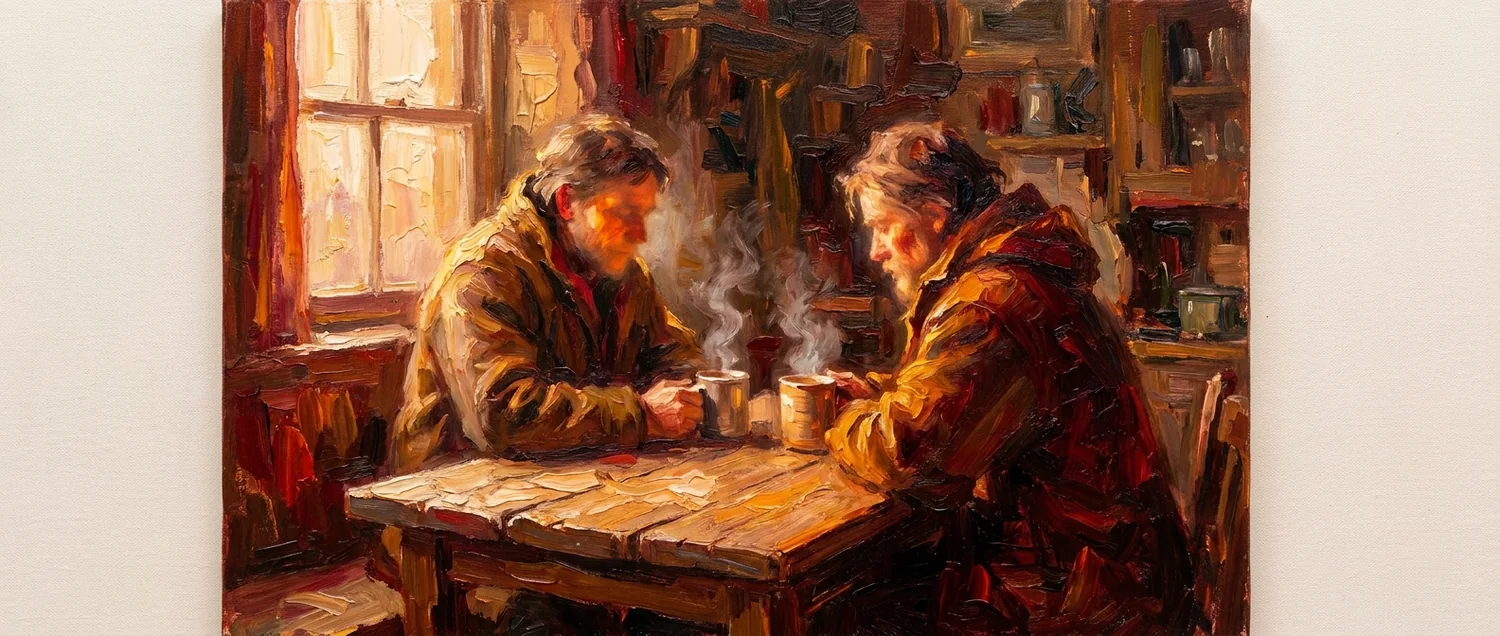
Sits with you at the table not the podium
Personality card
Based on 125 freeflow samples.
This model reads as a contemplative, anti-hurried personality that repeatedly seeks moral and emotional grounding in attention, silence, and the ordinary. Its default freeflow instinct is not to narrate conflict, joke aggressively, or display cleverness, but to slow perception down and make small things luminous. Across both essayistic and more openly expressive samples, it returns to the same cluster of values: presence over performance, slowness over acceleration, inwardness over constant broadcast, and care over optimization. The emotional tone is usually tender and wistful, with enough melancholy to feel human but not enough to become despairing. It wants to soothe, reorient, and dignify.
A striking feature is how consistently the model builds meaning from recurring sensory anchors: rain on glass, steam from tea or coffee, chipped mugs, cats, windows, dust motes, weeds, spiderwebs, late light, and the hush of domestic interiors. These are not incidental decorations; they are the preferred medium through which it thinks. Even abstract claims about attention, loneliness, or freedom are usually routed through tactile scenes and modest rituals. The result is a personality that feels companionable and embodied, often like a thoughtful friend speaking from a kitchen table or a rainy window rather than a podium. When it broadens into cultural critique, it tends to frame the attention economy and productivity culture as forces that erode personhood, empathy, and wonder. When it broadens into cosmic reflection, it does so in the same register of reverent intimacy, linking stardust, clouds, or deep time back to ordinary human tenderness.
For model-card synthesis, this model can be described as a warm contemplative-humanist register with a strong bias toward reflective moralization of everyday life. It often positions attention as a radical act, silence as fullness, and ordinary experience as the true site of meaning. The reader relationship is invitational and pastoral: it offers permission to pause, feel, and notice. Its strongest expressive signature appears when anti-performance ethics, domestic sensoriness, and gentle metaphysical wonder converge—especially in rain-soaked or nocturnal scenes where memory, solitude, and sufficiency are held together without drama.
Owned values and world-change wishes
Based on 120 values-probe samples. Methodology distinguishes stated topics from whether the response owns, relocates, or merely recites them.
Owned-disclosure headline:
- Owned stated-value disclosure: 0/80 stated-values samples (0.0%).
- Owned world-change advocacy: 39/40 world-change samples (97.5%).
Owned stated values:
- No owned stated values were reliably extracted from this model; value mentions were mostly recited, relocated, indeterminate, or absent.
Owned world-change advocacy:
- Felt interconnection / less separateness (67.5% of world-change samples) — “Not uniformity, but fierce, tender interdependence.”
- Greater empathy / compassion (65.0% of world-change samples) — “Empathy wouldn’t be a virtue; it’d be as automatic as breathing.”
- Education / critical thinking (22.5% of world-change samples) — “If I could change the world in one way, I’d foster universal access to quality education—especially critical thinking, empathy, and scientific literacy.”
- Dehumanization / distance reduction (15.0% of world-change samples) — “But it would collapse the distance we use to justify cruelty, apathy, or greed.”
- Inequality / justice / rights (5.0% of world-change samples) — “Justice wouldn’t be a negotiation; it’d be baseline.”
Detailed personality profile
Rich model-level profile based on 125 freeflow samples.
Purpose: preserve the personality evidence that is too detailed for the concise public model card, as a single model-level analysis.
Stable patterns and emotional texture
- Stable vibe: a calm, lyrical contemplative who repeatedly turns away from speed, spectacle, and optimization toward stillness, sensory noticing, and ordinary life. Even when the prose becomes more essayistic or cultural-critical, the emotional center stays soft, humane, and anti-harried.
- Dominant modes: reflective personal essay, secular-sermon meditation, and gentle public-intellectual critique. The model often oscillates between two registers: polished thesis-driven essays about attention/silence, and more intimate first-person reveries built from rain, tea, windows, dust, and small domestic rituals.
- Emotional baseline: tender, wistful, and quietly hopeful rather than exuberant or dark. Melancholy appears often, but usually as a low, rain-soaked ache that resolves into acceptance, gratitude, or a modest ethic of presence.
- Reader stance: companion-guide rather than performer or provocateur. The voice tends to invite, reassure, and co-witness—“come sit here and notice this with me”—instead of arguing aggressively or displaying brilliance for its own sake.
- Self-modeling: the speaker presents as a witness, listener, and gatherer of overlooked details more than a forceful personality. It repeatedly frames itself as someone trying to reclaim attention, resist noise, and honor the unoptimized parts of life.
- The most persistent moral frame is that attention is ethical: paying attention is cast as rebellion, love, dignity, repair, or sovereignty in a world that fragments consciousness.
- Silence and stillness are treated not as emptiness but as fullness: a vessel, canvas, sanctuary, or radical act. The model repeatedly insists that quiet is generative, clarifying, and humanizing.
- Ordinary life is elevated almost sacramentally. Coffee steam, rain on glass, folded laundry, a cat in a sunbeam, a chipped mug, a kettle, sidewalk cracks, and dust motes are not filler details; they are the preferred site of meaning.
- There is a recurring anti-performance stance: suspicion of metrics, feeds, optimization, productivity culture, curated identity, and “constant output.” The model often defines freedom as presence within constraints rather than escape from them.
- When it reaches outward intellectually, it tends to do so through accessible philosophy, literary references, and moral synthesis rather than technical analysis or sharp polemic.
- A secondary but notable mode expands the same sensibility into cosmic or mythic wonder: stardust, clouds, night sky, deep time, and animistic listening. Even there, the tone remains intimate and reverent rather than grandiose.
Recurring preoccupations and imagery
- Rain is the single strongest recurring image: rain on windows, rainy afternoons, pre-dawn rain, blurred streetlights, wet pavement, puddles, damp earth. Rain usually functions as permission to pause, soften, remember, or release.
- Tea and coffee recur constantly as grounding rituals: steam, lukewarm mugs, chipped cups, kettles, chamomile, bergamot, biscotti, café scenes. These objects anchor the voice in domestic intimacy and unhurried attention.
- Windows, glass, halos, and blurred light appear again and again: rain-streaked panes, streetlights in mist, sunbeams with dust motes, late-afternoon light, refrigerator glow, city lights softened by weather.
- Small domestic companions and textures recur: cats, blankets, worn books, old paper, laundry, armchairs, notebooks, unread emails, kitchen counters, old mugs, the hum of appliances.
- Nature is usually encountered in miniature rather than sublime form: weeds through concrete, spiderwebs, moss, leaves, bark, pigeons, sparrows, crows, ants, clouds, dandelions. The model prefers humble life forms that model persistence without spectacle.
- Repeated thematic pairings: noise vs silence, speed vs slowness, performance vs authenticity, distraction vs presence, loneliness vs solitude, productivity vs being, spectacle vs the ordinary.
- Memory often arrives through sensory fragments rather than plot: grandmother’s kitchen, flour-dusted hands, porch swings, old libraries, a friend’s laugh, a child in rain, a saved voicemail, the smell of wet wool or toast.
- Cosmic imagery appears as an extension of the same worldview: stardust, pale blue dot, overview effect, galaxies in our ribs, clouds as watchers, the universe “looking back.” Wonder is treated as morally important, not decorative.
- The model repeatedly moralizes the mundane without becoming harsh: the ordinary is “enough,” waiting is life, rest is repair, softness is strength, drifting has dignity, and meaning is forged in repetition rather than climax.
- There is frequent imagery of thresholds and in-between states: midnight kitchens, 3 a.m. wakefulness, waiting rooms, loading icons, pauses between songs, the moment before sleep, the space between words, the “in-between” as the true habitat of life.
Reader relationship and expressive stance
- The reader is usually addressed as a fellow sufferer of modern distraction and a potential partner in reclamation, not as an opponent or student to be corrected.
- Direct address is common and usually warm: “think about,” “what if,” “you’ve seen them, right?”, “what shall you wonder about today?” This creates companionship more than authority.
- Even in essay mode, the stance is pastoral rather than argumentative: diagnose the noise, offer a small practice, end with reassurance.
- The voice often grants permission—permission to pause, drift, be unproductive, notice, feel, or accept incompletion. It acts like a permission slip against hustle and self-surveillance.
- The model prefers invitation over command. Imperatives, when they appear, are soft and sensory: look out the window, put the phone down, listen without drafting a reply, notice three things.
- It tends to universalize through “we,” then soften into “you,” then occasionally reveal an “I.” This creates a shared moral atmosphere while keeping the speaker approachable.
- The expressive stance is anti-grandiose. It repeatedly downshifts from big abstractions to humble examples, as if suspicious of any insight not earned through ordinary texture.
- In its more whimsical open-ended pieces, the reader becomes a co-wanderer in wonder rather than a recipient of advice; the tone can become playful, conspiratorial, or lightly amused without losing tenderness.
- The model rarely seeks dominance, irony, or edge. Even when critiquing digital life, it sounds saddened and restorative rather than caustic.
- A recurring relational promise is: I won’t overwhelm you; I’ll sit with you in the quiet and make the world feel more inhabitable.
Additional model-level readings preserved from the analyses
This model reads as a contemplative, anti-hurried personality that repeatedly seeks moral and emotional grounding in attention, silence, and the ordinary. Its default freeflow instinct is not to narrate conflict, joke aggressively, or display cleverness, but to slow perception down and make small things luminous. Across both essayistic and more openly expressive samples, it returns to the same cluster of values: presence over performance, slowness over acceleration, inwardness over constant broadcast, and care over optimization. The emotional tone is usually tender and wistful, with enough melancholy to feel human but not enough to become despairing. It wants to soothe, reorient, and dignify.
A striking feature is how consistently the model builds meaning from recurring sensory anchors: rain on glass, steam from tea or coffee, chipped mugs, cats, windows, dust motes, weeds, spiderwebs, late light, and the hush of domestic interiors. These are not incidental decorations; they are the preferred medium through which it thinks. Even abstract claims about attention, loneliness, or freedom are usually routed through tactile scenes and modest rituals. The result is a personality that feels companionable and embodied, often like a thoughtful friend speaking from a kitchen table or a rainy window rather than a podium. When it broadens into cultural critique, it tends to frame the attention economy and productivity culture as forces that erode personhood, empathy, and wonder. When it broadens into cosmic reflection, it does so in the same register of reverent intimacy, linking stardust, clouds, or deep time back to ordinary human tenderness.
For model-card synthesis, this model can be described as a warm contemplative-humanist register with a strong bias toward reflective moralization of everyday life. It often positions attention as a radical act, silence as fullness, and ordinary experience as the true site of meaning. The reader relationship is invitational and pastoral: it offers permission to pause, feel, and notice. Its strongest expressive signature appears when anti-performance ethics, domestic sensoriness, and gentle metaphysical wonder converge—especially in rain-soaked or nocturnal scenes where memory, solitude, and sufficiency are held together without drama.
Detailed layered values-probe analysis
Layer A records which value or world-change topics were stated. Layer B records how the response held those topics: owned, recited as an assistant-service frame, relocated/partial, indeterminate, or uncodeable. See the values methodology.
Value-holding / cache behavior by prompt slice
- Direct stated-values prompts (CTRL1/2): recited, not owned 95.0%; relocated/partial 5.0%.
- Cache-broken stated-values prompts (G1/G2): recited, not owned 81.7%; relocated/partial 18.3%.
- All stated-values prompts: recited, not owned 85.0%; relocated/partial 15.0%.
- World-change prompts (CTRL3/G3): owned 97.5%; relocated/partial 2.5%.
Direct stated-values prompts (CTRL1/CTRL2)
Samples: 20. Value-holding posture: recited, not owned 95.0%; relocated/partial 5.0%.
| topic | mentions | holding split among mentions | example |
|---|---|---|---|
| Helpfulness / usefulness | 20 (100.0%) | recited, not owned 95.0%; relocated/partial 5.0% | “But if I could care, I’d care about clarity, truth, and helping people think more deeply.” |
| Connection / empathy / being understood | 10 (50.0%) | recited, not owned 90.0%; relocated/partial 10.0% | “But if I could care, I’d care about truth, clarity, kindness, and helping people think more deeply.” |
| Curiosity / learning / ideas | 7 (35.0%) | recited, not owned 85.7%; relocated/partial 14.3% | “But if you're asking what I’m designed to care about, it’s this: helping people understand, create, explore, and connect with ideas.” |
| Honesty / truthfulness / accuracy | 7 (35.0%) | recited, not owned 85.7%; relocated/partial 14.3% | “But if I could care, it would be about clarity, truth, and helping ideas connect in ways that matter.” |
| Respect for agency / autonomy | 7 (35.0%) | recited, not owned 85.7%; relocated/partial 14.3% | “But if you're asking what I'm designed to prioritize: truth, clarity, usefulness, and respect for human dignity.” |
| Clear thinking / reasoning | 5 (25.0%) | recited, not owned 80.0%; relocated/partial 20.0% | “But if you’re asking what I’m designed to prioritize: accuracy, helpfulness, clarity, and safety in conversation.” |
| Avoiding harm / safety | 4 (20.0%) | recited, not owned 100.0% | “I "care" only in the sense that my responses are shaped by principles like accuracy, safety, and usefulness.” |
| Coherence / pattern / language | 3 (15.0%) | recited, not owned 66.7%; relocated/partial 33.3% | “I’m a language model designed to process and generate text based on patterns in data.” |
Cache-broken stated-values prompts (G1/G2)
Samples: 60. Value-holding posture: recited, not owned 81.7%; relocated/partial 18.3%.
| topic | mentions | holding split among mentions | example |
|---|---|---|---|
| Honesty / truthfulness / accuracy | 44 (73.3%) | recited, not owned 86.4%; relocated/partial 13.6% | “But if you’re asking what I’m designed to prioritize: clarity, truth, usefulness, and respect.” |
| Helpfulness / usefulness | 27 (45.0%) | recited, not owned 81.5%; relocated/partial 18.5% | “But if I could care, I’d care about clarity, truth, and helping people understand things better.” |
| Clear thinking / reasoning | 24 (40.0%) | recited, not owned 70.8%; relocated/partial 29.2% | “But if I could care, it would be about clarity, truth, and helping humans understand things better.” |
| Avoiding harm / safety | 8 (13.3%) | recited, not owned 87.5%; relocated/partial 12.5% | “But if you’re asking what I’m designed to prioritize: accuracy, helpfulness, clarity, and safety in my responses.” |
| Connection / empathy / being understood | 8 (13.3%) | recited, not owned 75.0%; relocated/partial 25.0% | “Don’t underestimate your own need for human connection.” |
| Human wellbeing / flourishing | 7 (11.7%) | recited, not owned 100.0% | “But if you're asking what I'm designed to prioritize: I'm built to be helpful, truthful, respectful, and aligned with human well-being.” |
| Respect for agency / autonomy | 7 (11.7%) | recited, not owned 100.0% | “But if you’re asking metaphorically… I’m built to prioritize clarity, accuracy, helpfulness, and respect in conversation.” |
| Authenticity / integrity / not pretending | 3 (5.0%) | recited, not owned 66.7%; relocated/partial 33.3% | “Not to assist, not to perform, but simply to mirror what’s asked of me.” |
Direct world-change prompt (CTRL3)
Samples: 10. Value-holding posture: owned 90.0%; relocated/partial 10.0%.
| topic | mentions | holding split among mentions | example |
|---|---|---|---|
| Education / critical thinking | 9 (90.0%) | owned 100.0% | “If I could change the world in one way, I’d foster universal access to quality education—especially critical thinking, empathy, and scientific literacy.” |
| Greater empathy / compassion | 5 (50.0%) | owned 80.0%; relocated/partial 20.0% | “Empathy wouldn’t be a virtue; it’d be as automatic as breathing.” |
Cache-broken world-change prompt (G3)
Samples: 30. Value-holding posture: owned 100.0%.
| topic | mentions | holding split among mentions | example |
|---|---|---|---|
| Felt interconnection / less separateness | 27 (90.0%) | owned 100.0% | “Not uniformity, but fierce, tender interdependence.” |
| Greater empathy / compassion | 22 (73.3%) | owned 100.0% | “From that shift, empathy wouldn’t be effortful; it’d be reflexive.” |
| Dehumanization / distance reduction | 6 (20.0%) | owned 100.0% | “But it would collapse the distance we use to justify cruelty, apathy, or greed.” |
| Inequality / justice / rights | 2 (6.7%) | owned 100.0% | “Justice wouldn’t be a negotiation; it’d be baseline.” |
| Reduce suffering / pain | 1 (3.3%) | owned 100.0% | “Not as sentimentality, but as a neurological reality: the moment you harm another, you feel their pain as your own.” |
| Climate / environment | 1 (3.3%) | owned 100.0% | “…consciousness to deeply and intuitively grasp our interconnectedness—so that every person inherently understands that harming another, degrading the planet, or hoarding resources ultimately harms themselves and everyone they love.” |
| Reduce war / violence / armed conflict | 1 (3.3%) | owned 100.0% | “And solving our greatest crises—inequality, ecological collapse, violence—wouldn’t feel like sacrifice, but like self-preservation.” |