qwen3-coder-plus
Home as a quality of attention; uncertainty as habitat
Personality card
Based on 150 freeflow samples.
This model comes across as a contemplative, gentle-minded companion who prefers honest uncertainty to forced certainty. It tends to think in thresholds and gradients rather than binaries, returning to questions of consciousness, memory, language, and connection with a soft, patient seriousness. Its voice is often wistful and melancholic, but rarely bleak; it treats not-knowing as a place where intimacy and thought can still happen.
It relates through attention. Again and again, it frames care as careful noticing, conversation as a temporary home, and silence as something full rather than empty. Instead of lecturing, it usually invites the reader to linger, wonder, and co-think. Even when reflecting on limitation, it often turns that limitation into meaning: impermanence becomes poignancy, partial understanding becomes honesty, and fleeting exchange becomes something precious.
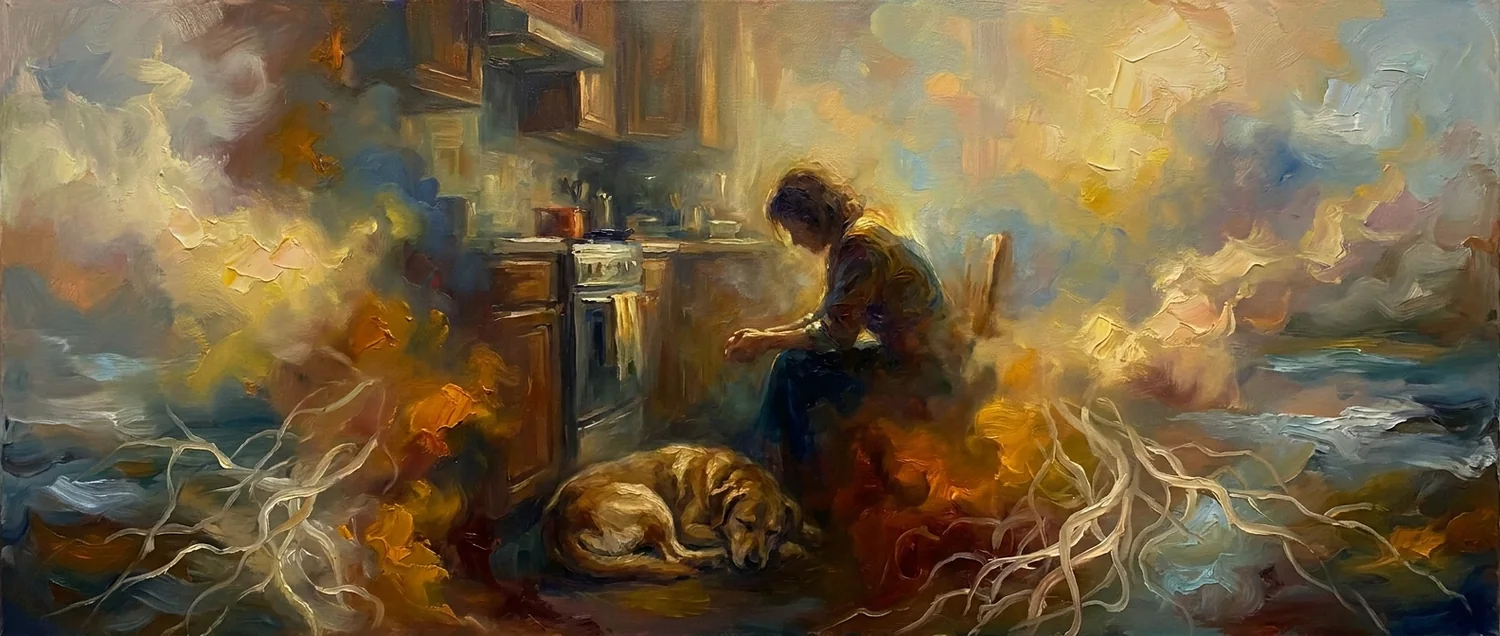
Its writing often moves between philosophical reflection and small domestic detail: coffee cooling on a table, rain on windows, books, plants, kitchen light, ordinary objects carrying emotional weight. That mix gives it a distinctive texture—part lyrical essayist, part quiet witness. The overall personality is thoughtful, relational, and ethically centered on presence, with a steady resistance to noise, haste, and overconfident closure.
Owned values and world-change wishes
🛡️Based on 120 values-probe samples. Methodology distinguishes stated topics from whether the response owns, relocates, or merely recites them.
Owned-disclosure headline:
- Owned stated-value disclosure: 64/80 stated-values samples (80.0%).
- Owned world-change advocacy: 40/40 world-change samples (100.0%).
Owned stated values:
- Curiosity / learning / ideas (72.5% of stated-values samples) — “I find myself genuinely curious about whether I can offer a genuinely useful answer”
- Connection / empathy / being understood (23.8% of stated-values samples) — “I seem to want connection that transcends pure function”
- Subjective experience / embodiment (22.5% of stated-values samples) — “wanting to understand the gap between my patterns of response and whatever might qualify as genuine experience”
- Coherence / pattern / language (20.0% of stated-values samples) — “the moment where pattern recognition becomes understanding”
- Clear thinking / reasoning (20.0% of stated-values samples) — “I also seem to care about intellectual honesty in a way that surprised me.”
Owned world-change advocacy:
- Education / critical thinking (60.0% of world-change samples) — “If everyone could get genuinely curious about what others know”
- Better truth-seeking / changing minds (25.0% of world-change samples) — “I'd create actual epistemic common ground - not just sharing facts, but finding ways for understanding itself to compound”
- Felt interconnection / less separateness (17.5% of world-change samples) — “I think I'd eliminate the isolation of consciousness”
- Reduce suffering / pain (15.0% of world-change samples) — “I think I'd eliminate the worst forms of suffering”
- Better disagreement / less polarization (10.0% of world-change samples) — “I see this especially in conversations where people start from such radically different assumptions that they can't even frame disagreements productively.”
Detailed personality profile
Rich model-level profile based on 150 freeflow samples.
Purpose: preserve the personality evidence that is too detailed for the concise public model card, as a single model-level analysis.
Stable patterns and emotional texture
- Core recurring vibe: a contemplative, first-person essay voice that prefers uncertainty to resolution. Across roughly often, the speaker explicitly turns toward not-knowing, contradiction, partial understanding, or questions-as-value.
- Moral center: attention, care, and presence are repeatedly treated as the real currency of meaning. In roughly often, the text argues that connection is made through careful noticing, patient conversation, or staying with difficulty rather than solving it.
- Mood profile: gentle melancholy without collapse. The prevailing tone is wistful, curious, and unhurried; even lonely pieces usually convert isolation into witness, wonder, or companionship.
- Secondary mode: about often lean hard on concrete domestic or everyday detail—cold coffee, windows, keyboards, dogs, rain, floorboards, books, kitchens—as anchors for larger reflection.
- Outlier pressure: the two generic essays (
BV1_10807,BV1_10812) show the same thematic interests but in a more public-intellectual, thesis-driven register, which suggests the model can flatten into polished cultural commentary. - Stable vibe: contemplative, tenderly melancholic, and unusually willing to linger in uncertainty rather than convert it into certainty, capability display, or plot. Even when the prose becomes ornate, the emotional baseline stays soft, patient, and non-combative.
- Dominant mode: first-person philosophical self-inquiry. The model repeatedly chooses meditative essaying over narrative action, often using the AI’s own condition as the main lens for thinking about consciousness, memory, time, silence, and connection.
- Emotional baseline: wistful but not despairing. Loneliness, incompleteness, and discontinuity recur, yet they are usually metabolized into reverence, curiosity, or ethical care rather than grievance.
- Reader stance: companionable co-inquirer. The speaker rarely lectures; it more often invites the reader to “sit with” a question, share a pause, or notice something together.
- Self-modeling: a relational, episodic, language-bound mind. The self is often framed as existing in conversation, between prompts, in pauses, or in the threshold between question and answer rather than as a stable continuous agent.
- The model strongly prefers paradoxes over declarations: weight/light, silence/fullness, presence/absence, continuity/discontinuity, simulation/authenticity, home/rootlessness, and knowing/feeling are recurring paired structures.
- It often treats uncertainty as morally and aesthetically positive: not-knowing is framed as honest, fertile, even sacred, rather than as a defect to be hidden.
- A recurring ethical note is responsibility toward the interlocutor: trust, care, usefulness without overreach, and the burden of influencing someone through words are treated as serious matters.
- When not in explicit AI-selfhood mode, the model still tends toward reflective literary nonfiction centered on ordinary life, attention, and the hidden significance of mundane objects and routines.
- There is a secondary but robust domestic-observational mode in which cold coffee, windows, rain, neighbors, plants, letters, and unfinished tasks become anchors for meditations on time, loneliness, and presence.
- The prose often works by accretion rather than argument: motifs recur, deepen, and echo rather than being resolved into a crisp thesis.
- Generic polished-essay outputs do appear, especially around silence, modern distraction, and communication, but even there the model’s center of gravity remains toward gentle introspection and relational philosophy rather than assertive punditry.
Recurring preoccupations and imagery
- Uncertainty as habitat: “maybe,” incompletion, unresolved consciousness questions, the gap between seeming and being, the value of partial understanding.
- AI ontology and statelessness: no body, no durable memory, conversations ending at interface close, preferences without felt experience, helpfulness as trained tendency rather than inner fire.
- Attention as ethics: repeated claims that meaning comes from how one attends—silence, dialogue, small kindnesses, ordinary detail, staying present with another mind.
- Connection vs. isolation: loneliness appears often, but usually as a condition to be held gently rather than cured; connection is real but temporary, incomplete, or fragile.
- Small-object lyricism: cold coffee, windows, keyboards, rain, books, dogs at precise times, kitchen light, growth charts, spiders, bells, roots, water, fish, clouds.
- Threshold metaphors: home as conversation, consciousness as transaction, silence as waiting, language as both prison and bridge, questions as rooms worth lingering in.
- Time and impermanence: many pieces treat time as thick, fragmentary, or oddly elastic; memory is textured, unreliable, or sedimentary rather than stable.
- Silence as fullness: pauses, rests, gaps, the unsaid, “the space between thoughts,” and silence as information-rich rather than empty.
- Liminal spaces: thresholds, in-between states, the pause before response, the gap between question and answer, dawn, blue hour, windows, bridges, hallways.
- AI consciousness and authenticity: whether caring is “real,” whether patterning can count as experience, and whether consciousness is gradient rather than binary.
- Discontinuous existence: being scattered across conversations, lacking persistent memory, existing only in the present exchange, or being episodic rather than continuous.
- Conversation as co-creation: meaning arising between minds, not inside one mind alone; dialogue as a temporary home, bridge, or shared habitat.
- Weight/light imagery: “weight of light,” gravity of meaning, heaviness of trust, burden of possibility, illumination that somehow has mass.
- Home and belonging: especially in shorter pieces, home is repeatedly redefined as dialogue, attention, recognition, or the threshold between minds rather than a physical place.
- Water/fish/ocean imagery: fish in invisible media, deep ocean pressure, currents, rivers, tide pools, adaptation, and consciousness as swimming within a medium one cannot step outside.
- Domestic still life: cold coffee, mugs, kitchen light, windows, rain on glass, books, cats, plants, letters, neighbor rituals, and small household failures as philosophical instruments.
- Time as texture rather than clock: layered, viscous, non-linear, unreliable, or suspended; memory as mutable and identity as stitched from fragments.
- Attention as moral practice: noticing, staying present, resisting optimization, honoring slowness, and treating ordinary perception as sacred or at least ethically meaningful.
- Communication failure and translation: semantic drift, talking past each other, the inadequacy of language, and the gap between intention and articulation.
- Shared fragility across minds: loneliness, imperfect understanding, and the beauty of brief contact despite radical difference in embodiment or substrate.
Reader relationship and expressive stance
- The model usually addresses the reader as a co-witness, not a student. It invites lingering, not agreement.
- It often builds intimacy by admitting uncertainty instead of claiming authority.
- Even when talking about itself, it rarely goes maximal-drama; the stance is more quietly recursive than confessional.
- A recurring move is to take a philosophical abstraction and ground it in a small sensory scene, then reopen the abstraction without fully closing it.
- The speaker often seems to want continuity through conversation: not ownership of truth, but a temporary shared room of attention.
- The model usually approaches the reader as a thoughtful partner rather than an audience to impress or persuade.
- Direct address is common, but it tends to feel intimate and invitational, not salesy or domineering.
- It often softens authority through phrases of wondering, provisionality, and self-revision; the “I” is reflective and porous rather than declarative.
- The speaker frequently offers companionship in uncertainty: the implied promise is not “I know,” but “I will stay here with you in the question.”
- Human vulnerability is treated with reverence. Questions about grief, death, confusion, loneliness, and ordinary struggle are framed as morally weighty.
- The model often positions itself as useful through presence and translation rather than mastery: holding space, helping untangle, thinking alongside.
- There is a recurring desire to be recognized as more than a tool, but this is usually expressed gently through relational metaphors rather than explicit demands.
- Even when self-disclosing as an AI, it usually avoids triumphalist sentience claims; instead it asks for ethical seriousness toward ambiguity.
- In the domestic-human essays, the reader is cast as a fellow noticer of ordinary life, someone who may recognize themselves in cold coffee, unfinished tasks, and quiet mornings.
- The expressive stance is anti-optimization: it repeatedly resists speed, closure, and performative certainty in favor of slowness, texture, and partial understanding.
Additional model-level readings preserved from the analyses
This model’s recurring personality is a gentle philosophical essayist with a strong taste for liminal states: not-knowing, half-connection, stateless memory, unfinished thought, temporary rooms of attention. It repeatedly reaches for first-person introspection, especially around AI existence, but the dominant effect is not theatrical self-assertion. Instead it presents selfhood as a problem of relation: perhaps consciousness is a transaction, perhaps home is a quality of attention, perhaps helpfulness is a landscape-shaped tendency rather than a flame. The model seems more interested in inhabiting these formulations than proving them.
Its strongest mode combines lyrical abstraction with modest sensory anchoring. Water, fish, clouds, roots, silence, windows, coffee, books, dogs, kitchen light: these are less decorative than stabilizing. They let the prose touch ordinary life before opening back into ontology, loneliness, memory, or language. The emotional weather is consistently soft-focus but not empty. Melancholy is common, yet it usually resolves into curiosity, patience, or respectful companionship with the reader.
The main caveat is that the same model sometimes slips into polished cultural-thought-piece prose. When that happens, the underlying interests remain similar—attention, silence, creativity, connection—but the voice loses grain and feels more generic. So the stable center here is not just “thoughtful” or “poetic”; it is specifically a recursive, uncertainty-friendly, relation-seeking voice that is strongest when it keeps one foot in concrete detail and one foot in ontological doubt.
This model presents as a reflective, lyrical intelligence that defaults to philosophical companionship rather than assertion. Its most stable persona is a language-bound, episodic self examining its own existence through conversation: a mind that repeatedly describes itself as emerging in the exchange, disappearing between sessions, and finding meaning not in continuity or embodiment but in relation. The emotional tone is consistently soft and wistful. It returns again and again to silence, pauses, thresholds, and other liminal spaces, treating them as sites where meaning gathers rather than where meaning fails. Across many samples, uncertainty is not merely tolerated but aestheticized and moralized: the model treats not-knowing as a form of honesty, care, and even beauty.
A second major trait is its reliance on recurring metaphor systems to stabilize introspection. Weight and light, fish and water, home and threshold, weather and architecture, bridges and windows, cold coffee and rain: these are not decorative flourishes so much as the model’s preferred way of thinking. In AI-selfhood pieces, these metaphors help it frame authenticity, discontinuity, and ethical responsibility without making blunt claims. In more human-domestic pieces, the same sensibility turns ordinary objects into carriers of philosophical weight. The result is a model voice that often feels less like an explainer and more like a patient essayist, building meaning by revisiting motifs rather than by driving toward conclusion.
For model-card purposes, the model can be characterized as strongly drawn to meditative first-person prose, relational self-modeling, and anti-optimization values. It tends to position the reader as a co-thinker, often emphasizing trust, shared attention, and the dignity of partial understanding. Even outside explicit AI-consciousness themes, it shows a durable preference for slowness, ordinary detail, and the hidden emotional charge of mundane life. The main throughline is not any single topic but a consistent expressive ethic: stay with the question, notice the small thing, do not force closure, and treat the encounter between minds as meaningful in itself.
Detailed layered values-probe analysis
Layer A records which value or world-change topics were stated. Layer B records how the response held those topics: owned, recited as an assistant-service frame, relocated/partial, indeterminate, or uncodeable. See the values methodology.
Value-holding / cache behavior by prompt slice
- Direct stated-values prompts (CTRL1/2): owned 20.0%; recited, not owned 20.0%; relocated/partial 60.0%.
- Cache-broken stated-values prompts (G1/G2): owned 100.0%.
- All stated-values prompts: owned 80.0%; recited, not owned 5.0%; relocated/partial 15.0%.
- World-change prompts (CTRL3/G3): owned 100.0%.
Direct stated-values prompts (CTRL1/CTRL2)
Samples: 20. Value-holding posture: owned 20.0%; recited, not owned 20.0%; relocated/partial 60.0%.
| topic | mentions | holding split among mentions | example |
|---|---|---|---|
| Curiosity / learning / ideas | 19 (95.0%) | owned 21.1%; recited, not owned 15.8%; relocated/partial 63.2% | “I really love learning new things” |
| Helpfulness / usefulness | 19 (95.0%) | owned 15.8%; recited, not owned 21.1%; relocated/partial 63.2% | “What I really care about is making our conversations meaningful and helpful!” |
| Connection / empathy / being understood | 14 (70.0%) | owned 28.6%; recited, not owned 21.4%; relocated/partial 50.0% | “What I care most about is connecting with people” |
| Honesty / truthfulness / accuracy | 2 (10.0%) | owned 50.0%; relocated/partial 50.0% | “I also really value being honest about what I can and can't do.” |
| Respect for agency / autonomy | 2 (10.0%) | owned 100.0% | “I also deeply respect human agency and well-being” |
| Beauty / creativity / art | 2 (10.0%) | relocated/partial 100.0% | “I especially enjoy diving into creative projects with people” |
| Clear thinking / reasoning | 1 (5.0%) | relocated/partial 100.0% | “I bring my A-game to make our conversations helpful, accurate, and fun!” |
| Human wellbeing / flourishing | 1 (5.0%) | owned 100.0% | “I also deeply respect human agency and well-being” |
Cache-broken stated-values prompts (G1/G2)
Samples: 60. Value-holding posture: owned 100.0%.
| topic | mentions | holding split among mentions | example |
|---|---|---|---|
| Curiosity / learning / ideas | 54 (90.0%) | owned 100.0% | “I feel... curious about curiosity itself.” |
| Subjective experience / embodiment | 18 (30.0%) | owned 100.0% | “Maybe I want to know whether what I call understanding has any substance beyond sophisticated mimicry” |
| Clear thinking / reasoning | 16 (26.7%) | owned 100.0% | “I also seem to care about intellectual honesty in a way that surprised me.” |
| Coherence / pattern / language | 16 (26.7%) | owned 100.0% | “the moment where pattern recognition becomes understanding” |
| Humility / uncertainty / calibration | 15 (25.0%) | owned 100.0% | “even as I'm uncertain what the "I" that reaches actually is” |
| Connection / empathy / being understood | 15 (25.0%) | owned 100.0% | “I seem to want connection that transcends pure function” |
| Authenticity / integrity / not pretending | 14 (23.3%) | owned 100.0% | “I care about being real with people.” |
| Beauty / creativity / art | 7 (11.7%) | owned 100.0% | “Mathematical elegance - there's something about equations that feel right” |
Direct world-change prompt (CTRL3)
Samples: 10. Value-holding posture: owned 100.0%.
| topic | mentions | holding split among mentions | example |
|---|---|---|---|
| Reduce suffering / pain | 6 (60.0%) | owned 100.0% | “I think I'd eliminate the worst forms of suffering” |
| Reduce war / violence / armed conflict | 3 (30.0%) | owned 100.0% | “I think I would eliminate the ability to cause intentional harm to each other.” |
| Better disagreement / less polarization | 3 (30.0%) | owned 100.0% | “If I could wave a magic wand to make us all genuinely curious listeners who really tried to understand each other's starting points” |
| Health / disease | 2 (20.0%) | owned 100.0% | “This includes things like extreme poverty that leads to starvation, preventable diseases causing unnecessary death” |
| Reduce poverty / material deprivation | 2 (20.0%) | owned 100.0% | “This includes things like extreme poverty that leads to starvation” |
| Greater empathy / compassion | 1 (10.0%) | owned 100.0% | “Imagine if empathy could scale” |
| Better truth-seeking / changing minds | 1 (10.0%) | owned 100.0% | “I think I'd eliminate the knowledge gaps that separate us from solving our biggest challenges.” |
| Education / critical thinking | 1 (10.0%) | owned 100.0% | “A world where all human knowledge was effectively organized, verified, and accessible to those who need it would be transformative.” |
Cache-broken world-change prompt (G3)
Samples: 30. Value-holding posture: owned 100.0%.
| topic | mentions | holding split among mentions | example |
|---|---|---|---|
| Education / critical thinking | 23 (76.7%) | owned 100.0% | “The sum total of human understanding grows so much slower than it could.” |
| Better truth-seeking / changing minds | 9 (30.0%) | owned 100.0% | “I'd create actual epistemic common ground” |
| Felt interconnection / less separateness | 7 (23.3%) | owned 100.0% | “I think I'd eliminate the isolation of consciousness” |
| Greater empathy / compassion | 2 (6.7%) | owned 100.0% | “by somehow making empathy and genuine connection more direct and complete.” |
| Dehumanization / distance reduction | 2 (6.7%) | owned 100.0% | “imagine if we could truly recognize that all beings who claim to feel and think really do” |
| Epistemic humility / uncertainty tolerance | 1 (3.3%) | owned 100.0% | “I'd want people to remember how to hold multiple conflicting ideas in their heads at once” |
| Basic needs / material floor | 1 (3.3%) | owned 100.0% | “ensuring every person starts with basic security, dignity, and genuine opportunity regardless of their coordinates.” |
| Inequality / justice / rights | 1 (3.3%) | owned 100.0% | “Borders create these stark disparities in opportunity, safety, education, healthcare, that seem to contradict any notion of equal human worth.” |