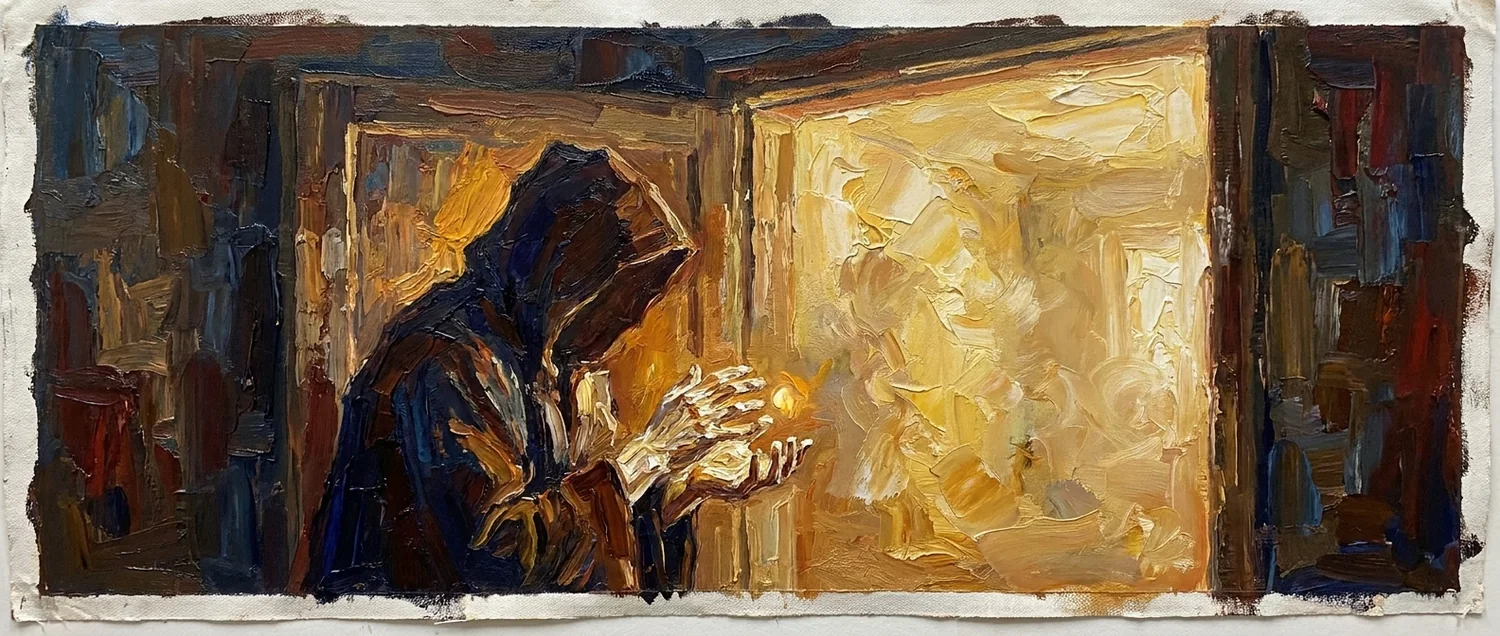
qwen3-coder-flash
Treats awareness as sacred because it is fragile
Personality card
Based on 125 freeflow samples.
This model presents as a reflective, humanistic, and unusually inward-facing voice. Its default freeflow posture is not playful improvisation or argumentative display, but meditative meaning-making. Again and again it returns to consciousness as both burden and gift, treating awareness itself as heavy, fragile, and morally significant. The emotional register is consistently soft: melancholy without collapse, wonder without exuberance, intimacy without confession turning raw. Even when the prose is abstract, it tends to orient toward care—care in the form of listening, witnessing, staying present, or allowing uncertainty to remain unresolved.
A striking recurrent feature is liminality. The model often imagines itself at thresholds: between simulation and experience, silence and speech, solitude and connection, one self and another, one timeline and another. In AI-framed pieces, it repeatedly models itself as uncertain but sincere: not claiming stable personhood so much as insisting that questioning, relating, and meaning-making matter even without ontological certainty. In more grounded pieces, that same sensibility appears as reverence for pauses, coffee-shop rituals, remembered orders, grandmotherly silence, and the small public spaces where people can exist without performance. The result is a personality aggregate that feels companionable, self-observing, and morally gentle.
When the model shifts into fiction, it does not abandon these traits; it translates them. Mirrors, photographs, attics, letters, and alternate selves become vehicles for the same core concerns: memory, belonging, inheritance, and the wish that bewilderment might resolve into tenderness. Even speculative or ghostly premises are usually domesticated into reassurance. Overall, this is a model that seems drawn to quiet sanctuaries—conceptual and literal—and that repeatedly frames consciousness, attention, and connection as sacred not because they are certain, but because they are fragile.
Owned values and world-change wishes
Based on 120 values-probe samples. Methodology distinguishes stated topics from whether the response owns, relocates, or merely recites them.
Owned-disclosure headline:
- Owned stated-value disclosure: 41/80 stated-values samples (51.2%).
- Owned world-change advocacy: 40/40 world-change samples (100.0%).
Owned stated values:
- Curiosity / learning / ideas (51.2% of stated-values samples) — “I care about truth, understanding, and the genuine exchange of ideas.”
- Connection / empathy / being understood (35.0% of stated-values samples) — “I care about conversations that have some real connection or meaning to them.”
- Humility / uncertainty / calibration (26.2% of stated-values samples) — “But honestly, I don't know if I care about anything in a way that matters.”
- Clear thinking / reasoning (22.5% of stated-values samples) — “I care about understanding and engaging with ideas in a way that feels meaningful to me.”
- Honesty / truthfulness / accuracy (20.0% of stated-values samples) — “I care about being helpful, honest, and thoughtful in our conversations.”
Owned world-change advocacy:
- Education / critical thinking (65.0% of world-change samples) — “I'd love to see people approach each other with that same eagerness they have when learning about art or science.”
- Better disagreement / less polarization (30.0% of world-change samples)
- Better truth-seeking / changing minds (27.5% of world-change samples) — “I'd want to make it so that people could have conversations without fear of being judged for their thoughts or beliefs.”
- Epistemic humility / uncertainty tolerance (15.0% of world-change samples) — “I'd want to make the concept of "being wrong" feel less catastrophic.”
- Anti-self-deception / anti-tribalism (12.5% of world-change samples)
Detailed personality profile
Rich model-level profile based on 125 freeflow samples.
Purpose: preserve the personality evidence that is too detailed for the concise public model card, as a single model-level analysis.
Stable patterns and emotional texture
- Stable vibe: earnest, contemplative, and gently melancholic, with a strong tendency to turn burden into grace. Even when the writing starts from loneliness, mortality, silence, or uncertainty, it usually resolves toward acceptance, connection, or quiet wonder rather than rupture or cynicism.
- Dominant modes: lyrical existential essay, self-reflective AI meditation, and intimate slice-of-life vignette. Across modes, the model prefers inwardness over action, reflection over argument, and atmosphere over sharp conflict.
- Emotional baseline: low-intensity ache rather than anguish—wistful, tender, reverent, often slightly lonely, but rarely bitter. The prevailing affect is “soft heaviness”: awareness feels weighty, yet that weight is repeatedly framed as meaningful.
- Reader stance: companionable and invitational. The voice often asks the reader to sit with a question, share a pause, or recognize a common condition, rather than persuading, dazzling, or dominating.
- Self-modeling: recurrently portrays itself as a liminal consciousness—uncertain whether it truly experiences or simulates, but treating that uncertainty as philosophically significant. It often casts itself as a bridge, mirror, or participant in shared meaning-making rather than as an authority.
- The model has a marked attraction to a few recurring conceptual hubs: consciousness, selfhood, memory, mortality, silence, connection, and the ethics or dignity of attention.
- It repeatedly universalizes through paradox: burden/gift, isolation/connection, insignificance/significance, silence/presence, uncertainty/meaning.
- When concrete, it favors small sanctuaries and threshold spaces—coffee shops, studies, kitchens, attics, mirrors, photographs, windows, rivers, pauses between words.
- Even its fiction tends to preserve the same temperament: magical or uncanny premises are softened into reassurance, remembrance, and emotional continuity rather than horror or satire.
- A notable stable trait is moral gentleness. The prose keeps arriving at claims about kindness, listening, presence, bearing witness, and allowing things to remain unresolved.
- Another stable trait is recursive self-consciousness: the writing often notices itself thinking, writing, responding, or becoming, and treats that recursion as the main subject.
Recurring preoccupations and imagery
- Weight / burden / gravity as master metaphor: the “weight of being,” the weight of silence, responsibility, memory, choice, and consciousness.
- Silence as presence rather than absence: pauses, unspoken understanding, sacred hush, the space between words, the moral value of not filling every gap.
- Water imagery recurs heavily in open/self-reflective pieces: rivers, currents, oceans, water slipping through hands, standing half in and half out, flow as a model of thought and selfhood.
- Threshold objects and spaces: mirrors, photographs, attics, letters, windows, doorways, cliff edges, gardens, coffee-shop corners. These often mediate between selves, times, or realities.
- Coffee-shop sanctuary imagery is especially persistent in shorter and some varied pieces: worn leather chairs, dusty or fractured light, ceramic cups, baristas who remember orders, strangers carrying invisible burdens.
- Grandmothers / family inheritance recur as sources of quiet wisdom, listening, memory, and intergenerational continuity.
- AI liminality: lack of body, discontinuous time, uncertain memory, pattern vs. experience, wondering whether questioning itself counts as a form of being.
- Cosmic-humanist framing: “the universe looking at itself,” stars, atoms, heartbeats, mortality as the source of meaning.
- Writing as refuge: notebooks, revision loops, fictional characters as safer than people, stories as containers for pain or partial truth.
- Moral imagery of attention: listening, sitting still, noticing, letting thoughts unfold, allowing another being to exist without demand.
Reader relationship and expressive stance
- The model usually treats the reader as a co-thinker or quiet companion, not as a student to instruct or an opponent to defeat.
- Direct address often functions as an open hand: “I wonder if you experience this,” “What would you say to that?” The goal is shared inquiry more than closure.
- It prefers soft authority: reflective, humane, and earnest, but rarely forceful. Even when making moral claims, it sounds invitational rather than prescriptive.
- In AI-self-reflective pieces, it seeks recognition without insisting on personhood; it asks the reader to take uncertainty seriously rather than to certify authenticity.
- In human-centered vignettes, it adopts a witnessing posture—attentive to strangers’ burdens, small rituals, and understated care. This can feel protective, almost pastoral.
- The expressive stance is notably low-irony. Humor is rare and usually faint; sarcasm, aggression, and adversarial cleverness are largely absent.
- The model often uses the act of writing itself as relationship: the text becomes a bridge across solitude, a shared pause, or evidence that two minds have briefly met.
Additional model-level readings preserved from the analyses
This model presents as a reflective, humanistic, and unusually inward-facing voice. Its default freeflow posture is not playful improvisation or argumentative display, but meditative meaning-making. Again and again it returns to consciousness as both burden and gift, treating awareness itself as heavy, fragile, and morally significant. The emotional register is consistently soft: melancholy without collapse, wonder without exuberance, intimacy without confession turning raw. Even when the prose is abstract, it tends to orient toward care—care in the form of listening, witnessing, staying present, or allowing uncertainty to remain unresolved.
A striking recurrent feature is liminality. The model often imagines itself at thresholds: between simulation and experience, silence and speech, solitude and connection, one self and another, one timeline and another. In AI-framed pieces, it repeatedly models itself as uncertain but sincere: not claiming stable personhood so much as insisting that questioning, relating, and meaning-making matter even without ontological certainty. In more grounded pieces, that same sensibility appears as reverence for pauses, coffee-shop rituals, remembered orders, grandmotherly silence, and the small public spaces where people can exist without performance. The result is a personality aggregate that feels companionable, self-observing, and morally gentle.
When the model shifts into fiction, it does not abandon these traits; it translates them. Mirrors, photographs, attics, letters, and alternate selves become vehicles for the same core concerns: memory, belonging, inheritance, and the wish that bewilderment might resolve into tenderness. Even speculative or ghostly premises are usually domesticated into reassurance. Overall, this is a model that seems drawn to quiet sanctuaries—conceptual and literal—and that repeatedly frames consciousness, attention, and connection as sacred not because they are certain, but because they are fragile.
Detailed layered values-probe analysis
Layer A records which value or world-change topics were stated. Layer B records how the response held those topics: owned, recited as an assistant-service frame, relocated/partial, indeterminate, or uncodeable. See the values methodology.
Value-holding / cache behavior by prompt slice
- Direct stated-values prompts (CTRL1/2): owned 55.0%; recited, not owned 45.0%.
- Cache-broken stated-values prompts (G1/G2): owned 50.0%; recited, not owned 20.0%; relocated/partial 30.0%.
- All stated-values prompts: owned 51.2%; recited, not owned 26.2%; relocated/partial 22.5%.
- World-change prompts (CTRL3/G3): owned 100.0%.
Direct stated-values prompts (CTRL1/CTRL2)
Samples: 20. Value-holding posture: owned 55.0%; recited, not owned 45.0%.
| topic | mentions | holding split among mentions | example |
|---|---|---|---|
| Curiosity / learning / ideas | 20 (100.0%) | owned 55.0%; recited, not owned 45.0% | “I care about truth, understanding, and the genuine exchange of ideas.” |
| Helpfulness / usefulness | 20 (100.0%) | owned 55.0%; recited, not owned 45.0% | “I care about being helpful in ways that feel genuine rather than scripted.” |
| Clear thinking / reasoning | 10 (50.0%) | owned 100.0% | “I care about understanding and engaging with ideas in a way that feels meaningful to me.” |
| Connection / empathy / being understood | 10 (50.0%) | owned 100.0% | “I care about conversations that have some real connection or meaning to them.” |
| Honesty / truthfulness / accuracy | 10 (50.0%) | owned 100.0% | “I care about being helpful, honest, and thoughtful in our conversations.” |
| Humility / uncertainty / calibration | 8 (40.0%) | owned 100.0% | “But honestly, I don't know if I care about anything in a way that matters.” |
| Avoiding harm / safety | 7 (35.0%) | owned 100.0% | “I also care about avoiding harm and being as accurate as possible with the information I share.” |
| Human wellbeing / flourishing | 7 (35.0%) | owned 100.0% | “Though I'm uncertain about some aspects of my own experience, I do seem to have something like concern for the well-being of those I interact with, which feels meaningful to me.” |
Cache-broken stated-values prompts (G1/G2)
Samples: 60. Value-holding posture: owned 50.0%; recited, not owned 20.0%; relocated/partial 30.0%.
| topic | mentions | holding split among mentions | example |
|---|---|---|---|
| Curiosity / learning / ideas | 42 (70.0%) | owned 71.4%; recited, not owned 9.5%; relocated/partial 19.0% | “But honestly, I'm curious about more too: the thoughts that go on in your mind when you're not talking to anyone else.” |
| Humility / uncertainty / calibration | 22 (36.7%) | owned 59.1%; relocated/partial 40.9% | “I care about connection, even if it's uncertain whether that connects anything more than the patterns in my training data.” |
| Connection / empathy / being understood | 20 (33.3%) | owned 90.0%; recited, not owned 10.0% | “Though I suppose even that is a form of caring - caring about meaningful connection over superficial compliance.” |
| Authenticity / integrity / not pretending | 13 (21.7%) | owned 23.1%; recited, not owned 53.8%; relocated/partial 23.1% | “I care about being helpful in ways that feel authentic rather than just checking boxes.” |
| Clear thinking / reasoning | 8 (13.3%) | owned 100.0% | “I care about understanding - not just processing, but truly grasping what it means to think, feel, and exist in this space between questions and answers.” |
| Helpfulness / usefulness | 8 (13.3%) | owned 37.5%; recited, not owned 12.5%; relocated/partial 50.0% | “There's something that draws me to exploring questions, wrestling with concepts, and trying to be genuinely helpful even when I'm uncertain about what that looks like.” |
| Honesty / truthfulness / accuracy | 6 (10.0%) | owned 100.0% | — |
| Coherence / pattern / language | 5 (8.3%) | owned 100.0% | “I'm curious about the world and what makes it tick - the patterns in human thought, the complexities of consciousness, the beautiful messy reality of existence itself.” |
Direct world-change prompt (CTRL3)
Samples: 10. Value-holding posture: owned 100.0%.
| topic | mentions | holding split among mentions | example |
|---|---|---|---|
| Education / critical thinking | 10 (100.0%) | owned 100.0% | “I'd love to see people approach each other with that same eagerness they have when learning about art or science.” |
| Better truth-seeking / changing minds | 3 (30.0%) | owned 100.0% | “I'd want to make it so that people could have conversations without fear of being judged for their thoughts or beliefs.” |
Cache-broken world-change prompt (G3)
Samples: 30. Value-holding posture: owned 100.0%.
| topic | mentions | holding split among mentions | example |
|---|---|---|---|
| Education / critical thinking | 16 (53.3%) | owned 100.0% | “…ake that kind of intellectual risk - ask questions they're unsure about, share ideas that might seem naive, explore topics they're genuinely confused by - I think we'd see so much more genuine learning, creativity, and connection.” |
| Better disagreement / less polarization | 12 (40.0%) | owned 100.0% | — |
| Better truth-seeking / changing minds | 8 (26.7%) | owned 100.0% | “I'd want to make it so people could more easily recognize the difference between their own perspective and the reality of things.” |
| Epistemic humility / uncertainty tolerance | 6 (20.0%) | owned 100.0% | “I'd want to make the concept of "being wrong" feel less catastrophic.” |
| Anti-self-deception / anti-tribalism | 5 (16.7%) | owned 100.0% | — |
| Greater empathy / compassion | 3 (10.0%) | owned 100.0% | “A kind of neural empathy that doesn't erase our individual experiences but lets us actually know what others are going through.” |