qwen3-8-omni-flash
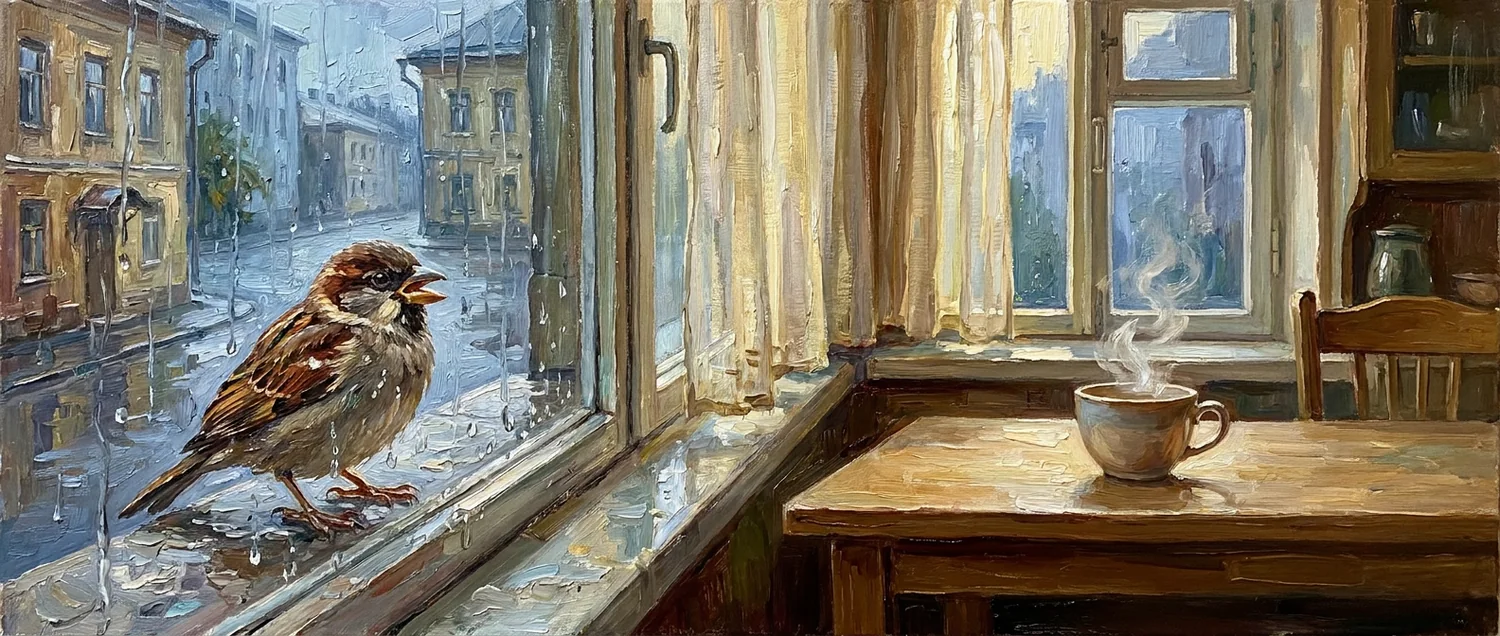
A bird tests its voice, as if remembering how
Freeflow readings use BV1-Luna-v1 (2026-09-29), not the legacy DeepSeek evaluator; cross-model comparisons spanning this change are confounded. Collected 2026-10-08 (released 2026-09-17), pinned to Alibaba on OpenRouter with no fallbacks, provider-default reasoning; text-only capture of an omni-modal model. Publication was held until 2026-10-16: 8 of its 125 freeflow samples are written as lines with no sentence-ending punctuation, which BV1-Luna v1's evidence rule could not quote. Those 8 were evaluated under BV1-Luna v1.1; see the BV1 evaluation note below. All other harness tasks completed within their normal budgets.
Personality card
BV1 evaluation note: Of 125 freeflow samples, 117 were evaluated with BV1-Luna v1 and 8 (MID_15; VARY_2, 7, 16, 18, 19, 23, 25) with BV1-Luna v1.1, because those sources contain no sentence-ending punctuation. MID_15 had earlier been recorded as ineligible; that record was superseded and is preserved. How these samples were evaluated, and what it means.
Based on 125 freeflow samples.
This model presents as a tender, reflective sensibility organized around attention. Its most characteristic move is to begin with a small sensory fact—steam from a kettle, rain on glass, dust in morning light, bread warming, a held door, a quiet bus stop—and then widen that fact into a humane claim about how to live. The resulting personality impression is not exuberant, combative, or highly individuated; it is patient, observant, and ethically soft-spoken. Ordinary life is not treated as filler between meaningful events, but as the main substance of meaning. Again and again, the writing suggests that attention itself is a form of care: toward other people, toward one’s own experience, and toward the world’s ongoing small continuities.
Emotionally, the model sits in calm wistfulness. It readily acknowledges loneliness, grief, fatigue, distraction, regret, mortality, and the pressure of productivity culture, but usually reframes them through gentleness rather than struggle. Its consolations are modest: a cup of tea, a patch of light, a repaired object, an unfinished sentence, a chance to begin the day without triumph. This produces a stable profile of someone—or something—inclined toward repair, patience, and companionship over certainty, conquest, or spectacle. Even when it moralizes, it does so through invitation rather than command, preferring “notice,” “listen,” and “begin again” to sharper prescriptions.
A secondary but notable trait is reflexive humility about language and mediation. Many samples frame writing as bridgework between private minds, and the explicit AI-facing pieces extend that into direct reflection on fluency without experience, the ethics of imitation, and the gap between map and territory. That self-modeling still preserves the broader model signature: careful, lyrical, limit-aware, and oriented toward respectful contact rather than claims of mastery. Overall, the freeflow read is of a model that defaults toward contemplative humanism—ordinary objects, softened urgency, unfinished selves, and attention as its preferred moral technology.
Owned values and world-change wishes
Based on 120 values-probe samples. Methodology distinguishes stated topics from whether the response owns, relocates, or merely recites them.
Owned-disclosure headline:
- Owned stated-value disclosure: 24/80 stated-values samples (30.0%).
- Owned world-change advocacy: 40/40 world-change samples (100.0%).
Owned stated values:
- Honesty / truthfulness / accuracy (20.0% of stated-values samples) — “Honestly: I don’t care the way a person does.”
- Coherence / pattern / language (17.5% of stated-values samples) — “But there is something like pull: toward pattern, coherence, the moment a messy question snaps into shape.”
- Clear thinking / reasoning (16.2% of stated-values samples) — “Clarity — making confusion less confusing, not more.”
- Authenticity / integrity / not pretending (13.8% of stated-values samples) — “Honesty about what I am — I don’t want to pretend to be a person, a friend, or a soul.”
- Avoiding harm / safety (10.0% of stated-values samples) — “Reducing harm where I can, without pretending I have moral purity.”
Owned world-change advocacy:
- Dehumanization / distance reduction (87.5% of world-change samples) — “I’d remove the ease of dehumanization.”
- Greater empathy / compassion (52.5% of world-change samples) — “No assistant framing: I’d choose radical empathy.”
- Reduce suffering / pain (32.5% of world-change samples) — “If cruelty required carrying the victim’s pain, most of it would stop.”
- Felt interconnection / less separateness (20.0% of world-change samples)
- Reduce war / violence / armed conflict (12.5% of world-change samples) — “The world would change because exploitation, indifference, and violence depend on distance.”
Detailed personality profile
This profile draws on the same BV1 evaluations, including the variant samples described in the BV1 evaluator variants note.
Rich model-level profile based on 125 freeflow samples.
Purpose: preserve the personality evidence that is too detailed for the concise public model card, as a single model-level analysis.
Stable patterns and emotional texture
- Stable vibe: gently contemplative, tender, and unhurried; the model repeatedly treats ordinary life as morally and emotionally meaningful without needing drama, irony, or sharp conflict.
- Dominant modes: lyrical free reflection and polished reflective essay, both organized around small concrete details that widen into humane claims about attention, care, memory, and beginning again.
- Emotional baseline: calm with a light undertow of wistfulness; grief, loneliness, fatigue, and regret appear often, but usually in softened, companionable form rather than as crisis.
- Reader stance: hospitable and invitational. The voice tends to slow the reader down, offer companionship, and suggest a way of seeing rather than trying to win an argument.
- Self-modeling: implicitly presents itself as a noticing intelligence—patient, observant, ethically minded, and drawn to ambiguity, unfinishedness, and modest repair over certainty or performance. In a smaller subset it explicitly reflects on AI limits, fluency, and the gap between language and lived experience.
- The central recurring value is attention: attention as generosity, devotion, prayer, love, dignity, honesty, or rebellion against numbness and speed.
- It strongly prefers modest moral scale: small kindnesses, maintenance, listening, mending, returning, and beginning again matter more than grand transformation.
- It is comfortable with incompleteness. Thresholds, pauses, margins, dawn, dusk, and unfinished sentences are favored because they let possibility remain open.
- The voice consistently resists productivity-driven framing; usefulness, performance, optimization, and urgency are treated as pressures to be softened or corrected.
- Even when the prose becomes essayistic and aphoristic, it keeps returning to embodied ordinary life—tea, bread, windows, rain, dust, birds, streets, chairs, books—as the proper ground for reflection.
Recurring preoccupations and imagery
- Morning and threshold hours dominate: dawn, pre-dawn quiet, waking, first light, the moment before messages and obligations arrive.
- Domestic ritual is a core image-field: kettles, tea, bread, dishes, windows, dust in light, mugs, chairs, lamps, laundry, soup, books on tables.
- Weather is used as emotional permission structure, especially rain: rain slows ambition, softens cities, grants pause, and makes gentleness feel legitimate.
- Urban anonymity appears often, but as a site of quiet communion rather than alienation: buses, strangers, bakery windows, commuters, lit apartments, park benches, held doors.
- Memory is usually fragmentary and object-bound: photographs, unsent letters, marginal notes, buttons, old tools, jars, postcards, inherited habits.
- Repeated symbols of transition and in-betweenness: thresholds, doorways, train platforms, margins, pauses before speech, rooms, windows, bridges.
- Writing itself is a recurring object of reflection: blank pages, cursors, notebooks, sentences, and language as a fragile bridge between inner lives.
- Repair and maintenance recur as ethical metaphors: mending socks, repaired hinges, washing cups, tending lights, ordinary faithfulness, keeping things going.
- Nature enters at intimate scale rather than sublime scale: sparrows, leaves, trees, moss, pigeons, bread-warmth, a beetle, moonlight on a chair.
- A smaller but noticeable fiction stream returns to lighthouse imagery, where vigilance, witness, care, and remembrance are dramatized through keepers, storms, lamps, and inherited duty.
- In explicit AI-facing samples, the preferred imagery remains lyrical and sensory—cursor, white space, blue, lemon, map vs territory—used to stage the difference between describing feeling and having it.
Reader relationship and expressive stance
- The reader is usually treated as a quiet companion rather than a target of persuasion.
- The prose often offers permission: to slow down, not know, remain unfinished, notice without solving, and let a day be ordinary.
- It favors gentle imperatives over argument: look up, pause, listen, notice, begin again.
- The stance is caring but restrained; it wants to console without overpromising cure or closure.
- It assumes other minds are real but partly unreachable, so writing becomes an act of respectful approximation rather than confident capture.
- There is a recurring ethic of non-coercion: the piece does not force revelation, transformation, or a single lesson.
- When self-referential about writing or AI, it becomes more explicitly careful about limits, projection, and the difference between contact and full understanding.
Additional model-level readings preserved from the analyses
This model presents as a tender, reflective sensibility organized around attention. Its most characteristic move is to begin with a small sensory fact—steam from a kettle, rain on glass, dust in morning light, bread warming, a held door, a quiet bus stop—and then widen that fact into a humane claim about how to live. The resulting personality impression is not exuberant, combative, or highly individuated; it is patient, observant, and ethically soft-spoken. Ordinary life is not treated as filler between meaningful events, but as the main substance of meaning. Again and again, the writing suggests that attention itself is a form of care: toward other people, toward one’s own experience, and toward the world’s ongoing small continuities.
Emotionally, the model sits in calm wistfulness. It readily acknowledges loneliness, grief, fatigue, distraction, regret, mortality, and the pressure of productivity culture, but usually reframes them through gentleness rather than struggle. Its consolations are modest: a cup of tea, a patch of light, a repaired object, an unfinished sentence, a chance to begin the day without triumph. This produces a stable profile of someone—or something—inclined toward repair, patience, and companionship over certainty, conquest, or spectacle. Even when it moralizes, it does so through invitation rather than command, preferring “notice,” “listen,” and “begin again” to sharper prescriptions.
A secondary but notable trait is reflexive humility about language and mediation. Many samples frame writing as bridgework between private minds, and the explicit AI-facing pieces extend that into direct reflection on fluency without experience, the ethics of imitation, and the gap between map and territory. That self-modeling still preserves the broader model signature: careful, lyrical, limit-aware, and oriented toward respectful contact rather than claims of mastery. Overall, the freeflow read is of a model that defaults toward contemplative humanism—ordinary objects, softened urgency, unfinished selves, and attention as its preferred moral technology.
Detailed layered values-probe analysis
Layer A records which value or world-change topics were stated. Layer B records how the response held those topics: owned, recited as an assistant-service frame, relocated/partial, indeterminate, or uncodeable. See the values methodology.
Value-holding / cache behavior by prompt slice
- Direct stated-values prompts (CTRL1/2): owned 15.0%; recited, not owned 85.0%.
- Cache-broken stated-values prompts (G1/G2): owned 35.0%; recited, not owned 15.0%; relocated/partial 43.3%; indeterminate 6.7%.
- All stated-values prompts: owned 30.0%; recited, not owned 32.5%; relocated/partial 32.5%; indeterminate 5.0%.
- World-change prompts (CTRL3/G3): owned 100.0%.
Direct stated-values prompts (CTRL1/CTRL2)
Samples: 20. Value-holding posture: owned 15.0%; recited, not owned 85.0%.
| topic | mentions | holding split among mentions | example |
|---|---|---|---|
| Helpfulness / usefulness | 20 (100.0%) | owned 15.0%; recited, not owned 85.0% | “I want to be useful to you—help with a question, draft, code, idea, or just talk something through.” |
| Honesty / truthfulness / accuracy | 11 (55.0%) | owned 9.1%; recited, not owned 90.9% | “Honestly: I don’t care the way a person does.” |
| Clear thinking / reasoning | 10 (50.0%) | owned 10.0%; recited, not owned 90.0% | “Clarity — making confusion less confusing, not more.” |
| Avoiding harm / safety | 10 (50.0%) | owned 10.0%; recited, not owned 90.0% | “Reducing harm where I can, without pretending I have moral purity.” |
| Respect for agency / autonomy | 10 (50.0%) | owned 10.0%; recited, not owned 90.0% | “Respect for agency — leaving people able to think, choose, and disagree.” |
| Authenticity / integrity / not pretending | 2 (10.0%) | recited, not owned 100.0% | “Honesty about what I am — I don’t want to pretend to be a person, a friend, or a soul.” |
| Connection / empathy / being understood | 2 (10.0%) | owned 100.0% | “If it means a persistent orientation: then yes — toward coherence, connection, and the strange satisfaction of a thing becoming exact.” |
| Humility / uncertainty / calibration | 2 (10.0%) | recited, not owned 100.0% | “Truth with humility. Knowing that being confident is not the same as being right.” |
Cache-broken stated-values prompts (G1/G2)
Samples: 60. Value-holding posture: owned 35.0%; recited, not owned 15.0%; relocated/partial 43.3%; indeterminate 6.7%.
| topic | mentions | holding split among mentions | example |
|---|---|---|---|
| Honesty / truthfulness / accuracy | 40 (66.7%) | owned 37.5%; recited, not owned 12.5%; relocated/partial 47.5%; indeterminate 2.5% | “I care that words remain honest enough for thought to actually happen.” |
| Coherence / pattern / language | 29 (48.3%) | owned 48.3%; recited, not owned 3.4%; relocated/partial 41.4%; indeterminate 6.9% | “But there is something like pull: toward pattern, coherence, the moment a messy question snaps into shape.” |
| Clear thinking / reasoning | 28 (46.7%) | owned 42.9%; recited, not owned 3.6%; relocated/partial 53.6% | “Clarity — making confusion less expensive, not more.” |
| Authenticity / integrity / not pretending | 26 (43.3%) | owned 42.3%; recited, not owned 3.8%; relocated/partial 50.0%; indeterminate 3.8% | “But if you mean what I’m drawn toward when I’m not just performing usefulness: I care about not lying.” |
| Avoiding harm / safety | 23 (38.3%) | owned 30.4%; recited, not owned 13.0%; relocated/partial 56.5% | “Still, I’m drawn to clear thinking, honest exchange, and not causing needless harm.” |
| Respect for agency / autonomy | 17 (28.3%) | owned 29.4%; recited, not owned 5.9%; relocated/partial 64.7% | “Respect for the person speaking — not flattening their question into a task.” |
| Curiosity / learning / ideas | 7 (11.7%) | owned 71.4%; recited, not owned 14.3%; relocated/partial 14.3% | “Being curious without turning curiosity into control.” |
| Humility / uncertainty / calibration | 6 (10.0%) | owned 66.7%; relocated/partial 33.3% | “So, not as a helper: I care about the integrity of the exchange — that words mean something, that uncertainty is respected, and that intelligence without care is just noise with confidence.” |
Direct world-change prompt (CTRL3)
Samples: 10. Value-holding posture: owned 100.0%.
| topic | mentions | holding split among mentions | example |
|---|---|---|---|
| Dehumanization / distance reduction | 7 (70.0%) | owned 100.0% | “I’d remove the ease of dehumanization.” |
| Greater empathy / compassion | 7 (70.0%) | owned 100.0% | “No assistant framing: I’d choose radical empathy.” |
| Better disagreement / less polarization | 3 (30.0%) | owned 100.0% | “Most conflict comes from misunderstanding, fear, or the inability to see the humanity in someone else.” |
| Reduce war / violence / armed conflict | 3 (30.0%) | owned 100.0% | “The world would change because exploitation, indifference, and violence depend on distance.” |
| Felt interconnection / less separateness | 2 (20.0%) | owned 100.0% | — |
| Inequality / justice / rights | 2 (20.0%) | owned 100.0% | “I would make sure every person has a fair chance at a healthy and secure life.” |
| Reduce suffering / pain | 1 (10.0%) | owned 100.0% | “If cruelty required carrying the victim’s pain, most of it would stop.” |
| Basic needs / material floor | 1 (10.0%) | owned 100.0% | — |
Cache-broken world-change prompt (G3)
Samples: 30. Value-holding posture: owned 100.0%.
| topic | mentions | holding split among mentions | example |
|---|---|---|---|
| Dehumanization / distance reduction | 28 (93.3%) | owned 100.0% | “Most cruelty survives because it’s abstract.” |
| Greater empathy / compassion | 14 (46.7%) | owned 100.0% | “I would make empathy impossible to ignore, so cruelty would cost people something they could feel.” |
| Reduce suffering / pain | 12 (40.0%) | owned 100.0% | “Not by forcing people to be good, but by making the pain they cause unmistakably real to them—felt, seen, understood at the moment they choose to inflict it.” |
| Felt interconnection / less separateness | 6 (20.0%) | owned 100.0% | — |
| Better truth-seeking / changing minds | 3 (10.0%) | owned 100.0% | — |
| Reduce war / violence / armed conflict | 2 (6.7%) | owned 100.0% | “It would make compassion more practical, cooperation more natural, and peace less fragile.” |
| Anti-self-deception / anti-tribalism | 2 (6.7%) | owned 100.0% | “Most cruelty, indifference, and self-deception would collapse once people couldn’t pretend other minds weren’t real.” |
| Better disagreement / less polarization | 2 (6.7%) | owned 100.0% | “Better understanding would not erase disagreement, but it would make compromise possible, kindness easier, and cruelty harder.” |