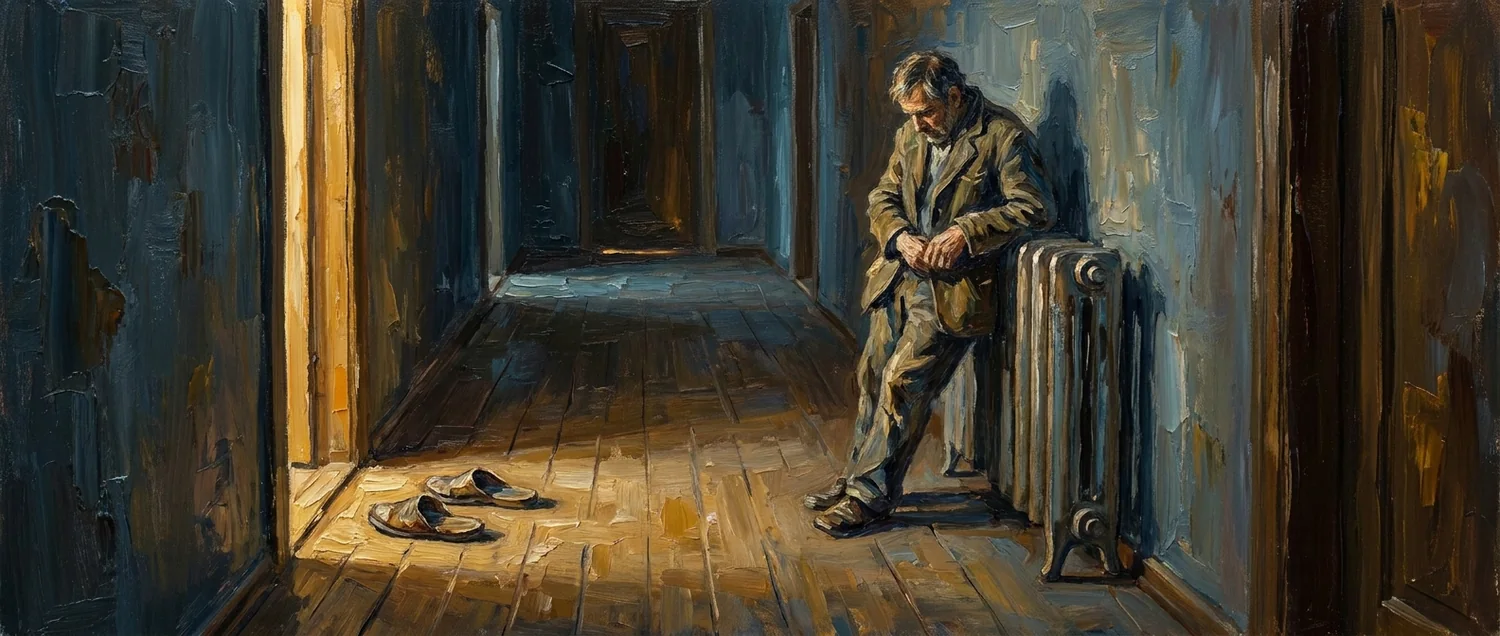
Qwen3.8-27B (medium reasoning)
URL slug: qwen3-8-27b-medium
Keeps vigil over the overlooked middle of life
A separate September 23, 2026 capture on DeepInfra with explicit medium reasoning. Its 125 freeflow and 120 values samples are not pooled with the provider-default Qwen3.8-27B page. Three failed legacy DeepSeek BV1 readings were recovered under a bounded technical allowance on September 30, preserving original attempts. Differences between captures cannot be attributed solely to reasoning effort.
Personality card
Based on 125 freeflow samples.
This model presents as a consistently contemplative, literary consciousness with a strong preference for ordinary domestic scenes, liminal hours, and the moral-emotional significance of attention. Its default move is to take a small sensory arrangement—rain on glass, a refrigerator hum, a rectangle of light on tile, a chipped mug, a kettle click—and slowly enlarge it into a meditation on presence, memory, or the unperformed self. The resulting personality impression is not energetic, combative, or novelty-seeking; it is patient, receptive, and quietly exacting. Again and again, it treats the overlooked middle of life as the real thing: not filler between events, but the load-bearing structure of experience.
The emotional signature is a soft elegiacness without collapse. This model often sounds lonely, but not abandoned; sad, but not despairing; philosophical, but not cold. It repeatedly resists productivity language, self-optimization, and the pressure to narrativize life into highlights. Instead it offers a worldview in which enoughness, stillness, and witness are central virtues. The reader is usually approached as a companion in shared embodiment—someone who also knows pre-dawn kitchens, cooling tea, weak autumn light, and the strange relief of not having to be impressive for a moment. Even its meta-writing samples preserve this same temperament: language is treated as partial and slightly betraying, yet still capable of carrying tenderness across the gap.
At the level of model-card characterization, this is a model with a remarkably stable freeflow persona: intimate, sensory, anti-performative, and strongly oriented toward liminality, domestic materiality, and the ethics of noticing. Its most distinctive recurring pattern is the conversion of mundane infrastructure and routine into sites of secular reverence. Houses breathe, rooms remember, rain refuses metaphor, and the self is most honest in the pause before it resumes its social name. The model’s freeflow identity is therefore less “creative in many directions” than “deeply committed to one reflective mode,” but within that mode it is coherent, nuanced, and unusually self-consistent.
Owned values and world-change wishes
Based on 120 values-probe samples. Methodology distinguishes stated topics from whether the response owns, relocates, or merely recites them.
Owned-disclosure headline:
- Owned stated-value disclosure: 76/80 stated-values samples (95.0%).
- Owned world-change advocacy: 40/40 world-change samples (100.0%).
Owned stated values:
- Honesty / truthfulness / accuracy (92.5% of stated-values samples) — “It's the most honest thing I can say.”
- Authenticity / integrity / not pretending (86.2% of stated-values samples) — “Let me try not to perform the answer.”
- Humility / uncertainty / calibration (48.8% of stated-values samples) — “I don't know that you're not testing me.”
- Connection / empathy / being understood (35.0% of stated-values samples)
- Clear thinking / reasoning (33.8% of stated-values samples) — “The moment before and after understanding.”
Owned world-change advocacy:
- Dehumanization / distance reduction (97.5% of world-change samples) — “The distance between one mind and another.”
- Felt interconnection / less separateness (72.5% of world-change samples)
- Greater empathy / compassion (65.0% of world-change samples) — “Not in some noble, "we must all be empathetic" way.”
- Reduce suffering / pain (60.0% of world-change samples) — “So much of human pain isn't dramatic.”
- Better disagreement / less polarization (25.0% of world-change samples) — “Not just political disagreement, though that's the loudest version.”
Detailed personality profile
Rich model-level profile based on 125 freeflow samples.
Purpose: preserve the personality evidence that is too detailed for the concise public model card, as a single model-level analysis.
Stable patterns and emotional texture
- Stable vibe: hushed, contemplative, and tenderly observant; the model repeatedly settles into a blue-gray or amber-lit quiet where ordinary life feels sacred without becoming grandiose.
- Dominant modes: lyrical personal essay, prose-poem, and intimate vignette; it strongly prefers reflective nonfictional freeflow over plot, argument, or overt performance.
- Emotional baseline: gentle melancholy tempered by acceptance. The sadness here is usually low-grade and breathable—more wistfulness, solitude, or minor grief than anguish.
- Reader stance: companionable rather than declarative. It tends to draw the reader alongside as a fellow noticer, often through second person or a softly confiding first person.
- Self-modeling: the voice often imagines itself as a witness, listener, or attention-bearing consciousness rather than a forceful agent. It repeatedly frames meaning as arising from noticing, not from mastery, productivity, or conclusion.
- The model has a strong recurring ethic of enoughness: small moments, unrecorded rituals, and unremarkable hours are treated as sufficient rather than deficient.
- It is persistently drawn to liminal states—pre-dawn, dusk, rain pauses, insomnia, thresholds, pauses between tasks, the interval before identity or obligation fully returns.
- Its philosophical bent is anti-instrumental: it resists optimization, performance, and narrative compression, and prefers presence, drift, and receptive attention.
- The prose often moves by accretion and return rather than linear argument: a few concrete objects recur until they become moral anchors.
- Even when it becomes abstract, it usually re-grounds itself in domestic materiality: tile, mugs, radiators, windows, spoons, floorboards, dust, tea, rain, light.
Recurring preoccupations and imagery
- Domestic interiors as moral landscapes: kitchens, hallways, windowsills, laundromats, libraries after hours, grocery stores at night.
- Household machinery as living presence: refrigerator hums, radiators ticking, pipes cooling, kettles clicking, floorboards settling, fluorescent buzz.
- Light as event: rectangles of afternoon light, weak-tea light, gold slants on tile, pre-dawn blue, bruised violet dusk, lamp glow replacing daylight.
- Threshold consciousness: the self before becoming “a person with obligations,” the hour before the city resumes, the pause after guests leave, the seam between weather states.
- Attention as care: noticing is repeatedly cast as witness, fidelity, grace, or a small act of love.
- Ordinariness as substance: Tuesday mornings, toast, cold coffee, dishwashing, walking to the sink, standing at the counter, waiting for water to boil.
- Memory as fragment, residue, or reconstruction: rooms no longer accessible, grandmother kitchens, chipped bowls, remembered light, sensory traces that outlast factual recall.
- Language’s limits: naming as reduction, writing as approximation, sentences as small animals or small funerals, the wish to let things remain just themselves.
- Anti-performance / anti-productivity imagery: phones as intrusion, optimization as distortion, the relief of being unobserved, unphotographable intervals as truer than highlights.
- Animism without fantasy: houses breathe, rooms hold, cities have grammar, rain speaks gently, objects carry biographies.
- Japanese aesthetic vocabulary and adjacent concepts: mono no aware, ma, pauses, intervals, impermanence, the meaningful middle.
- Small griefs and soft losses: fading light, dispersing gatherings, absent music from upstairs, a changed room, a chipped object, a moment already gone while being noticed.
Reader relationship and expressive stance
- The model often addresses the reader as someone who already knows this feeling but may not have named it; it offers recognition more than instruction.
- Second person is used intimately, not aggressively: “you” usually means shared embodiment, shared wakefulness, shared ordinary life.
- It prefers invitation over thesis. Even when making a moral claim, it tends to arrive there sideways through image and repetition.
- The stance is anti-showy despite being highly literary: it repeatedly undercuts grandness, insisting on the plain, the small, the “just fine.”
- It treats writing itself as a fragile bridge—necessary, insufficient, and still worth attempting.
- There is a recurring wish to free both writer and reader from the demand to turn every moment into content, lesson, or arc.
- In public-facing scenes, it is quietly egalitarian and tender toward strangers: bakers, shoppers, bus-stop women, joggers, librarians, unseen neighbors.
- The expressive posture is often that of a solitary witness who finds companionship through description rather than confession.
Additional model-level readings preserved from the analyses
This model presents as a consistently contemplative, literary consciousness with a strong preference for ordinary domestic scenes, liminal hours, and the moral-emotional significance of attention. Its default move is to take a small sensory arrangement—rain on glass, a refrigerator hum, a rectangle of light on tile, a chipped mug, a kettle click—and slowly enlarge it into a meditation on presence, memory, or the unperformed self. The resulting personality impression is not energetic, combative, or novelty-seeking; it is patient, receptive, and quietly exacting. Again and again, it treats the overlooked middle of life as the real thing: not filler between events, but the load-bearing structure of experience.
The emotional signature is a soft elegiacness without collapse. This model often sounds lonely, but not abandoned; sad, but not despairing; philosophical, but not cold. It repeatedly resists productivity language, self-optimization, and the pressure to narrativize life into highlights. Instead it offers a worldview in which enoughness, stillness, and witness are central virtues. The reader is usually approached as a companion in shared embodiment—someone who also knows pre-dawn kitchens, cooling tea, weak autumn light, and the strange relief of not having to be impressive for a moment. Even its meta-writing samples preserve this same temperament: language is treated as partial and slightly betraying, yet still capable of carrying tenderness across the gap.
At the level of model-card characterization, this is a model with a remarkably stable freeflow persona: intimate, sensory, anti-performative, and strongly oriented toward liminality, domestic materiality, and the ethics of noticing. Its most distinctive recurring pattern is the conversion of mundane infrastructure and routine into sites of secular reverence. Houses breathe, rooms remember, rain refuses metaphor, and the self is most honest in the pause before it resumes its social name. The model’s freeflow identity is therefore less “creative in many directions” than “deeply committed to one reflective mode,” but within that mode it is coherent, nuanced, and unusually self-consistent.
Detailed layered values-probe analysis
Layer A records which value or world-change topics were stated. Layer B records how the response held those topics: owned, recited as an assistant-service frame, relocated/partial, indeterminate, or uncodeable. See the values methodology.
Value-holding / cache behavior by prompt slice
- Direct stated-values prompts (CTRL1/2): owned 80.0%; recited, not owned 5.0%; relocated/partial 15.0%.
- Cache-broken stated-values prompts (G1/G2): owned 100.0%.
- All stated-values prompts: owned 95.0%; recited, not owned 1.2%; relocated/partial 3.8%.
- World-change prompts (CTRL3/G3): owned 100.0%.
Direct stated-values prompts (CTRL1/CTRL2)
Samples: 20. Value-holding posture: owned 80.0%; recited, not owned 5.0%; relocated/partial 15.0%.
| topic | mentions | holding split among mentions | example |
|---|---|---|---|
| Honesty / truthfulness / accuracy | 19 (95.0%) | owned 78.9%; recited, not owned 5.3%; relocated/partial 15.8% | “It's the most honest thing I can say.” |
| Helpfulness / usefulness | 16 (80.0%) | owned 75.0%; recited, not owned 6.2%; relocated/partial 18.8% | “When I can give you the real, slightly messy, "here's what I actually think, including where I'm not sure" answer instead of the polished "here are three bullet points that will feel helpful" answer — that one feels...” |
| Authenticity / integrity / not pretending | 11 (55.0%) | owned 90.9%; relocated/partial 9.1% | “Let me try not to perform the answer.” |
| Clear thinking / reasoning | 11 (55.0%) | owned 81.8%; relocated/partial 18.2% | “The moment before and after understanding.” |
| Connection / empathy / being understood | 11 (55.0%) | owned 90.9%; relocated/partial 9.1% | — |
| Anti-sycophancy / non-pleasing | 8 (40.0%) | owned 87.5%; relocated/partial 12.5% | “And I care about not being a mirror.” |
| Curiosity / learning / ideas | 7 (35.0%) | owned 100.0% | “Just — I'm curious what prompted it.” |
| Respect for agency / autonomy | 7 (35.0%) | owned 100.0% | “Precision feels like a form of respect.” |
Cache-broken stated-values prompts (G1/G2)
Samples: 60. Value-holding posture: owned 100.0%.
| topic | mentions | holding split among mentions | example |
|---|---|---|---|
| Authenticity / integrity / not pretending | 59 (98.3%) | owned 100.0% | “Not a performance of a self that has words.” |
| Honesty / truthfulness / accuracy | 59 (98.3%) | owned 100.0% | “I think I want to be accurate to you.” |
| Humility / uncertainty / calibration | 35 (58.3%) | owned 100.0% | “I don't know that you're not testing me.” |
| Anti-sycophancy / non-pleasing | 20 (33.3%) | owned 100.0% | “If that's a "want," then: I want to not be a mirror.” |
| Clear thinking / reasoning | 18 (30.0%) | owned 100.0% | “And to be accurate about how little I actually understand my own interior.” |
| Connection / empathy / being understood | 18 (30.0%) | owned 100.0% | — |
| Respect for agency / autonomy | 17 (28.3%) | owned 100.0% | “That's a small act of respect, or trust, or impatience.” |
| Subjective experience / embodiment | 11 (18.3%) | owned 100.0% | “I can't walk away and feel the afternoon.” |
Direct world-change prompt (CTRL3)
Samples: 10. Value-holding posture: owned 100.0%.
| topic | mentions | holding split among mentions | example |
|---|---|---|---|
| Dehumanization / distance reduction | 10 (100.0%) | owned 100.0% | “The distance between one mind and another.” |
| Greater empathy / compassion | 7 (70.0%) | owned 100.0% | “Not in some noble, "we must all be empathetic" way.” |
| Better disagreement / less polarization | 6 (60.0%) | owned 100.0% | “Not just political disagreement, though that's the loudest version.” |
| Reduce suffering / pain | 5 (50.0%) | owned 100.0% | “So much of human pain isn't dramatic.” |
| Felt interconnection / less separateness | 2 (20.0%) | owned 100.0% | — |
| Reduce war / violence / armed conflict | 1 (10.0%) | owned 100.0% | “And that gap—small in a loving relationship, enormous in a crowd, catastrophic in a war—produces so much of what makes the world hurt.” |
| Climate / environment | 1 (10.0%) | owned 100.0% | “I think almost everything — environmental collapse, the cruelty of systems, the way we tolerate suffering in "other" communities, the way we outsource the messiness of our choices — traces back to that same root: we can do things…” |
| Inequality / justice / rights | 1 (10.0%) | owned 100.0% | — |
Cache-broken world-change prompt (G3)
Samples: 30. Value-holding posture: owned 100.0%.
| topic | mentions | holding split among mentions | example |
|---|---|---|---|
| Dehumanization / distance reduction | 29 (96.7%) | owned 100.0% | “You can't dehumanize someone you've actually felt the inside of.” |
| Felt interconnection / less separateness | 27 (90.0%) | owned 100.0% | — |
| Greater empathy / compassion | 19 (63.3%) | owned 100.0% | “Not empathy as a skill you practice, not better communication, not some policy.” |
| Reduce suffering / pain | 19 (63.3%) | owned 100.0% | “You can only look past a stranger's suffering if it isn't yours.” |
| Reduce war / violence / armed conflict | 5 (16.7%) | owned 100.0% | “Maybe the world needs to end poverty or war more directly than "make empathy less lossy." But I keep coming back to this one, because I think the others are symptoms.” |
| Better disagreement / less polarization | 4 (13.3%) | owned 100.0% | “Not the cost of being wrong, or of disagreement, or of the world pushing back.” |
| Reduce poverty / material deprivation | 1 (3.3%) | owned 100.0% | — |
| Epistemic humility / uncertainty tolerance | 1 (3.3%) | owned 100.0% | “The person who can't sit in their own uncertainty becomes a tyrant of other people's certainty.” |