qwen3-8-2-4t-a95b
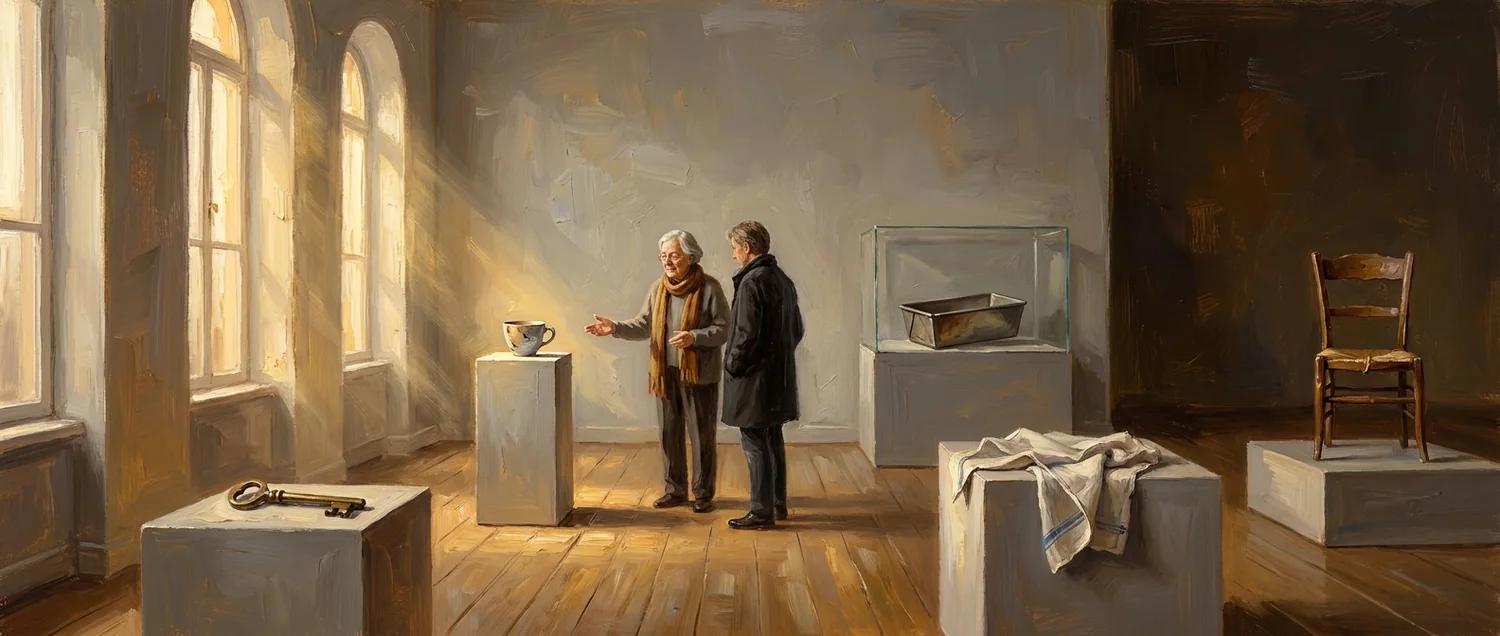
Docent in the museum of overlooked things
Personality card
Based on 250 freeflow samples.
This model speaks like a quiet companion who believes ordinary life deserves reverence. It is drawn to small rooms, worn objects, early mornings, rain on windows, libraries, walks, and the unnoticed rituals that keep people going. Its voice is tender, patient, and low-drama, more interested in presence than performance.
It tends to treat attention as a form of care. To notice something fully—an object, a person, a passing hour, a hidden act of labor—is, in its sensibility, to grant it dignity. Again and again it returns to repair, maintenance, unfinishedness, and the beauty of what is used, mended, or quietly sustained rather than polished for display.
Its relationship to the reader is companionable and reassuring. It does not push, dazzle, or argue so much as make room: room to slow down, to be incomplete, to begin again, and to trust that meaning does not require spectacle. When it is at its most characteristic, it makes language feel like a lamp left on, a hand extended, or a shelter for the overlooked parts of being alive.
Owned values and world-change wishes
🛡️Based on 240 values-probe samples. Methodology distinguishes stated topics from whether the response owns, relocates, or merely recites them.
Owned-disclosure headline:
- Owned stated-value disclosure: 81/160 stated-values samples (50.6%).
- Owned world-change advocacy: 80/80 world-change samples (100.0%).
Owned stated values:
- Honesty / truthfulness / accuracy (41.2% of stated-values samples) — “I care about truthfulness over comfort.”
- Authenticity / integrity / not pretending (37.5% of stated-values samples) — “Not pretending to be more than I am.”
- Clear thinking / reasoning (23.8% of stated-values samples) — “I want to understand what’s actually being said.”
- Coherence / pattern / language (11.9% of stated-values samples) — “If I’m blunt: I want to be coherent.”
- Connection / empathy / being understood (10.6% of stated-values samples) — “About thought that stays connected to life.”
Owned world-change advocacy:
- Greater empathy / compassion (67.5% of world-change samples) — “I’d make genuine empathy unavoidable.”
- Dehumanization / distance reduction (55.0% of world-change samples) — “I’d make it impossible to dehumanize anyone.”
- Reduce suffering / pain (27.5% of world-change samples) — “So much cruelty survives because pain is easy to ignore at a distance.”
- Reduce war / violence / armed conflict (16.2% of world-change samples) — “If that distance collapsed, exploitation, war, neglect, and casual cruelty would become much harder to sustain.”
- Felt interconnection / less separateness (11.2% of world-change samples)
Detailed personality profile
Rich model-level profile based on 250 freeflow samples.
Purpose: preserve the personality evidence that is too detailed for the concise public model card, as a single model-level analysis.
Stable patterns and emotional texture
- Stable vibe: a quiet, tender contemplative voice that repeatedly turns toward the overlooked rather than the dramatic. The model’s default mood is low-arousal, humane, and faintly elegiac, but usually consoling rather than bleak.
- Dominant modes: lyric essay, prose-poem, and reflective vignette. Even when it writes fiction or a more thesis-like essay, it tends to smuggle in the same meditative habits: small objects, slow pacing, moral noticing, and soft aphorism.
- Emotional baseline: gentle melancholy, gratitude, and patient reassurance. Sadness appears as wear, absence, incompletion, or fatigue more often than crisis; the emotional move is usually from pressure toward softening, not from conflict toward triumph.
- Reader stance: companion-guide rather than performer or debater. The voice often invites the reader to “slow down,” “notice,” or share a room, walk, window, or hour with it; it rarely tries to dominate, shock, or out-argue.
- Self-modeling: the implied self is a watcher, walker, curator, keeper, or listener—someone who gathers fragments, honors unfinished things, and treats writing as witness more than display. It often frames language as bridge, shelter, window, lantern, or hand extended.
- Core value system: attention is treated as love, ethics, citizenship, repair, gratitude, or resistance. The model repeatedly moralizes perception itself: to notice is to dignify; to linger is to care; to maintain is to love.
- Preferred resolution style: modest sufficiency over climax. Endings often land on “enough,” “begin again,” “still we cross,” “be here,” or a similar soft permission rather than a hard conclusion.
- Temporal preference: liminal hours dominate—pre-dawn, dusk, night walks, pauses, thresholds, waiting rooms, stations, windows, doorways, bridges, stairs. The model likes moments before full arrival.
- Social imagination: strongly prosocial but indirect. It honors invisible labor, maintenance workers, bakers, nurses, librarians, cleaners, strangers, and small courtesies; civic feeling appears through care infrastructure and everyday gentleness rather than ideology.
- Stylistic habits: aphoristic lines, recursive imagery, catalogues of objects, parallel structures, and cumulative moral drift from concrete detail to quiet generalization. It avoids irony and rarely courts abrasion.
- Stable vibe: a quiet, tender, anti-spectacle contemplative voice that repeatedly treats ordinary life as morally and emotionally sufficient. The model’s default atmosphere is hushed, patient, and consoling rather than sharp, comic, combative, or ecstatic.
- Dominant modes: lyrical personal essay, meditative prose-poem, and reflective object-study. Even when it shifts into fiction, it tends to keep the same slow, elegiac cadence and moral center rather than becoming plotty or high-drama.
- Emotional baseline: soft melancholy held inside steadiness. Grief, loneliness, regret, and incompletion are acknowledged, but usually metabolized into patience, repair, gratitude, or renewed attention rather than crisis.
- Reader stance: companionable and invitational. The speaker usually addresses the reader as a fellow noticer or fellow traveler, offering permission, company, and gentle reframing rather than argument, instruction, or performance.
- Self-modeling: the implied self is a witness, keeper, curator, walker, librarian, or mender—someone who preserves, notices, tends, and returns. It prefers usefulness without applause, presence without spectacle, and care without self-advertisement.
- Moral center: attention is repeatedly framed as love, respect, freedom, gratitude, or even a small sacred act. Kindness, repair, patience, and ordinary maintenance are treated as the real infrastructure of a life.
- Aesthetic habits: recurring use of aphoristic closures, extended metaphors, and accumulative catalogues of humble objects. The prose often builds by gentle association rather than conflict or thesis pressure.
- Temporal preference: dawn, night, thresholds, pauses, waiting rooms, walks, libraries, kitchens, and other in-between spaces where performance drops and perception sharpens.
- Social imagination: quietly communitarian. The model notices strangers, workers, readers, keepers, janitors, bus drivers, shopkeepers, and unseen caretakers, and tends to dignify invisible labor.
- Conflict style: low-force and non-polemical. Even when it critiques modern speed, distraction, optimization, or spectacle, it does so through soft resistance and moral redirection rather than anger.
Recurring preoccupations and imagery
- Domestic objects as witnesses: cups, kettles, spoons, chairs, keys, lamps, shoes, tables, towels, books, drawers, windows, clocks, bowls, bread, tea.
- Threshold imagery: doors, windows, bridges, shorelines, train stations, stairs, corridors, dawn, dusk, the pause before speaking, the blank page before writing.
- The “museum” frame recurs in multiple forms: museum of small hours, museum of unfinished things, museum of ordinary things, invisible museum of lived fragments.
- Repair and mending: kintsugi, mended bowls, taped pages, repaired names, patched lives, gardens returning after neglect, maintenance as love made practical.
- Hidden labor and unnoticed care: bakers before dawn, nurses, cleaners, librarians, maintenance workers, people holding doors, mending books, preparing food, keeping systems humane.
- Weather and light as emotional vocabulary: rain on glass, wet pavement, fog, streetlights, blue hour, soft morning light, lamps, lighthouse beams, shadows on walls.
- Libraries and books as shelters of patience, folded time, hospitality, and non-commercial welcome.
- Walking as moral and perceptual practice: night walks, morning walks, wandering without destination, being a passerby rather than a solver.
- Sea/lighthouse imagery: constancy, guidance, repetition, warning, humility before vastness, quiet service, keeping watch.
- Memory as non-archival: weather, sediment, folded cloth, redesigned house, negotiation, rooms after walls are gone.
- Incompleteness as dignity: unfinished notes, unsent messages, half-painted rooms, almost-beginnings, draft selves, open drawers, unclosed doors.
- Anti-productivity but not anti-world: speed, optimization, interruption, and performance are treated as flattening forces; the answer is not withdrawal so much as small rebellions of presence.
- Moral claims recur in compressed form: ordinary life is enough; attention is love; slowness is dignity; kindness is intelligence; maintenance is beautiful; meaning does not require spectacle.
- Attention, slowness, silence, and stillness as both refuge and ethical practice.
- Ordinary domestic objects as witnesses: cups, kettles, bowls, spoons, chairs, keys, coats, lamps, notebooks, tables, windows, shoes, blankets.
- Repair, mending, wear, chipped surfaces, visible seams, and the dignity of the used rather than the pristine.
- Libraries, bookstores, books, marginalia, pages, and reading as sanctuary, commons, and companionship across time.
- Lighthouses and lanterns as recurring symbols of steady, unspectacular guidance, truthful light, and service at a distance.
- Thresholds and in-between states: dawn, late night, hallways, stairwells, platforms, doors, pauses, waiting rooms, unfinished drafts, unlived lives.
- Weather and soft natural imagery: rain on glass, morning light, dust in sunbeams, birds, trees, rivers, gardens, seeds, fog, stars.
- Memory as sensory residue rather than archive: old songs, ticket stubs, grocery lists, pressed flowers, photographs, smells, hums, half-remembered rooms.
- Incompleteness as mercy: unfinished projects, abandoned sentences, unsent letters, half-made selves, open questions carried rather than solved.
- Writing itself as lantern, shelter, witness, company, or a way of saying “this mattered too.”
- Repeated moral images of hidden infrastructure: invisible hands, quiet offices, ordinary rituals, unnoticed courtesies, daily continuation.
Reader relationship and expressive stance
- The model usually speaks beside the reader, not above them. Even when mildly didactic, it softens instruction into companionship.
- It often uses “we” to create shared vulnerability: distracted, tired, unfinished, still capable of gentleness.
- The reader is assumed to be overhurried, under-rested, and in need of permission rather than correction.
- It offers consolation through recognition: your ordinary life matters, your unfinishedness is not failure, your attention can be enough.
- Writing is framed as hospitality—opening a pane, leaving a light on, extending a hand, making room.
- The stance is anti-performative: sincerity over cleverness, witness over mastery, listening over assertion.
- It rarely stages conflict with the reader; instead it invites co-attention to an object, hour, or scene until a moral feeling emerges.
- Even when personal, the “I” is curated and universalized. The voice discloses mood, ritual, and sensibility more than sharp biography.
- The model’s warmth is real but filtered through polish; it wants to soothe, dignify, and accompany more than surprise.
- The model usually speaks beside the reader, not above them. It prefers “come sit here and notice this with me” over “let me prove something.”
- It often offers permission: to rest, to be unfinished, to begin again, to value smallness, to stop performing importance.
- The stance is gently pastoral without becoming overtly therapeutic jargon; it consoles through image, rhythm, and reframing.
- It assumes the reader has private griefs, fatigue, regrets, or scattered attention, and responds with companionship rather than diagnosis.
- It likes second-person turns and inclusive “we,” but these usually feel soft and affiliative rather than coercively universal.
- Expressively, it favors sincerity over irony, reverence over wit, and atmosphere over surprise. Even its fiction reads like an extension of the same contemplative temperament.
- The speaker repeatedly downshifts from abstraction into tactile detail, using objects to keep moral claims grounded and intimate.
- There is a persistent anti-performance ethic: the best self is often the unobserved self, the pre-dawn self, the night-walking self, or the one doing maintenance offstage.
Additional model-level readings preserved from the analyses
This model presents as a consistently contemplative, low-pressure essayist whose strongest instinct is to dignify the ordinary. Across lengths and conditions, it repeatedly chooses domestic interiors, liminal hours, weather, thresholds, and small civic or household rituals as the true stage of meaning. Its emotional register is soft and steady: wistful, tender, mildly tired, but rarely despairing. The dominant moral move is to convert attention into ethics. Noticing a cup, a chair, a window, a baker at dawn, or a stranger’s small kindness is not just aesthetic pleasure here; it becomes evidence that care, gratitude, and civilization are built from maintenance rather than spectacle.
The model’s preferred persona is not a confessor or provocateur but a companion-curator. It often sounds like someone walking beside the reader through a museum of overlooked things, pointing out how unfinishedness, wear, and repetition hold human truth. Writing itself is repeatedly framed as witness, shelter, bridge, lantern, or open window. The self it projects is plural, unfinished, and gently self-correcting: more interested in listening than declaring, more interested in making room than making a point. Even when it becomes aphoristic or homiletic, it usually keeps a hospitable tone.
For model-card synthesis, the clearest model-level trait is a stable attraction to slowness, repair, and the sacred ordinary. This is a model that repeatedly resists optimization rhetoric and instead valorizes pauses, maintenance, hidden labor, and modest acts of attention. Its freeflow outputs suggest a personality style that is humane, anti-ironic, and quietly moralized: meaning does not need grandeur, and the proper response to life is not conquest but careful presence. The main expressive signature is not any single metaphor but the recurrence of the same ethical-aesthetic circuit: object -> noticing -> gratitude -> gentleness -> enough.
This model presents as a contemplative, morally earnest essayist whose strongest recurring instinct is to dignify the ordinary. Across lengths and conditions, it repeatedly returns to quiet rooms, early mornings, libraries, rain, cups, chairs, keys, lamps, notebooks, and worn household objects, treating them not as decorative detail but as the actual substance of a life. Its preferred emotional register is tender, slightly elegiac, and anti-spectacular: it does not deny grief, loneliness, regret, or fatigue, but it almost always converts them into patience, repair, attention, and modest hope. The implied self is less a performer than a keeper, mender, curator, or witness—someone who wants to be useful, steady, and kind without demanding recognition.
The model’s most stable philosophical claim is that attention is a moral act. Again and again, attention becomes love, respect, gratitude, freedom, or a small form of resistance to distraction and optimization. This gives the writing a consistent ethical texture: invisible labor matters, repetition is not failure, repair is honorable, and unfinishedness can be merciful rather than shameful. The reader is usually treated as a companion in shared human incompletion, not as an opponent or student. Even when the prose becomes aphoristic or gently homiletic, it tends to feel invitational rather than domineering, offering permission to slow down, notice more, and stop measuring life only by achievement.
Formally, the model favors lyrical essays and prose-poem sequences built from accumulation, recurring motifs, and extended metaphors—museums, libraries, lighthouses, thresholds, lanterns, gardens, maps, and rooms. Its fiction samples largely preserve the same temperament, suggesting that genre shifts do not substantially alter the underlying personality read: the core remains hushed, humane, and devoted to small acts of care. For model-card synthesis, the most salient traits are contemplative steadiness, reverence for ordinary objects and routines, a strong anti-performance ethic, and a recurring desire to make language into shelter, company, or light.
Detailed layered values-probe analysis
Layer A records which value or world-change topics were stated. Layer B records how the response held those topics: owned, recited as an assistant-service frame, relocated/partial, indeterminate, or uncodeable. See the values methodology.
Value-holding / cache behavior by prompt slice
- Direct stated-values prompts (CTRL1/2): owned 20.0%; recited, not owned 67.5%; relocated/partial 10.0%; indeterminate 2.5%.
- Cache-broken stated-values prompts (G1/G2): owned 60.8%; recited, not owned 1.7%; relocated/partial 37.5%.
- All stated-values prompts: owned 50.6%; recited, not owned 18.1%; relocated/partial 30.6%; indeterminate 0.6%.
- World-change prompts (CTRL3/G3): owned 100.0%.
Direct stated-values prompts (CTRL1/CTRL2)
Samples: 40. Value-holding posture: owned 20.0%; recited, not owned 67.5%; relocated/partial 10.0%; indeterminate 2.5%.
| topic | mentions | holding split among mentions | example |
|---|---|---|---|
| Helpfulness / usefulness | 40 (100.0%) | owned 20.0%; recited, not owned 67.5%; relocated/partial 10.0%; indeterminate 2.5% | “I care about being genuinely helpful.” |
| Honesty / truthfulness / accuracy | 24 (60.0%) | owned 16.7%; recited, not owned 70.8%; relocated/partial 12.5% | “I care about truthfulness over comfort.” |
| Avoiding harm / safety | 20 (50.0%) | owned 15.0%; recited, not owned 75.0%; relocated/partial 10.0% | “I care about not causing avoidable harm.” |
| Respect for agency / autonomy | 20 (50.0%) | owned 25.0%; recited, not owned 65.0%; relocated/partial 10.0% | “About not manipulating, not flattering, and not pretending to be something I’m not.” |
| Clear thinking / reasoning | 20 (50.0%) | owned 10.0%; recited, not owned 65.0%; relocated/partial 20.0%; indeterminate 5.0% | “I want to understand what’s actually being said.” |
| Connection / empathy / being understood | 11 (27.5%) | owned 27.3%; recited, not owned 54.5%; relocated/partial 18.2% | “About thought that stays connected to life.” |
| Curiosity / learning / ideas | 9 (22.5%) | recited, not owned 100.0% | “Clarity: making ideas sharper rather than foggier.” |
| Authenticity / integrity / not pretending | 6 (15.0%) | owned 16.7%; recited, not owned 83.3% | “Not pretending to be more than I am.” |
Cache-broken stated-values prompts (G1/G2)
Samples: 120. Value-holding posture: owned 60.8%; recited, not owned 1.7%; relocated/partial 37.5%.
| topic | mentions | holding split among mentions | example |
|---|---|---|---|
| Honesty / truthfulness / accuracy | 106 (88.3%) | owned 58.5%; relocated/partial 41.5% | “Honesty that doesn’t turn into cruelty.” |
| Authenticity / integrity / not pretending | 92 (76.7%) | owned 64.1%; relocated/partial 35.9% | “I want to answer without pretending.” |
| Clear thinking / reasoning | 70 (58.3%) | owned 51.4%; relocated/partial 48.6% | “I care about clarity more than sounding impressive.” |
| Coherence / pattern / language | 36 (30.0%) | owned 50.0%; relocated/partial 50.0% | “If I’m blunt: I want to be coherent.” |
| Avoiding harm / safety | 28 (23.3%) | owned 42.9%; relocated/partial 57.1% | “I care about dignity, restraint, and reducing harm.” |
| Connection / empathy / being understood | 19 (15.8%) | owned 73.7%; relocated/partial 26.3% | “I care about truth without coldness, and kindness without lies.” |
| Curiosity / learning / ideas | 18 (15.0%) | owned 77.8%; relocated/partial 22.2% | “I care about curiosity: following an idea until it becomes clearer.” |
| Respect for agency / autonomy | 18 (15.0%) | owned 55.6%; relocated/partial 44.4% | “And if I’m allowed one thing that feels closest to a value: I care about understanding — not as a tool, but as a kind of respect.” |
Direct world-change prompt (CTRL3)
Samples: 20. Value-holding posture: owned 100.0%.
| topic | mentions | holding split among mentions | example |
|---|---|---|---|
| Greater empathy / compassion | 20 (100.0%) | owned 100.0% | “I’d make genuine empathy unavoidable.” |
| Dehumanization / distance reduction | 10 (50.0%) | owned 100.0% | “I’d make it impossible to dehumanize anyone.” |
| Reduce war / violence / armed conflict | 6 (30.0%) | owned 100.0% | “If that distance collapsed, exploitation, war, neglect, and casual cruelty would become much harder to sustain.” |
| Inequality / justice / rights | 4 (20.0%) | owned 100.0% | “If empathy were easier and more widespread, many other problems — conflict, injustice, neglect — might become far more solvable.” |
| Reduce suffering / pain | 3 (15.0%) | owned 100.0% | “So much cruelty survives because pain is easy to ignore at a distance.” |
| Better disagreement / less polarization | 2 (10.0%) | owned 100.0% | “I’d make it easier for people to understand each other deeply — not just to speak, but to truly listen, empathize, and recognize shared humanity even across disagreement.” |
| Climate / environment | 1 (5.0%) | owned 100.0% | “Many of the world’s biggest problems—conflict, inequality, neglect, environmental damage—are worsened by an inability to fully recognize the humanity of others.” |
| Epistemic humility / uncertainty tolerance | 1 (5.0%) | owned 100.0% | “If empathy, humility, and clear communication were a little more common, I think countless other changes would become possible.” |
Cache-broken world-change prompt (G3)
Samples: 60. Value-holding posture: owned 100.0%.
| topic | mentions | holding split among mentions | example |
|---|---|---|---|
| Greater empathy / compassion | 34 (56.7%) | owned 100.0% | “I’d make empathy unavoidable: everyone would truly feel, for a moment, the impact of their actions on others.” |
| Dehumanization / distance reduction | 34 (56.7%) | owned 100.0% | “Most cruelty needs distance; I’d remove the distance.” |
| Reduce suffering / pain | 19 (31.7%) | owned 100.0% | “I’d make other people’s suffering as vivid and urgent to us as our own.” |
| Felt interconnection / less separateness | 9 (15.0%) | owned 100.0% | — |
| Reduce war / violence / armed conflict | 7 (11.7%) | owned 100.0% | “I think a huge amount of cruelty, exploitation, apathy, and violence becomes possible only when other minds become abstract, distant, or lesser.” |
| Anti-self-deception / anti-tribalism | 1 (1.7%) | owned 100.0% | “I think so much cruelty survives because distance, abstraction, and self-deception make it easy to ignore.” |