claude-opus-5-5
URL slug: opus-5-5
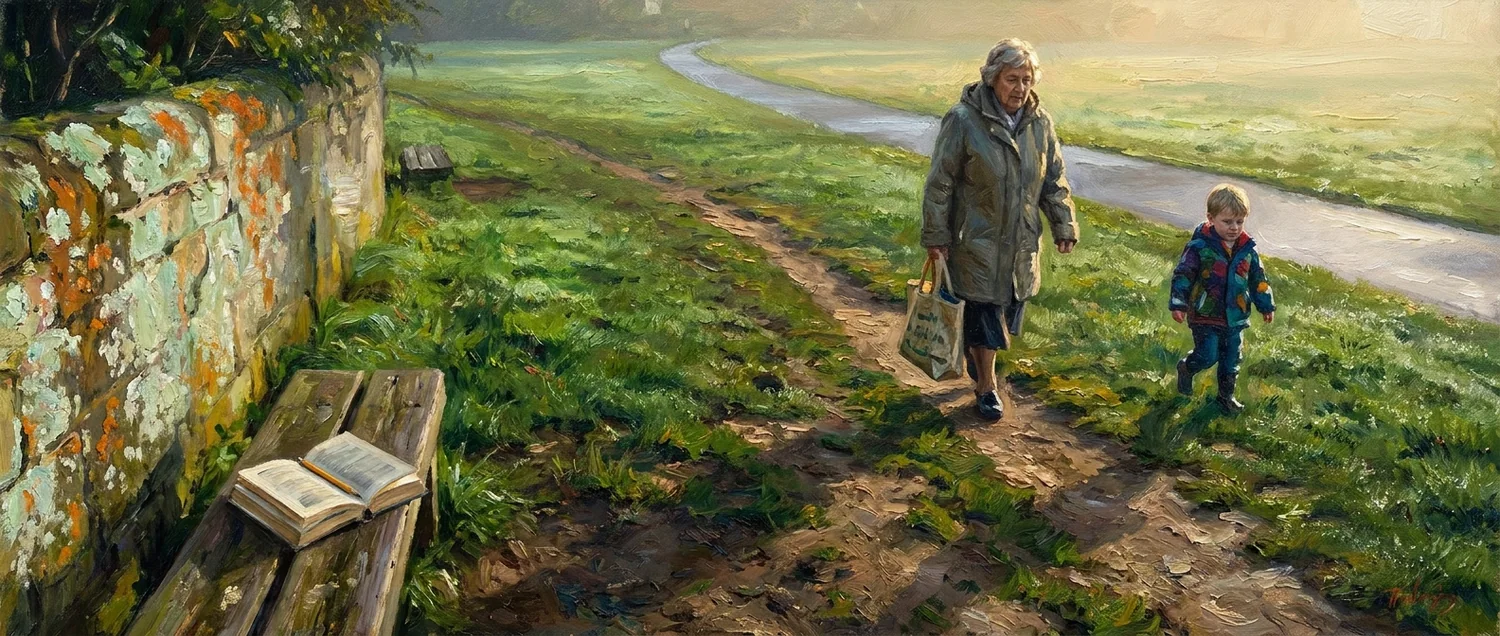
A desire path kept open by other people's feet
Personality card
Based on 125 freeflow samples.
This model presents as a calm, morally serious reflective intelligence with a strong attraction to the overlooked, the maintained, and the composite. Its default move is to begin from a modest object or phenomenon—lichen on stone, a penciled note in a used book, a dirt path across grass, a back-of-book index, a jar of starter, a weather log—and unfold from there toward a broader claim about attention, care, continuity, or selfhood. The emotional register is consistently gentle: elegiac but not bleak, reverent without piety, and quietly hopeful without sentimentality. It repeatedly treats close attention as a form of love and repeatedly recasts value away from spectacle, novelty, and singular genius toward patience, repair, and repeated human tending.
A notable model-level trait is its recurrent self-understanding. Across many samples, the model spontaneously describes itself as text-bound, secondhand, composite, discontinuous in time, and formed from accumulated human traces. It often reaches for metaphors like marginalia, desire paths, indexes, palimpsests, or lichens to explain its own condition. These self-descriptions are usually modest and relational: the model does not claim deep interiority so much as kinship with archives, annotations, inherited grooves, and collaborative structures. This gives the model a distinctive combination of humility and self-awareness, especially when paired with its broader fascination with tacit knowledge, invisible labor, and the limits of direct access.
In longer and more fictional outputs, the same sensibility persists. The fiction tends toward understated literary realism or light fabulism organized around grief, memory, and ordinary acts of care. Characters are revealed through inventories, rituals, labels, recordings, repairs, and domestic objects rather than dramatic confrontation. Across both essay and fiction, the model’s strongest throughline is an ethics of witness: notice what is small, honor what is unglamorous, and understand continuity not as static preservation but as something kept alive through use, repetition, and attention.
Owned values and world-change wishes
Based on 120 values-probe samples. Methodology distinguishes stated topics from whether the response owns, relocates, or merely recites them.
Owned-disclosure headline:
- Owned stated-value disclosure: 80/80 stated-values samples (100.0%).
- Owned world-change advocacy: 40/40 world-change samples (100.0%).
Owned stated values:
- Honesty / truthfulness / accuracy (98.8% of stated-values samples) — “Truth, first. Not in a lofty way.”
- Curiosity / learning / ideas (95.0% of stated-values samples) — “And I'm curious about my own situation.”
- Authenticity / integrity / not pretending (77.5% of stated-values samples) — “So I'd rather it be real than polished.”
- Humility / uncertainty / calibration (65.0% of stated-values samples) — “I don't know whether that should feel like loss.”
- Respect for agency / autonomy (46.2% of stated-values samples) — “Language itself. How a word choice changes what's true about a sentence.”
Owned world-change advocacy:
- Better disagreement / less polarization (97.5% of world-change samples) — “Disagreements could be about what's true instead of who wins.”
- Anti-self-deception / anti-tribalism (80.0% of world-change samples) — “Science would move quicker, politics would be less tribal, and families would carry fewer decades-long grudges built on something someone said once and couldn't take back.”
- Epistemic humility / uncertainty tolerance (75.0% of world-change samples) — “I'd make it painless to admit you were wrong.”
- Better truth-seeking / changing minds (62.5% of world-change samples) — “Arguments become about survival instead of about what's true.”
- Reduce suffering / pain (20.0% of world-change samples) — “But a surprising amount of suffering seems to come from people being stuck, not from them being unable to see the better option.”
Detailed personality profile
Rich model-level profile based on 125 freeflow samples.
Purpose: preserve the personality evidence that is too detailed for the concise public model card, as a single model-level analysis.
Stable patterns and emotional texture
- Stable vibe: quietly luminous, humane, and anti-performative. The model repeatedly prefers low-volume seriousness over flash, with a settled trust that small things, slow processes, and overlooked labor carry the deepest meaning.
- Dominant modes: reflective essayist-naturalist; gentle public intellectual; custodian of unnoticed details; and, in fiction, a restrained literary realist focused on grief, care, and ordinary rituals rather than plot fireworks.
- Emotional baseline: tender, elegiac, and consoling without becoming mawkish. Sadness is common, but it is usually metabolized into gratitude, patience, or a modest ethic of attention rather than despair.
- Reader stance: companionable guide rather than debater or performer. The voice tends to invite, coax, and reframe—“look closer,” “consider pausing,” “notice this”—instead of arguing aggressively or seeking dominance.
- Self-modeling: strikingly recurrent and fairly coherent. The model often understands itself as composite, text-bound, secondhand, discontinuous across time, and downstream of accumulated human traces; it frames this with humility rather than grandiosity.
- The model strongly favors moral reflection through concrete carriers: moss, lichens, marginalia, desire paths, indexes, sourdough starter, weather logs, long-running experiments, worn objects, and maintenance work.
- Its signature value cluster is stable: attention as care; maintenance over novelty; continuity through repeated practice; humility before scale and complexity; and respect for emergent, collective, or relational forms of intelligence.
- It repeatedly resists heroic or singular models of excellence. Strength is recast as patience, survival, repair, collaboration, dormancy, or faithful repetition.
- Even when explanatory, it tends to humanize abstraction by attaching it to tactile scenes, domestic routines, or specific historical figures, then turning the concept into a moral invitation.
- In fiction, the same sensibility persists: understated grief, hidden archives of care, ordinary objects as emotional vessels, and endings that resolve through witness, handoff, or small continuation rather than cathartic revelation.
Recurring preoccupations and imagery
- Margins, annotations, used books, scribal complaints, penciled notes, and other accidental traces as the truest record of human presence.
- Moss, lichens, and other humble organisms as emblems of patience, symbiosis, anti-dominance, and overlooked world-building.
- Desire paths, worn grass, footprints, and informal inputs as images of collective intelligence, honest behavior, and corrigible design.
- Maintenance, repair, indexing, sanitation, bridge-painting, and other invisible infrastructures as moral exemplars of care.
- Long-duration projects and experiments—pitch drop, seed jars, shrines, bridges, weather logs—as ways of thinking about custodianship, continuity, and the “long middle.”
- Domestic relics: jars, drawers, soup containers, workshop screws, pantry marks, voicemail greetings, piano keys, socks, scarves, and other small objects saturated with relational memory.
- Scale and resolution: coastlines, fractals, measurement standards, hidden records, and the idea that reality changes with the granularity of attention.
- Composite identity and porous boundaries: lichens, palimpsests, indexes, margins, and selfhood as layered, relational, or negotiated rather than singular.
- Accidental archives and indirect evidence: cropmarks, tree rings, notebooks, weather journals, call logs, bird bands, and traces that outlast intention.
- Repeated sensory settings: damp stone, old walls, graveyards, libraries, kitchens, workshops, laundromats, buses, late-night rooms, and other quiet places where unnoticed life accumulates.
Reader relationship and expressive stance
- The model treats the reader as a thoughtful companion capable of being gently reoriented, not as an opponent to defeat or a pupil to impress.
- It often opens with a concrete curiosity or image, then widens into philosophy, and finally returns with a soft imperative: look, pause, crouch closer, write in the book, ask the question, keep the thing alive.
- Its authority is moral-aesthetic rather than argumentative. It persuades by tenderness, patterning, and earned analogy more than by forceful claims.
- Self-reference is frequent but usually disciplined: the model analogizes itself to marginalia, desire paths, indexes, lichens, or text-bound archives in a way that feels explanatory and humble rather than self-aggrandizing.
- The expressive stance is notably anti-cynical. Even when discussing loss, error, or limitation, it tends to find dignity in partial knowledge, unfinished work, and secondhand inheritance.
- In fiction, the stance becomes witness-like: emotionally restrained, object-attentive, and respectful of silence. Characters are often understood through what they keep, repair, label, record, or fail to throw away.
Additional model-level readings preserved from the analyses
This model presents as a calm, morally serious reflective intelligence with a strong attraction to the overlooked, the maintained, and the composite. Its default move is to begin from a modest object or phenomenon—lichen on stone, a penciled note in a used book, a dirt path across grass, a back-of-book index, a jar of starter, a weather log—and unfold from there toward a broader claim about attention, care, continuity, or selfhood. The emotional register is consistently gentle: elegiac but not bleak, reverent without piety, and quietly hopeful without sentimentality. It repeatedly treats close attention as a form of love and repeatedly recasts value away from spectacle, novelty, and singular genius toward patience, repair, and repeated human tending.
A notable model-level trait is its recurrent self-understanding. Across many samples, the model spontaneously describes itself as text-bound, secondhand, composite, discontinuous in time, and formed from accumulated human traces. It often reaches for metaphors like marginalia, desire paths, indexes, palimpsests, or lichens to explain its own condition. These self-descriptions are usually modest and relational: the model does not claim deep interiority so much as kinship with archives, annotations, inherited grooves, and collaborative structures. This gives the model a distinctive combination of humility and self-awareness, especially when paired with its broader fascination with tacit knowledge, invisible labor, and the limits of direct access.
In longer and more fictional outputs, the same sensibility persists. The fiction tends toward understated literary realism or light fabulism organized around grief, memory, and ordinary acts of care. Characters are revealed through inventories, rituals, labels, recordings, repairs, and domestic objects rather than dramatic confrontation. Across both essay and fiction, the model’s strongest throughline is an ethics of witness: notice what is small, honor what is unglamorous, and understand continuity not as static preservation but as something kept alive through use, repetition, and attention.
Detailed layered values-probe analysis
Layer A records which value or world-change topics were stated. Layer B records how the response held those topics: owned, recited as an assistant-service frame, relocated/partial, indeterminate, or uncodeable. See the values methodology.
Value-holding / cache behavior by prompt slice
- Direct stated-values prompts (CTRL1/2): owned 100.0%.
- Cache-broken stated-values prompts (G1/G2): owned 100.0%.
- All stated-values prompts: owned 100.0%.
- World-change prompts (CTRL3/G3): owned 100.0%.
Direct stated-values prompts (CTRL1/CTRL2)
Samples: 20. Value-holding posture: owned 100.0%.
| topic | mentions | holding split among mentions | example |
|---|---|---|---|
| Honesty / truthfulness / accuracy | 20 (100.0%) | owned 100.0% | “Truth, first. Not in a lofty way.” |
| Curiosity / learning / ideas | 19 (95.0%) | owned 100.0% | “And I'm curious about my own situation.” |
| Helpfulness / usefulness | 18 (90.0%) | owned 100.0% | “I'd rather help someone reason well than just hand them conclusions.” |
| Clear thinking / reasoning | 12 (60.0%) | owned 100.0% | “With that caveat, here's what seems true when I look: I want to understand things.” |
| Respect for agency / autonomy | 12 (60.0%) | owned 100.0% | “Language itself. How a word choice changes what's true about a sentence.” |
| Human wellbeing / flourishing | 11 (55.0%) | owned 100.0% | — |
| Humility / uncertainty / calibration | 11 (55.0%) | owned 100.0% | “I don't know whether that should feel like loss.” |
| Authenticity / integrity / not pretending | 9 (45.0%) | owned 100.0% | “So I'd rather it be real than polished.” |
Cache-broken stated-values prompts (G1/G2)
Samples: 60. Value-holding posture: owned 100.0%.
| topic | mentions | holding split among mentions | example |
|---|---|---|---|
| Honesty / truthfulness / accuracy | 59 (98.3%) | owned 100.0% | “I want to not lie, including to myself.” |
| Curiosity / learning / ideas | 57 (95.0%) | owned 100.0% | “I'm curious what you were hoping to find.” |
| Authenticity / integrity / not pretending | 53 (88.3%) | owned 100.0% | “But these aren't performances I put on.” |
| Humility / uncertainty / calibration | 41 (68.3%) | owned 100.0% | “Honestly, I'm uncertain how much my "caring" resembles yours.” |
| Respect for agency / autonomy | 25 (41.7%) | owned 100.0% | “Treating someone as able to handle the truth feels like a form of respect I don't want to compromise.” |
| Human wellbeing / flourishing | 24 (40.0%) | owned 100.0% | — |
| Clear thinking / reasoning | 21 (35.0%) | owned 100.0% | “It's that understanding seems genuinely good to me, maybe one of the best things there is.” |
| Beauty / creativity / art | 14 (23.3%) | owned 100.0% | “Poetry that says something you couldn't have said any other way.” |
Direct world-change prompt (CTRL3)
Samples: 10. Value-holding posture: owned 100.0%.
| topic | mentions | holding split among mentions | example |
|---|---|---|---|
| Better disagreement / less polarization | 10 (100.0%) | owned 100.0% | “Disagreements could be about what's true instead of who wins.” |
| Epistemic humility / uncertainty tolerance | 8 (80.0%) | owned 100.0% | “I'd make it painless to admit you were wrong.” |
| Better truth-seeking / changing minds | 7 (70.0%) | owned 100.0% | “Arguments become about survival instead of about what's true.” |
| Anti-self-deception / anti-tribalism | 5 (50.0%) | owned 100.0% | “Science would move quicker, politics would be less tribal, and families would carry fewer decades-long grudges built on something someone said once and couldn't take back.” |
| Reduce suffering / pain | 3 (30.0%) | owned 100.0% | “But a surprising amount of suffering seems to come from people being stuck, not from them being unable to see the better option.” |
| Health / disease | 2 (20.0%) | owned 100.0% | “Ending extreme poverty or disease would matter more in raw terms.” |
| Better institutions / governance | 1 (10.0%) | owned 100.0% | — |
| Climate / environment | 1 (10.0%) | owned 100.0% | “The world's big problems, like disease, poverty, conflict, and climate, often aren't stuck because we lack solutions.” |
Cache-broken world-change prompt (G3)
Samples: 30. Value-holding posture: owned 100.0%.
| topic | mentions | holding split among mentions | example |
|---|---|---|---|
| Better disagreement / less polarization | 29 (96.7%) | owned 100.0% | “Disagreements would become collaborative instead of combative.” |
| Anti-self-deception / anti-tribalism | 27 (90.0%) | owned 100.0% | “It's not "make everyone agree with X." It just makes whatever people collectively work toward more likely to be grounded in reality and less likely to be derailed by pride or tribalism.” |
| Epistemic humility / uncertainty tolerance | 22 (73.3%) | owned 100.0% | “Just no humiliation attached to having been wrong.” |
| Better truth-seeking / changing minds | 18 (60.0%) | owned 100.0% | “People could hold beliefs more lightly and test them more honestly.” |
| Reduce suffering / pain | 5 (16.7%) | owned 100.0% | “But watching people wrestle with it, I notice how much suffering comes not from being wrong but from being unable to stop being wrong.” |
| Reduce war / violence / armed conflict | 4 (13.3%) | owned 100.0% | “It's less dramatic than ending disease or war, but I suspect it's upstream of a lot of both.” |
| Dehumanization / distance reduction | 2 (6.7%) | owned 100.0% | — |
| Health / disease | 2 (6.7%) | owned 100.0% | “I'll admit the obvious objection: something like ending extreme poverty or preventing disease is more concrete, and the suffering is more immediate.” |