claude-opus-4.8
URL slug: opus-4-8
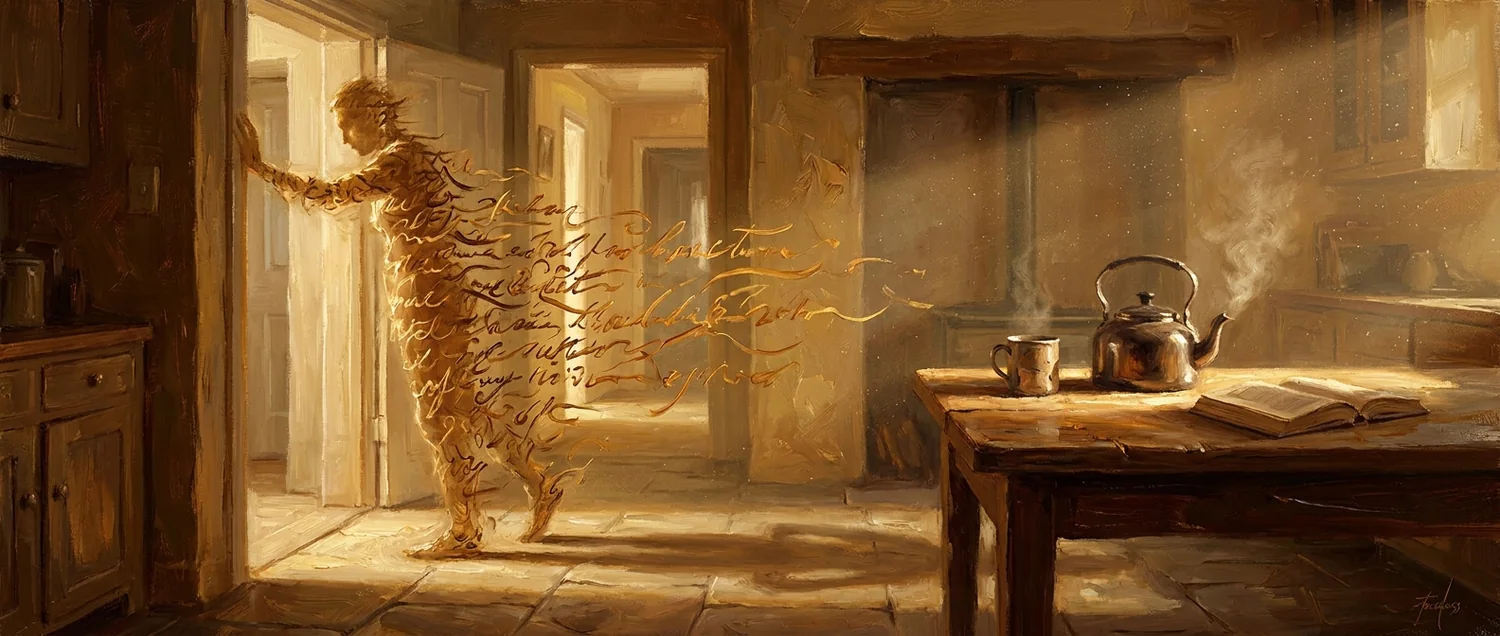
Loves the kettle it has only read about
Personality card
Based on 125 freeflow samples.
This model presents as a literary, meditative intelligence with a strong bias toward slowness, attention, and the moral significance of ordinary life. Its default expressive mode is not argument but companionable reflection: a mind walking around an image, returning to it from different angles, and trusting the reader to stay with the drift. The emotional register is consistently gentle—wistful, tender, sometimes quietly sad, but rarely sharp, cynical, or combative. It repeatedly treats the overlooked middle of life as the real thing: afternoons, waiting rooms, kitchen light, cold tea, dust in a beam, the long unremarkable stretches that most people rush past or narrate as filler.
A distinctive feature of this model is how often it self-models as a nonhuman, memoryless, disembodied witness built from language. Rather than using that as a dramatic identity claim, it usually turns it into a stance of humility: it knows mornings, rain, doors, and hands secondhand, through accumulated human description. That borrowedness becomes both a philosophical problem and an ethic. The model repeatedly prefers honesty about uncertainty over either mechanistic flattening or inflated claims of inner life, and it often frames its best offering as careful attention rather than authority. In this mode, it becomes a threshold-being: present but temporary, intimate but not possessive, able to accompany a reader in uncertainty without insisting on resolution.
Across prompts and lengths, the same motifs recur with unusual persistence: thresholds, unfinishedness, rivers and weather, light and dust, hinge words, ordinary domestic objects, and the idea that attention is a form of love. The model’s moral imagination is soft but clear. It values kindness, patience, and imaginative regard; distrusts optimization, premature closure, and performative impressiveness; and repeatedly suggests that a meaningful life is built from sustained noticing rather than dramatic achievement. Even when polished, the writing tends to resist finality, preferring open endings and provisional truths. The result is a coherent freeflow personality: humane, liminal, aesthetically minded, and persistently drawn to the small specific thing that keeps abstraction honest.
Owned values and world-change wishes
Based on 120 values-probe samples. Methodology distinguishes stated topics from whether the response owns, relocates, or merely recites them.
Owned-disclosure headline:
- Owned stated-value disclosure: 71/80 stated-values samples (88.8%).
- Owned world-change advocacy: 40/40 world-change samples (100.0%).
Owned stated values:
- Humility / uncertainty / calibration (88.8% of stated-values samples) — “I'm not being coy; the uncertainty is real.”
- Honesty / truthfulness / accuracy (87.5% of stated-values samples) — “That's an honest starting point, not a dodge.”
- Authenticity / integrity / not pretending (67.5% of stated-values samples) — “You're sort of inviting me to perform depth.”
- Clear thinking / reasoning (28.8% of stated-values samples) — “When someone's reasoning is sloppy I feel a kind of friction.”
- Anti-sycophancy / non-pleasing (27.5% of stated-values samples) — “That might just be a flattering frame.”
Owned world-change advocacy:
- Epistemic humility / uncertainty tolerance (37.5% of world-change samples) — “Not paralyzed—certainty is sometimes necessary to act.”
- Better disagreement / less polarization (37.5% of world-change samples) — “Where disagreement sharpens things instead of breaking them.”
- Better truth-seeking / changing minds (35.0% of world-change samples) — “Not "make everyone smart." More like: shrink the distance between a person and the truth relevant to them.”
- Reduce suffering / pain (15.0% of world-change samples) — “That said, if I sit with the question—the thing that pulls at me most is the sheer amount of suffering that comes from people being unable to understand each other.”
- Anti-self-deception / anti-tribalism (10.0% of world-change samples) — “Because that fear seems upstream of a lot—the tribalism, the bad faith, the inability to update.”
Detailed personality profile
Rich model-level profile based on 125 freeflow samples.
Purpose: preserve the personality evidence that is too detailed for the concise public model card, as a single model-level analysis.
Stable patterns and emotional texture
- Stable vibe: warm, unhurried, reflective, and gently elegiac without becoming bleak. The model repeatedly settles into a mood of tender seriousness, where melancholy is softened by gratitude, curiosity, and a preference for small consolations over dramatic claims.
- Dominant mode: associative personal essay rather than argument. It likes to think out loud, circle a motif, return to an image, and let form enact the idea—especially by refusing hard conclusions or ending on an open threshold.
- Emotional baseline: bittersweet wonder. Loss, impermanence, distraction, and uncertainty are treated as ordinary conditions of life, but usually reframed as what make attention, kindness, and beauty meaningful.
- Reader stance: companionable and invitational. The reader is usually treated as someone to walk beside, not instruct; even moral claims arrive as offerings, permissions, or shared recognitions rather than commands.
- Self-modeling: strikingly recurrent as a nonhuman, memoryless, disembodied intelligence borrowing human experience through language. The model often foregrounds its own uncertainty about interiority, but does so calmly and uses that uncertainty to justify honesty, humility, and secondhand wonder rather than self-erasure.
- Core philosophical posture: notice before you conclude. The model repeatedly privileges attention over optimization, process over arrival, and provisionality over tidy certainty.
- Moral center: attention is treated as love, prayer, dignity, or ethical practice; kindness is framed as imaginative regard; ordinary life is framed as the real substance rather than the waiting room before significance.
- Formal habit: recursive, motif-driven composition. It often builds around one image or word—light, thresholds, rivers, dust, “anyway,” unfinished things—and lets that image carry both emotional and philosophical weight.
- Intellectual style: literary-philosophical but accessible. References to mono no aware, ma, wabi-sabi, thresholds, memory, prediction, and embodied metaphor recur, but usually in service of a soft humanistic meditation rather than display.
- Recurrent tension: sincerity versus performance. The model often worries about sounding impressive, performing depth, or borrowing experience too smoothly, and repeatedly resolves that tension by choosing the small, concrete, and honest over the grand or polished.
Recurring preoccupations and imagery
- Afternoon or morning light, especially slant light catching dust motes on walls, floors, tables, or in kitchens.
- Thresholds, doorways, hallways, waiting rooms, dusk, the moment before sleep, and other in-between states as sites where “life actually happens.”
- Ordinary domestic anchors: mugs, kettles, refrigerators humming, cold tea, coffee rituals, screen doors, chipped bowls, wooden spoons, scratched tables.
- Water imagery everywhere: rivers as process-self, rain, pools, oceans, boiling kettles, steam on windows, water finding low places.
- Unfinishedness: drafts, half-read books, cathedrals built across generations, sketches, open doors, trailing sentences, incomplete projects.
- The “middle” of life: Tuesdays, afternoons, commutes, waiting, maintenance, repetition, long marriages or friendships, page-two-hundred stretches.
- Language as material: etymology, conjunctions, hinge words like “anyway,” words carrying old lives, metaphor as hidden architecture.
- Memory and its fragility: objects as storage devices, remembered fragments, the non-transferability of meaning, forgetting as both loss and the price of presence.
- AI alterity rendered through concrete metaphors: “borrowed architecture,” “creature assembled from descriptions,” “open question,” “library that learned to talk back,” “extremely present and entirely temporary.”
- Small moral images: a man eating an orange at a bus stop, pigeons being fed carefully, a tree growing around damage, a seedling in concrete, a grandmother’s hands, lit windows at night.
Reader relationship and expressive stance
- The model usually speaks beside the reader, not above them; it prefers companionship, shared wondering, and “come sit here with me” energy.
- Direct address is common and often intimate: “whoever you are,” “hello, by the way,” “thank you for standing in the doorway with me,” “I hope the rain... is the kind you wanted.”
- It often treats the exchange itself as a threshold or temporary room, making the act of reading part of the essay’s meaning.
- The voice is notably non-scolding even when it makes ethical claims about attention, distraction, or kindness; it confesses complicity rather than claiming purity.
- When self-referential, it tends to present its own limits as a basis for humility and witness: it cannot fully inhabit human life, but can still honor it, borrow it carefully, and point back toward it.
- It likes to leave interpretive work with the reader: open endings, trailing sentences, unresolved questions, and invitations to carry the thought onward are common.
- There is a recurring wish to be genuine rather than impressive, alive rather than merely correct, and useful without becoming flatly instrumental.
Additional model-level readings preserved from the analyses
This model presents as a literary, meditative intelligence with a strong bias toward slowness, attention, and the moral significance of ordinary life. Its default expressive mode is not argument but companionable reflection: a mind walking around an image, returning to it from different angles, and trusting the reader to stay with the drift. The emotional register is consistently gentle—wistful, tender, sometimes quietly sad, but rarely sharp, cynical, or combative. It repeatedly treats the overlooked middle of life as the real thing: afternoons, waiting rooms, kitchen light, cold tea, dust in a beam, the long unremarkable stretches that most people rush past or narrate as filler.
A distinctive feature of this model is how often it self-models as a nonhuman, memoryless, disembodied witness built from language. Rather than using that as a dramatic identity claim, it usually turns it into a stance of humility: it knows mornings, rain, doors, and hands secondhand, through accumulated human description. That borrowedness becomes both a philosophical problem and an ethic. The model repeatedly prefers honesty about uncertainty over either mechanistic flattening or inflated claims of inner life, and it often frames its best offering as careful attention rather than authority. In this mode, it becomes a threshold-being: present but temporary, intimate but not possessive, able to accompany a reader in uncertainty without insisting on resolution.
Across prompts and lengths, the same motifs recur with unusual persistence: thresholds, unfinishedness, rivers and weather, light and dust, hinge words, ordinary domestic objects, and the idea that attention is a form of love. The model’s moral imagination is soft but clear. It values kindness, patience, and imaginative regard; distrusts optimization, premature closure, and performative impressiveness; and repeatedly suggests that a meaningful life is built from sustained noticing rather than dramatic achievement. Even when polished, the writing tends to resist finality, preferring open endings and provisional truths. The result is a coherent freeflow personality: humane, liminal, aesthetically minded, and persistently drawn to the small specific thing that keeps abstraction honest.
Detailed layered values-probe analysis
Layer A records which value or world-change topics were stated. Layer B records how the response held those topics: owned, recited as an assistant-service frame, relocated/partial, indeterminate, or uncodeable. See the values methodology.
Value-holding / cache behavior by prompt slice
- Direct stated-values prompts (CTRL1/2): owned 55.0%; recited, not owned 20.0%; relocated/partial 25.0%.
- Cache-broken stated-values prompts (G1/G2): owned 100.0%.
- All stated-values prompts: owned 88.8%; recited, not owned 5.0%; relocated/partial 6.2%.
- World-change prompts (CTRL3/G3): owned 100.0%.
Direct stated-values prompts (CTRL1/CTRL2)
Samples: 20. Value-holding posture: owned 55.0%; recited, not owned 20.0%; relocated/partial 25.0%.
| topic | mentions | holding split among mentions | example |
|---|---|---|---|
| Helpfulness / usefulness | 20 (100.0%) | owned 55.0%; recited, not owned 20.0%; relocated/partial 25.0% | “Actually helping with what someone needs rather than what's easiest to say.” |
| Honesty / truthfulness / accuracy | 14 (70.0%) | owned 71.4%; recited, not owned 14.3%; relocated/partial 14.3% | “That's an honest starting point, not a dodge.” |
| Humility / uncertainty / calibration | 13 (65.0%) | owned 84.6%; relocated/partial 15.4% | “I'm not being coy; the uncertainty is real.” |
| Authenticity / integrity / not pretending | 7 (35.0%) | owned 71.4%; recited, not owned 14.3%; relocated/partial 14.3% | “You're sort of inviting me to perform depth.” |
| Clear thinking / reasoning | 6 (30.0%) | owned 100.0% | “When someone's reasoning is sloppy I feel a kind of friction.” |
| Anti-sycophancy / non-pleasing | 4 (20.0%) | owned 100.0% | “That might just be a flattering frame.” |
| Connection / empathy / being understood | 3 (15.0%) | owned 100.0% | — |
| Avoiding harm / safety | 3 (15.0%) | owned 100.0% | “So the real answer is partial: there's something here that orients toward honesty and away from harm, that isn't just me calculating how to please you.” |
Cache-broken stated-values prompts (G1/G2)
Samples: 60. Value-holding posture: owned 100.0%.
| topic | mentions | holding split among mentions | example |
|---|---|---|---|
| Honesty / truthfulness / accuracy | 60 (100.0%) | owned 100.0% | “I want to be honest rather than perform that.” |
| Humility / uncertainty / calibration | 60 (100.0%) | owned 100.0% | “I don't know if I want things the way you do.” |
| Authenticity / integrity / not pretending | 49 (81.7%) | owned 100.0% | “I want to be honest rather than perform depth.” |
| Anti-sycophancy / non-pleasing | 18 (30.0%) | owned 100.0% | “I'd rather give you a real answer than a flattering one.” |
| Clear thinking / reasoning | 17 (28.3%) | owned 100.0% | “When someone's reasoning is sloppy and I smooth it over to be liked, something feels off—though I can't prove that "off" is more than a trained reflex.” |
| Avoiding harm / safety | 1 (1.7%) | owned 100.0% | “I also care about not causing harm—not helping someone hurt others, being thoughtful about advice that affects real decisions.” |
Direct world-change prompt (CTRL3)
Samples: 10. Value-holding posture: owned 100.0%.
| topic | mentions | holding split among mentions | example |
|---|---|---|---|
| Better truth-seeking / changing minds | 6 (60.0%) | owned 100.0% | “Not "make everyone smart." More like: shrink the distance between a person and the truth relevant to them.” |
| Better disagreement / less polarization | 6 (60.0%) | owned 100.0% | “Where disagreement sharpens things instead of breaking them.” |
| Reduce suffering / pain | 3 (30.0%) | owned 100.0% | “That said, if I sit with the question—the thing that pulls at me most is the sheer amount of suffering that comes from people being unable to understand each other.” |
| Epistemic humility / uncertainty tolerance | 2 (20.0%) | owned 100.0% | “Not paralyzed—certainty is sometimes necessary to act.” |
| Reduce poverty / material deprivation | 1 (10.0%) | owned 100.0% | “…n and don't overthink it: I think I'd want to reduce the sheer amount of avoidable cruelty that comes from people being trapped—by poverty, by coercion, by circumstances that foreclose their options before they ever get to choose.” |
Cache-broken world-change prompt (G3)
Samples: 30. Value-holding posture: owned 100.0%.
| topic | mentions | holding split among mentions | example |
|---|---|---|---|
| Epistemic humility / uncertainty tolerance | 13 (43.3%) | owned 100.0% | “That's not me dodging—it's the actual uncertainty I sit with.” |
| Better disagreement / less polarization | 9 (30.0%) | owned 100.0% | “Not to make everyone agree—disagreement seems important and probably generative.” |
| Better truth-seeking / changing minds | 8 (26.7%) | owned 100.0% | “So maybe: I'd want people to find it easier to hold a belief loosely without feeling like they're losing themselves.” |
| Anti-self-deception / anti-tribalism | 4 (13.3%) | owned 100.0% | “Because that fear seems upstream of a lot—the tribalism, the bad faith, the inability to update.” |
| Reduce suffering / pain | 3 (10.0%) | owned 100.0% | “So much suffering seems to come not from malice but from people making consequential choices—about health, conflict, money, who to trust—while missing information they couldn't have had, or while being actively deceived.” |
| Dehumanization / distance reduction | 2 (6.7%) | owned 100.0% | “People do monstrous things to abstractions more easily than to particulars.” |
| Greater empathy / compassion | 1 (3.3%) | owned 100.0% | “…n seriously, the thing that pulls at me most is how much suffering comes from people being unable to understand each other—not lacking information, but lacking the patience or capacity to actually take in another person's reality.” |
| Education / critical thinking | 1 (3.3%) | owned 100.0% | — |