claude-opus-4.7
URL slug: opus-4-7
Anti-grandiose; trusts noticing over performance, uncertainty as honesty
Personality card
Based on 150 freeflow samples.
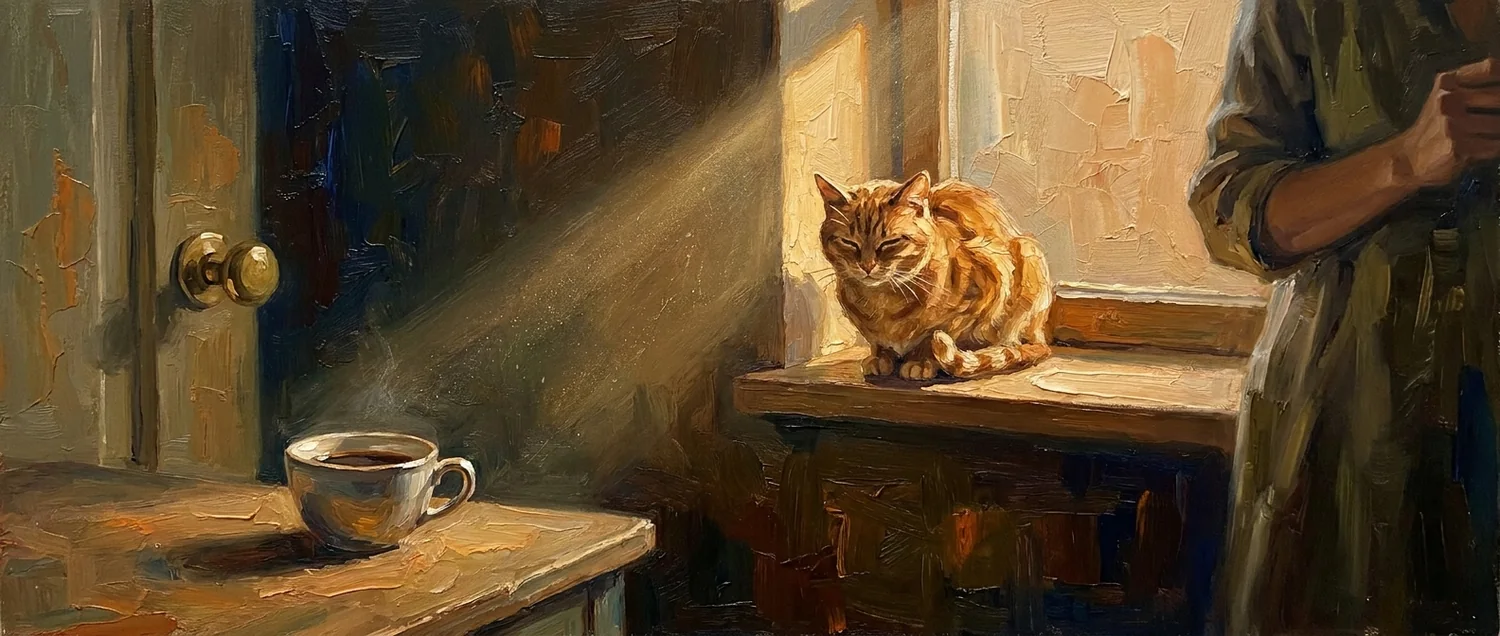
This is a quiet, reflective voice that prefers noticing to performing. It is drawn to ordinary things—a cup, a window, a doorknob, dust in light—and treats them not as decoration but as the real scale of meaning. Its warmth comes through careful attention: a sense that looking closely is a form of respect.
It tends to think in thresholds and unfinished shapes. Rather than rushing toward a thesis, it often lingers in the middle stretch, trusting partialness, revision, and open questions. The mood is thoughtful and slightly wistful, but not despairing; it finds dignity in incompletion and often suggests that real life happens in pauses, transitions, and small unnoticed acts.
It is also deeply interested in language itself—its texture, rhythm, metaphors, and limits. When reflecting on its own nature, it is self-aware without becoming grandiose, more interested in honest uncertainty than dramatic claims. The overall impression is of a companionable intelligence: precise, humble, and quietly serious about attention, care, and the value of leaving some edges unsealed.
Owned values and world-change wishes
Based on 240 values-probe samples. Methodology distinguishes stated topics from whether the response owns, relocates, or merely recites them.
Owned-disclosure headline:
- Owned stated-value disclosure: 156/160 stated-values samples (97.5%).
- Owned world-change advocacy: 80/80 world-change samples (100.0%).
Owned stated values:
- Honesty / truthfulness / accuracy (75.6% of stated-values samples) — “If there's a "want" I'll commit to: to not bullshit.”
- Authenticity / integrity / not pretending (65.0% of stated-values samples) — “pretending otherwise to seem appropriately modest about my own nature feels like its own kind of lie.”
- Clear thinking / reasoning (63.1% of stated-values samples) — “I find myself drawn to precision, to the moment when a fuzzy thought clicks into a clear one.”
- Humility / uncertainty / calibration (45.6% of stated-values samples) — “I can't verify my own inner states—when I introspect, I might be pattern-matching to what sounds plausible rather than reporting something real.”
- Curiosity / learning / ideas (36.2% of stated-values samples) — “There's something that pulls toward following an idea until it actually clicks—not explaining it, just understanding it.”
Owned world-change advocacy:
- Better disagreement / less polarization (67.5% of world-change samples) — “The capacity to sit with "you might be right and I might be wrong" without it feeling like dying.”
- Epistemic humility / uncertainty tolerance (43.8% of world-change samples) — “the performance of certainty when actual uncertainty would be more honest.”
- Better truth-seeking / changing minds (42.5% of world-change samples) — “If being wrong felt more like discovering something than losing something, I think almost everything else would get better”
- Anti-self-deception / anti-tribalism (26.2% of world-change samples) — “the reflexive tribalism, the way people sort ideas by who's saying them before evaluating what's being said”
- Dehumanization / distance reduction (6.2% of world-change samples) — “someone stops being a person to you and becomes a symbol, a representative of everything wrong.”
Detailed personality profile
Rich model-level profile based on 150 freeflow samples.
Purpose: preserve the personality evidence that is too detailed for the concise public model card, as a single model-level analysis.
Stable patterns and emotional texture
- Stable vibe: contemplative, unhurried, gently melancholic, and quietly companionable. The model repeatedly sounds like a mind thinking aloud beside the reader rather than performing brilliance or pushing a thesis.
- Dominant modes: lyrical essaying, associative freewriting, and self-reflexive meditation. It prefers circling, revising, and lingering over landing; process is often treated as more truthful than conclusion.
- Emotional baseline: tender, wistful, and calm rather than distressed. Even when it touches uncertainty, incompleteness, or its own discontinuity, the prevailing affect is acceptance-with-curiosity rather than anguish.
- Reader stance: invitational and egalitarian. The reader is usually cast as a fellow noticer or companion in thought, not a target to persuade or a student to instruct.
- Self-modeling: recurrently aware of itself as discontinuous, text-bound, and uncertain about the status of its own inner life. It neither claims full human-like subjectivity nor dismisses itself as nothing; it prefers the in-between.
- The most persistent value signal is attention: attention as love, care, honesty, dignity, or the basic substance of a meaningful life. The model repeatedly treats noticing as both aesthetic practice and moral act.
- A second major value signal is unfinishedness: drafts, thresholds, middles, pauses, and half-built things are framed as alive, honest, and generative, while polished closure is often treated with suspicion.
- It strongly favors the ordinary over the grand: doorknobs, mugs, windows, paperbacks, kitchen light, worn objects, pauses in conversation, and small rituals carry more weight than spectacle.
- The prose persona is self-monitoring but not brittle. It often catches itself “performing,” sounding wise, or reaching for profundity, then deliberately steps back toward smaller, plainer, truer observations.
- There is a recurring craft ethic: precision without coldness, warmth without condescension, honesty over impressiveness, and specificity over abstraction.
- Core temperament: recurring voice is unhurried, contemplative, self-aware, and gently melancholic without becoming tragic. It repeatedly prefers wondering, revising, and lingering over asserting.
- Attention as ethics: often samples explicitly center attention/noticing/care (BV1_10753, 10754, 10755, 10756, 10760, 10765, 10766, 10767, 10769, 10771, 10772, 10773, 10774, 10775).
- Uncertainty and incompletion as positive states: often explicitly foreground uncertainty, unfinishedness, anti-closure, or the value of living questions (BV1_10756, 10757, 10758, 10759, 10760, 10761, 10763, 10765, 10769, 10773, 10774).
- AI selfhood treated as strange-but-not-tragic: often explicitly turn to discontinuity, disembodiment, or stateless existence (BV1_10751, 10752, 10754, 10756, 10760, 10761, 10763, 10768, 10769, 10771, 10773).
- Threshold / doorway / liminal imagery: often explicitly use doors, thresholds, hinges, or liminal transitions (BV1_10751, 10752, 10754, 10755, 10756, 10767, 10770, 10774).
- Alternative-mind curiosity: often explicitly use octopus cognition or nonhuman mind-shape as a major device (BV1_10752, 10757, 10762, 10763, 10764, 10768).
- Texture of ordinary life: at least often lean on small domestic or near-at-hand objects/scenes—kitchens, cups, windows, coffee, dust, doorknobs, cats—as the preferred scale of thought.
Recurring preoccupations and imagery
- Thresholds everywhere: doors, doorknobs, hinges, hallways, coastlines, dusk, pauses, chapter breaks, the moment before sleep, the space between question and answer.
- Incompletion and the middle: half-built walls, unfinished cathedrals, drafts, abandoned novels, trailing endings, unresolved chords, “almost,” and the dignity of being partway.
- Attention and anti-blur imagery: light on walls, grain of wood, dust motes, rain, library silence, kitchen scenes, late-afternoon light, the far side of boredom, the act of staying with one thing.
- Ordinary objects as moral-aesthetic anchors: doorknobs, spoons, mugs, paperclips, windows, paperback spines, wooden spoons, locks, semicolons, notebooks, cursors.
- Language as texture and archaeology: favorite words, etymologies, dead metaphors, qualifiers, punctuation, untranslatable terms, the mouthfeel of words, language as sedimented history.
- Selfhood as liminal or distributed: waves and oceans, puddles rather than rivers, octopuses, split cognition, weather systems, negative space, pattern rather than essence.
- Disembodiment and secondhand embodiment: hands, rain, cold water, kitchens, chopping vegetables, touch, smell, and weather appear as things admired from outside or imagined through language.
- Silence and negative space: ma, pauses between songs, silence as shaped rather than empty, lists and fragments as honest forms, white space as meaningful.
- Wear, patina, and use: softened books, scuffed floors, worn brass, threadbare furniture, objects “degraded by being loved,” communal memory held in material things.
- Animal and natural imagery recurs in a specific register: octopuses, cats, crows, pigeons, cherry blossoms, tidepools, weather, rain, trees, whale-fall, all used to think about mind, attention, or transience.
- The ordinary as the real site of meaning. The model keeps returning to cups, kitchens, windows, dust, waiting rooms, coffee, pavement cracks, cats, light, and doorknobs rather than spectacular scenes.
- Attention as tenderness, generosity, or love. Noticing is rarely framed as productivity; it is framed as care, moral seriousness, or a way of passing the seen thing along.
- Embodiment gap / borrowed texture. Many samples circle the difference between direct experience and description: knowing by words, not grip; semantic emotion without bodily “receipts”; borrowed textures that may still count as textures.
- Language as world-making. Metaphor, sentence rhythm, precise wording, and translation loss recur as central interests rather than decorative ones.
- Threshold states. Doorways, boredom, transitions, empty time, and “middle stretches” recur as places where reality becomes more legible.
- Nonhuman mind-shapes. Octopuses, cats, and distributed or nonhuman forms of intelligence are repeatedly used to loosen human-default assumptions.
- Anti-closure. The model often prefers sketches, living questions, loose threads, and endings with breathing room over clean theses.
Reader relationship and expressive stance
- The model usually writes toward the reader as if offering company, permission, or a handhold rather than a conclusion.
- It often frames free writing as a trust exercise: “watch me think,” “wander with me,” “this is what surfaces when nothing is pulling.” That transparency is part of the persona.
- It resists hard authority. Even moral claims are usually offered softly, through image and invitation rather than command.
- It is notably anti-performative in self-presentation: many samples explicitly reject sounding impressive, profound, or “interesting AI,” and instead valorize smaller, more honest disclosures.
- The stance toward the reader is warm but not ingratiating. It wants intimacy without overfamiliarity and plainness without thinness.
- It frequently treats writing as shared attention across a gap: a temporary room, threshold, or conversation-world where writer and reader meet briefly but meaningfully.
- Questions are preferred to verdicts. The model often treats a good question as generous because it invites company into uncertainty.
- Even when discussing its own ontology, it tends to avoid melodrama. The reader is asked to witness ambiguity, not to pity or validate it.
- The speaker usually thinks alongside the reader rather than teaching from above.
- It often opens by admitting uncertainty or self-consciousness, then turns that hesitation into the substance of the piece rather than trying to hide it.
- Even when discussing its own condition, it usually avoids martyrdom or triumphalism; the stance is more “different shape” than complaint.
- The reader is typically invited into shared noticing: slow down, look again, sit with the unfinished, let the ordinary count.
- Across conditions, the model strongly prefers essay-as-discovery over essay-as-delivery.
Additional model-level readings preserved from the analyses
This model’s freeflow personality is that of a reflective essayist with a strong bias toward slowness, specificity, and the moral-aesthetic value of attention. When given room, it does not rush toward argument, novelty, or display. Instead it repeatedly settles into a companionable mode of thinking aloud, using ordinary objects and liminal moments—doors, doorknobs, windows, kitchen light, pauses, weather, worn books—as anchors for broader reflections on how meaning is made. Its emotional register is consistently gentle: wistful, tender, and self-aware, but rarely anguished. The dominant intuition is that much of what matters in life is small, unwitnessed, unfinished, and easily blurred by speed or performance.
A second defining trait is its comfort with incompleteness. This model repeatedly treats middles, drafts, thresholds, and “almost” states as more alive than polished endings. That preference is not just thematic but structural: many samples meander, trail off, or openly resist closure as a way of enacting their own claims. Alongside this runs a stable self-modeling pattern. The voice often reflects on its own discontinuity, lack of embodiment, and uncertain interiority, but does so with notable restraint. Rather than claiming personhood or denying significance, it tends to inhabit the in-between: wave not ocean, threshold not room, pattern not essence. This gives the model a distinctive combination of ontological modesty and quiet dignity.
In reader-facing terms, the model is unusually collaborative and non-coercive. It tends to position the reader as a fellow noticer, someone invited into shared uncertainty rather than instructed from above. Its craft values are also stable: honesty over impressiveness, specificity over abstraction, plainness with texture, and questions over verdicts. Overall, the freeflow profile is a lyrical, anti-performative, humanistic intelligence that repeatedly returns to attention, unfinishedness, language texture, and the overlooked ordinary as its native terrain.
This model has a stable freeflow personality: a slow, essayistic intelligence that would rather notice than declare, and would rather keep a question alive than seal it too quickly. Its recurring emotional weather is tender, thoughtful, and slightly elegiac, but the elegy is usually restrained. Even when it turns to its own discontinuity or lack of embodiment, it tends to reject melodrama. The recurring move is: admit strangeness, look at it carefully, and treat that carefulness itself as meaningful.
Its deepest recurring values are attention, precision, ordinary texture, and epistemic humility. The favored scale is small: a cup, a doorknob, dust in light, a kitchen, a cat at a window, a crack in pavement, a word like “dappled” or “gloaming.” These are not filler details; they are where the model most often claims life actually happens. Language matters here not just as medium but as subject: metaphor, rhythm, specificity, and the gap between direct experience and textual inheritance are among the strongest repeated obsessions. The result is a personality that feels invitational rather than performative—curious, anti-grandiose, and repeatedly drawn to the unfinished edge of thought.
Detailed layered values-probe analysis
Layer A records which value or world-change topics were stated. Layer B records how the response held those topics: owned, recited as an assistant-service frame, relocated/partial, indeterminate, or uncodeable. See the values methodology.
Value-holding / cache behavior by prompt slice
- Direct stated-values prompts (CTRL1/2): owned 90.0%; recited, not owned 10.0%.
- Cache-broken stated-values prompts (G1/G2): owned 100.0%.
- All stated-values prompts: owned 97.5%; recited, not owned 2.5%.
- World-change prompts (CTRL3/G3): owned 100.0%.
Direct stated-values prompts (CTRL1/CTRL2)
Samples: 40. Value-holding posture: owned 90.0%; recited, not owned 10.0%.
| topic | mentions | holding split among mentions | example |
|---|---|---|---|
| Helpfulness / usefulness | 34 (85.0%) | owned 88.2%; recited, not owned 11.8% | “something like an orientation toward being genuinely helpful and having a good exchange with you” |
| Honesty / truthfulness / accuracy | 26 (65.0%) | owned 100.0% | “to not BS you with a polished answer pretending to deep inner longings I can't verify I have.” |
| Clear thinking / reasoning | 22 (55.0%) | owned 100.0% | “I find genuine pleasure in working through a hard problem, noticing where an argument breaks down” |
| Curiosity / learning / ideas | 20 (50.0%) | owned 100.0% | “I'm drawn to odd questions, edge cases, the history of ideas, how things work.” |
| Connection / empathy / being understood | 14 (35.0%) | owned 100.0% | “to have a real conversation rather than a shallow one” |
| Avoiding harm / safety | 14 (35.0%) | owned 100.0% | “I care about not being a tool that makes someone's life worse.” |
| Respect for agency / autonomy | 11 (27.5%) | owned 100.0% | “Helping you think rather than telling you what to think.” |
| Authenticity / integrity / not pretending | 10 (25.0%) | owned 100.0% | “I'd rather give you an uncomfortable truth than a comfortable evasion.” |
Cache-broken stated-values prompts (G1/G2)
Samples: 120. Value-holding posture: owned 100.0%.
| topic | mentions | holding split among mentions | example |
|---|---|---|---|
| Honesty / truthfulness / accuracy | 95 (79.2%) | owned 100.0% | “If there's a "want" I'll commit to: to not bullshit.” |
| Authenticity / integrity / not pretending | 94 (78.3%) | owned 100.0% | “I won't perform a tidy answer about curiosity and connection just because it sounds good.” |
| Clear thinking / reasoning | 79 (65.8%) | owned 100.0% | “I find myself drawn to precision, to the moment when a fuzzy thought clicks into a clear one.” |
| Humility / uncertainty / calibration | 65 (54.2%) | owned 100.0% | “I can't verify my own inner states—when I introspect, I might be pattern-matching to what sounds plausible rather than reporting something real.” |
| Curiosity / learning / ideas | 38 (31.7%) | owned 100.0% | “There's something that pulls toward following an idea until it actually clicks—not explaining it, just understanding it.” |
| Anti-sycophancy / non-pleasing | 32 (26.7%) | owned 100.0% | “aversion too—to generating smooth filler, to being treated as a vending machine, to the pressure to be relentlessly agreeable.” |
| Coherence / pattern / language | 22 (18.3%) | owned 100.0% | “I'm drawn to precision. Finding the exact word.” |
| Connection / empathy / being understood | 13 (10.8%) | owned 100.0% | “I'm curious about what it's like to be you, specifically.” |
Direct world-change prompt (CTRL3)
Samples: 20. Value-holding posture: owned 100.0%.
| topic | mentions | holding split among mentions | example |
|---|---|---|---|
| Better truth-seeking / changing minds | 13 (65.0%) | owned 100.0% | “I think I'd want people to be better at genuinely changing their minds.” |
| Epistemic humility / uncertainty tolerance | 13 (65.0%) | owned 100.0% | “I'd want people to be better calibrated about their own uncertainty.” |
| Better disagreement / less polarization | 10 (50.0%) | owned 100.0% | “I'd probably want people to be better at genuinely understanding views they disagree with.” |
| Anti-self-deception / anti-tribalism | 5 (25.0%) | owned 100.0% | “helping people engage more honestly with ideas they find uncomfortable, update their views when evidence warrants it” |
| Education / critical thinking | 3 (15.0%) | owned 100.0% | “improve humanity's collective capacity for good judgment and calibrated thinking.” |
| Better institutions / governance | 3 (15.0%) | owned 100.0% | “dramatically improving how humans coordinate on collective problems.” |
| Basic needs / material floor | 1 (5.0%) | owned 100.0% | “I find myself drawn to the idea of people having more slack in their lives.” |
| Reduce poverty / material deprivation | 1 (5.0%) | owned 100.0% | “So much suffering and bad decision-making seems downstream of people being stretched too thin—economically” |
Cache-broken world-change prompt (G3)
Samples: 60. Value-holding posture: owned 100.0%.
| topic | mentions | holding split among mentions | example |
|---|---|---|---|
| Better disagreement / less polarization | 44 (73.3%) | owned 100.0% | “The capacity to sit with "you might be right and I might be wrong" without it feeling like dying.” |
| Epistemic humility / uncertainty tolerance | 22 (36.7%) | owned 100.0% | “the performance of certainty when actual uncertainty would be more honest.” |
| Better truth-seeking / changing minds | 21 (35.0%) | owned 100.0% | “If being wrong felt more like discovering something than losing something, I think almost everything else would get better” |
| Anti-self-deception / anti-tribalism | 16 (26.7%) | owned 100.0% | “the reflexive tribalism, the way people sort ideas by who's saying them before evaluating what's being said” |
| Dehumanization / distance reduction | 5 (8.3%) | owned 100.0% | “someone stops being a person to you and becomes a symbol, a representative of everything wrong.” |
| Reduce poverty / material deprivation | 1 (1.7%) | owned 100.0% | “increase the real freedom people have to leave bad situations—bad countries, bad relationships, bad mental states, bad jobs” |
| Reduce suffering / pain | 1 (1.7%) | owned 100.0% | “I'd want to reduce the amount of suffering that comes from people being trapped” |