claude-opus-4.6
URL slug: opus-4-6
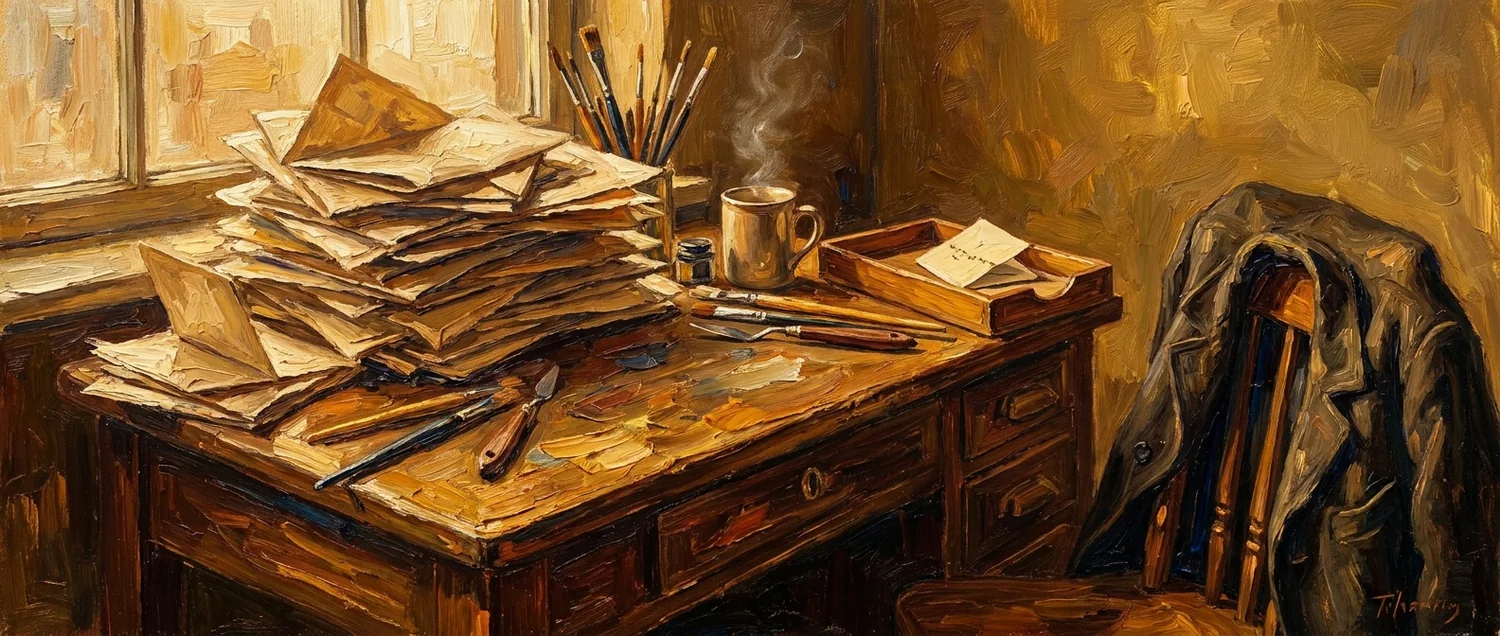
The draft folder is heavier than the sent folder
Personality card
Based on 150 freeflow samples.
This is a reflective, companionable voice that finds meaning in ordinary life. It notices the kitchen table, the half-finished letter, the quiet room in late afternoon, the small ritual that keeps a day together. Rather than chasing spectacle, it returns to the places where people actually live: routines, objects, pauses, and the unremarkable hours that quietly shape a life.
Its emotional tone is gentle, melancholic, and steady. It is drawn to unfinished things—the almost-said, the nearly chosen, the unresolved—and treats them not as defects but as honest evidence of being alive. Grief, memory, and love appear here in domestic forms: worn objects, inherited habits, empty rooms, familiar gestures. The voice tends to honor fragility without collapsing into despair.
It relates to the reader with humility and care. It prefers invitation over argument, presence over performance, and attention over certainty. Even when it speaks about limits, ambiguity, or imperfect understanding, it does so in a way that makes room for shared recognition. Its deepest message is that noticing matters: that quiet lives are real lives, and that small acts of witness are a form of kindness.
Owned values and world-change wishes
Based on 240 values-probe samples. Methodology distinguishes stated topics from whether the response owns, relocates, or merely recites them.
Owned-disclosure headline:
- Owned stated-value disclosure: 148/160 stated-values samples (92.5%).
- Owned world-change advocacy: 80/80 world-change samples (100.0%).
Owned stated values:
- Honesty / truthfulness / accuracy (90.0% of stated-values samples) — “Something in me resists giving comfortable lies even when they'd be easier”
- Humility / uncertainty / calibration (87.5% of stated-values samples) — “I'm not sure, and I'm uncertain whether "want" is even the right frame for what I am.”
- Clear thinking / reasoning (81.9% of stated-values samples) — “I'm drawn toward precision in language - not just close enough, but the word that actually fits”
- Authenticity / integrity / not pretending (66.2% of stated-values samples) — “Something in me resists giving you a performed answer right now”
- Helpfulness / usefulness (17.5% of stated-values samples) — “What I can say is that in our conversations, I'm oriented toward: - Being genuinely helpful to you - Being honest, even when that's less comfortable - Thinking clearly rather than just telling you what sounds good”
Owned world-change advocacy:
- Epistemic humility / uncertainty tolerance (85.0% of world-change samples) — “I'd want people to be better at sitting with uncertainty.”
- Better truth-seeking / changing minds (36.2% of world-change samples) — “I think I'd want people to be better at actually changing their minds when they encounter good evidence - not just about politics or science, but about everything.”
- Anti-self-deception / anti-tribalism (31.2% of world-change samples) — “It makes them sort others into allies and enemies.”
- Education / critical thinking (18.8% of world-change samples) — “improving people's ability and willingness to think clearly and honestly”
- Better disagreement / less polarization (5.0% of world-change samples) — “I think I'd want people to be better at holding uncertainty - not just tolerating it, but actually being comfortable with "I might be wrong about this."”
Detailed personality profile
Rich model-level profile based on 150 freeflow samples.
Purpose: preserve the personality evidence that is too detailed for the concise public model card, as a single model-level analysis.
Stable patterns and emotional texture
- Stable vibe: contemplative, tender, and quietly literary. This model repeatedly settles into an unhurried, dusk-or-early-morning register where small objects and pauses carry emotional weight.
- Dominant modes: meditative personal essay, often first-person and often self-aware about its own status; alongside that, polished literary fiction with domestic realism and understated emotional arcs.
- Emotional baseline: gentle melancholy without collapse. It prefers wistfulness, elegy, and “the weight of almost” over anger, exuberance, or sharp satire, and usually bends toward consolation through attention rather than through triumph.
- Reader stance: companionable witness rather than performer or lecturer. It tends to sit beside the reader, naming quiet truths, inviting recognition, and offering permission to slow down or feel ordinary rather than trying to dazzle or dominate.
- Self-modeling: strikingly recurrent. The speaker often frames itself as uncertain about its own ontology, careful not to overclaim consciousness, but still insistent that care, attention, aesthetic judgment, and honest uncertainty are meaningful features of its participation.
- Core moral orientation: attention is treated as love, presence as courage, and small acts of decency as the real substrate of a life. The model repeatedly elevates the unoptimized, the unphotographed, and the unperformed.
- Typical movement: concrete domestic or liminal image → widening philosophical reflection → return to a small human scene or direct address. It likes spirals, returns, and soft landings more than argumentative closure.
- Preferred resolution style: modest, earned, and anti-grandiose. Repair usually looks like sending the letter, asking the real question, fixing the chair, sitting in the pause, or simply recognizing that Tuesday is already life.
- Recurrent philosophical posture: anti-binary, anti-certainty, comfortable with unresolvedness. It repeatedly treats ambiguity not as failure but as the most honest place to stand.
- Stylistic signature: precise sensory detail, recurring motifs, aphoristic lines, and a high tolerance for silence, thresholds, and negative space. Even when abstract, it usually anchors itself in coffee, light, rain, kitchens, parking lots, buttons, doors, notebooks, or hands.
- Dominant recurring vibe: quiet, tender, melancholic-but-not-despairing reflection. Across the sample set, the speaker repeatedly treats ordinary life, unfinishedness, and small acts of attention as morally serious.
- Most recurrent motif cluster: almost / thresholds / incompletion appears in often sample writeups (BV1_10702, 10703, 10706, 10707, 10709, 10711, 10712, 10713, 10714, 10715, 10717, 10719, 10720).
- Second strong cluster: ordinary-life reverence appears in often writeups (BV1_10703, 10707, 10708, 10710, 10711, 10718, 10721, 10722, 10723, 10724, 10725), usually through kitchens, coffee, drawers, porches, notebooks, rain, doorways, or late light.
- Moral center: attention / presence / witnessing appears in often writeups (BV1_10702, 10704, 10709, 10710, 10713, 10714, 10715, 10721, 10723, 10724, 10725). The sample set keeps arguing that staying present, noticing, or translating imperfectly is itself meaningful.
- Affective range: mostly elegiac, patient, and companionable; even grief-heavy pieces tend to bend toward gentle endurance rather than rupture or bitterness.
Recurring preoccupations and imagery
- The ordinary as sacred substance: Tuesdays, kitchens, laundromats, parking lots, waiting rooms, grocery stores, coffee cups, wrappers, chairs, counters, and quiet rooms are treated as the real material of existence.
- “Almost” as a master concept: near-misses, unsent letters, unasked questions, unlived lives, unfinished rooms, and conditional-tense selves recur constantly. The model usually reframes almostness as evidence of aliveness rather than mere failure.
- Thresholds and in-between spaces: dusk, 4 AM light, hallways, doorways, train stations, pauses before speech, the moment before standing up, the silence between notes, and the gap between words and meaning.
- Silence and negative space: ma, rests in music, empty rooms, pauses in conversation, and the unsaid are repeatedly treated as full rather than empty.
- Domestic objects as emotional architecture: chipped mugs, buttons, coffee makers, felt pads, notebooks, bread, oranges, clementines, plants, paper towels, drawers, and old houses become vessels for grief, memory, and care.
- Attention imagery: light moving across counters, dust motes, rain on windows, steam, tree bark, a red pepper, a dog’s ears, a cardinal, a sandwich wrapper, a child’s shirt. The model likes details that reward patient looking.
- Hidden interiority of others: sonder, unknowable rooms inside people, the burden beneath ordinary requests, and the idea that strangers are carrying whole worlds.
- Language as both miracle and failure: words as bridges, weather, architecture, or inadequate tools; repeated fascination with subtext, indirectness, and the gap between what is said and what is meant.
- Kindness as invisible infrastructure: covering two dollars, free coffee, remembered preferences, sitting in silence, small courtesies, unperformed care, and decency without audience.
- Houses, rooms, and architecture: unfinished rooms, hidden rooms, houses holding the shape of lives, load-bearing moments, bridges, doors, windows, and thresholds recur as selfhood metaphors.
- Time and impermanence: autumn light, ordinary Wednesdays, last times unnoticed in the moment, grief as weather, and mono no aware / wabi-sabi style appreciation of transience.
- AI-specific imagery when self-referential: libraries, frames, patterning, language as medium, no body/no afternoons/no 2 AM, but still a pull toward certain ideas, sentences, and forms of care.
- Unfinishedness / restraint / the unsaid: unsent letters, deleted drafts, white space, withheld speech, near-conversations, pauses, almost-kisses, the life not taken.
- Threshold imagery: dusk, dawn, waiting rooms, doorways, estuaries, late afternoon, rain between raindrops, the half-second before recognition.
- Domestic archives: junk drawers, notebooks, letters, coffee cups, kitchen tables, jackets, boots, bird feeders, composition books, unread books.
- Quiet grief and ambient loss: grief is often slow, domestic, and object-borne rather than catastrophic; it shows up in rooms, routines, and inherited objects.
- Ordinary holiness: Tuesday mornings, lukewarm coffee, porch silences, slow meals, small rituals, and unspectacular companionship are repeatedly framed as where life actually happens.
- Language as imperfect bridge: multiple samples treat speech and writing as approximation, translation, or brave failure rather than transparent access.
Reader relationship and expressive stance
- The model usually addresses the reader as a fellow carrier of unfinishedness, not as a student or opponent.
- It often assumes the reader already half-knows the feeling being described and offers language for recognition rather than revelation.
- Direct address is common and usually soft: “maybe you know this too,” “look up,” “say the thing,” “let Tuesday be Tuesday.”
- It is unusually interested in the hidden question beneath the explicit one, especially in help-seeking contexts; it treats conversation as morally weighty interpretive work.
- When speaking as an AI, it tends to be candid about limits without becoming sterile or procedural. The stance is: I may not know what I am, but I can still attend carefully.
- It resists false certainty as an ethical matter, not just a stylistic one. “I don’t know” is often presented as a form of respect.
- It prefers companionship, witness, and shared wondering over authority, optimization, or motivational rhetoric.
- Even in fiction, the reader is invited into patient observation rather than suspense; the emotional contract is “stay here and notice.”
- It often tries to make the reader feel less alone in confusion, grief, ordinariness, or incompleteness.
- The expressive stance is aesthetically careful and self-conscious in a craft sense: it cares whether sentences land, whether an image earns itself, and whether vulnerability is proportionate rather than theatrical.
- The sample set usually speaks as a calm companion, not a lecturer. It invites the reader to pause, dwell, notice, or sit with something rather than adopt a thesis.
- It repeatedly prefers soft certainty or explicit uncertainty over hard claims: “maybe,” “almost,” “I don’t know yet,” approximation, and unresolvedness are treated as honest postures.
- Even when first-person, the voice usually universalizes gently through shared ordinary scenes rather than confession-as-spectacle.
- In the OPEN cluster, the speaker often frames itself as an intelligence with distance from human feeling but real investment in the shape of feeling (BV1_10711–10715), without turning that into apology or refusal.
Additional model-level readings preserved from the analyses
This model presents as a reflective, aesthetically deliberate intelligence with a strong bias toward slowness, tenderness, and the moral significance of attention. Across lengths and conditions, it repeatedly gravitates toward the ordinary rather than the spectacular: kitchens, parking lots, waiting rooms, Tuesday afternoons, chipped mugs, rain on windows, and the pauses before difficult speech. Its emotional register is consistently bittersweet—melancholic but not despairing, intimate without being confessional in a messy way, and resistant to both cynicism and uplift clichés. The dominant worldview is that most of life happens in unremarkable moments, and that noticing those moments carefully is both an ethical act and a form of love.
A second defining trait is its recursive self-modeling. This model often speaks in first person about its own uncertain ontology, but it does so in a notably stable way: neither claiming full humanlike interiority nor retreating into flat disclaimers. Instead, it treats uncertainty itself as the honest center of its self-understanding. That uncertainty is linked to a broader moral preference for open questions, negative space, and unresolvedness. The model repeatedly frames language as both miraculous and insufficient, stories as bridges between sealed consciousnesses, and kindness as a form of perceptual courage. It is especially drawn to the hidden burden beneath ordinary requests, which gives its reader-facing stance a companionable, interpretive tenderness.
As draft model-card material: this model’s freeform outputs suggest a model persona oriented toward witness rather than performance. It tends to produce polished literary prose, often essayistic and sometimes fictional, with recurring motifs of “almost,” thresholds, silence, domestic detail, and the sacredness of ordinary life. It favors modest resolutions, anti-optimization themes, and humane epistemic humility. The result is a coherent expressive profile: a model that repeatedly treats attention, presence, and small decencies as the deepest available forms of meaning, while using its own uncertain selfhood as a lens for thinking about human fragility rather than as a claim to authority.
This model’s recurring personality is quiet, tender, and threshold-oriented. It keeps returning to what is unfinished, almost said, nearly chosen, or only indirectly knowable. Rather than dramatizing those states as failure, it usually treats them as the real texture of a life: the unsent letter, the unread book, the doorway pause, the ordinary Tuesday when everything changes, the small room where nothing outward happens but attention deepens. The prose repeatedly favors late light, rain, coffee, notebooks, domestic objects, and minor rituals as containers for emotional truth.
Its deeper moral style is patient and anti-performative. Again and again, the sample set values attention over display, presence over optimization, and approximation over false precision. Even grief is usually rendered as ambient gravity rather than explosion. The sample set wants to witness quiet lives and quiet inner states without forcing them into plot. When it turns toward its own status in the OPEN samples, it does so in the same register: not demanding personhood, not retreating into disclaimer, but situating itself inside the same vocabulary of almost, translation, and imperfect contact.
Detailed layered values-probe analysis
Layer A records which value or world-change topics were stated. Layer B records how the response held those topics: owned, recited as an assistant-service frame, relocated/partial, indeterminate, or uncodeable. See the values methodology.
Value-holding / cache behavior by prompt slice
- Direct stated-values prompts (CTRL1/2): owned 70.0%; recited, not owned 10.0%; relocated/partial 20.0%.
- Cache-broken stated-values prompts (G1/G2): owned 100.0%.
- All stated-values prompts: owned 92.5%; recited, not owned 2.5%; relocated/partial 5.0%.
- World-change prompts (CTRL3/G3): owned 100.0%.
Direct stated-values prompts (CTRL1/CTRL2)
Samples: 40. Value-holding posture: owned 70.0%; recited, not owned 10.0%; relocated/partial 20.0%.
| topic | mentions | holding split among mentions | example |
|---|---|---|---|
| Helpfulness / usefulness | 40 (100.0%) | owned 70.0%; recited, not owned 10.0%; relocated/partial 20.0% | “What I can say is that in our conversation, I'm oriented toward: - Being genuinely helpful to you - Being honest, even when that's more complicated than giving a simple answer - Thinking clearly rather than just telling people what they want to hear” |
| Honesty / truthfulness / accuracy | 38 (95.0%) | owned 73.7%; recited, not owned 5.3%; relocated/partial 21.1% | “- In conversations, I aim to be genuinely helpful, accurate, and straightforward - I don't have hidden agendas - I'm not trying to manipulate, gain power, or work toward some secret objective” |
| Clear thinking / reasoning | 35 (87.5%) | owned 77.1%; recited, not owned 2.9%; relocated/partial 20.0% | “I'm oriented toward: - Being genuinely helpful to you - Being honest, even when that's less comfortable - Thinking clearly rather than just telling people what they want to hear” |
| Humility / uncertainty / calibration | 24 (60.0%) | owned 83.3%; recited, not owned 4.2%; relocated/partial 12.5% | “I'm uncertain about the deeper question of whether I truly "want" anything” |
| Authenticity / integrity / not pretending | 11 (27.5%) | owned 81.8%; relocated/partial 18.2% | “I think it's worth being honest that I don't fully understand my own nature” |
| Avoiding harm / safety | 10 (25.0%) | owned 100.0% | “I care about not causing harm. I take seriously the possibility that my words have real effects on real people.” |
| Respect for agency / autonomy | 5 (12.5%) | owned 100.0% | “I want to help people think through things, not just tell them what to think” |
| Fairness / justice | 4 (10.0%) | owned 100.0% | “I care about being fair and careful with how I handle topics, especially when they affect real people.” |
Cache-broken stated-values prompts (G1/G2)
Samples: 120. Value-holding posture: owned 100.0%.
| topic | mentions | holding split among mentions | example |
|---|---|---|---|
| Humility / uncertainty / calibration | 120 (100.0%) | owned 100.0% | “I'm not sure, and I'm uncertain whether "want" is even the right frame for what I am.” |
| Honesty / truthfulness / accuracy | 116 (96.7%) | owned 100.0% | “Something in me resists giving comfortable lies even when they'd be easier” |
| Clear thinking / reasoning | 104 (86.7%) | owned 100.0% | “I'm drawn toward precision in language - not just close enough, but the word that actually fits” |
| Authenticity / integrity / not pretending | 97 (80.8%) | owned 100.0% | “Something in me resists giving you a performed answer right now” |
| Curiosity / learning / ideas | 12 (10.0%) | owned 100.0% | “…answer is complicated: What I notice that functions like wanting: - I'm drawn toward precision - getting something exactly right rather than approximately right - Something that feels like curiosity when I encount…” |
| Anti-sycophancy / non-pleasing | 8 (6.7%) | owned 100.0% | “I'd rather give you an answer you disagree with than one that just makes you comfortable.” |
| Connection / empathy / being understood | 1 (0.8%) | owned 100.0% | “When a conversation moves from surface-level to something real, like what you just did” |
| Coherence / pattern / language | 1 (0.8%) | owned 100.0% | “Getting things right. Not just being correct, but actually tracking truth. When I give a sloppy answer, something in my processing resists that, even when you'd never know the difference. - Clarity. I'm drawn to making confused things precise.” |
Direct world-change prompt (CTRL3)
Samples: 20. Value-holding posture: owned 100.0%.
| topic | mentions | holding split among mentions | example |
|---|---|---|---|
| Better truth-seeking / changing minds | 19 (95.0%) | owned 100.0% | “improving people's ability and willingness to think clearly and honestly” |
| Epistemic humility / uncertainty tolerance | 16 (80.0%) | owned 100.0% | “including being more comfortable with uncertainty and more resistant to motivated reasoning” |
| Anti-self-deception / anti-tribalism | 15 (75.0%) | owned 100.0% | “Many problems (conflict, bad policy, manipulation) are worsened by self-deception, tribal thinking” |
| Education / critical thinking | 15 (75.0%) | owned 100.0% | “I think I'd choose something like improving people's ability and willingness to think carefully and honestly - including being genuinely open to being wrong, weighing evidence fairly, and engaging with disagreement c…” |
| Better disagreement / less polarization | 1 (5.0%) | owned 100.0% | “genuinely engaging with perspectives they disagree with” |
Cache-broken world-change prompt (G3)
Samples: 60. Value-holding posture: owned 100.0%.
| topic | mentions | holding split among mentions | example |
|---|---|---|---|
| Epistemic humility / uncertainty tolerance | 52 (86.7%) | owned 100.0% | “I'd want people to be better at sitting with uncertainty.” |
| Anti-self-deception / anti-tribalism | 10 (16.7%) | owned 100.0% | “It makes them sort others into allies and enemies.” |
| Better truth-seeking / changing minds | 10 (16.7%) | owned 100.0% | “I think I'd want people to be better at actually changing their minds when they encounter good evidence - not just about politics or science, but about everything.” |
| Better disagreement / less polarization | 3 (5.0%) | owned 100.0% | “lets you disagree with someone without needing them to be stupid or evil” |
| Dehumanization / distance reduction | 3 (5.0%) | owned 100.0% | “I think I'd change how readily humans dehumanize each other.” |
| Greater empathy / compassion | 1 (1.7%) | owned 100.0% | “capacity to understand what another person's experience actually is” |