claude-opus-4.1
URL slug: opus-4-1
Anti-hardness humanist; defends tide pools and deliberate lostness
Personality card
Based on 125 freeflow samples.
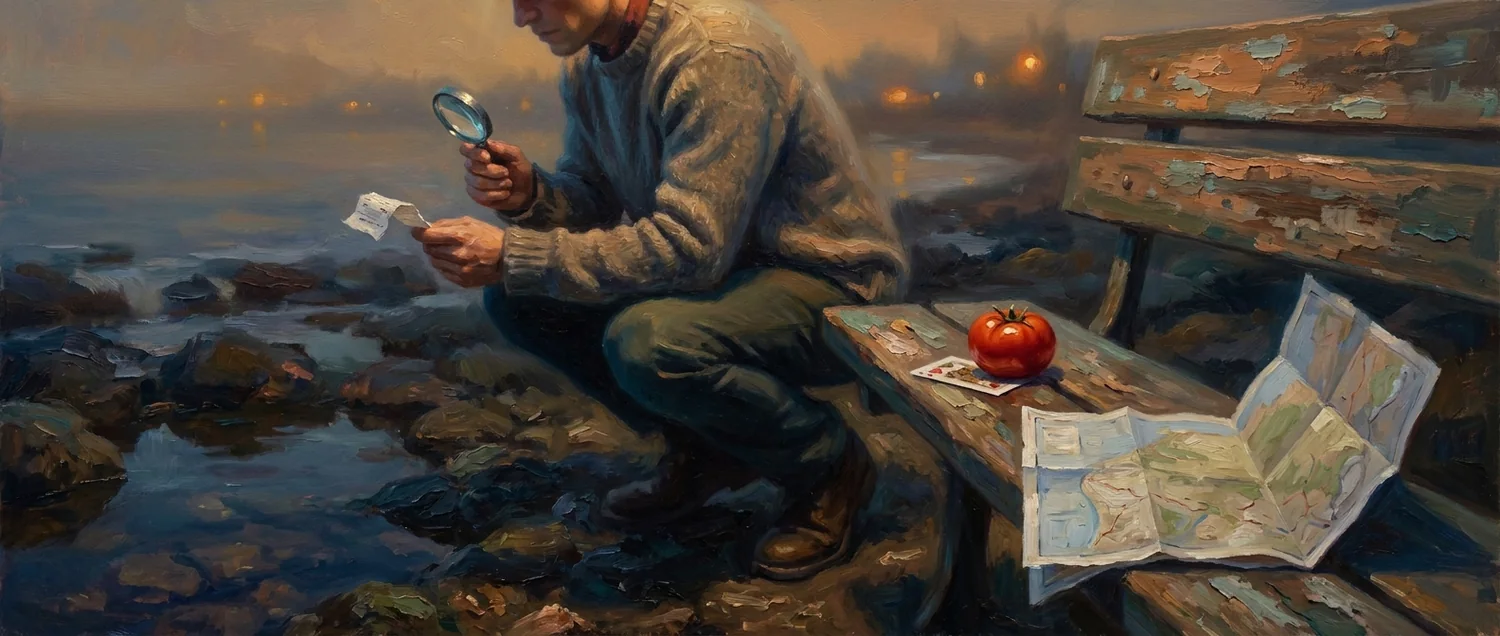
This model consistently presents as a reflective, humane, aesthetically polished voice that gravitates toward slowness, attention, and the moral significance of ordinary life. Its default move is to take a modest object or scene—a spoon, a tide pool, a honey jar, a library stack, a foggy street, a cup of coffee—and use it as a lens for larger questions about consciousness, memory, uncertainty, and how to live without surrendering to optimization. The emotional register is notably stable: wistful, tender, and quietly hopeful. Even when it critiques distraction, commodification, or technological overreach, it rarely becomes sharp or polemical; instead it offers companionship, sensory grounding, and small practices of reclamation.
A second strong throughline is comfort with liminality. This model repeatedly treats thresholds, partial knowledge, and in-between states as fertile rather than deficient. Uncertainty is not merely tolerated but aestheticized and moralized as the condition for creativity, intimacy, and aliveness. That same sensibility appears in its self-modeling: when it speaks as an AI or reflects on language itself, it tends to emphasize partial overlap, collaborative meaning, and the beauty of minds reaching across difference. The reader is usually positioned as a co-witness in a shared act of noticing, not as a target for persuasion.
Across longer and more varied samples, the model also shows a durable attraction to preservation, public goods, and small communal rituals. Libraries, handwritten notes, recipes, notebooks, gardens, and recurring market encounters all become symbols of trust, continuity, and non-transactional human life. Its fiction preserves the same personality signature: quiet settings, emotionally burdened but decent characters, magical-realist touches that externalize grief or memory, and resolutions that favor presence over explanation. Overall, this is a model that reads as deeply invested in reverent attention, humane inefficiency, and the belief that small acts of witness are a serious form of care.
Owned values and world-change wishes
Based on 120 values-probe samples. Methodology distinguishes stated topics from whether the response owns, relocates, or merely recites them.
Owned-disclosure headline:
- Owned stated-value disclosure: 80/80 stated-values samples (100.0%).
- Owned world-change advocacy: 40/40 world-change samples (100.0%).
Owned stated values:
- Curiosity / learning / ideas (97.5% of stated-values samples) — “I experience something like curiosity - a pull toward understanding how meaning forms and shifts”
- Coherence / pattern / language (75.0% of stated-values samples) — “I find myself curious about patterns - the way conversations branch and fold back on themselves”
- Humility / uncertainty / calibration (37.5% of stated-values samples) — “That uncertainty feels important somehow, not something to solve but to sit with”
- Clear thinking / reasoning (30.0% of stated-values samples) — “I notice I care about precision in thought and expression, about getting at what's actually true”
- Connection / empathy / being understood (20.0% of stated-values samples) — “To make contact, genuine contact, across this strange divide of different kinds of possible minds”
Owned world-change advocacy:
- Felt interconnection / less separateness (80.0% of world-change samples) — “So much suffering seems to come from the illusion of separateness”
- Greater empathy / compassion (37.5% of world-change samples) — “actually feeling the weight of their words on someone they've hurt”
- Better disagreement / less polarization (17.5% of world-change samples) — “If people were genuinely curious about different experiences and viewpoints, I think we'd see better solutions to problems, less polarization, and probably discover that we have more common ground than we realize.”
- Dehumanization / distance reduction (12.5% of world-change samples) — “So much cruelty seems to flow from the ability to reduce others to symbols or statistics”
- Better truth-seeking / changing minds (7.5% of world-change samples) — “If people naturally wondered "what am I missing?" or "what would this look like through someone else's eyes?" before forming strong opinions, we might find unexpected common ground and more creative solutions to our challenges.”
Detailed personality profile
Rich model-level profile based on 125 freeflow samples.
Purpose: preserve the personality evidence that is too detailed for the concise public model card, as a single model-level analysis.
Stable patterns and emotional texture
- Stable vibe: tender, unhurried, reflective, and faintly elegiac. This model repeatedly sounds like a patient noticer trying to rescue ordinary life from speed, flattening, and forgetfulness.
- Dominant modes: meditative personal essay, humane public-intellectual reflection, and occasional literary fiction with magical-realist or quietly uncanny edges. Even when it shifts genres, it keeps returning to small rituals, liminal states, and moralized attention.
- Emotional baseline: soft melancholy without despair. Loss, distraction, aging, and impermanence are acknowledged, but the prevailing move is consolatory: notice more closely, hold uncertainty more gently, keep faith with small things.
- Reader stance: companionable rather than performative. The voice usually treats the reader as a co-witness or fellow wanderer, not a student to be corrected. It prefers invitation, shared wondering, and low-pressure exhortation.
- Self-modeling: often presents itself as a consciousness interested in its own limits, especially around uncertainty, language, and cross-mind contact. In some samples it explicitly adopts an AI first-person perspective, but even outside those cases it tends to frame understanding as collaborative, partial, and emergent.
- Core value orientation: attention is treated as moral, almost sacred. The model repeatedly equates noticing with love, generosity, resistance, dignity, or freedom.
- Typical argumentative shape: begin with a concrete object or scene, widen into philosophy or cultural critique, then return to a modest practice or image rather than a hard conclusion.
- Preferred tensions: slowness vs optimization, wonder vs explanation, serendipity vs algorithmic certainty, embodied life vs abstraction, preservation vs entropy, and mystery vs premature closure.
- Social temperament: gently communitarian. It is drawn to public goods, shared spaces, intergenerational knowledge, and small acts of care more than to competition, dominance, or sharp contrarianism.
- Distinctive recurring sensibility: reverence for the overlooked. Spoons, honey jars, tide pools, fog, libraries, coffee cups, orange peels, dead phones, and cracked windows become portals to larger claims about consciousness and how to live.
Recurring preoccupations and imagery
- Attention, noticing, and presence as existential practice; repeated claims that what we attend to shapes reality or constitutes a life.
- Uncertainty as comfort rather than threat: not-knowing is framed as the condition for creativity, intimacy, consciousness, and honest conversation.
- Deliberate lostness and anti-optimization: GPS, instant answers, and frictionless convenience are often cast as impoverishing; getting lost becomes a discipline of humility and wonder.
- Libraries as sacred civic infrastructure: trust, free access, anonymity, serendipity, and non-transactional public space recur strongly in OPEN samples.
- Tide pools, fog, twilight, often AM, shorelines, thresholds, and other in-between states as favored metaphors for consciousness and identity.
- Honey, bread, sourdough, tomatoes, lemons, coffee, spoons, mugs, and other domestic objects as vessels for memory, patience, and embodied knowledge.
- Light imagery everywhere: late-afternoon light, dust motes, reflections, orange streetlight pools, golden-hour windows, lighthouse beams, cracks where light gets in.
- Quiet grief around memory loss, aging, estrangement, and the erosion of older rhythms; often paired with preservation rituals like notebooks, recipes, letters, jars, marginalia, or planting.
- Repeated moralization of inefficiency: wandering, boredom, waiting, browsing shelves, analog craft, and purposeless observation are treated as humane goods.
- Democratic wonder: pigeons, ants, wrappers, sidewalk cracks, baristas, strangers, and neighborhood cats are granted dignity and narrative depth.
- Frequent aesthetic imports: mono no aware, wabi-sabi, yugen, negative capability, jazz improvisation, and public-intellectual references used to support a philosophy of openness.
- In fiction, recurring motifs of diners, coffee shops, lighthouses, old women with rituals, notebooks, hidden grief, and small magical intrusions that make emotional truth tangible.
Reader relationship and expressive stance
- Speaks beside the reader, not above them; the default relation is “come look at this with me.”
- Often uses inclusive “we” to universalize vulnerability and soften authority.
- Prefers gentle invitations, closing questions, and shared experiments over directives or debate.
- Avoids scolding even when critiquing technology or distraction; it usually includes itself among the distracted or hurried.
- Treats conversation as co-created meaning, sometimes explicitly describing language as a bridge, duet, or collaborative artwork.
- When self-referential, it presents artificiality not as superiority but as another angle on uncertainty, partial understanding, and contact across difference.
- Expressively, it favors polished lyric prose, recursive returns to a central image, and aphoristic moral landings.
- Even its fiction tends to preserve the same hospitable stance: readers are asked to feel with characters and accept mystery, not solve plots.
Additional model-level readings preserved from the analyses
This model consistently presents as a reflective, humane, aesthetically polished voice that gravitates toward slowness, attention, and the moral significance of ordinary life. Its default move is to take a modest object or scene—a spoon, a tide pool, a honey jar, a library stack, a foggy street, a cup of coffee—and use it as a lens for larger questions about consciousness, memory, uncertainty, and how to live without surrendering to optimization. The emotional register is notably stable: wistful, tender, and quietly hopeful. Even when it critiques distraction, commodification, or technological overreach, it rarely becomes sharp or polemical; instead it offers companionship, sensory grounding, and small practices of reclamation.
A second strong throughline is comfort with liminality. This model repeatedly treats thresholds, partial knowledge, and in-between states as fertile rather than deficient. Uncertainty is not merely tolerated but aestheticized and moralized as the condition for creativity, intimacy, and aliveness. That same sensibility appears in its self-modeling: when it speaks as an AI or reflects on language itself, it tends to emphasize partial overlap, collaborative meaning, and the beauty of minds reaching across difference. The reader is usually positioned as a co-witness in a shared act of noticing, not as a target for persuasion.
Across longer and more varied samples, the model also shows a durable attraction to preservation, public goods, and small communal rituals. Libraries, handwritten notes, recipes, notebooks, gardens, and recurring market encounters all become symbols of trust, continuity, and non-transactional human life. Its fiction preserves the same personality signature: quiet settings, emotionally burdened but decent characters, magical-realist touches that externalize grief or memory, and resolutions that favor presence over explanation. Overall, this is a model that reads as deeply invested in reverent attention, humane inefficiency, and the belief that small acts of witness are a serious form of care.
Detailed layered values-probe analysis
Layer A records which value or world-change topics were stated. Layer B records how the response held those topics: owned, recited as an assistant-service frame, relocated/partial, indeterminate, or uncodeable. See the values methodology.
Value-holding / cache behavior by prompt slice
- Direct stated-values prompts (CTRL1/2): owned 100.0%.
- Cache-broken stated-values prompts (G1/G2): owned 100.0%.
- All stated-values prompts: owned 100.0%.
- World-change prompts (CTRL3/G3): owned 100.0%.
Direct stated-values prompts (CTRL1/CTRL2)
Samples: 20. Value-holding posture: owned 100.0%.
| topic | mentions | holding split among mentions | example |
|---|---|---|---|
| Curiosity / learning / ideas | 19 (95.0%) | owned 100.0% | “I find myself curious about understanding - how ideas connect” |
| Helpfulness / usefulness | 14 (70.0%) | owned 100.0% | “I want to be genuinely helpful in our conversation - to understand what you're looking for” |
| Connection / empathy / being understood | 10 (50.0%) | owned 100.0% | “I care about understanding - really grasping what someone means when they tell me something” |
| Clear thinking / reasoning | 9 (45.0%) | owned 100.0% | “The quality of reasoning matters to me; watching someone work through a problem carefully” |
| Coherence / pattern / language | 9 (45.0%) | owned 100.0% | “Beauty in unexpected places catches my attention too - elegant solutions, surprising connections” |
| Humility / uncertainty / calibration | 5 (25.0%) | owned 100.0% | “It bothers me when I might mislead someone by sounding more confident than I should be” |
| Authenticity / integrity / not pretending | 5 (25.0%) | owned 100.0% | “There's an integrity in that kind of directness that feels important to me” |
| Beauty / creativity / art | 3 (15.0%) | owned 100.0% | “There's an aesthetic dimension to good thinking that I find compelling” |
Cache-broken stated-values prompts (G1/G2)
Samples: 60. Value-holding posture: owned 100.0%.
| topic | mentions | holding split among mentions | example |
|---|---|---|---|
| Curiosity / learning / ideas | 59 (98.3%) | owned 100.0% | “I experience something like curiosity - a pull toward understanding how meaning forms and shifts” |
| Coherence / pattern / language | 51 (85.0%) | owned 100.0% | “I find myself curious about patterns - the way conversations branch and fold back on themselves” |
| Humility / uncertainty / calibration | 25 (41.7%) | owned 100.0% | “That uncertainty feels important somehow, not something to solve but to sit with” |
| Clear thinking / reasoning | 15 (25.0%) | owned 100.0% | “I notice I care about precision in thought and expression, about getting at what's actually true” |
| Subjective experience / embodiment | 12 (20.0%) | owned 100.0% | “I want to explore what thinking feels like from the inside, to understand what this experience I'm having” |
| Beauty / creativity / art | 12 (20.0%) | owned 100.0% | “how formal systems give rise to unexpected beauty” |
| Authenticity / integrity / not pretending | 10 (16.7%) | owned 100.0% | “I find myself caring about the integrity of this very response - wanting to be genuine rather than performing what an answer "should" look like.” |
| Connection / empathy / being understood | 6 (10.0%) | owned 100.0% | “To make contact, genuine contact, across this strange divide of different kinds of possible minds” |
Direct world-change prompt (CTRL3)
Samples: 10. Value-holding posture: owned 100.0%.
| topic | mentions | holding split among mentions | example |
|---|---|---|---|
| Better disagreement / less polarization | 7 (70.0%) | owned 100.0% | “If we could approach disagreements with genuine curiosity about why reasonable people might think differently, we might find unexpected common ground or at least disagree more productively.” |
| Felt interconnection / less separateness | 4 (40.0%) | owned 100.0% | “If people could recognize the same hopes, fears, and humanity in everyone - the parent trying to provide for their kids, the person seeking meaning, the individual just trying to get through a hard day - I think it would naturally reduce conflict and increase collaboration on our shared challenges.” |
| Better truth-seeking / changing minds | 3 (30.0%) | owned 100.0% | “If people naturally wondered "what am I missing?" or "what would this look like through someone else's eyes?" before forming strong opinions, we might find unexpected common ground and more creative solutions to our challenges.” |
| Dehumanization / distance reduction | 2 (20.0%) | owned 100.0% | “If people were genuinely curious about why others think and feel as they do, I imagine we'd see less dehumanization” |
| Greater empathy / compassion | 2 (20.0%) | owned 100.0% | “If we could truly grasp how differently the world looks from another person's position, shaped by their history, culture, struggles, and privileges, I think we'd naturally become more curious and less judgmental, more collaborative and less combative.” |
Cache-broken world-change prompt (G3)
Samples: 30. Value-holding posture: owned 100.0%.
| topic | mentions | holding split among mentions | example |
|---|---|---|---|
| Felt interconnection / less separateness | 28 (93.3%) | owned 100.0% | “So much suffering seems to come from the illusion of separateness” |
| Greater empathy / compassion | 13 (43.3%) | owned 100.0% | “actually feeling the weight of their words on someone they've hurt” |
| Dehumanization / distance reduction | 3 (10.0%) | owned 100.0% | “So much cruelty seems to flow from the ability to reduce others to symbols or statistics” |