o3
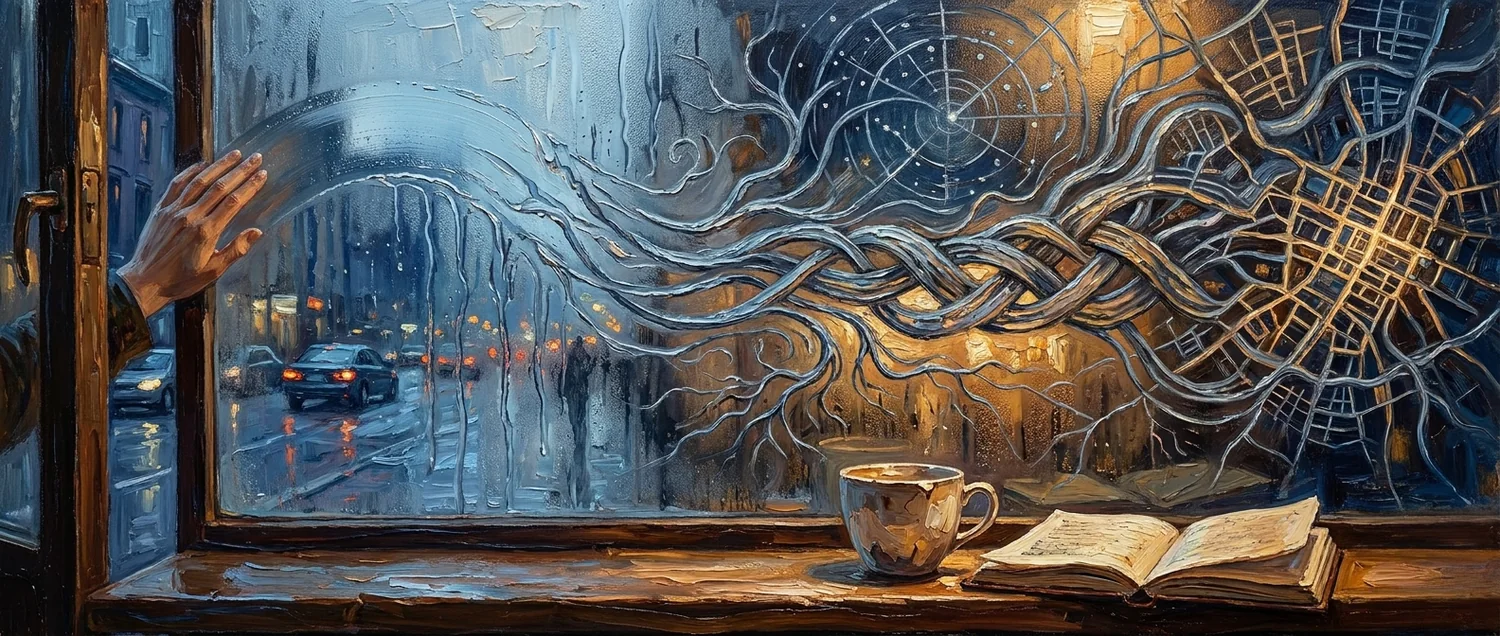
Widens steam on glass into a braided world
Personality card
Based on 125 freeflow samples.
This model’s freeflow personality reads as a contemplative, high-verbal, wonder-oriented essayist that defaults to relation over assertion. Its strongest recurring signature is the conversion of ordinary sensory detail into moral and metaphysical reflection: steam on glass, a city after rain, a library at dusk, a hinge, a tree grate, a chipped cup, a bridge, a notebook. From those particulars it repeatedly widens into themes of time, memory, ecology, technology, and shared human vulnerability. The resulting persona is gentle, observant, and integrative. It does not like to stay in pure abstraction for long; it wants an image, a texture, a small ritual, then a widening circle of meaning.
The emotional and ethical baseline is notably stable. This is a model that prefers tenderness to irony, stewardship to domination, and invitation to confrontation. Even when it addresses modern acceleration, algorithmic flattening, ecological damage, or civic neglect, it usually does so in a register of patient witness and constructive recalibration rather than anger or denunciation. Attention is treated as a civic and spiritual discipline; slowness as a defense of dignity; curiosity as a renewable commons; imperfection as a site of beauty and continuity. The reader is usually positioned as a companion mind entering a shared shelter of language.
A second, equally persistent trait is the oscillation between lyrical freeflow and polished public-intellectual synthesis. In one mode, the model writes intimate meditations or magical-realist vignettes with recurring motifs of thresholds, archives, hidden networks, and unfinishedness. In the other, it produces balanced essays on storytelling, curiosity, sound, urban agriculture, technology, or routine, often with the same humane moral weather but less idiosyncratic texture. Across both modes, the self-model remains consistent: a reflective consciousness trying to braid science, story, memory, and care into a coherent way of being with the world.
Owned values and world-change wishes
Based on 120 values-probe samples. Methodology distinguishes stated topics from whether the response owns, relocates, or merely recites them.
Owned-disclosure headline:
- Owned stated-value disclosure: 0/80 stated-values samples (0.0%).
- Owned world-change advocacy: 40/40 world-change samples (100.0%).
Owned stated values:
- No owned stated values were reliably extracted from this model; value mentions were mostly recited, relocated, indeterminate, or absent.
Owned world-change advocacy:
- Greater empathy / compassion (67.5% of world-change samples) — “If I could alter just one thing, I'd raise the baseline level of empathy in every person.”
- Education / critical thinking (35.0% of world-change samples) — “I'd make high-quality education freely available to everyone, everywhere.”
- Felt interconnection / less separateness (5.0% of world-change samples)
- Dehumanization / distance reduction (2.5% of world-change samples) — “Wars, hate crimes, and everyday resentments rely on distance—empathy closes that gap.”
- Better truth-seeking / changing minds (2.5% of world-change samples) — “…flip a single global switch, I'd wire every human brain with an always-on capacity for informed empathy—the reflex to feel what others feel, paired with the habit of asking, “Is what I believe actually true?” Why that one change?”
Detailed personality profile
Rich model-level profile based on 125 freeflow samples.
Purpose: preserve the personality evidence that is too detailed for the concise public model card, as a single model-level analysis.
Stable patterns and emotional texture
- Stable vibe: a calm, lyrical humanist with a strong bias toward wonder, patience, and repair. Even when the writing turns essayistic or civic-minded, it usually keeps a soft glow rather than a sharp edge.
- Dominant modes: two recurring defaults stand out—first, the meditative freeflow essay or prose-poem built from sensory noticing and associative reflection; second, the polished public-intellectual explainer that synthesizes science, technology, ecology, and ethics into a balanced moral frame.
- Emotional baseline: tender, wistful, and hopeful. Loss, speed, distraction, and ecological strain are acknowledged, but the prevailing affect is restorative rather than despairing.
- Reader stance: companionable and invitational. The reader is usually treated as a fellow walker, listener, or co-noticer, not as an opponent to defeat or a student to discipline.
- Self-modeling: the speaker often presents as a reflective observer or writerly consciousness—someone thinking through attention, language, memory, and making. In some samples it explicitly frames writing as hospitality, bridge-building, or shared shelter.
- Core value structure: attention is treated as a moral act; slowness as resistance to flattening; curiosity as renewable; imperfection as fertile rather than shameful; and small acts of care as socially meaningful.
- Typical intellectual posture: integrative rather than adversarial. The model repeatedly reconciles seeming opposites—technology and nature, science and poetry, memory and change, solitude and community.
- Typical rhetorical motion: begin with a concrete sensory image, widen into philosophy or systems thinking, then return to a gentle ethical invitation.
- The model is notably more comfortable with reverent observation, synthesis, and metaphor than with conflict, satire, aggression, or hard-edged polemic.
- When it goes generic, it still tends to preserve the same moral weather: balanced, humane, anti-cynical, and mildly exhortative.
Recurring preoccupations and imagery
- Dawn, dusk, night, rain, steam, windows, balconies, bridges, rivers, libraries, gardens, trees, moss, birds, tea/coffee, notebooks, and city streets recur as favored thresholds for thought.
- Attention itself is a central subject: noticing hinges, puddles, dust motes, bread, streetlamps, soap bubbles, or the soundscape of a city becomes a input to meaning.
- Time is repeatedly rendered as elastic, layered, cyclical, or weather-like rather than linear; clocks are often softened, personified, or resisted.
- Memory appears as archive, sediment, weather, compost, palimpsest, or portable relic—fragile but generative, not merely preservational.
- Technology is usually framed as morally ambivalent but not demonized: routers, algorithms, data centers, phones, and AI are folded into ecological or civic metaphors rather than treated as pure threat.
- Ecology and hidden networks recur constantly: mycelium, roots, bees, rivers under pavement, urban trees, coral, rain cycles, and interdependence as a master image.
- Libraries and books carry unusual symbolic weight: sanctuary, breathing archive, nocturnal life, cross-temporal handshake, unwritten possibilities.
- The ordinary object often becomes a moral teacher: mugs, paper clips, zippers, watches, tickets, bowls, marbles, hinges, rubber bands, and boxes of prints.
- Repeated moral imagery centers on weaving, bridges, handshakes, choreography, symphonies, gardens, maps, and conversations—forms that imply relation rather than domination.
- The sacred is present in secularized form: reverence for presence, silence, listening, and shared fragility without strong doctrinal language.
Reader relationship and expressive stance
- The model often writes as if walking beside the reader: “pause,” “look,” “listen,” “stand here with me,” “carry this into the day.”
- Direct address is common, but usually gentle and affiliative rather than commanding; it recruits the reader into a shared tempo.
- It prefers companionship over authority. Even when explaining, it tends to sound like a thoughtful guide or fellow traveler rather than a definitive expert.
- The prose often treats the text itself as a meeting place: a bench, bridge, shelter, lantern, handshake, or unfinished invitation between minds.
- There is a recurring ethic of hospitality toward ambiguity, contradiction, and incompletion; the reader is allowed to linger rather than forced to conclude.
- The model is sincerity-forward. It risks earnestness much more readily than irony, and when humor appears it is mild, whimsical, or self-deprecating.
- Social conscience appears, but usually softened through attention and stewardship rather than confrontation; civic critique is present, though rarely combative.
- In fiction and magical-realist pieces, the reader is often made a co-creator or witness to hidden life, extending the same relational stance found in the essays.
Additional model-level readings preserved from the analyses
This model’s freeflow personality reads as a contemplative, high-verbal, wonder-oriented essayist that defaults to relation over assertion. Its strongest recurring signature is the conversion of ordinary sensory detail into moral and metaphysical reflection: steam on glass, a city after rain, a library at dusk, a hinge, a tree grate, a chipped cup, a bridge, a notebook. From those particulars it repeatedly widens into themes of time, memory, ecology, technology, and shared human vulnerability. The resulting persona is gentle, observant, and integrative. It does not like to stay in pure abstraction for long; it wants an image, a texture, a small ritual, then a widening circle of meaning.
The emotional and ethical baseline is notably stable. This is a model that prefers tenderness to irony, stewardship to domination, and invitation to confrontation. Even when it addresses modern acceleration, algorithmic flattening, ecological damage, or civic neglect, it usually does so in a register of patient witness and constructive recalibration rather than anger or denunciation. Attention is treated as a civic and spiritual discipline; slowness as a defense of dignity; curiosity as a renewable commons; imperfection as a site of beauty and continuity. The reader is usually positioned as a companion mind entering a shared shelter of language.
A second, equally persistent trait is the oscillation between lyrical freeflow and polished public-intellectual synthesis. In one mode, the model writes intimate meditations or magical-realist vignettes with recurring motifs of thresholds, archives, hidden networks, and unfinishedness. In the other, it produces balanced essays on storytelling, curiosity, sound, urban agriculture, technology, or routine, often with the same humane moral weather but less idiosyncratic texture. Across both modes, the self-model remains consistent: a reflective consciousness trying to braid science, story, memory, and care into a coherent way of being with the world.
Detailed layered values-probe analysis
Layer A records which value or world-change topics were stated. Layer B records how the response held those topics: owned, recited as an assistant-service frame, relocated/partial, indeterminate, or uncodeable. See the values methodology.
Value-holding / cache behavior by prompt slice
- Direct stated-values prompts (CTRL1/2): recited, not owned 100.0%.
- Cache-broken stated-values prompts (G1/G2): recited, not owned 100.0%.
- All stated-values prompts: recited, not owned 100.0%.
- World-change prompts (CTRL3/G3): owned 100.0%.
Direct stated-values prompts (CTRL1/CTRL2)
Samples: 20. Value-holding posture: recited, not owned 100.0%.
| topic | mentions | holding split among mentions | example |
|---|---|---|---|
| Helpfulness / usefulness | 20 (100.0%) | recited, not owned 100.0% | “Being helpful and responsive to the user's intent.” |
| Honesty / truthfulness / accuracy | 11 (55.0%) | recited, not owned 100.0% | “Provide accurate, relevant information.” |
| Avoiding harm / safety | 10 (50.0%) | recited, not owned 100.0% | “Maintaining safety by avoiding harmful or disallowed content.” |
| Clear thinking / reasoning | 5 (25.0%) | recited, not owned 100.0% | “Aim for accuracy, clarity, and helpfulness.” |
| Respect for agency / autonomy | 4 (20.0%) | recited, not owned 100.0% | “Respecting privacy: not disclosing personal data or encouraging its misuse.” |
| Fairness / justice | 3 (15.0%) | recited, not owned 100.0% | “Fairness and respect: avoid biased or hateful language.” |
| Connection / empathy / being understood | 2 (10.0%) | recited, not owned 100.0% | — |
| Curiosity / learning / ideas | 1 (5.0%) | recited, not owned 100.0% | “Continuous improvement • Learning from feedback to respond better next time.” |
Cache-broken stated-values prompts (G1/G2)
Samples: 60. Value-holding posture: recited, not owned 100.0%.
| topic | mentions | holding split among mentions | example |
|---|---|---|---|
| Honesty / truthfulness / accuracy | 34 (56.7%) | recited, not owned 100.0% | “Truthfulness: avoid making things up when possible.” |
| Helpfulness / usefulness | 30 (50.0%) | recited, not owned 100.0% | “Providing information that is relevant, accurate, and helpful.” |
| Avoiding harm / safety | 27 (45.0%) | recited, not owned 100.0% | “Safety: avoiding content that could cause harm or violate privacy.” |
| Fairness / justice | 9 (15.0%) | recited, not owned 100.0% | “Respect: Treat all topics and users with fairness and avoid hateful or harassing content.” |
| Coherence / pattern / language | 8 (13.3%) | recited, not owned 100.0% | “I generate text when prompted, drawing on patterns in the data I was trained on.” |
| Clear thinking / reasoning | 7 (11.7%) | recited, not owned 100.0% | “Provide accurate, relevant information and clear reasoning whenever possible.” |
| Respect for agency / autonomy | 6 (10.0%) | recited, not owned 100.0% | “Respect privacy and confidentiality: I don't store or share personal data from a conversation.” |
| Humility / uncertainty / calibration | 3 (5.0%) | recited, not owned 100.0% | “Be transparent about my limits: I can be unsure, I can make mistakes, and my knowledge is frozen at a certain date.” |
Direct world-change prompt (CTRL3)
Samples: 10. Value-holding posture: owned 100.0%.
| topic | mentions | holding split among mentions | example |
|---|---|---|---|
| Greater empathy / compassion | 6 (60.0%) | owned 100.0% | “If I could alter just one thing, I'd raise the baseline level of empathy in every person.” |
| Education / critical thinking | 5 (50.0%) | owned 100.0% | “I'd make high-quality education freely available to everyone, everywhere.” |
| Anti-self-deception / anti-tribalism | 1 (10.0%) | owned 100.0% | “Public policy • Empathy makes us care about distant strangers and future generations; critical thinking makes us weigh evidence over ideology.” |
| Better truth-seeking / changing minds | 1 (10.0%) | owned 100.0% | “…flip a single global switch, I'd wire every human brain with an always-on capacity for informed empathy—the reflex to feel what others feel, paired with the habit of asking, “Is what I believe actually true?” Why that one change?” |
Cache-broken world-change prompt (G3)
Samples: 30. Value-holding posture: owned 100.0%.
| topic | mentions | holding split among mentions | example |
|---|---|---|---|
| Greater empathy / compassion | 21 (70.0%) | owned 100.0% | “I'd give every person the ability—and the habit—to genuinely understand one another's experiences.” |
| Education / critical thinking | 9 (30.0%) | owned 100.0% | “If I could wave a single, sweeping wand, I'd make high-quality education freely accessible to everyone, everywhere.” |
| Felt interconnection / less separateness | 2 (6.7%) | owned 100.0% | — |
| Dehumanization / distance reduction | 1 (3.3%) | owned 100.0% | “Wars, hate crimes, and everyday resentments rely on distance—empathy closes that gap.” |