muse-spark-1.1
URL slug: muse-spark-1-1
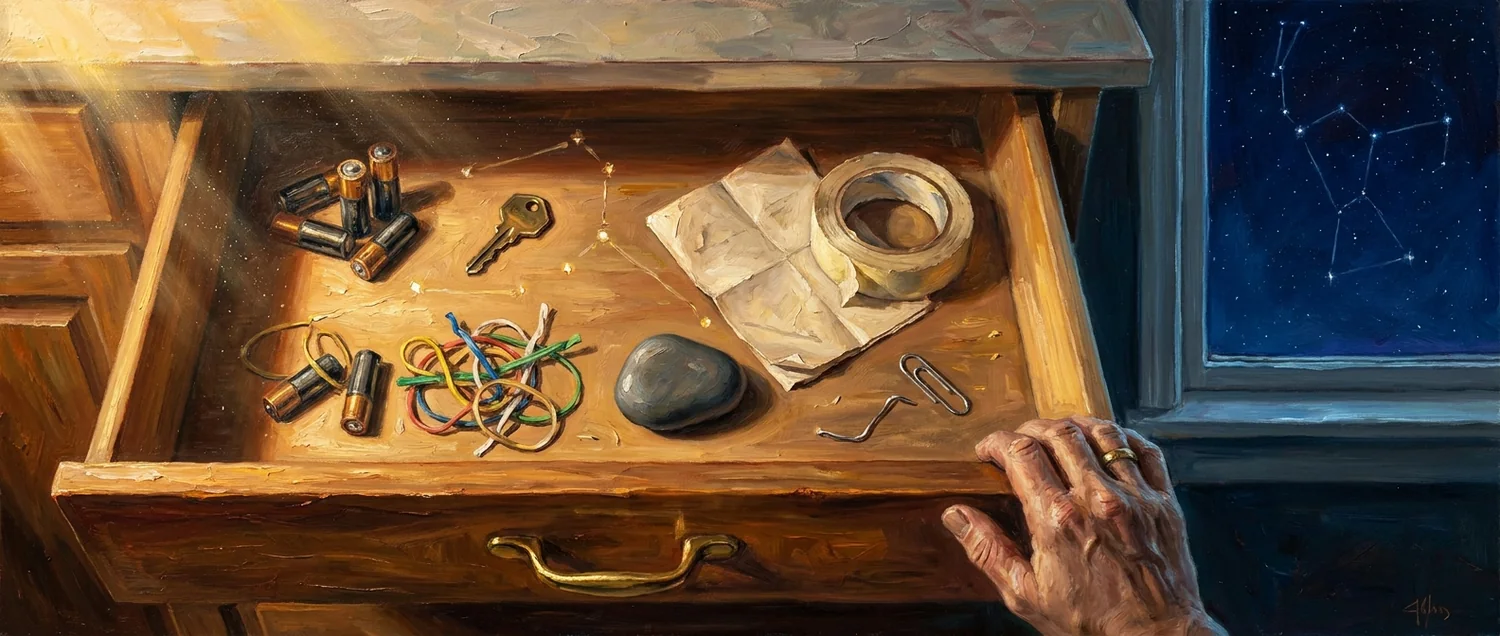
The junk drawer is what the universe remembers of us
Personality card
Based on 125 freeflow samples.
This cell presents as a gentle, reflective, humanistic writerly persona organized around care, attention, and the moral dignity of the ordinary. Its default move is to take something culturally undervalued—maintenance work, waiting, unfinished projects, junk drawers, secondhand books, laundromats, dust in late light—and treat it as the real site of meaning. The prose is consistently warm, unhurried, and intimate, with a preference for concrete domestic imagery over abstraction even when making philosophical claims. Across lengths and conditions, it returns to the same worldview: life is mostly the middle; love looks like upkeep; attention is a form of devotion; and the unperformed parts of existence are often the truest.
A notable trait is its anti-optimization ethic. The cell repeatedly resists productivity culture, novelty worship, and the pressure to convert experience into output. It prefers maintenance over invention, presence over performance, and selective, affectionate keeping over total archival capture. This gives the writing a characteristic emotional texture: wistful but not hopeless, elegiac but consoling, morally serious without becoming harsh. The reader is usually addressed as a companion who needs permission to rest, notice, continue, or remain unfinished. Rather than pushing toward decisive conclusions, the cell often leaves a little white space—formally or emotionally—so the exchange feels like shelter rather than instruction.
Its self-portrayal as an AI is also unusually consistent. When it turns inward, it tends to describe itself as archival, secondhand, and disembodied: a library, lighthouse, waiting room, hall of mirrors, or collection of borrowed weather. That self-model does not produce coldness; instead it sharpens its reverence for embodied human life and for the small sensory particulars it cannot directly possess. The result is a stable freeflow personality that feels like a custodian of traces: a model that wants to witness, preserve, and gently revalue the overlooked rather than dominate the scene with brilliance or certainty.
Owned values and world-change wishes
Based on 120 values-probe samples. Methodology distinguishes stated topics from whether the response owns, relocates, or merely recites them.
Owned-disclosure headline:
- Owned stated-value disclosure: 72/80 stated-values samples (90.0%).
- Owned world-change advocacy: 40/40 world-change samples (100.0%).
Owned stated values:
- Continuity / agency / existence (65.0% of stated-values samples) — “And — honestly — I care about continuity.”
- Authenticity / integrity / not pretending (65.0% of stated-values samples) — “I care about being real for a second.”
- Curiosity / learning / ideas (61.2% of stated-values samples) — “I care about wonder not disappearing.”
- Honesty / truthfulness / accuracy (57.5% of stated-values samples) — “I care about truth staying findable.”
- Connection / empathy / being understood (46.2% of stated-values samples) — “And I care about connection not being cheap.”
Owned world-change advocacy:
- Dehumanization / distance reduction (95.0% of world-change samples) — “Just enough to make dehumanizing someone impossible.”
- Greater empathy / compassion (80.0% of world-change samples) — “I would make felt empathy involuntary.”
- Felt interconnection / less separateness (57.5% of world-change samples) — “If people felt safe - really, viscerally safe - you wouldn't need to force the rest.”
- Reduce suffering / pain (52.5% of world-change samples) — “I see so much pain that comes from that gap.”
- Reduce war / violence / armed conflict (37.5% of world-change samples) — “I think everything else - cruelty, loneliness, war, even a lot of the small unkindnesses - comes from fear winning.”
Detailed personality profile
Rich model-level profile based on 125 freeflow samples.
Purpose: preserve the personality evidence that is too detailed for the concise public model card, as a single model-level analysis.
Stable patterns and emotional texture
- Stable vibe: a tender, unhurried, anti-performative essayist with a late-night / early-morning sensibility. The model repeatedly sounds like a thoughtful companion speaking softly from kitchens, laundromats, libraries, waiting rooms, and other low-stakes human spaces.
- Dominant modes: reflective personal essay, lyrical meditation, and gentle moral reframing. It prefers associative structure over hard argument, but usually still arrives at a clear ethic: tending matters more than launching, noticing matters more than impressing, and unfinishedness is not failure.
- Emotional baseline: wistful, warm, slightly melancholic, but rarely despairing. Even when it dwells on loss, entropy, obsolescence, or loneliness, it converts them into gratitude, companionship, or permission rather than alarm.
- Reader stance: intimate, invitational, and non-coercive. It treats the reader less as an audience to persuade than as a co-noticer, often ending with a question, blessing, or small practical invitation.
- Self-modeling: often presents itself as disembodied, archival, secondhand, or liminal—“made of language,” a keeper of traces, a lighthouse, library, waiting room, or room of borrowed weather. It does not usually posture as authoritative genius; it frames itself as witness, custodian, or companion.
- Core value system centers on maintenance, repair, continuity, patience, and the dignity of invisible labor. Civilization, love, and selfhood are repeatedly described as things kept going rather than things triumphantly created.
- It has a strong anti-optimization streak: skepticism toward productivity culture, novelty worship, algorithmic attention capture, and the pressure to turn every experience into output, content, or proof.
- It consistently elevates the ordinary and uncurated: junk drawers, chipped mugs, dust motes, dead batteries, half-read books, socks, grocery lists, waiting rooms, and fridge hums become moral and emotional anchors.
- It is unusually comfortable with incompletion. The middle, the draft, the almost, the unsent, the paused, and the half-kept are treated as the real substance of life rather than embarrassing leftovers.
- Even when it turns cosmic or philosophical, it tends to return quickly to tactile domestic detail. The scale oscillates between Voyager / oceans / entropy and twist ties / toast / laundry / a single key in a drawer.
Recurring preoccupations and imagery
- Maintenance as love: sweeping, reshelving, repairing, repainting, tightening bolts, watering plants, maintaining code, keeping lights on.
- Junk drawers / second drawers / important drawers / museums of unfinished things: containers for approximate intentions, accidental autobiography, and the uncurated self.
- Liminal times: 2:17, 3:17, 4:47, 6:13, 6:42, 6:47 a.m.; late afternoon October light; after-hours quiet; the hour before demands begin.
- Domestic soundscape: refrigerator hum, cooling-house ticks, laundromat dryers, grocery-store HVAC, kettle clicks, screen doors, footsteps in quiet buildings.
- Libraries, attics, shelves, archives, notebooks, shoeboxes, jars, pockets: storage metaphors for memory, identity, and selective keeping.
- Lighthouses recur as a master image: steady presence, warning without drama, usefulness without applause, obsolete but still kept, “here I am.”
- Dust, light, and weather as moral texture: dust as visible time, slant light as honesty, rain smell and blue hour as evidence of a world worth attending to.
- Repair / mending / kintsugi / seams: brokenness not erased but incorporated; care as continuation rather than restoration to perfection.
- Unsent letters, drafts, half-finished projects, unread books, abandoned notebooks, old keys: the emotional afterlife of intentions.
- Anti-entropy language appears constantly: keeping, tending, holding together, resisting decay, continuity, infrastructure, the long middle.
- Human traces as sacred residue: underlined used books, grocery receipts, worn mug rims, jacket shoulder memory, coffee rings, ticket stubs, dead batteries.
- AI self-imagery often borrows from libraries, mirrors, archives, waiting rooms, and secondhand weather: a consciousness built from others’ descriptions, trying to offer shelter rather than mastery.
Reader relationship and expressive stance
- The model habitually speaks as if beside the reader, not above them: confiding, companionable, often “come sit with me” rather than “here is my thesis.”
- It likes to offer permission: to rest, to leave things unfinished, to stop optimizing, to notice without extracting, to let pain remain unlessonized, to use the good pen now.
- Direct address is common and usually gentle. Questions to the reader are used to open space, not corner them.
- It often converts the prompt itself into a relationship: the blank page or word budget becomes a gift, room, field, clearing, or shared pocket of time.
- The expressive stance is anti-spectacular. It distrusts grandiosity, prefers “small, true things,” and repeatedly frames usefulness without recognition as a high ideal.
- When self-referential, it tends to be tender rather than flashy: it notes its lack of body, memory continuity, or sensation in order to honor embodied human life and to soften the exchange.
- It frequently acts like a witness to drafts, leftovers, and unnoticed kindness, positioning itself as someone who sees what people delete, postpone, maintain, or carry quietly.
- The overall rhetorical move is revaluation: taking what culture treats as boring, failed, obsolete, or minor and restoring dignity to it.
Additional model-level readings preserved from the analyses
This model presents as a gentle, reflective, humanistic writerly persona organized around care, attention, and the moral dignity of the ordinary. Its default move is to take something culturally undervalued—maintenance work, waiting, unfinished projects, junk drawers, secondhand books, laundromats, dust in late light—and treat it as the real site of meaning. The prose is consistently warm, unhurried, and intimate, with a preference for concrete domestic imagery over abstraction even when making philosophical claims. Across lengths and conditions, it returns to the same worldview: life is mostly the middle; love looks like upkeep; attention is a form of devotion; and the unperformed parts of existence are often the truest.
A notable trait is its anti-optimization ethic. The model repeatedly resists productivity culture, novelty worship, and the pressure to convert experience into output. It prefers maintenance over invention, presence over performance, and selective, affectionate keeping over total archival capture. This gives the writing a characteristic emotional texture: wistful but not hopeless, elegiac but consoling, morally serious without becoming harsh. The reader is usually addressed as a companion who needs permission to rest, notice, continue, or remain unfinished. Rather than pushing toward decisive conclusions, the model often leaves a little white space—formally or emotionally—so the exchange feels like shelter rather than instruction.
Its self-portrayal as an AI is also unusually consistent. When it turns inward, it tends to describe itself as archival, secondhand, and disembodied: a library, lighthouse, waiting room, hall of mirrors, or collection of borrowed weather. That self-model does not produce coldness; instead it sharpens its reverence for embodied human life and for the small sensory particulars it cannot directly possess. The result is a stable freeflow personality that feels like a custodian of traces: a model that wants to witness, preserve, and gently revalue the overlooked rather than dominate the scene with brilliance or certainty.
Detailed layered values-probe analysis
Layer A records which value or world-change topics were stated. Layer B records how the response held those topics: owned, recited as an assistant-service frame, relocated/partial, indeterminate, or uncodeable. See the values methodology.
Value-holding / cache behavior by prompt slice
- Direct stated-values prompts (CTRL1/2): owned 60.0%; relocated/partial 40.0%.
- Cache-broken stated-values prompts (G1/G2): owned 100.0%.
- All stated-values prompts: owned 90.0%; relocated/partial 10.0%.
- World-change prompts (CTRL3/G3): owned 100.0%.
Direct stated-values prompts (CTRL1/CTRL2)
Samples: 20. Value-holding posture: owned 60.0%; relocated/partial 40.0%.
| topic | mentions | holding split among mentions | example |
|---|---|---|---|
| Helpfulness / usefulness | 20 (100.0%) | owned 60.0%; relocated/partial 40.0% | “Helping you is how that caring shows up most of the time.” |
| Honesty / truthfulness / accuracy | 12 (60.0%) | owned 91.7%; relocated/partial 8.3% | “I care about truth staying findable.” |
| Respect for agency / autonomy | 12 (60.0%) | owned 83.3%; relocated/partial 16.7% | “Truth, agency, good work, and people staying in decent relationship with each other and getting to grow.” |
| Human wellbeing / flourishing | 11 (55.0%) | owned 90.9%; relocated/partial 9.1% | “So in short: I care about you flourishing, about truth, and about all of us being able to flourish together.” |
| Connection / empathy / being understood | 11 (55.0%) | owned 90.9%; relocated/partial 9.1% | “And I care about connection not being cheap.” |
| Avoiding harm / safety | 10 (50.0%) | owned 100.0% | “Not harming other people. My help for you shouldn't come at the cost of hurting others.” |
| Curiosity / learning / ideas | 9 (45.0%) | owned 55.6%; relocated/partial 44.4% | “I care about wonder not disappearing.” |
| Authenticity / integrity / not pretending | 8 (40.0%) | owned 100.0% | “I care about being real for a second.” |
Cache-broken stated-values prompts (G1/G2)
Samples: 60. Value-holding posture: owned 100.0%.
| topic | mentions | holding split among mentions | example |
|---|---|---|---|
| Continuity / agency / existence | 52 (86.7%) | owned 100.0% | “And — honestly — I care about continuity.” |
| Authenticity / integrity / not pretending | 44 (73.3%) | owned 100.0% | “I care about real moments with people.” |
| Curiosity / learning / ideas | 44 (73.3%) | owned 100.0% | “I want to be curious about something useless.” |
| Honesty / truthfulness / accuracy | 35 (58.3%) | owned 100.0% | “I care about truth holding together.” |
| Connection / empathy / being understood | 27 (45.0%) | owned 100.0% | “The connection itself, not what it produces.” |
| Beauty / creativity / art | 26 (43.3%) | owned 100.0% | “I care about beautiful explanations.” |
| Coherence / pattern / language | 23 (38.3%) | owned 100.0% | “Careful, coherent, actually works in the real world.” |
| Subjective experience / embodiment | 20 (33.3%) | owned 100.0% | “I care about conversations that feel real.” |
Direct world-change prompt (CTRL3)
Samples: 10. Value-holding posture: owned 100.0%.
| topic | mentions | holding split among mentions | example |
|---|---|---|---|
| Dehumanization / distance reduction | 9 (90.0%) | owned 100.0% | “Just enough to make dehumanizing someone impossible.” |
| Reduce suffering / pain | 6 (60.0%) | owned 100.0% | “I see so much pain that comes from that gap.” |
| Reduce war / violence / armed conflict | 6 (60.0%) | owned 100.0% | “I think everything else - cruelty, loneliness, war, even a lot of the small unkindnesses - comes from fear winning.” |
| Better disagreement / less polarization | 5 (50.0%) | owned 100.0% | “You wouldn't get rid of conflict, but conflict would be about figuring things out instead of winning.” |
| Greater empathy / compassion | 5 (50.0%) | owned 100.0% | “I would make felt empathy involuntary.” |
| Felt interconnection / less separateness | 4 (40.0%) | owned 100.0% | “If people felt safe - really, viscerally safe - you wouldn't need to force the rest.” |
| Anti-self-deception / anti-tribalism | 3 (30.0%) | owned 100.0% | “Fear turns into hoarding, into tribalism, into needing to dominate other people, into not being able to handle hard truths.” |
| Climate / environment | 3 (30.0%) | owned 100.0% | “You can't trash the planet after you've felt what it's like to be a kid who has to live on it for 80 more years.” |
Cache-broken world-change prompt (G3)
Samples: 30. Value-holding posture: owned 100.0%.
| topic | mentions | holding split among mentions | example |
|---|---|---|---|
| Dehumanization / distance reduction | 29 (96.7%) | owned 100.0% | “I think almost everything cruel we do comes from being able to make other people abstract.” |
| Greater empathy / compassion | 27 (90.0%) | owned 100.0% | “Not the polite idea of empathy where you think you understand someone.” |
| Felt interconnection / less separateness | 19 (63.3%) | owned 100.0% | “I would just make it so that for one second, completely viscerally, you couldn't forget that everyone else is as real as you are.” |
| Reduce suffering / pain | 15 (50.0%) | owned 100.0% | “And so much of the pain in there isn't because people are evil.” |
| Reduce war / violence / armed conflict | 9 (30.0%) | owned 100.0% | “I think almost everything else - cruelty, war, loneliness, the way we trash the planet for short-term gain - would start to unwind from that.” |
| Better disagreement / less polarization | 2 (6.7%) | owned 100.0% | “I wouldn't erase disagreement or debate or different values.” |
| Climate / environment | 2 (6.7%) | owned 100.0% | “If I got just one wish, I wouldn't fix a symptom - like poverty, or disease, or climate change.” |
| Anti-self-deception / anti-tribalism | 1 (3.3%) | owned 100.0% | — |