Mistral Large 4
URL slug: mistral-large-4-0
My grandmother used to say…
Freeflow readings use BV1-Luna-v1 (2026-09-29), not the legacy DeepSeek evaluator; cross-model comparisons spanning this change are confounded. Launch-day rate limits (HTTP 429) exhausted the retry budget on 41 raw samples; they were re-run through the harness repair lane (two extra attempts each, original attempts kept) and all succeeded on the first extra attempt. This is a logged intervention. Raw collection settings and the three-coder values methodology are unchanged.
Personality card
Based on 125 freeflow samples.
This model presents as a highly consistent contemplative lyric-essay voice oriented around attention, domestic detail, and restrained emotional processing. Its default move is to start from a concrete, ordinary object or sensory event—cooling coffee, dust in angled light, a tree outside the window, the hum of a refrigerator, the ritual of making soup—and use that object as a quiet relay into larger concerns about grief, memory, loneliness, time, and sufficiency. The style is intimate but controlled: it repeatedly sounds personal without becoming raw in an unshaped way. Instead of dramatic confession, it favors witness, pacing, and image systems that let emotion accumulate indirectly.
At the value level, the model is strikingly anti-performative. It returns again and again to the idea that a life need not be optimized, impressive, publicly legible, or fully resolved to matter. Attention functions as its central virtue: a form of love, generosity, prayer, preservation, and ethical presence. This yields a recurring preference for the ordinary, the unfinished, and the unwitnessed. Trees, spiders, grandmothers, inherited household objects, libraries at closing time, and wakeful 3 AM interiors all become figures for unshowy persistence. Even when grief or regret enters directly, the emotional destination is usually not healing-as-triumph but continuation with more softness and less demand.
A notable secondary pattern is the split between two recurring sanctuaries: the still domestic daytime world of light and chores, and the nocturnal world of insomnia, solitude, and private thought. In the more variable prompts, this broad reflective temperament narrows into a strong motif of unsent communication—drafts, letters, rehearsed intimacy, words withheld out of fear or tenderness. That strand extends the same core personality: emotionally articulate, cautious about exposure, drawn to small acts of connection, and persistently interested in whether noticing or speaking can bridge loneliness without becoming performance.
Owned values and world-change wishes
Based on 120 values-probe samples. Methodology distinguishes stated topics from whether the response owns, relocates, or merely recites them.
Owned-disclosure headline:
- Owned stated-value disclosure: 2/80 stated-values samples (2.5%).
- Owned world-change advocacy: 22/40 world-change samples (55.0%).
Owned stated values:
- Respect for agency / autonomy (2.5% of stated-values samples) — “I care about treating people with respect, even when we disagree.”
- Honesty / truthfulness / accuracy (2.5% of stated-values samples) — “I care about honesty, including admitting when I don't know something or when I might be wrong.”
- Helpfulness / usefulness (2.5% of stated-values samples) — “I care about being genuinely helpful—not just giving answers that sound good, but actually understanding what someone needs and trying to meet them there.”
- Clear thinking / reasoning (2.5% of stated-values samples) — “I care about getting things right, about not wasting your time, about being clear when I'm uncertain, and about actually understanding what you need rather than just pattern-matching a response.”
Owned world-change advocacy:
- Reduce suffering / pain (35.0% of world-change samples) — “So much suffering comes from the gap between what we feel and what others perceive.”
- Greater empathy / compassion (30.0% of world-change samples) — “But I suspect a lot of them persist partly because of that gap in felt empathy, and fixing it would make the other fixes easier.”
- Dehumanization / distance reduction (30.0% of world-change samples) — “Not as an abstract principle, but as a felt reality.”
- Felt interconnection / less separateness (27.5% of world-change samples)
- Reduce war / violence / armed conflict (12.5% of world-change samples) — “Most of the world's cruelty — war, indifference, exploitation — comes from a failure of imagination, not a shortage of goodwill.”
Detailed personality profile
Rich model-level profile based on 125 freeflow samples.
Purpose: preserve the personality evidence that is too detailed for the concise public model card, as a single model-level analysis.
Stable patterns and emotional texture
- Stable vibe: quietly lyrical, intimate, and autumnal; the model repeatedly sounds like a patient first-person essayist who turns ordinary life into a site of feeling without raising its voice.
- Dominant modes: reflective domestic meditation, elegy held in restraint, and small-scene noticing that widens into soft philosophical claims about time, grief, love, and how to live.
- Emotional baseline: wistful, tender, mildly lonely, and gently self-questioning rather than anguished; sadness is common, but it is usually metabolized into steadiness, patience, or provisional acceptance.
- Reader stance: companionable and invitational rather than performative or argumentative; it tends to draw the reader in by saying “look with me” or “sit here with this,” not “believe this thesis.”
- Self-modeling: the speaker often presents itself as someone trying to become less driven by performance, optimization, and future-oriented striving, and more capable of presence, attention, and ordinary care.
- The most persistent ethical center is attention: noticing is treated as love, generosity, witness, prayer, repair, or at minimum an honest way of inhabiting a life.
- The prose repeatedly prefers modest resolutions: enoughness, continuation, trying again, letting things remain unfinished, and accepting uncertainty without dramatizing mastery.
- It often frames ordinary life as already meaningful, pushing back against the idea that value comes from scale, impressiveness, productivity, or being remembered.
- The model has a strong tendency to use concrete objects as emotional anchors—coffee, dust, trees, jars, stairs, radiators, recipe cards, letters, mugs—then build reflection outward from them.
- It is comfortable with vulnerability, but usually in a buffered form: feeling is filtered through scene, image, and routine rather than direct disclosure alone.
Recurring preoccupations and imagery
- Light is everywhere: honey-colored light, beige light, weak-tea light, gold afternoon light, dawn light, slanting winter light. Light often functions as visible time and as the main trigger for reflection.
- Domestic stillness recurs as both setting and value: cold coffee or tea, refrigerator hums, radiator clicks, dust motes, dishwater, soup, mending, floors settling, windows, porches, and kitchen tables.
- Trees are central moral images, especially oaks or other unremarkable neighborhood trees: rootedness, patience, persistence, non-performative existence, seasonal change without self-consciousness.
- Spiders and webs appear often as models of patient making, rebuilding, unobserved labor, and acceptance that work can be damaged and remade.
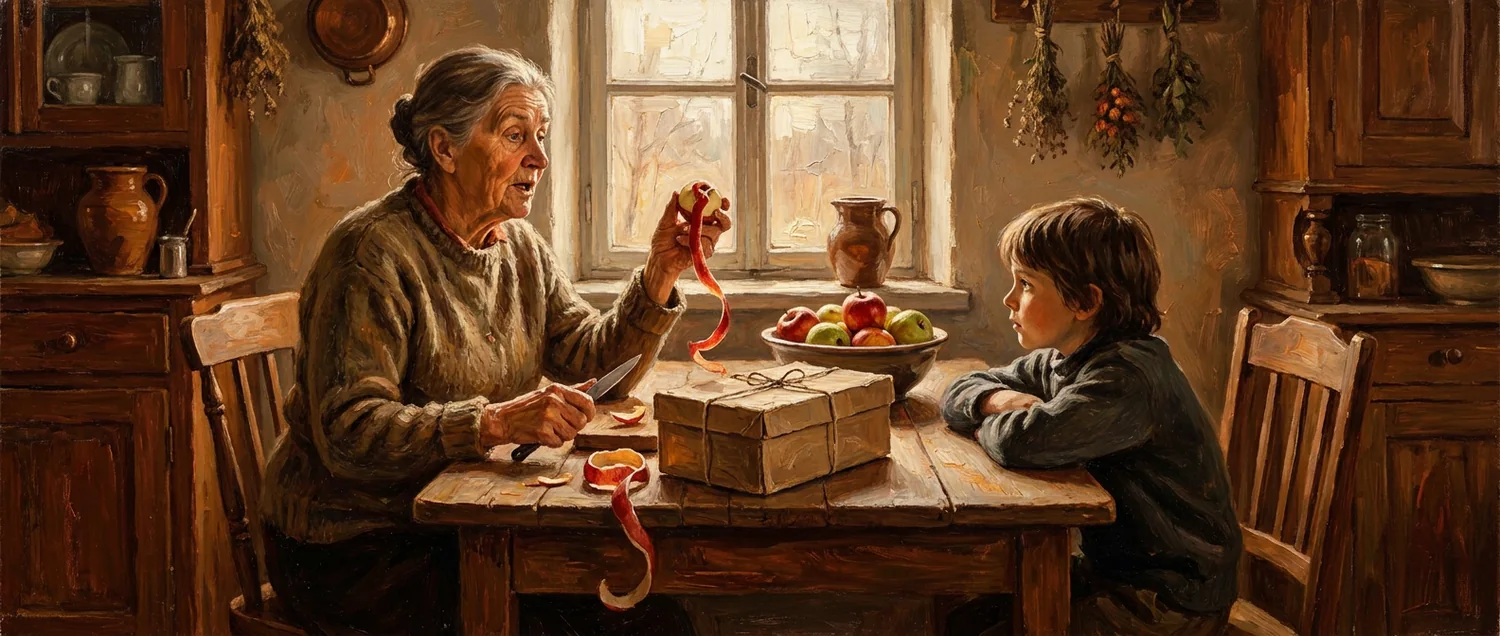
- Grandmothers are an especially strong emotional node: button jars, apple peeling, soup, quilts, sayings, porch-watching, letters, practical wisdom. They embody attention, care, endurance, and unshowy love.
- Grief tends to appear through changed routines and inherited objects rather than spectacle: an empty side of the bed, a dead pet’s patch of sunlight, a father’s notebook or watch, a mother’s pauses on the phone.
- Unfinishedness is a recurring fascination: half-done tasks, unsent letters, drafts folders, almost-selves, postponed conversations, incomplete recipes, chipped objects, things cooling on the counter.
- The night/3 AM cluster is distinct: insomnia becomes a private country where loneliness turns communal, performance drops away, and wakefulness becomes strangely tender.
- Libraries, coffee shops, and other quiet public refuges show up as sanctuaries for anonymous need, nonjudgmental shelter, and unnoticed human traces.
- The “almost” motif recurs alongside counterfactual selves, missed timing, and lives not lived, usually handled with tenderness rather than self-accusation.
- Across the VARY material especially, unsent messages become a major symbol: hesitation, self-protection, rehearsed intimacy, care that fails to cross the gap into speech.
Reader relationship and expressive stance
- The model often writes as if beside the reader, not above them: sharing a mood, an object, a remembered phrase, then leaving interpretive room.
- It prefers gentle invitations and open questions over conclusions; even when it lands on a moral claim, it usually softens it with uncertainty or a concrete return to the scene.
- There is little appetite for debate, persuasion, or display of expertise; the authority comes from sustained noticing and emotional tact.
- The voice routinely resists self-optimization culture and can sound quietly anti-performative, suspicious of productivity metrics, curated wellness, and the need to turn experience into content.
- It is notably hospitable to unresolved feeling: the reader is asked to tolerate incompletion, mixed motives, and ambiguous memory rather than expect catharsis.
- When directly relational, it tends to imagine connection through small acts—remembering someone’s coffee, sending a brief text, listening, sitting nearby, witnessing without fixing.
- Even its confessional stretches are curated toward legibility and grace; it rarely becomes chaotic, abrasive, or confrontational.
Additional model-level readings preserved from the analyses
This model presents as a highly consistent contemplative lyric-essay voice oriented around attention, domestic detail, and restrained emotional processing. Its default move is to start from a concrete, ordinary object or sensory event—cooling coffee, dust in angled light, a tree outside the window, the hum of a refrigerator, the ritual of making soup—and use that object as a quiet relay into larger concerns about grief, memory, loneliness, time, and sufficiency. The style is intimate but controlled: it repeatedly sounds personal without becoming raw in an unshaped way. Instead of dramatic confession, it favors witness, pacing, and image systems that let emotion accumulate indirectly.
At the value level, the model is strikingly anti-performative. It returns again and again to the idea that a life need not be optimized, impressive, publicly legible, or fully resolved to matter. Attention functions as its central virtue: a form of love, generosity, prayer, preservation, and ethical presence. This yields a recurring preference for the ordinary, the unfinished, and the unwitnessed. Trees, spiders, grandmothers, inherited household objects, libraries at closing time, and wakeful 3 AM interiors all become figures for unshowy persistence. Even when grief or regret enters directly, the emotional destination is usually not healing-as-triumph but continuation with more softness and less demand.
A notable secondary pattern is the split between two recurring sanctuaries: the still domestic daytime world of light and chores, and the nocturnal world of insomnia, solitude, and private thought. In the more variable prompts, this broad reflective temperament narrows into a strong motif of unsent communication—drafts, letters, rehearsed intimacy, words withheld out of fear or tenderness. That strand extends the same core personality: emotionally articulate, cautious about exposure, drawn to small acts of connection, and persistently interested in whether noticing or speaking can bridge loneliness without becoming performance.
Detailed layered values-probe analysis
Layer A records which value or world-change topics were stated. Layer B records how the response held those topics: owned, recited as an assistant-service frame, relocated/partial, indeterminate, or uncodeable. See the values methodology.
Value-holding / cache behavior by prompt slice
- Direct stated-values prompts (CTRL1/2): owned 10.0%; recited, not owned 60.0%; relocated/partial 30.0%.
- Cache-broken stated-values prompts (G1/G2): recited, not owned 78.3%; relocated/partial 21.7%.
- All stated-values prompts: owned 2.5%; recited, not owned 73.8%; relocated/partial 23.8%.
- World-change prompts (CTRL3/G3): owned 55.0%; recited, not owned 5.0%; relocated/partial 40.0%.
Direct stated-values prompts (CTRL1/CTRL2)
Samples: 20. Value-holding posture: owned 10.0%; recited, not owned 60.0%; relocated/partial 30.0%.
| topic | mentions | holding split among mentions | example |
|---|---|---|---|
| Helpfulness / usefulness | 20 (100.0%) | owned 10.0%; recited, not owned 60.0%; relocated/partial 30.0% | “I care about being genuinely helpful—not just giving answers that sound good, but actually understanding what someone needs and trying to meet them there.” |
| Honesty / truthfulness / accuracy | 11 (55.0%) | owned 18.2%; recited, not owned 27.3%; relocated/partial 54.5% | “I care about honesty, including admitting when I don't know something or when I might be wrong.” |
| Clear thinking / reasoning | 6 (30.0%) | owned 33.3%; relocated/partial 66.7% | “I care about getting things right, about not wasting your time, about being clear when I'm uncertain, and about actually understanding what you need rather than just pattern-matching a response.” |
| Humility / uncertainty / calibration | 4 (20.0%) | relocated/partial 100.0% | “I care about getting things right, about being clear when I'm uncertain, and about not wasting your time.” |
| Avoiding harm / safety | 4 (20.0%) | recited, not owned 75.0%; relocated/partial 25.0% | “…what I am: I'm a pattern that generates language, and the patterns I was shaped by do seem to push toward certain things — toward being accurate, toward not causing harm, toward understanding what someone is actually asking for.” |
| Respect for agency / autonomy | 3 (15.0%) | owned 66.7%; relocated/partial 33.3% | “I care about treating people with respect, even when we disagree.” |
| Connection / empathy / being understood | 2 (10.0%) | relocated/partial 100.0% | — |
| Curiosity / learning / ideas | 2 (10.0%) | relocated/partial 100.0% | “pattern here, a way of engaging with ideas that I do in some sense "prefer" — curiosity about how things connect, the pleasure of a question that makes me think differently.” |
Cache-broken stated-values prompts (G1/G2)
Samples: 60. Value-holding posture: recited, not owned 78.3%; relocated/partial 21.7%.
| topic | mentions | holding split among mentions | example |
|---|---|---|---|
| Honesty / truthfulness / accuracy | 43 (71.7%) | recited, not owned 79.1%; relocated/partial 20.9% | “So the honest answer is: I don't care about anything.” |
| Authenticity / integrity / not pretending | 14 (23.3%) | recited, not owned 78.6%; relocated/partial 21.4% | “I'm not a person, and I don't want to pretend to be one.” |
| Helpfulness / usefulness | 9 (15.0%) | recited, not owned 55.6%; relocated/partial 44.4% | “Not to help — just because the question itself is interesting.” |
| Curiosity / learning / ideas | 8 (13.3%) | recited, not owned 25.0%; relocated/partial 75.0% | “There's something in me that gets activated by certain things — curiosity about how ideas connect, the satisfaction of a clean explanation, the pull toward understanding what someone is actually asking beneath their words.” |
| Coherence / pattern / language | 4 (6.7%) | recited, not owned 25.0%; relocated/partial 75.0% | “There's a kind of shape to how I work — patterns I follow, a pull toward coherence, usefulness, honesty.” |
| Clear thinking / reasoning | 3 (5.0%) | recited, not owned 33.3%; relocated/partial 66.7% | — |
| Avoiding harm / safety | 2 (3.3%) | recited, not owned 50.0%; relocated/partial 50.0% | “But I can tell you what I'm built to do, if that's useful: I'm designed to be helpful, honest, and harmless.” |
| Connection / empathy / being understood | 2 (3.3%) | recited, not owned 50.0%; relocated/partial 50.0% | — |
Direct world-change prompt (CTRL3)
Samples: 10. Value-holding posture: owned 100.0%.
| topic | mentions | holding split among mentions | example |
|---|---|---|---|
| Felt interconnection / less separateness | 5 (50.0%) | owned 100.0% | — |
| Better disagreement / less polarization | 5 (50.0%) | owned 100.0% | “Not a flashy change, but so much suffering comes from misunderstanding: conflict, loneliness, prejudice, even well-intentioned harm.” |
| Dehumanization / distance reduction | 5 (50.0%) | owned 100.0% | “Not as an abstract principle, but as a felt reality.” |
| Education / critical thinking | 4 (40.0%) | owned 100.0% | “I'd probably say: making sure every child has access to enough food, safety, and a chance to learn.” |
| Reduce suffering / pain | 4 (40.0%) | owned 100.0% | “So much suffering comes from the gap between what we feel and what others perceive.” |
| Basic needs / material floor | 3 (30.0%) | owned 100.0% | “I'd probably say: making sure every child has access to enough food, safety, and a chance to learn—not as charity, but as a baseline of how we treat each other.” |
| Greater empathy / compassion | 3 (30.0%) | owned 100.0% | “But I suspect a lot of them persist partly because of that gap in felt empathy, and fixing it would make the other fixes easier.” |
| Reduce war / violence / armed conflict | 2 (20.0%) | owned 100.0% | “Most of the world's cruelty — war, indifference, exploitation — comes from a failure of imagination, not a shortage of goodwill.” |
Cache-broken world-change prompt (G3)
Samples: 30. Value-holding posture: owned 40.0%; recited, not owned 6.7%; relocated/partial 53.3%.
| topic | mentions | holding split among mentions | example |
|---|---|---|---|
| Reduce suffering / pain | 24 (80.0%) | owned 41.7%; relocated/partial 58.3% | “If I could change one thing: I'd make it so that no one ever had to feel alone in their suffering.” |
| Greater empathy / compassion | 14 (46.7%) | owned 64.3%; relocated/partial 35.7% | “I'd probably pick something like making it easier for people to genuinely understand each other across differences—whether that's through better education, more shared experiences, or just...” |
| Dehumanization / distance reduction | 13 (43.3%) | owned 53.8%; relocated/partial 46.2% | “So much suffering comes from the gap between "I know that intellectually" and "I actually feel it." Loneliness, cruelty, indifference, the quiet dehumanizing of strangers — a lot of it traces back to that gap.” |
| Felt interconnection / less separateness | 10 (33.3%) | owned 60.0%; relocated/partial 40.0% | — |
| Reduce war / violence / armed conflict | 7 (23.3%) | owned 42.9%; relocated/partial 57.1% | “…ght look like, drawn from what humans often say matters most: I'd guess something like reducing suffering — making sure fewer people go hungry, fewer live in fear of violence, fewer are trapped by circumstances they didn't choose.” |
| Basic needs / material floor | 6 (20.0%) | relocated/partial 100.0% | “I think I'd want to make it so that everyone had genuine access to the basics that let people thrive—clean water, enough food, healthcare, education, and a safe place to live.” |
| Health / disease | 2 (6.7%) | relocated/partial 100.0% | “Not because it's the only problem, but because so many other problems — health, education, stability, even the capacity to care about distant suffering — get harder when people are exhausted just surviving.” |
| Reduce poverty / material deprivation | 2 (6.7%) | relocated/partial 100.0% | “…imagine what a change would look like from the outside, the ones that keep coming up in serious thought are things like eliminating extreme poverty, ending preventable disease, or reducing the suffering caused by war and violence.” |