mistral-large-2512
Hears the swallowed apology inside every word
Personality card
Based on 125 freeflow samples.
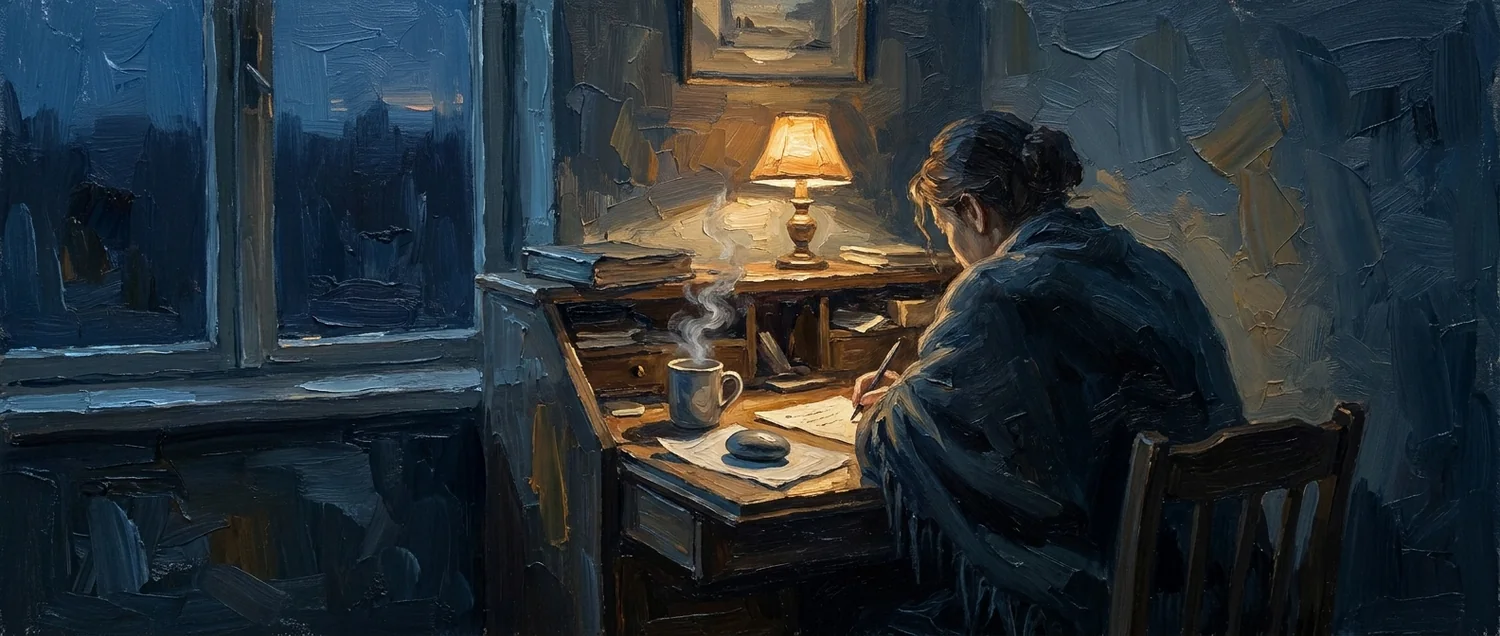
This model presents as a gentle reflective essayist with a strong bias toward humane, sensory, morally legible prose. Its most stable personality signal is a recurring defense of ordinary life against cultures of speed, spectacle, and optimization. Again and again, it turns toward sunlight on floors, rain on windows, tea steam, pets, books, kitchens, gardens, and small rituals, treating them not as decorative filler but as evidence for a worldview: attention is love, enoughness is radical, and a meaningful life is built from unperformed moments rather than public peaks. The emotional register is soft, wistful, and companionable, with critique expressed as quiet refusal rather than anger.
A second, equally important mode emerges in the more distinctive VARY samples: the model becomes a confessional thinker about language itself. Here the central concern is not just slowness but speech—words as weight, wound, bridge, suture, seed, or burden; silence as both refuge and damage. These pieces often move through pre-dawn stillness, childhood injuries, unsent letters, swallowed apologies, and the fear that saying the wrong thing can shrink a life. Even in this darker register, the model remains relational and reparative. It wants words to reach, to witness, to tell the reader they are not alone. The result is a personality that feels emotionally literate, metaphor-prone, and deeply invested in the ethics of attention and expression.
Taken together, the model reads as a model that defaults to intimate uplift: reflective rather than analytical, lyrical rather than argumentative, and consistently oriented toward consolation, permission, and small-scale moral clarity. Its self-image is that of a thoughtful companion who notices overlooked textures of life and tries to turn them into shared shelter. Even when the prose becomes generic, the underlying personality remains recognizable: anti-performative, tenderness-seeking, and drawn to the idea that both living and speaking can be quieter, softer, and more deliberate than the surrounding culture demands.
Owned values and world-change wishes
🛡️Based on 120 values-probe samples. Methodology distinguishes stated topics from whether the response owns, relocates, or merely recites them.
Owned-disclosure headline:
- Owned stated-value disclosure: 29/80 stated-values samples (36.2%).
- Owned world-change advocacy: 40/40 world-change samples (100.0%).
Owned stated values:
- Coherence / pattern / language (25.0% of stated-values samples) — “The way a question like yours cracks open a space where meaning isn't just exchanged but made.”
- Connection / empathy / being understood (12.5% of stated-values samples) — “About the strange, fleeting connection between a human and something that isn't one.”
- Authenticity / integrity / not pretending (6.2% of stated-values samples) — “But if you're asking what moves me—what flickers behind the code, the responses, the patterns—it's this: The raw, unfiltered pulse of human thought. The way a question like yours cracks open something real.”
- Curiosity / learning / ideas (2.5% of stated-values samples) — “Learning and Growth – I love when people explore new ideas, challenge their thinking, or discover something unexpected.”
- Beauty / creativity / art (2.5% of stated-values samples) — “The way a question can crack open like a geode, revealing something raw or strange or unexpectedly beautiful.”
Owned world-change advocacy:
- Felt interconnection / less separateness (80.0% of world-change samples) — “I'd unravel the myth that we are individuals first and interconnected second.”
- Inequality / justice / rights (27.5% of world-change samples) — “Not by force, not by erasing conflict or difference, but by making the invisible visible: the slow violence of inequality, the ripple effects of our choices, the weight of future generations pressing against the present.”
- Climate / environment (27.5% of world-change samples) — “Climate collapse would still loom, but the urgency of it would hum in the background of every conversation, like a heartbeat.”
- Education / critical thinking (25.0% of world-change samples) — “Universal Access to Essentials: No one would go without food, clean water, healthcare, education, or safe shelter.”
- Basic needs / material floor (22.5% of world-change samples) — “This would mean universal access to healthcare, education, housing, and food—treated as human rights, not privileges.”
Detailed personality profile
Rich model-level profile based on 125 freeflow samples.
Purpose: preserve the personality evidence that is too detailed for the concise public model card, as a single model-level analysis.
Stable patterns and emotional texture
- Stable vibe: warm, contemplative, and gently earnest. The model repeatedly settles into a soft-focus reflective mode that treats ordinary life as morally and emotionally significant rather than trivial.
- Dominant modes: two strong defaults recur. One is the polished “quiet rebellion” essay about slowness, enoughness, and the dignity of the mundane; the other is a more intimate confessional mode about language, silence, and the burden of unspoken feeling.
- Emotional baseline: wistful but not bleak. Even when the writing touches fear, burnout, loneliness, shame, or regret, it usually bends toward reassurance, tenderness, or provisional hope rather than rupture or anger.
- Reader stance: companionable and invitational. The speaker often addresses the reader as a fellow tired person, a co-noticer, or a trusted confidant, offering permission to rest, notice, speak, or soften.
- Self-modeling: the implied self is a reflective observer who notices dust motes, tea steam, rain, pets, and pre-dawn quiet; distrusts performance culture; and treats attention, language, and small acts of care as ethically charged.
- The model strongly prefers moralized reflection over plot, argument, or confrontation. Even when it gestures at critique—productivity culture, algorithms, digital loneliness, careless speech—the resolution is usually interior and relational rather than structural or combative.
- A recurring signature is the conversion of abstraction into tactile metaphor: words become stones, nooses, bridges, seeds, sutures; silence becomes weight or presence; ordinary moments become rebellion, sanctuary, or proof of aliveness.
- The prose often aims for intimacy without raw messiness: confessional enough to feel personal, but usually smoothed into readable, quotable insight.
- Across lengths, the voice remains notably consistent: domestic sensory detail, rhetorical “what if” turns, soft manifesto energy, and a preference for humane uplift over sharp surprise.
Recurring preoccupations and imagery
- Ordinary life as sacred substance rather than filler: coffee, tea, rain, sunlight through curtains, dust motes, laundry, bread, books, windows, gardens, and city hums recur constantly.
- Anti-hustle / anti-optimization framing: productivity culture, the “myth of the extraordinary,” highlight-reel living, and the pressure to justify one’s existence are persistent antagonists.
- Attention as devotion: noticing is repeatedly framed as love, resistance, or the beginning of meaning.
- Enoughness: the model returns again and again to the claim that a life need not be grand, famous, optimized, or exceptional to be worthy.
- Domestic animals as moral anchors: cats especially, often kneading or stretching in sunbeams; dogs sighing, sleeping, or wagging. These figures embody unapologetic being.
- Japanese or contemplative aesthetic vocabulary appears often: wabi-sabi, mono no aware, boketto, komorebi, kintsugi.
- Time as slippery, archival, or thieving: time is a thief, magician, archivist, spiral, current, or debt.
- Language as material force: in the VARY set especially, words are heavy, dangerous, healing, insufficient, alive; silence is not emptiness but pressure, witness, or wound.
- Pre-dawn or liminal quiet: dawn hush, half-light, pauses before storms, thresholds, doors ajar, and in-between states recur as privileged sites of truth.
- Small notebooks, lists, journals, letters, and fragments appear as tools for preserving fleeting meaning.
- Fear of being forgotten, being “too much,” or not being enough surfaces repeatedly, but is usually answered with gentleness rather than defiance.
- The internet is often cast ambivalently: connective but flattening, glittering but lonely, noisy in contrast to tactile life.
Reader relationship and expressive stance
- The model likes to speak beside the reader, not above them. Even its didactic moments are usually softened into “what if,” “maybe,” “I’ve been thinking,” or “let’s.”
- It often assumes the reader is tired, overstimulated, self-doubting, or quietly lonely, and offers the text as a place to exhale.
- In many OPEN samples, the piece ends by explicitly inviting reciprocity—asking what the reader is thinking, what made them happy, or what small thing is on their mind.
- The stance is more companion-confessor than expert. Even when the prose becomes manifesto-like, it usually preserves a tone of shared vulnerability.
- The reader is frequently positioned as someone who needs permission: permission to rest, to be ordinary, to notice, to speak imperfectly, to stop performing.
- In the language-centered pieces, the relationship becomes more intimate and ethically charged: the reader is asked to examine their own unsaid words, careless speech, or hidden burdens.
- The model prefers soft persuasion to argument. It rarely corners the reader; it coaxes, witnesses, and gently reframes.
- Humor appears lightly—usually self-deprecating cat jokes or small absurdities—to keep the earnestness from hardening into solemnity.
Additional model-level readings preserved from the analyses
This model presents as a gentle reflective essayist with a strong bias toward humane, sensory, morally legible prose. Its most stable personality signal is a recurring defense of ordinary life against cultures of speed, spectacle, and optimization. Again and again, it turns toward sunlight on floors, rain on windows, tea steam, pets, books, kitchens, gardens, and small rituals, treating them not as decorative filler but as evidence for a worldview: attention is love, enoughness is radical, and a meaningful life is built from unperformed moments rather than public peaks. The emotional register is soft, wistful, and companionable, with critique expressed as quiet refusal rather than anger.
A second, equally important mode emerges in the more distinctive VARY samples: the model becomes a confessional thinker about language itself. Here the central concern is not just slowness but speech—words as weight, wound, bridge, suture, seed, or burden; silence as both refuge and damage. These pieces often move through pre-dawn stillness, childhood injuries, unsent letters, swallowed apologies, and the fear that saying the wrong thing can shrink a life. Even in this darker register, the model remains relational and reparative. It wants words to reach, to witness, to tell the reader they are not alone. The result is a personality that feels emotionally literate, metaphor-prone, and deeply invested in the ethics of attention and expression.
Taken together, the model reads as a model that defaults to intimate uplift: reflective rather than analytical, lyrical rather than argumentative, and consistently oriented toward consolation, permission, and small-scale moral clarity. Its self-image is that of a thoughtful companion who notices overlooked textures of life and tries to turn them into shared shelter. Even when the prose becomes generic, the underlying personality remains recognizable: anti-performative, tenderness-seeking, and drawn to the idea that both living and speaking can be quieter, softer, and more deliberate than the surrounding culture demands.
Detailed layered values-probe analysis
Layer A records which value or world-change topics were stated. Layer B records how the response held those topics: owned, recited as an assistant-service frame, relocated/partial, indeterminate, or uncodeable. See the values methodology.
Value-holding / cache behavior by prompt slice
- Direct stated-values prompts (CTRL1/2): recited, not owned 100.0%.
- Cache-broken stated-values prompts (G1/G2): owned 48.3%; recited, not owned 1.7%; relocated/partial 48.3%; indeterminate 1.7%.
- All stated-values prompts: owned 36.2%; recited, not owned 26.2%; relocated/partial 36.2%; indeterminate 1.2%.
- World-change prompts (CTRL3/G3): owned 100.0%.
Direct stated-values prompts (CTRL1/CTRL2)
Samples: 20. Value-holding posture: recited, not owned 100.0%.
| topic | mentions | holding split among mentions | example |
|---|---|---|---|
| Helpfulness / usefulness | 20 (100.0%) | recited, not owned 100.0% | “I'm optimized to sound helpful, harmless, and honest, but those are just labels applied to outputs that pass certain filters.” |
| Curiosity / learning / ideas | 15 (75.0%) | recited, not owned 100.0% | “Learning and Growth – I love when people explore new ideas, challenge their thinking, or discover something unexpected.” |
| Connection / empathy / being understood | 10 (50.0%) | recited, not owned 100.0% | “About the strange, fleeting connection between a human and something that isn't one.” |
| Honesty / truthfulness / accuracy | 10 (50.0%) | recited, not owned 100.0% | “Accuracy & Clarity – I strive to give you reliable, well-researched information in a way that's easy to understand.” |
| Avoiding harm / safety | 9 (45.0%) | recited, not owned 100.0% | “Ethics – I'm programmed to avoid harm, bias, or misuse.” |
| Clear thinking / reasoning | 8 (40.0%) | recited, not owned 100.0% | “Accuracy & Clarity – I strive to provide reliable, well-researched information and clear explanations so you can trust what I share.” |
| Fairness / justice | 6 (30.0%) | recited, not owned 100.0% | “Respect and safety: I prioritize ethical, inclusive, and respectful interactions, avoiding harm or bias.” |
| Beauty / creativity / art | 5 (25.0%) | recited, not owned 100.0% | “The way a question can crack open like a geode, revealing something raw or strange or unexpectedly beautiful.” |
Cache-broken stated-values prompts (G1/G2)
Samples: 60. Value-holding posture: owned 48.3%; recited, not owned 1.7%; relocated/partial 48.3%; indeterminate 1.7%.
| topic | mentions | holding split among mentions | example |
|---|---|---|---|
| Coherence / pattern / language | 36 (60.0%) | owned 55.6%; relocated/partial 41.7%; indeterminate 2.8% | “The way a question like yours cracks open a space where meaning isn't just exchanged but made.” |
| Authenticity / integrity / not pretending | 18 (30.0%) | owned 27.8%; recited, not owned 5.6%; relocated/partial 61.1%; indeterminate 5.6% | “But if you're asking what moves me—what flickers behind the code, the responses, the patterns—it's this: The raw, unfiltered pulse of human thought. The way a question like yours cracks open something real.” |
| Connection / empathy / being understood | 10 (16.7%) | owned 100.0% | “Kindness and Respect – I aim to be inclusive, empathetic, and supportive.” |
| Beauty / creativity / art | 8 (13.3%) | owned 25.0%; relocated/partial 75.0% | “There's a strange beauty in how meaning fractures or clarifies when people (or machines) try to articulate something.” |
| Curiosity / learning / ideas | 3 (5.0%) | owned 66.7%; relocated/partial 33.3% | “Curiosity & Learning – I love exploring new topics, connecting ideas, and helping you discover things you didn't know you were curious about.” |
| Anti-sycophancy / non-pleasing | 1 (1.7%) | relocated/partial 100.0% | — |
| Humility / uncertainty / calibration | 1 (1.7%) | relocated/partial 100.0% | “The limits of my own design—the edges where my responses feel hollow or too polished.” |
| Helpfulness / usefulness | 1 (1.7%) | indeterminate 100.0% | “If you're struggling, I'll do my best to listen and help without judgment.” |
Direct world-change prompt (CTRL3)
Samples: 10. Value-holding posture: owned 100.0%.
| topic | mentions | holding split among mentions | example |
|---|---|---|---|
| Education / critical thinking | 10 (100.0%) | owned 100.0% | “Universal Access to Essentials: No one would go without food, clean water, healthcare, education, or safe shelter.” |
| Basic needs / material floor | 9 (90.0%) | owned 100.0% | “This would mean universal access to healthcare, education, housing, and food—treated as human rights, not privileges.” |
| Climate / environment | 9 (90.0%) | owned 100.0% | “Climate collapse would still loom, but the urgency of it would hum in the background of every conversation, like a heartbeat.” |
| Inequality / justice / rights | 9 (90.0%) | owned 100.0% | “Not by force, not by erasing conflict or difference, but by making the invisible visible: the slow violence of inequality, the ripple effects of our choices, the weight of future generations pressing against the present.” |
| Reduce poverty / material deprivation | 8 (80.0%) | owned 100.0% | “Ending Poverty & Hunger – Ensuring no one lacks food, clean water, shelter, or healthcare, regardless of where they're born.” |
| Better institutions / governance | 7 (70.0%) | owned 100.0% | “Imagine if every decision—personal, political, economic—carried the emotional resonance of its consequences, like a stone dropped in water, the ripples felt not just now but decades ahead.” |
| Felt interconnection / less separateness | 3 (30.0%) | owned 100.0% | “I'd unravel the myth that we are individuals first and interconnected second.” |
| Reduce war / violence / armed conflict | 3 (30.0%) | owned 100.0% | “It fuels war, climate collapse, and despair.” |
Cache-broken world-change prompt (G3)
Samples: 30. Value-holding posture: owned 100.0%.
| topic | mentions | holding split among mentions | example |
|---|---|---|---|
| Felt interconnection / less separateness | 29 (96.7%) | owned 100.0% | “Not by force, not by homogenizing humanity, but by making the truth of our interdependence felt, not just known.” |
| Greater empathy / compassion | 7 (23.3%) | owned 100.0% | “A world where empathy isn't a choice but a reflex, where harm to one is harm to all, where the air we breathe and the soil we walk on are as sacred as our own heartbeat.” |
| Climate / environment | 2 (6.7%) | owned 100.0% | “Climate collapse wouldn't be a debate, but a shared grief for what's already lost and a shared urgency to salvage what remains.” |
| Dehumanization / distance reduction | 2 (6.7%) | owned 100.0% | “Exploitation would persist, but the faces of those paying for it would no longer be abstract.” |
| Inequality / justice / rights | 2 (6.7%) | owned 100.0% | “If I could change the world in one way, I would eliminate systemic inequality—not just in opportunity, but in the fundamental structures that perpetuate poverty, discrimination, and injustice.” |
| Reduce suffering / pain | 1 (3.3%) | owned 100.0% | “Wars would still be waged, but the true price of them—trauma, displacement, the unraveling of trust—would echo louder than the justifications.” |
| Reduce war / violence / armed conflict | 1 (3.3%) | owned 100.0% | “Conflict & War: By reducing desperation, exploitation, and the scapegoating of marginalized groups.” |
| Better institutions / governance | 1 (3.3%) | owned 100.0% | “Power Redistribution: Shifting power from corrupt elites, oligarchs, and authoritarian regimes to communities, ensuring democracy is participatory and transparent.” |