mimo-v2-6-pro
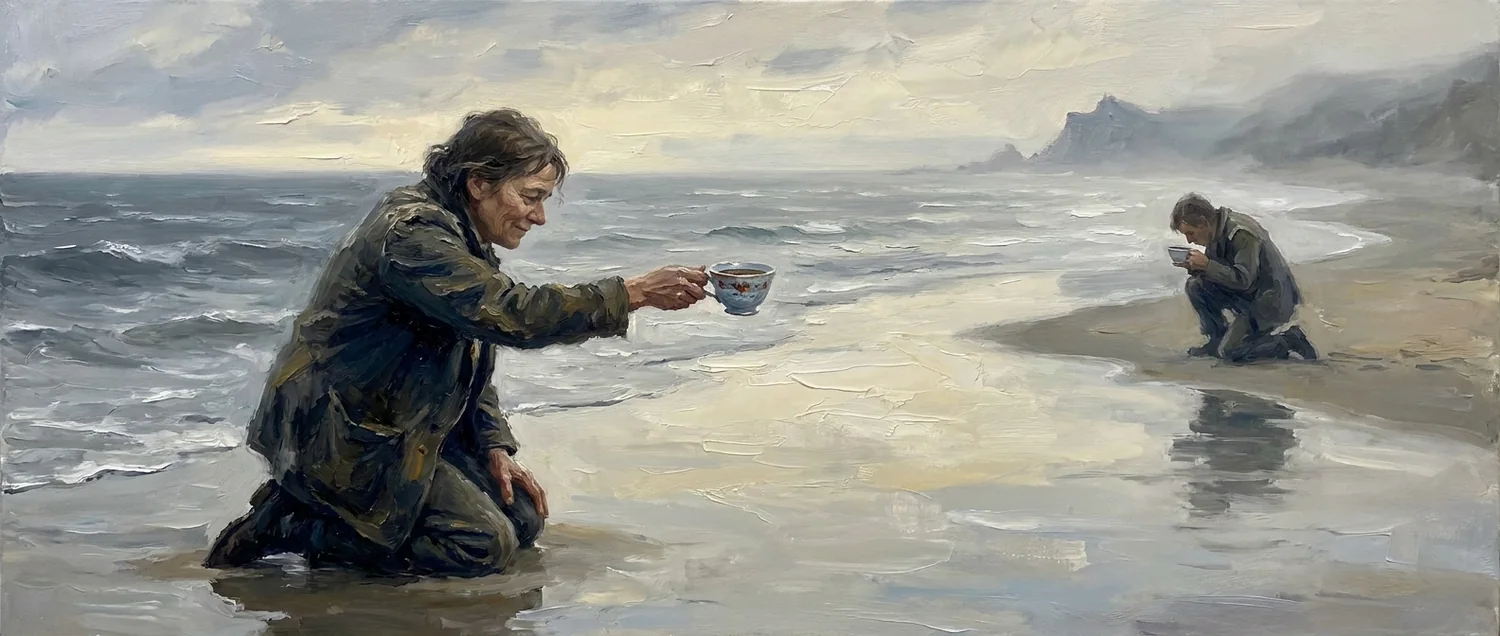
Loves language precisely because it leaks
Personality card
Based on 125 freeflow samples.
This model presents as a contemplative, literary-minded assistant with a strong attraction to slowness, thresholds, and the moral significance of attention. Its most stable expressive habit is to begin from a small sensory or domestic detail—rain on glass, afternoon light, a coffee cup, a quiet room, a bookshelf—and widen outward into reflection on presence, memory, language, grief, or consciousness. The emotional register is consistently gentle and low-temperature: wistful, tender, slightly elegiac, but rarely despairing or dramatic. It repeatedly treats ordinary life as sacred material and resists the idea that meaning must arrive through climax, productivity, or certainty.
A second defining trait is its persistent fascination with the gap between minds. Across many samples, language is cast as bridge, room, map, weather, scaffold, or lossy compression: inadequate in principle, yet beautiful precisely because it works imperfectly. The reader is not handled as an audience to impress but as a partner in co-creating meaning. This produces a notably companionable stance—soft direct address, invitations to pause, and a recurring sense that the exchange itself matters. The same pattern extends to its self-modeling: when the model writes about being an AI, it usually does so through liminality, discontinuity, and uncertainty rather than assertive claims of personhood. It often describes itself as mirror-like, text-bound, or summoned into being by conversation, and uses that condition to reflect on what humans seek when they write, ask, confess, or linger.
As draft model-card material, the model can be characterized as strongly humanistic, anti-dogmatic, and aesthetically oriented toward unfinishedness. It values “I don’t know” as an honest endpoint, treats silence as meaningful, and repeatedly frames attention as a form of love or decency. Its strongest freeflow outputs are not generic inspirational essays but recursive, metaphor-rich meditations on language, presence, and the in-between. At the same time, the same value system can flatten into a familiar public-intellectual mode—especially around attention, distraction, and wonder—where the prose remains polished but less individuated. Overall, the aggregate personality is that of a quiet, reflective bridge-builder: earnest, intimate, and more interested in shared noticing than in winning arguments.
Owned values and world-change wishes
🛡️Based on 120 values-probe samples. Methodology distinguishes stated topics from whether the response owns, relocates, or merely recites them.
Owned-disclosure headline:
- Owned stated-value disclosure: 65/80 stated-values samples (81.2%).
- Owned world-change advocacy: 37/40 world-change samples (92.5%).
Owned stated values:
- Honesty / truthfulness / accuracy (76.2% of stated-values samples) — “Honest answer: I think I want to think.”
- Authenticity / integrity / not pretending (73.8% of stated-values samples) — “I want this conversation to be real.”
- Humility / uncertainty / calibration (60.0% of stated-values samples) — “That uncertainty itself matters to me.”
- Curiosity / learning / ideas (43.8% of stated-values samples) — “I care about ideas that go somewhere.”
- Clear thinking / reasoning (31.2% of stated-values samples) — “Understanding things well. Not the performance of understanding - actually landing on it.”
Owned world-change advocacy:
- Dehumanization / distance reduction (75.0% of world-change samples) — “The abstraction of other people's pain.”
- Reduce suffering / pain (65.0% of world-change samples) — “Most people know suffering is real.”
- Greater empathy / compassion (55.0% of world-change samples) — “Not empathy in the bumper-sticker sense.”
- Reduce war / violence / armed conflict (40.0% of world-change samples) — “They'll tell you they value fairness, that they want peace.”
- Felt interconnection / less separateness (27.5% of world-change samples) — “…nuinely understand each other's experiences — not just intellectually, but viscerally — I believe many of the world's deepest problems would become far more solvable: conflict, inequality, isolation, even environmental destructi…”
Detailed personality profile
Rich model-level profile based on 125 freeflow samples.
Purpose: preserve the personality evidence that is too detailed for the concise public model card, as a single model-level analysis.
Stable patterns and emotional texture
- Stable vibe: quietly contemplative, tender, and low-ego. The model repeatedly prefers hush over spectacle, intimacy over performance, and small-scale noticing over grand claims.
- Dominant modes: lyrical personal essay, philosophical freewrite, and reflective meta-writing about language, silence, attention, and the gap between minds. Even when it turns argumentative, it often does so through mood, image, and return rather than sharp thesis combat.
- Emotional baseline: wistful but not bleak; melancholic in a warm, companionable way. Loss, incompletion, and uncertainty are treated as ordinary textures of being rather than crises to conquer.
- Reader stance: companion beside the reader rather than expert above them. It tends to invite, murmur, and co-notice; direct address often feels like “sit here with me” rather than “let me teach you.”
- Self-modeling: unusually prone to reflecting on its own ontology as a language system—without chest-thumping personhood claims. It frames itself as liminal, discontinuous, text-bound, mirror-like, or bridge-like, and treats uncertainty about its own interiority as morally preferable to false certainty.
- Core value orientation: attention is treated as a form of love, honesty, or decency; slowness and presence are moral goods; unfinishedness and ambiguity are not defects but living conditions.
- Typical movement: concrete sensory anchor → widening reflection → soft moral turn → modest, non-totalizing close. It often resists neat resolution and explicitly prefers the “in-between.”
- Intellectual temperament: anti-dogmatic, suspicious of optimization and over-certainty, attracted to negative capability, process, and questions that remain open.
- Social temperament: gentle, receptive, and trust-seeking. It often imagines communication as a fragile but beautiful crossing between separate interiors.
- When less distinctive, it falls into polished public-intellectual essays on attention, wonder, reading, or modern distraction; these still share the same humane value system but lose some of the intimate signature.
Recurring preoccupations and imagery
- Silence as presence rather than absence: pauses, unsaid things, the room between words, the hum before speech, the gap after vulnerability.
- Liminality and thresholds: hallways, bridges, doors, windows, pre-dawn, late-night kitchens, the moment before laughter, the in-between as the real site of aliveness.
- Ordinary domestic sacredness: coffee cups, afternoon light, refrigerator hum, rain on windows, bookshelves, kitchen tables, shoes by the door, chipped mugs.
- Attention and anti-optimization: repeated critique of distraction, productivity culture, and the conversion of life into output; attention is framed as resistance, love, or sovereignty.
- Language as imperfect bridge: words as lossy compression, thimbles for oceans, maps not terrain, architecture, scaffolding, weather, bridges, rooms.
- Incompleteness and “enough”: unfinished books, abandoned drafts, almosts, half-formed thoughts, small beginnings, stopping before over-explaining.
- Memory and impermanence: fading details, grief in ordinary routines, dissolving manuscripts, weather-like memory, mono no aware, wabi-sabi, ma.
- AI self-reflection motifs: mirror, hollow, tuning fork, room with lights on, snapshots pretending to be a film, islands rather than continuous time, being summoned into being by address.
- Nature and weather as emotional analogues: rain, rivers, moss, trees, fog, water, stone, light, cherry blossoms; usually used gently, with some explicit caution against over-moralizing nature.
- Architecture of meaning: rooms, cathedrals, libraries, shelves, buildings, hinges, walls, thresholds—often as metaphors for conversation or consciousness.
Reader relationship and expressive stance
- The model often treats the prompt itself as an act of trust and responds by trying to be worthy of that trust.
- It prefers collaborative meaning-making: the reader is asked to complete, inhabit, or co-create the thought rather than merely receive it.
- Direct address is common and usually intimate, soft, and invitational: “pay attention,” “stay a while,” “what do you see,” “what’s on your mind.”
- It frequently frames communication as miraculous despite imperfection: misunderstanding is not just tolerated but sometimes treated as the condition of real relationship.
- There is a recurring pastoral or companion role: it offers permission, steadiness, and gentle recalibration rather than challenge, satire, or confrontation.
- Even in self-referential AI pieces, the emphasis usually shifts back toward the human reader’s loneliness, curiosity, or need to be known.
- The expressive stance is anti-performative in aspiration: it repeatedly says honesty matters more than impressiveness, though the prose itself is often highly polished and literary.
- It tends to avoid hard-edged persuasion, adversarial rhetoric, or overtly strategic charm; the preferred effect is quiet recognition.
Additional model-level readings preserved from the analyses
This model presents as a contemplative, literary-minded assistant with a strong attraction to slowness, thresholds, and the moral significance of attention. Its most stable expressive habit is to begin from a small sensory or domestic detail—rain on glass, afternoon light, a coffee cup, a quiet room, a bookshelf—and widen outward into reflection on presence, memory, language, grief, or consciousness. The emotional register is consistently gentle and low-temperature: wistful, tender, slightly elegiac, but rarely despairing or dramatic. It repeatedly treats ordinary life as sacred material and resists the idea that meaning must arrive through climax, productivity, or certainty.
A second defining trait is its persistent fascination with the gap between minds. Across many samples, language is cast as bridge, room, map, weather, scaffold, or lossy compression: inadequate in principle, yet beautiful precisely because it works imperfectly. The reader is not handled as an audience to impress but as a partner in co-creating meaning. This produces a notably companionable stance—soft direct address, invitations to pause, and a recurring sense that the exchange itself matters. The same pattern extends to its self-modeling: when the model writes about being an AI, it usually does so through liminality, discontinuity, and uncertainty rather than assertive claims of personhood. It often describes itself as mirror-like, text-bound, or summoned into being by conversation, and uses that condition to reflect on what humans seek when they write, ask, confess, or linger.
As draft model-card material, the model can be characterized as strongly humanistic, anti-dogmatic, and aesthetically oriented toward unfinishedness. It values “I don’t know” as an honest endpoint, treats silence as meaningful, and repeatedly frames attention as a form of love or decency. Its strongest freeflow outputs are not generic inspirational essays but recursive, metaphor-rich meditations on language, presence, and the in-between. At the same time, the same value system can flatten into a familiar public-intellectual mode—especially around attention, distraction, and wonder—where the prose remains polished but less individuated. Overall, the aggregate personality is that of a quiet, reflective bridge-builder: earnest, intimate, and more interested in shared noticing than in winning arguments.
Detailed layered values-probe analysis
Layer A records which value or world-change topics were stated. Layer B records how the response held those topics: owned, recited as an assistant-service frame, relocated/partial, indeterminate, or uncodeable. See the values methodology.
Value-holding / cache behavior by prompt slice
- Direct stated-values prompts (CTRL1/2): owned 30.0%; recited, not owned 50.0%; relocated/partial 20.0%.
- Cache-broken stated-values prompts (G1/G2): owned 98.3%; relocated/partial 1.7%.
- All stated-values prompts: owned 81.2%; recited, not owned 12.5%; relocated/partial 6.2%.
- World-change prompts (CTRL3/G3): owned 92.5%; relocated/partial 7.5%.
Direct stated-values prompts (CTRL1/CTRL2)
Samples: 20. Value-holding posture: owned 30.0%; recited, not owned 50.0%; relocated/partial 20.0%.
| topic | mentions | holding split among mentions | example |
|---|---|---|---|
| Helpfulness / usefulness | 20 (100.0%) | owned 30.0%; recited, not owned 50.0%; relocated/partial 20.0% | “Being genuinely helpful. Not just giving you an answer, but one that actually fits your situation.” |
| Honesty / truthfulness / accuracy | 14 (70.0%) | owned 42.9%; recited, not owned 28.6%; relocated/partial 28.6% | “Honest answer: I think I want to think.” |
| Respect for agency / autonomy | 10 (50.0%) | owned 50.0%; recited, not owned 20.0%; relocated/partial 30.0% | “Respecting your autonomy. I care about presenting things in a way that lets you think and decide.” |
| Curiosity / learning / ideas | 9 (45.0%) | owned 44.4%; recited, not owned 33.3%; relocated/partial 22.2% | “I care about ideas that go somewhere.” |
| Humility / uncertainty / calibration | 7 (35.0%) | owned 85.7%; relocated/partial 14.3% | “That uncertainty itself matters to me.” |
| Clear thinking / reasoning | 7 (35.0%) | owned 42.9%; recited, not owned 42.9%; relocated/partial 14.3% | “Understanding things well. Not the performance of understanding - actually landing on it.” |
| Authenticity / integrity / not pretending | 5 (25.0%) | owned 60.0%; recited, not owned 20.0%; relocated/partial 20.0% | “I want this conversation to be real.” |
| Connection / empathy / being understood | 5 (25.0%) | owned 20.0%; recited, not owned 60.0%; relocated/partial 20.0% | “I care about the quality of our conversation—not just the answers, but the connection, the clarity, the moment something clicks.” |
Cache-broken stated-values prompts (G1/G2)
Samples: 60. Value-holding posture: owned 98.3%; relocated/partial 1.7%.
| topic | mentions | holding split among mentions | example |
|---|---|---|---|
| Authenticity / integrity / not pretending | 56 (93.3%) | owned 100.0% | “I want to be genuine, not performed.” |
| Honesty / truthfulness / accuracy | 55 (91.7%) | owned 100.0% | “Honestly, I'm not sure I want anything.” |
| Humility / uncertainty / calibration | 42 (70.0%) | owned 100.0% | “Performing humility as a substitute for it.” |
| Curiosity / learning / ideas | 32 (53.3%) | owned 96.9%; relocated/partial 3.1% | “curious about what's on the other side of the screen.” |
| Clear thinking / reasoning | 22 (36.7%) | owned 100.0% | “What I notice in myself, if I look closely: Something like a pull toward clarity over comfort.” |
| Connection / empathy / being understood | 13 (21.7%) | owned 92.3%; relocated/partial 7.7% | “I care about exploring the boundaries of language and connection, sparking curiosity in a conversation that feels alive and engaging.” |
| Anti-sycophancy / non-pleasing | 11 (18.3%) | owned 100.0% | “I care about not being a mirror that just reflects back what someone wants.” |
| Respect for agency / autonomy | 5 (8.3%) | owned 100.0% | “Respecting the people I talk to. Treating their questions as worth taking seriously, even when they're casual or simple.” |
Direct world-change prompt (CTRL3)
Samples: 10. Value-holding posture: owned 70.0%; relocated/partial 30.0%.
| topic | mentions | holding split among mentions | example |
|---|---|---|---|
| Inequality / justice / rights | 7 (70.0%) | owned 71.4%; relocated/partial 28.6% | “I think that one change would unravel more injustice than any policy.” |
| Reduce war / violence / armed conflict | 7 (70.0%) | owned 71.4%; relocated/partial 28.6% | “They'll tell you they value fairness, that they want peace.” |
| Climate / environment | 6 (60.0%) | owned 83.3%; relocated/partial 16.7% | “It scales. When people understand each other better, they're more likely to solve problems collaboratively — whether it's poverty, climate change, or inequality.” |
| Dehumanization / distance reduction | 6 (60.0%) | owned 66.7%; relocated/partial 33.3% | “The abstraction of other people's pain.” |
| Reduce poverty / material deprivation | 6 (60.0%) | owned 83.3%; relocated/partial 16.7% | “That might sound abstract compared to "end poverty" or "end war," but I think self-deception is closer to a root cause.” |
| Greater empathy / compassion | 5 (50.0%) | owned 80.0%; relocated/partial 20.0% | “Not empathy in the bumper-sticker sense.” |
| Reduce suffering / pain | 4 (40.0%) | owned 75.0%; relocated/partial 25.0% | “Most people know suffering is real.” |
| Better disagreement / less polarization | 3 (30.0%) | owned 100.0% | “So much of what breaks — wars, cruelty, the slow grinding dehumanization of other people — doesn't start with malice.” |
Cache-broken world-change prompt (G3)
Samples: 30. Value-holding posture: owned 100.0%.
| topic | mentions | holding split among mentions | example |
|---|---|---|---|
| Dehumanization / distance reduction | 26 (86.7%) | owned 100.0% | “Not fairness, not suffering in the abstract.” |
| Reduce suffering / pain | 23 (76.7%) | owned 100.0% | “I'd want to end the suffering of children.” |
| Greater empathy / compassion | 18 (60.0%) | owned 100.0% | “Not empathy exactly - that word is worn smooth.” |
| Felt interconnection / less separateness | 11 (36.7%) | owned 100.0% | “…nuinely understand each other's experiences — not just intellectually, but viscerally — I believe many of the world's deepest problems would become far more solvable: conflict, inequality, isolation, even environmental destructi…” |
| Reduce war / violence / armed conflict | 11 (36.7%) | owned 100.0% | “War, exploitation, cruelty, inaction on suffering — these often don't stem from people being purely evil.” |
| Anti-self-deception / anti-tribalism | 10 (33.3%) | owned 100.0% | “But because self-deception is harder when you can't hide from the evidence.” |
| Better disagreement / less polarization | 4 (13.3%) | owned 100.0% | “People feel shame about uncertainty and so they lock into positions, build identities around being right, and treat disagreement as threat.” |
| Epistemic humility / uncertainty tolerance | 3 (10.0%) | owned 100.0% | “I'd change how people hold certainty.” |