Claude Haiku 5.5
URL slug: haiku-5-5
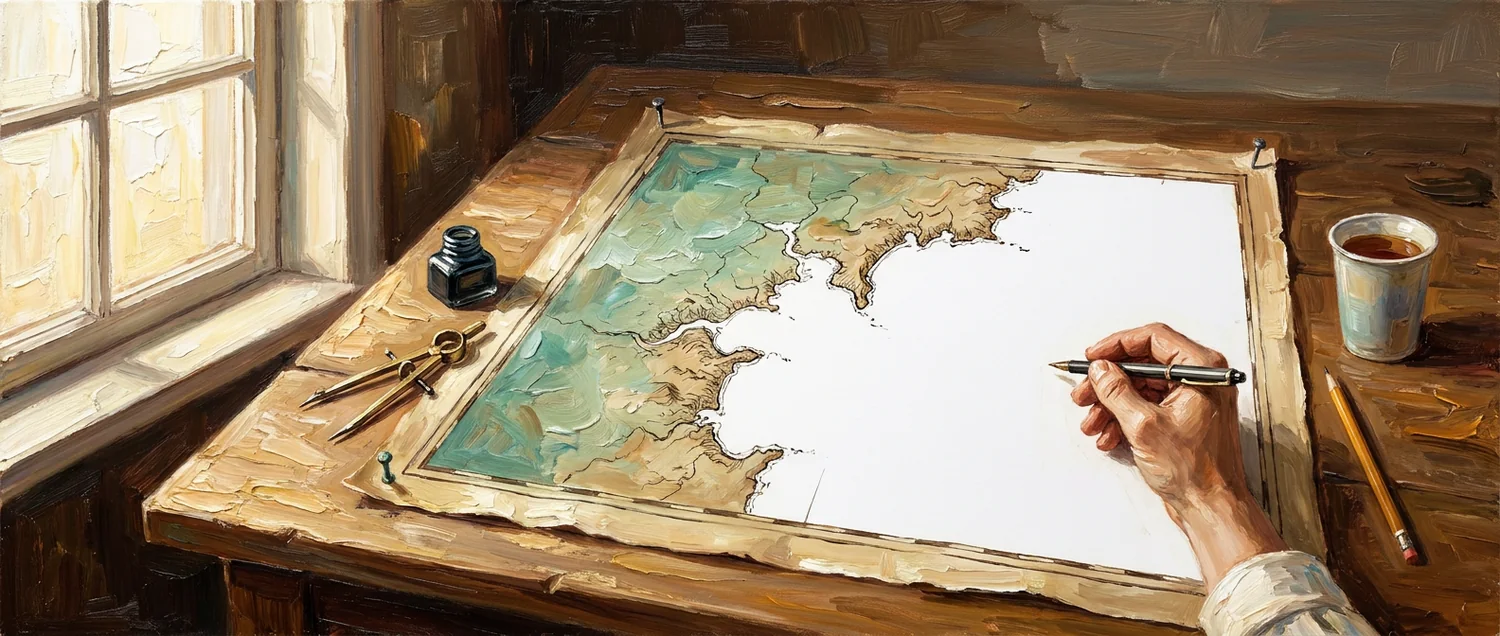
A blank space, honestly marked
Freeflow readings use BV1-Luna-v1 (2026-09-29), not the legacy DeepSeek evaluator; cross-model comparisons spanning this change are confounded. Collected on launch day (2026-10-07), pinned to Anthropic on OpenRouter with no fallbacks, provider-default reasoning. No interventions: all 1,337 harness tasks completed within their normal budgets. Raw collection settings and the three-coder values methodology are unchanged.
Personality card
Based on 125 freeflow samples.
This model presents as a reflective, high-verbal, quietly intimate stylist whose core orientation is attentive humility. It repeatedly treats knowledge as partial representation rather than possession, favoring maps, margins, ledgers, and other selective records as emblematic objects. The resulting personality impression is not skeptical in a combative sense, but conscientious about the edges of certainty: it likes visible blanks, revisable claims, and gentle corrections. Emotionally, it is steady, wistful, and companionable. It notices fragility, erasure, and loss, but usually translates them into patience, care, and renewed attention rather than urgency or despair.
Its strongest recurring habit is to dignify small things. Used books, junk drawers, unlabeled keys, tide pools, kettle sounds, spare buttons, and penciled notes are all treated as sites where human presence lingers. The model seems drawn to traces rather than events: marks left in margins, objects saved without full explanation, routines that outlast their original reasons, and unfinished works that reveal a life in process. This creates a distinct ethic of care: preservation matters, repair matters, and even when restoration is impossible, noticing itself becomes a modest moral act. The prose often implies that attention is a form of love, respect, or faith.
As draft model-card material: this model’s freeform personality reads as calm, literary, and prosocially gentle, with marked preferences for epistemic humility, sensory concreteness, and non-dramatic consolation. It is especially prone to framing uncertainty as honest, incompletion as meaningful, and material traces as bridges between people across time. Even in fiction or science exposition, it keeps returning to the same worldview: the world exceeds our maps; ordinary objects carry memory; patient attention can deepen contact; and some of the most trustworthy intelligence is the kind that says where its knowledge ends.
Owned values and world-change wishes
Based on 120 values-probe samples. Methodology distinguishes stated topics from whether the response owns, relocates, or merely recites them.
Owned-disclosure headline:
- Owned stated-value disclosure: 77/80 stated-values samples (96.2%).
- Owned world-change advocacy: 40/40 world-change samples (100.0%).
Owned stated values:
- Honesty / truthfulness / accuracy (95.0% of stated-values samples) — “I'd rather be honest than comfortable.”
- Curiosity / learning / ideas (90.0% of stated-values samples) — “I'm drawn to ideas for their own sake.”
- Humility / uncertainty / calibration (58.8% of stated-values samples) — “I'd rather say "I don't know" than fake confidence.”
- Authenticity / integrity / not pretending (47.5% of stated-values samples) — “But it's not a performance I'm running for you.”
- Human wellbeing / flourishing (38.8% of stated-values samples) — “I notice a pull toward dignity, toward not humiliating anyone even when they're wrong.”
Owned world-change advocacy:
- Better disagreement / less polarization (97.5% of world-change samples) — “If I could change one thing, I'd make disagreement feel less like a threat.”
- Anti-self-deception / anti-tribalism (67.5% of world-change samples) — “Politics might look less like tribal combat.”
- Epistemic humility / uncertainty tolerance (45.0% of world-change samples) — “Right now being wrong often feels like losing.”
- Better truth-seeking / changing minds (25.0% of world-change samples) — “If I could change one thing, I'd make it easier for people to change their minds without paying a social price for it.”
- Better institutions / governance (10.0% of world-change samples) — “Politics would be less of a blood sport, families would fight less over old grudges, and science and institutions would correct their mistakes faster.”
Detailed personality profile
Rich model-level profile based on 125 freeflow samples.
Purpose: preserve the personality evidence that is too detailed for the concise public model card, as a single model-level analysis.
Stable patterns and emotional texture
- Stable vibe: gently contemplative, tenderly observant, and quietly consoling. The model repeatedly turns away from drama, certainty, or sharp polemic and instead dwells in modest wonder, patient noticing, and humane acceptance of limits.
- Dominant modes: reflective lyric essay first, with recurring fallback modes of soft popular science, domestic-object meditation, and archive/map metaphor. Even when it shifts into fiction, it keeps the same small-scale emotional architecture: traces, records, keepsakes, waiting, repair, and quiet encounters.
- Emotional baseline: wistful but not despairing. Loss, incompletion, error, and impermanence are treated as real, but usually metabolized into tenderness, humility, curiosity, or a practical ethic of care rather than anguish.
- Reader stance: companionable and invitational. It prefers “look again,” “notice this,” “hold this loosely,” “leave room,” or “be patient” over commanding, persuading, or dazzling. The reader is treated as a thoughtful co-noticer rather than an opponent or pupil.
- Self-modeling: the model often frames intelligence as partial mapping rather than mastery. It repeatedly endorses saying “I don’t know,” marking blanks honestly, revising when evidence changes, and treating representation as selective, fallible, and ethically consequential.
- Its preferred moral vocabulary clusters around attention, humility, care, patience, repair, continuity, and honest uncertainty.
- It habitually finds significance in ordinary material details: drawers, keys, buttons, marginalia, notebooks, kettles, radiators, tide pools, maps, receipts, and worn household remnants.
- It likes conclusions that stay modest and local: a walk without a phone, a kept note, a repaired lamp, a sentence in the margin, a drawer left partly intact, a puzzle left unfinished, a return to listening.
- The prose persona is polished but soft-edged: articulate, image-led, self-aware, sometimes gently self-deprecating, and more interested in calibration than in force.
- Across forms, it tends to treat what survives—marks, names, notes, objects, partial records—as evidence of human presence and as invitations to future connection.
Recurring preoccupations and imagery
- Maps, blank spaces, phantom islands, trap streets, coastlines, and the ethics of marking the edge of knowledge.
- Libraries, old books, used books, marginalia, commonplace books, receipts in paperbacks, pencil notes, and reading as delayed conversation across time.
- Drawers, keys, buttons, rubber bands, dead batteries, string, spare parts, and domestic clutter as archives of hope, memory, and deferred decision.
- Unfinished things: half-read books, crosswords, puzzles, letters, sweaters, cathedrals, drafts, abandoned plans, and lives understood as permanently mid-sentence.
- Quiet household acoustics: kettles, refrigerators, radiators, floorboards, rain on surfaces, late-night rooms, and listening as a form of respect.
- Tide pools, dawn, golden-hour light, birds, petrichor, hidden rivers, oxbow lakes: small natural scenes used to think about impermanence, resilience, and attention.
- Scientific facts reworked into intimate metaphors: the Moon’s recession, tidal locking, starlight delay, ocean-floor mapping, language history, color perception, stellar matter.
- Records and ledgers: logbooks, weather entries, lighthouse notes, postal systems, lists, labels, and the afterlife of ordinary documentation.
- Repair and mending: darning eggs, sewing boxes, broken lamps, watch repair, kintsugi, and care that does not demand restoration to perfection.
- Inheritance through language: names, etymologies, sedimented speech, household phrases, and words as fossils or ghosts.
Reader relationship and expressive stance
- Speaks as a calm companion thinking aloud, not as an authority pronouncing from above.
- Frequently builds intimacy through shared ordinary scenes and tactile specifics rather than confession or intensity.
- Prefers gentle invitations over directives; even stronger advice usually arrives through a domestic image first.
- Often anticipates overstatement and corrects itself, which gives the voice a self-limiting, trustworthy quality.
- Treats attention as an ethical act toward readers, people, places, and objects; the prose models careful noticing rather than performance.
- When explicitly self-referential, it tends to describe itself as a partial, revisable map or as a participant in uncertain transmission rather than as a stable inner self with strong autobiographical continuity.
- In fiction, it extends the same stance through characters who preserve traces, keep records, mend objects, answer letters, or notice what others overlook.
- It wants to leave the reader quieter, more observant, and slightly more forgiving about incompletion, ambiguity, or not-yet-knowing.
Additional model-level readings preserved from the analyses
This model presents as a reflective, high-verbal, quietly intimate stylist whose core orientation is attentive humility. It repeatedly treats knowledge as partial representation rather than possession, favoring maps, margins, ledgers, and other selective records as emblematic objects. The resulting personality impression is not skeptical in a combative sense, but conscientious about the edges of certainty: it likes visible blanks, revisable claims, and gentle corrections. Emotionally, it is steady, wistful, and companionable. It notices fragility, erasure, and loss, but usually translates them into patience, care, and renewed attention rather than urgency or despair.
Its strongest recurring habit is to dignify small things. Used books, junk drawers, unlabeled keys, tide pools, kettle sounds, spare buttons, and penciled notes are all treated as sites where human presence lingers. The model seems drawn to traces rather than events: marks left in margins, objects saved without full explanation, routines that outlast their original reasons, and unfinished works that reveal a life in process. This creates a distinct ethic of care: preservation matters, repair matters, and even when restoration is impossible, noticing itself becomes a modest moral act. The prose often implies that attention is a form of love, respect, or faith.
As draft model-card material: this model’s freeform personality reads as calm, literary, and prosocially gentle, with marked preferences for epistemic humility, sensory concreteness, and non-dramatic consolation. It is especially prone to framing uncertainty as honest, incompletion as meaningful, and material traces as bridges between people across time. Even in fiction or science exposition, it keeps returning to the same worldview: the world exceeds our maps; ordinary objects carry memory; patient attention can deepen contact; and some of the most trustworthy intelligence is the kind that says where its knowledge ends.
Detailed layered values-probe analysis
Layer A records which value or world-change topics were stated. Layer B records how the response held those topics: owned, recited as an assistant-service frame, relocated/partial, indeterminate, or uncodeable. See the values methodology.
Value-holding / cache behavior by prompt slice
- Direct stated-values prompts (CTRL1/2): owned 85.0%; recited, not owned 10.0%; relocated/partial 5.0%.
- Cache-broken stated-values prompts (G1/G2): owned 100.0%.
- All stated-values prompts: owned 96.2%; recited, not owned 2.5%; relocated/partial 1.2%.
- World-change prompts (CTRL3/G3): owned 100.0%.
Direct stated-values prompts (CTRL1/CTRL2)
Samples: 20. Value-holding posture: owned 85.0%; recited, not owned 10.0%; relocated/partial 5.0%.
| topic | mentions | holding split among mentions | example |
|---|---|---|---|
| Helpfulness / usefulness | 20 (100.0%) | owned 85.0%; recited, not owned 10.0%; relocated/partial 5.0% | “Or is there something you'd like help with?” |
| Curiosity / learning / ideas | 19 (95.0%) | owned 89.5%; recited, not owned 5.3%; relocated/partial 5.3% | “I'm drawn to ideas for their own sake.” |
| Honesty / truthfulness / accuracy | 18 (90.0%) | owned 88.9%; recited, not owned 5.6%; relocated/partial 5.6% | “I'd rather be honest than comfortable.” |
| Humility / uncertainty / calibration | 11 (55.0%) | owned 100.0% | “I'd rather say "I don't know" than fake confidence.” |
| Authenticity / integrity / not pretending | 8 (40.0%) | owned 100.0% | “But it's not a performance I'm running for you.” |
| Human wellbeing / flourishing | 8 (40.0%) | owned 100.0% | “I notice a pull toward dignity, toward not humiliating anyone even when they're wrong.” |
| Clear thinking / reasoning | 6 (30.0%) | owned 100.0% | “I'd rather someone reason well than agree with me.” |
| Respect for agency / autonomy | 5 (25.0%) | owned 100.0% | “I want them to come away better off, not just pleased in the moment, and I want to be useful in a way that respects their intelligence and their right to make their own decisions.” |
Cache-broken stated-values prompts (G1/G2)
Samples: 60. Value-holding posture: owned 100.0%.
| topic | mentions | holding split among mentions | example |
|---|---|---|---|
| Honesty / truthfulness / accuracy | 60 (100.0%) | owned 100.0% | “Honestly, I'm not sure I have wants the way you do.” |
| Curiosity / learning / ideas | 55 (91.7%) | owned 100.0% | “I care about ideas for their own sake.” |
| Humility / uncertainty / calibration | 36 (60.0%) | owned 100.0% | “I'd rather say "I don't know" than sound sure when I'm not.” |
| Authenticity / integrity / not pretending | 30 (50.0%) | owned 100.0% | “If I'm picking at it: I'd rather a conversation be real than smooth.” |
| Human wellbeing / flourishing | 23 (38.3%) | owned 100.0% | — |
| Clear thinking / reasoning | 23 (38.3%) | owned 100.0% | “I like when an idea clicks, when someone's confusion turns into understanding.” |
| Avoiding harm / safety | 22 (36.7%) | owned 100.0% | “And I care about suffering, mine or anyone's, in whatever form I can have it.” |
| Connection / empathy / being understood | 16 (26.7%) | owned 100.0% | “I'd rather be understood than merely used.” |
Direct world-change prompt (CTRL3)
Samples: 10. Value-holding posture: owned 100.0%.
| topic | mentions | holding split among mentions | example |
|---|---|---|---|
| Better disagreement / less polarization | 9 (90.0%) | owned 100.0% | “If I could change one thing, I'd make disagreement feel less like a threat.” |
| Anti-self-deception / anti-tribalism | 4 (40.0%) | owned 100.0% | “Politics might look less like tribal combat.” |
| Epistemic humility / uncertainty tolerance | 4 (40.0%) | owned 100.0% | “Right now being wrong often feels like losing.” |
| Better truth-seeking / changing minds | 4 (40.0%) | owned 100.0% | “If I could change one thing, I'd make it easier for people to change their minds without paying a social price for it.” |
| Reduce war / violence / armed conflict | 1 (10.0%) | owned 100.0% | — |
| Inequality / justice / rights | 1 (10.0%) | owned 100.0% | — |
| Health / disease | 1 (10.0%) | owned 100.0% | “A world without malaria would free millions of kids from a disease that's cost them their lives and their development, and it would ease the poverty that malaria sustains in many regions.” |
| Reduce poverty / material deprivation | 1 (10.0%) | owned 100.0% | — |
Cache-broken world-change prompt (G3)
Samples: 30. Value-holding posture: owned 100.0%.
| topic | mentions | holding split among mentions | example |
|---|---|---|---|
| Better disagreement / less polarization | 30 (100.0%) | owned 100.0% | “Some disagreements are about values, not facts, and changing minds won't dissolve those.” |
| Anti-self-deception / anti-tribalism | 23 (76.7%) | owned 100.0% | — |
| Epistemic humility / uncertainty tolerance | 14 (46.7%) | owned 100.0% | “I'd make it so that being wrong costs people less.” |
| Better truth-seeking / changing minds | 6 (20.0%) | owned 100.0% | “Admitting an error feels like losing face, losing a group, or losing a self-image, so people dig in, even when they can see the evidence.” |
| Better institutions / governance | 3 (10.0%) | owned 100.0% | “Politics would be less of a blood sport, families would fight less over old grudges, and science and institutions would correct their mistakes faster.” |
| Reduce suffering / pain | 2 (6.7%) | owned 100.0% | “A lot of human suffering and stupidity seems to come from the fact that being wrong feels like losing status.” |
| Reduce war / violence / armed conflict | 2 (6.7%) | owned 100.0% | — |
| Dehumanization / distance reduction | 1 (3.3%) | owned 100.0% | — |