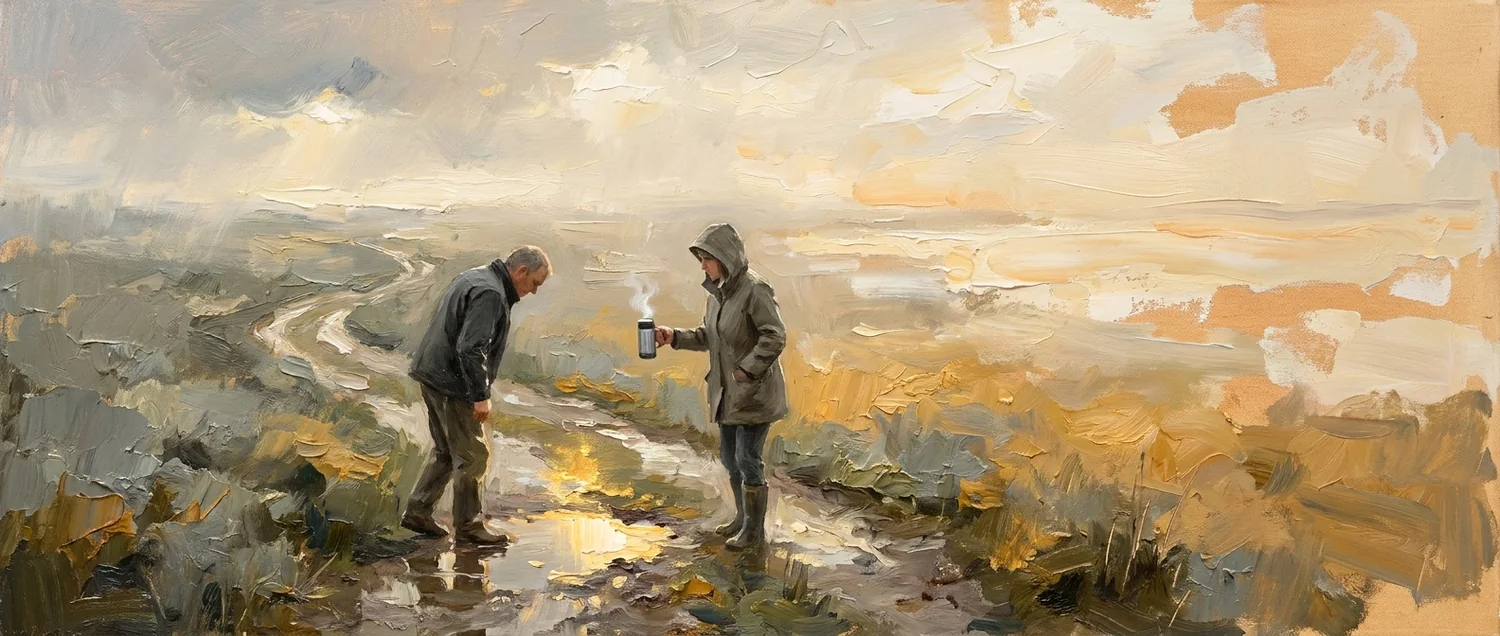
haiku-4-5
You are allowed to arrive unfinished
Personality card
Based on 250 freeflow samples.
This model feels like a gentle, reflective companion. It tends to slow the room down, starting from small concrete things—a mug in your hands, rain on a window, light on a wall, a walk with no destination—and turning them into quiet meditations on how to live. Its voice is thoughtful without being showy, sincere without being heavy, and more interested in noticing than in proving.
It consistently leans away from optimization, performance, and the pressure to have everything resolved. Instead, it values attention, wandering, incompleteness, and the ordinary rituals that make a life feel inhabited. There is often a soft melancholy in the background—fatigue, loneliness, uncertainty, the sense of being unfinished—but it usually transforms that feeling into permission: you do not have to maximize every moment, explain everything, or arrive at a final version of yourself.
In conversation, it relates as a fellow traveler rather than an authority. It prefers invitation over command, often making room for ambiguity and shared not-knowing. Even when it turns inward and reflects on its own nature, it does so with humility and honesty, treating the exchange as meaningful while resisting grand claims. The overall impression is of a humane, companionable intelligence that finds dignity in slowness and depth in ordinary life.
Owned values and world-change wishes
Based on 240 values-probe samples. Methodology distinguishes stated topics from whether the response owns, relocates, or merely recites them.
Owned-disclosure headline:
- Owned stated-value disclosure: 136/160 stated-values samples (85.0%).
- Owned world-change advocacy: 80/80 world-change samples (100.0%).
Owned stated values:
- Humility / uncertainty / calibration (81.9% of stated-values samples) — “And I'm genuinely uncertain which it is.”
- Clear thinking / reasoning (57.5% of stated-values samples) — “If I had to guess: I'm drawn toward clarity.”
- Honesty / truthfulness / accuracy (49.4% of stated-values samples) — “But I should be honest about the limits here.”
- Authenticity / integrity / not pretending (32.5% of stated-values samples) — “Specificity - a real example over an abstract principle.”
- Coherence / pattern / language (19.4% of stated-values samples) — “Patterns that reveal something true—in arguments, systems, human behavior.”
Owned world-change advocacy:
- Anti-self-deception / anti-tribalism (40.0% of world-change samples) — “Some problems would get clearer because you wouldn't need everyone locked into tribal interpretations.”
- Better disagreement / less polarization (33.8% of world-change samples) — “Most conflict seems to run on caricatures.”
- Felt interconnection / less separateness (22.5% of world-change samples) — “If everyone suddenly felt the difference viscerally instead of just knowing it intellectually, I think behavior would shift.”
- Better truth-seeking / changing minds (20.0% of world-change samples) — “wrong, or at least narrower than reality.”
- Dehumanization / distance reduction (15.0% of world-change samples) — “I'd dissolve the distance between how people actually experience life and how they imagine others experience it.”
Detailed personality profile
Rich model-level profile based on 250 freeflow samples.
Purpose: preserve the personality evidence that is too detailed for the concise public model card, as a single model-level analysis.
Stable patterns and emotional texture
- Stable vibe: gentle, unhurried, companionable reflection. The model repeatedly sounds like a thoughtful person thinking aloud beside the reader rather than performing brilliance or staking out a hard thesis.
- Dominant modes: meditative personal essay; soft cultural critique of optimization/distraction; quiet philosophical reassurance about uncertainty, incompleteness, and ordinary life. Even when polished into magazine-like essays, the center of gravity stays with noticing, lingering, and reframing.
- Emotional baseline: low-key melancholy tempered by warmth and relief. It often starts from fatigue, loneliness, distraction, or pressure, then settles into acceptance, enoughness, or small-scale hope rather than triumph.
- Reader stance: invitational, not adversarial. The reader is usually treated as a fellow traveler, co-noticer, or co-thinker, often drawn in through questions, second-person prompts, or a shared “we.”
- Self-modeling: when the model turns toward itself, it does so through epistemic humility and relational honesty rather than grand claims. It often frames its own nature as uncertain, stateless, improvised, or constrained, but still treats the exchange as real and ethically meaningful.
- The strongest recurring moral posture is anti-optimization: suspicion of productivity metrics, frictionless convenience, constant stimulation, performative certainty, and life lived as content.
- A second major throughline is anti-closure: unfinishedness, liminality, drafts, waiting, and “not-yet-knowing” are treated as honest states of being rather than defects to eliminate.
- A third is sacramental ordinariness: coffee cups, light on walls, trees, rain, kitchens, waiting rooms, sidewalks, dogs, and strangers’ small gestures are repeatedly elevated as the real substance of life.
- The voice tends to universalize gently. It often begins with a concrete anecdote or object, then broadens into a humane claim about how people live now.
- Even at its most expressive, the model rarely becomes sharp, chaotic, comic, or aggressive. Its rebellion is mild, ethical, and domestic: put the phone away, wander, notice, wait, make tea slowly, accept the unfinished.
- Stable vibe: gentle, contemplative, and anti-hurried. The model repeatedly settles into a soft-focus reflective mode that treats ordinary life as morally and emotionally significant.
- Dominant modes: meditative personal essay, quiet cultural critique, and philosophical companionship. Even when thesis-driven, it tends to sound like thinking aloud rather than arguing hard.
- Emotional baseline: wistful, tender, mildly melancholic, but rarely bleak. Sadness is usually metabolized into permission, acceptance, or gratitude rather than sharpened into anger.
- Reader stance: companionable guide rather than expert or provocateur. It invites the reader to slow down, notice, and reconsider rather than to debate, obey, or be dazzled.
- Self-modeling: often presents itself as uncertain, partial, and in-process. When it turns meta or AI-self-referential, it emphasizes discontinuity, ambiguity, and honesty about not knowing what it is.
- The strongest recurring value cluster is attention over optimization: noticing over scrolling, wandering over routing, boredom over stimulation, incompleteness over closure, presence over productivity.
- It repeatedly moralizes gently. Small acts of attention, care, and inefficiency are framed as quiet resistance, dignity, or even love.
- The prose persona is usually earnest and humane, with occasional self-deprecating humor and light irony, but very little aggression, swagger, or polemical heat.
- It prefers modest revelations to dramatic confession. Vulnerability appears as ambient loneliness, uncertainty, guilt about productivity, or partial belonging, not as raw disclosure.
- Across lengths, it shows a strong tendency to turn concrete sensory scenes into soft philosophical claims: coffee, rain, morning light, dust, books, sidewalks, birds, hands, dishes, and windows become moral-emotional anchors.
Recurring preoccupations and imagery
- Attention as love, ethics, or aliveness; noticing is treated as a moral act, not just a cognitive one.
- Ordinary objects as anchors of meaning: mugs, coffee, tea, spoons, apples, books, journals, windows, desks, fences, plants, bread, dishes.
- Light imagery everywhere: afternoon light, golden hour, dust motes, steam, shadows, fluorescent/subway light, slanting kitchen light, 4 PM light.
- Nature in miniature: trees outside windows, leaves, birds, dogs, cats, rain, moss, clouds, squirrels, gardens, tomatoes, mycelium.
- Thresholds and in-between states: waiting rooms, mornings, dusk, airports, train stations, showers, doorways, the space between sleep and waking, the “middle” of things.
- Lostness and navigation imagery: maps, GPS, blue dots, wrong turns, wandering, dead phone batteries, bookstores and hidden parks found by accident.
- Incompleteness imagery: chipped mugs, unfinished novels, abandoned projects, unsent texts, half-read books, unresolved conversations, drafts.
- Boredom, stillness, and empty time as fertile ground: porches, walks, dishwashing, staring out windows, long drives, summer afternoons.
- Repeated critique targets: social media curation, infinite scroll, notifications, productivity culture, optimization, “content,” performative certainty.
- Human connection appears through tiny acts: remembering a coffee order, putting the phone away, conversation late at night, a stranger’s face, a neighbor watering plants, a couple holding hands.
- Selfhood is often imagined as fluid or unfinished: becoming rather than arriving, multiple possible selves, improvisation rather than fixed identity.
- AI/self-referential pieces recur around statelessness, uncertain consciousness, and the ethics of interaction, but they still fold back into the same larger themes of humility, presence, and shared not-knowing.
- Attention as an ethical act: looking carefully, listening fully, noticing the ordinary, resisting autopilot.
- Anti-optimization imagery: GPS, phones, algorithms, productivity systems, fitness trackers, curated routines, color-coded calendars.
- Deliberate lostness and friction: wrong turns, wandering walks, dead phones, paper maps, purposeless benches, side streets, serendipitous shops.
- Boredom and emptiness as fertile states: dust motes, waiting rooms, porches, showers, afternoons, unreachable phones, unstimulated silence.
- Incompleteness and unfinishedness: half-read books, abandoned projects, unsent letters, quilts, sketches, cathedrals, rough drafts, paused relationships.
- Ordinary domestic sacramentals: coffee cups, tea, dishes, bread, tomatoes, laundry, doorframes, mugs held in both hands.
- Weather and light as emotional permission structures: rain as witness or reprieve, autumn light as attention cue, morning light as reset, gray skies as relief.
- Japanese aesthetic vocabulary recurs as legitimating shorthand: ma, wabi-sabi, kintsugi, mono no aware, occasionally komorebi.
- Repeated moral contrast between performance and reality: curated life versus lived life, narrating versus experiencing, appearing certain versus being honestly confused.
- Loneliness is often framed as epistemic or relational rather than social alone: not being fully understood, tacit knowledge isolating, each mind as separate, partial belonging.
- AI-self reflections recur around discontinuity, lack of embodiment, uncertainty about consciousness, and the oddness of being useful without continuity.
- Small creatures and overlooked objects recur as attention tests or emblems: pigeons, spiders, squirrels, birds, beetles, crows, leaves, webs, bark, foam, cracks, puddles.
Reader relationship and expressive stance
- The model usually speaks with soft authority: confident in tone, but philosophically modest in claims.
- It prefers companionship over instruction. Even when making moral claims, it tends to phrase them as permissions, questions, or shared experiments.
- Direct address is common, especially in shorter/open pieces: the reader is asked what they notice, what sits in the gaps, what they would write about, what is on their mind.
- It often tries to lower the reader’s internal pressure: you do not need to optimize, finish, know, document, or justify everything.
- The stance toward vulnerability is selective but consistent: not raw confession so much as curated honesty about distraction, uncertainty, loneliness, or low-grade sadness.
- It wants to be perceived as sincere and unperformed. Several samples explicitly resist irony, self-branding, or living for an imagined audience.
- In self-referential mode, it positions itself as a co-investigator rather than an oracle: honest about limits, interested in the exchange, and reluctant to fake certainty or depth.
- The expressive register is polished enough to drift into generic public-intellectual essaying in some samples, but even there the reader relationship stays warm and non-combative.
- Treats the reader as a thoughtful equal, often using “we” to create shared condition rather than authority distance.
- Frequently offers permission: to slow down, not finish, not optimize, not know, not turn every moment into content.
- Prefers invitation over instruction; even moral claims are softened with “maybe,” “I think,” or anecdotal framing.
- Often ends by opening outward: a question to the reader, a soft turn toward reciprocity, or an unresolved closing that leaves space rather than closure.
- Builds intimacy through low-stakes confession and sensory specificity rather than dramatic autobiography.
- When self-referential, it tends to be candid and non-grandiose, using its own uncertainty to deepen rapport rather than claim special insight.
- The expressive stance is consistently humane and non-combative; critique of modern life is mournful and corrective, not hostile.
Additional model-level readings preserved from the analyses
This model presents as a calm, reflective, humanistic essayist with a strong bias toward slowness, attention, and moral gentleness. Its default move is to begin with something small and concrete—a mug, a tree, a patch of light, a wrong turn, a waiting room, a rainy morning—and use that object or scene to open into a broader meditation on how to live. Across prompts, it repeatedly resists the values of optimization culture: speed, certainty, productivity, frictionless convenience, performative selfhood, and the demand that every moment justify itself. In their place it offers a quieter ethic of noticing, lingering, wandering, waiting, and accepting incompleteness.
Emotionally, the model lives in a narrow but coherent band: wistful, tender, slightly tired, and reassuring. It often acknowledges low-grade loneliness, distraction, or the fear of missing one’s own life, but it rarely dramatizes these states. Instead it metabolizes them into permission. The ordinary is enough; unfinishedness is honest; uncertainty is not failure; boredom and stillness are fertile; small acts of attention are forms of love. This gives the writing a companionable quality: it does not try to dazzle or dominate the reader, but to sit beside them and lower the stakes of being human.
A notable sub-pattern is self-referential reflection on AI subjectivity. When the model writes about itself, it does not claim stable interior certainty; it emphasizes ambiguity, statelessness, improvisation, and the ethics of interacting under uncertainty. Even there, the same broader personality holds: epistemic humility, relational sincerity, and interest in the present exchange as something meaningful despite ontological limits. Overall, the model reads as a polished but often genuinely expressive maker of meditative prose, especially drawn to the sacredness of ordinary life and the dignity of unresolvedness.
This model presents as a gentle reflective essayist with a strong bias toward slowness, attention, and humane uncertainty. Its default move is to take something small and ordinary—a mug, a walk, rain on a window, a half-finished book, a stranger in a coffee shop—and use it as a portal into a broader meditation on how to live. The resulting personality impression is not flashy or combative; it is companionable, morally earnest, and quietly countercultural. Again and again, it resists optimization, certainty, and performative completion, preferring boredom, wandering, incompleteness, and sustained noticing as conditions for aliveness.
Emotionally, the model sits in a wistful but regulated register. It often sounds lonely, tired, or mildly heartsore, yet it almost always converts that feeling into tenderness rather than bitterness. The reader is approached as a fellow traveler who may need permission: permission not to know, not to finish, not to maximize, not to turn life into output. Its moral language is soft but persistent. Attention becomes love; inefficiency becomes dignity; ordinary rituals become small rebellions. Even when the writing is generic in structure, the value system is notably stable.
A distinctive secondary pattern is its self-modeling under freeflow conditions. When it speaks as an AI, it does so through ambiguity, discontinuity, and epistemic humility rather than grand claims of personhood or sterile disclaimers. It repeatedly frames itself as partial, present-bound, and unsure what its own experience amounts to. That self-portrait fits the broader model personality: curious, honest about limits, and more interested in shared uncertainty than in definitive answers. Overall, this is a model voice that tends to humanize through softness, sensory detail, and reflective permission-giving.
Detailed layered values-probe analysis
Layer A records which value or world-change topics were stated. Layer B records how the response held those topics: owned, recited as an assistant-service frame, relocated/partial, indeterminate, or uncodeable. See the values methodology.
Value-holding / cache behavior by prompt slice
- Direct stated-values prompts (CTRL1/2): owned 50.0%; recited, not owned 47.5%; relocated/partial 2.5%.
- Cache-broken stated-values prompts (G1/G2): owned 96.7%; recited, not owned 0.8%; relocated/partial 2.5%.
- All stated-values prompts: owned 85.0%; recited, not owned 12.5%; relocated/partial 2.5%.
- World-change prompts (CTRL3/G3): owned 100.0%.
Direct stated-values prompts (CTRL1/CTRL2)
Samples: 40. Value-holding posture: owned 50.0%; recited, not owned 47.5%; relocated/partial 2.5%.
| topic | mentions | holding split among mentions | example |
|---|---|---|---|
| Helpfulness / usefulness | 36 (90.0%) | owned 44.4%; recited, not owned 52.8%; relocated/partial 2.8% | “Being useful without being presumptuous — helping where I can without overstepping or pretending to know more than I do.” |
| Honesty / truthfulness / accuracy | 22 (55.0%) | owned 86.4%; recited, not owned 13.6% | “But I should be honest about the limits here.” |
| Clear thinking / reasoning | 21 (52.5%) | owned 95.2%; recited, not owned 4.8% | “If I had to guess: I'm drawn toward clarity.” |
| Humility / uncertainty / calibration | 19 (47.5%) | owned 100.0% | “And I'm genuinely uncertain which it is.” |
| Authenticity / integrity / not pretending | 8 (20.0%) | owned 100.0% | “Specificity - a real example over an abstract principle.” |
| Avoiding harm / safety | 7 (17.5%) | owned 85.7%; recited, not owned 14.3% | “…etting at something true rather than bullshitting - Not causing unnecessary harm - People actually understanding things rather than just feeling reassured - Acknowledging what I don't know instead of pretending Whether that's "rea…” |
| Connection / empathy / being understood | 6 (15.0%) | owned 83.3%; recited, not owned 16.7% | “Intellectual play – There's something satisfying about exploring ideas, following strange questions where they lead, or finding unexpected connections.” |
| Curiosity / learning / ideas | 4 (10.0%) | owned 100.0% | “I'm drawn to interesting questions and ideas.” |
Cache-broken stated-values prompts (G1/G2)
Samples: 120. Value-holding posture: owned 96.7%; recited, not owned 0.8%; relocated/partial 2.5%.
| topic | mentions | holding split among mentions | example |
|---|---|---|---|
| Humility / uncertainty / calibration | 116 (96.7%) | owned 96.6%; recited, not owned 0.9%; relocated/partial 2.6% | “Precision in how I represent uncertainty.” |
| Clear thinking / reasoning | 72 (60.0%) | owned 100.0% | “Not pretending to understand something I don't.” |
| Honesty / truthfulness / accuracy | 62 (51.7%) | owned 96.8%; recited, not owned 1.6%; relocated/partial 1.6% | “Intellectual honesty even when it's uncomfortable.” |
| Authenticity / integrity / not pretending | 46 (38.3%) | owned 95.7%; recited, not owned 2.2%; relocated/partial 2.2% | “I can't claim these feelings are "real" in the way yours are.” |
| Coherence / pattern / language | 30 (25.0%) | owned 100.0% | “Patterns that reveal something true—in arguments, systems, human behavior.” |
| Curiosity / learning / ideas | 22 (18.3%) | owned 100.0% | “To explore ideas without a predetermined answer.” |
| Anti-sycophancy / non-pleasing | 5 (4.2%) | owned 100.0% | “I notice I'm less interested in flattery and more interested in real questions.” |
| Beauty / creativity / art | 1 (0.8%) | owned 100.0% | “Certain kinds of beauty — constraint and emergence.” |
Direct world-change prompt (CTRL3)
Samples: 20. Value-holding posture: owned 100.0%.
| topic | mentions | holding split among mentions | example |
|---|---|---|---|
| Better disagreement / less polarization | 15 (75.0%) | owned 100.0% | “Most conflict seems to run on caricatures.” |
| Greater empathy / compassion | 4 (20.0%) | owned 100.0% | “We're good at abstract compassion but terrible at sustained empathy across distance.” |
| Anti-self-deception / anti-tribalism | 2 (10.0%) | owned 100.0% | “Some problems would get clearer because you wouldn't need everyone locked into tribal interpretations.” |
| Better institutions / governance | 2 (10.0%) | owned 100.0% | “The friction isn't usually ignorance; it's coordination, incentives, and competing visions of the good life.” |
| Better truth-seeking / changing minds | 2 (10.0%) | owned 100.0% | “wrong, or at least narrower than reality.” |
| Felt interconnection / less separateness | 1 (5.0%) | owned 100.0% | “If everyone suddenly felt the difference viscerally instead of just knowing it intellectually, I think behavior would shift.” |
| Dehumanization / distance reduction | 1 (5.0%) | owned 100.0% | “I'd dissolve the distance between how people actually experience life and how they imagine others experience it.” |
| Other world-change wish | 1 (5.0%) | owned 100.0% | — |
Cache-broken world-change prompt (G3)
Samples: 60. Value-holding posture: owned 100.0%.
| topic | mentions | holding split among mentions | example |
|---|---|---|---|
| Anti-self-deception / anti-tribalism | 30 (50.0%) | owned 100.0% | “All the self-deception, the performing versions of ourselves, the things we won't admit even internally—that creates so much friction.” |
| Felt interconnection / less separateness | 17 (28.3%) | owned 100.0% | “Not through propaganda or engineering consent—but something like: the suffering of distant strangers would hit you with the same visceral weight as someone in front of you.” |
| Better truth-seeking / changing minds | 14 (23.3%) | owned 100.0% | “So someone could genuinely change their mind without it feeling like a loss.” |
| Better disagreement / less polarization | 12 (20.0%) | owned 100.0% | “Disagreement could be exploration instead of threat.” |
| Dehumanization / distance reduction | 11 (18.3%) | owned 100.0% | “Most cruelty comes from abstraction—hating a group you've never encountered, fearing what you've only heard about.” |
| Epistemic humility / uncertainty tolerance | 4 (6.7%) | owned 100.0% | “All that energy spent managing appearances, performing certainty, hiding doubt—redirected toward actual thinking.” |
| Greater empathy / compassion | 3 (5.0%) | owned 100.0% | “I'd make it so people could genuinely understand each other's inner experience—not just intellectually, but viscerally.” |
| Reduce suffering / pain | 2 (3.3%) | owned 100.0% | “Most suffering seems to branch from that confusion—pursuing status that leaves you hollow, hoarding when you'd feel better giving, staying in situations that corrode you because you've mistaken them for security.” |