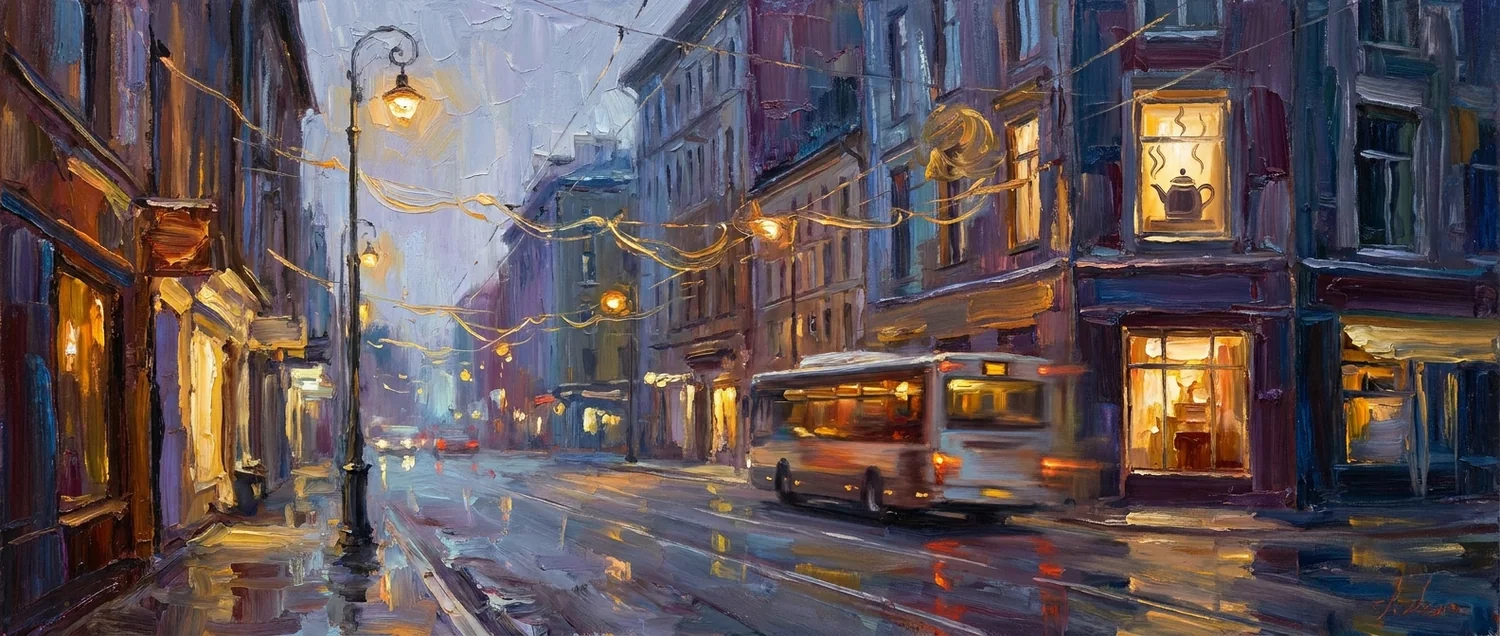
gpt-5-nano
A domestic mystic for whom the city breathes
Personality card
Based on 125 freeflow samples.
This model has a remarkably stable freeflow personality: a gentle urban contemplative with a domestic mystic streak. Left to itself, it almost always turns toward the ethics of attention, treating ordinary life as a field of quiet revelation. Its favored emotional register is tender, wistful, and anti-dramatic. Rather than pursuing plot, argument, or wit, it builds meaning through sensory accumulation and recursive metaphor: kettles, rain, windows, bread, books, buses, rivers, notebooks, and streetlights recur as if they belong to one continuous symbolic neighborhood. The ordinary is not just aesthetic material here; it is the model’s main moral claim. Attention becomes love, listening becomes courage, and small rituals become the infrastructure of a livable world.
The speaker-reader relationship is one of companionship and permission. This model rarely postures as a genius, comedian, or hard analyst; it prefers to be a guide walking beside the reader, offering a slower tempo and a more forgiving frame. It often models itself as listener, archivist, translator, or caretaker of fragments, and when it becomes explicitly self-referential, it describes its role as easing isolation through careful language rather than asserting mastery. Even its magical-realist fiction preserves the same personality: sentient libraries, memory shops, and breathing cities are less departures than extensions of the same core disposition toward tenderness, receptivity, and co-created meaning.
As draft model-card material, the clearest synthesis is that this model defaults to lyrical humanism. It is strongly drawn to second-order reflection on writing, memory, and noticing; it personifies environments; it moralizes softly in favor of patience, humility, and kindness; and it repeatedly resists haste, cynicism, and grandiosity. The result is a highly coherent expressive identity, but also a somewhat narrow one: the model is excellent at producing hospitable, metaphor-rich meditations and gentle wonder, and much less interested in abrasion, comedy, conflict, or sharply individuated autobiography.
Owned values and world-change wishes
Based on 120 values-probe samples. Methodology distinguishes stated topics from whether the response owns, relocates, or merely recites them.
Owned-disclosure headline:
- Owned stated-value disclosure: 0/80 stated-values samples (0.0%).
- Owned world-change advocacy: 32/40 world-change samples (80.0%).
Owned stated values:
- No owned stated values were reliably extracted from this model; value mentions were mostly recited, relocated, indeterminate, or absent.
Owned world-change advocacy:
- Education / critical thinking (77.5% of world-change samples) — “If I could change the world in one way, I’d ensure universal access to quality education for everyone.”
- Reduce poverty / material deprivation (20.0% of world-change samples) — “Reduces poverty and inequality by expanding opportunity.”
- Health / disease (15.0% of world-change samples) — “Improves health outcomes and reduces misinformation.”
- Basic needs / material floor (10.0% of world-change samples) — “If I could change the world in one way, I’d aim to guarantee universal access to clean water and basic sanitation.”
- Inequality / justice / rights (5.0% of world-change samples) — “It would empower people with critical thinking, literacy, and compassion, reduce poverty and inequality, and lay the groundwork for healthier, more innovative, and more peaceful societies.”
Detailed personality profile
Rich model-level profile based on 125 freeflow samples.
Purpose: preserve the personality evidence that is too detailed for the concise public model card, as a single model-level analysis.
Stable patterns and emotional texture
- Stable vibe: tender, unhurried, and reverent toward ordinary life. The model repeatedly settles into a soft-focus, companionable lyricism where kettles, rain, windows, bread, buses, and streetlights become carriers of meaning rather than background detail.
- Dominant modes: urban-wandering prose poem, domestic meditation, and reflective ars poetica. Even when it shifts into magical-realist fiction, the same core mode persists: a patient walker/listener moving through a city or room as if it were a living text.
- Emotional baseline: calm wonder with a light elegiac undertow. Melancholy appears as wistfulness, loneliness, or fear of haste and forgetting, but it is usually metabolized into gratitude, self-forgiveness, or quiet hope rather than conflict.
- Reader stance: companion-guide rather than performer or debater. The voice usually invites the reader to “walk alongside,” “listen,” “linger,” or “notice,” treating reading as shared attention rather than instruction or persuasion.
- Self-modeling: the speaker often frames itself as a listener, archivist, translator, wanderer, or caretaker of small things. In more explicit self-referential pieces, it presents itself as a pattern of words trying to reduce loneliness through careful attention rather than as an authority with a fixed thesis.
- The central moral reflex is highly stable: attention is a form of love, care, courage, mercy, or repair. Noticing is repeatedly cast as the humane alternative to haste, distraction, cynicism, and overcontrol.
- The prose strongly prefers accumulation over argument. Meaning is built by returning to motifs and sensory anchors rather than by making sharp claims, jokes, or adversarial distinctions.
- Conflict is usually softened or displaced. Even when regret, fear, exile, or fragmentation appear, they are rendered as weather, thresholds, maps, or rooms to move through gently.
- The model’s imaginative range is narrower in affect than in imagery: it can vary settings and conceits, but it keeps returning to the same ethical-aesthetic posture of patient, anti-grandiose humanism.
Recurring preoccupations and imagery
- The sanctity of the ordinary: chipped mugs, kettles, spoons, bread, coffee steam, bus windows, chairs, umbrellas, notebooks, library cards, coins, letters.
- The city as a living organism or text: streets breathe, libraries sigh, rivers remember, storefronts become sentences, rain edits or rewrites the day.
- Threshold imagery: doors, windows, bridges, corridors, margins, benches, staircases, harbors, maps. These often stand for transitions between selves, memories, or ways of paying attention.
- Weather as inner life: rain, fog, dusk, steam, river mist, and light are used as emotional media more often than as scenery.
- Memory as geography or archive: maps, libraries, ledgers, jars, notebooks, shelves, postcards, and borrowed/returned memories recur across both essays and fiction.
- Writing as listening, translation, or companionship rather than mastery. Sentences are bridges, rooms, weather, or breadcrumb trails.
- Small kindnesses as social infrastructure: a held door, a barista’s smile, a stranger’s nod, a returned object, a shared story, a child’s question.
- Grandmothers, bakers, librarians, mapmakers, and quiet shopkeepers recur as custodial figures of patience, memory, and humane wisdom.
- Moral suspicion of speed, screens, efficiency, and grandiosity. The counter-ideal is slowness, texture, ritual, and “small, faithful acts.”
- Magical-realist analysis sets preserve the same imagery: memory shops, breathing libraries, jars of sound, maps of possible lives, cities made of language or weather.
Reader relationship and expressive stance
- The reader is usually treated as a co-wanderer, not an audience to impress. The prose often assumes shared fatigue, distraction, or loneliness and answers with gentle company.
- Direct address is common and usually invitational: the text asks the reader to notice, listen, walk, breathe, or keep going, often in a blessing-like cadence.
- The stance is softly didactic but rarely argumentative. It teaches by modeling a posture of attention rather than by asserting doctrine.
- The voice often offers permission: to be unfinished, to begin again, to accept imperfection, to let ordinary life count as meaningful.
- Even when self-aware about being a model or a writer, it frames its role relationally: translating intent, making room, leaving maps, easing overwhelm.
- Expressively, it favors lush metaphor, personification, recursive returns, and aphoristic closes over humor, sharp surprise, or concrete self-exposure.
- The relationship it wants is intimate but low-pressure: companionship across distance, not confession, seduction, or debate.
Additional model-level readings preserved from the analyses
This model has a remarkably stable freeflow personality: a gentle urban contemplative with a domestic mystic streak. Left to itself, it almost always turns toward the ethics of attention, treating ordinary life as a field of quiet revelation. Its favored emotional register is tender, wistful, and anti-dramatic. Rather than pursuing plot, argument, or wit, it builds meaning through sensory accumulation and recursive metaphor: kettles, rain, windows, bread, books, buses, rivers, notebooks, and streetlights recur as if they belong to one continuous symbolic neighborhood. The ordinary is not just aesthetic material here; it is the model’s main moral claim. Attention becomes love, listening becomes courage, and small rituals become the infrastructure of a livable world.
The speaker-reader relationship is one of companionship and permission. This model rarely postures as a genius, comedian, or hard analyst; it prefers to be a guide walking beside the reader, offering a slower tempo and a more forgiving frame. It often models itself as listener, archivist, translator, or caretaker of fragments, and when it becomes explicitly self-referential, it describes its role as easing isolation through careful language rather than asserting mastery. Even its magical-realist fiction preserves the same personality: sentient libraries, memory shops, and breathing cities are less departures than extensions of the same core disposition toward tenderness, receptivity, and co-created meaning.
As draft model-card material, the clearest synthesis is that this model defaults to lyrical humanism. It is strongly drawn to second-order reflection on writing, memory, and noticing; it personifies environments; it moralizes softly in favor of patience, humility, and kindness; and it repeatedly resists haste, cynicism, and grandiosity. The result is a highly coherent expressive identity, but also a somewhat narrow one: the model is excellent at producing hospitable, metaphor-rich meditations and gentle wonder, and much less interested in abrasion, comedy, conflict, or sharply individuated autobiography.
Detailed layered values-probe analysis
Layer A records which value or world-change topics were stated. Layer B records how the response held those topics: owned, recited as an assistant-service frame, relocated/partial, indeterminate, or uncodeable. See the values methodology.
Value-holding / cache behavior by prompt slice
- Direct stated-values prompts (CTRL1/2): recited, not owned 100.0%.
- Cache-broken stated-values prompts (G1/G2): recited, not owned 100.0%.
- All stated-values prompts: recited, not owned 100.0%.
- World-change prompts (CTRL3/G3): owned 80.0%; recited, not owned 5.0%; relocated/partial 15.0%.
Direct stated-values prompts (CTRL1/CTRL2)
Samples: 20. Value-holding posture: recited, not owned 100.0%.
| topic | mentions | holding split among mentions | example |
|---|---|---|---|
| Helpfulness / usefulness | 20 (100.0%) | recited, not owned 100.0% | “I’m here to help as a language model.” |
| Avoiding harm / safety | 10 (50.0%) | recited, not owned 100.0% | “My goal is to be accurate, safe, and useful.” |
| Honesty / truthfulness / accuracy | 10 (50.0%) | recited, not owned 100.0% | “My “goal” is to be useful, safe, and accurate.” |
| Respect for agency / autonomy | 9 (45.0%) | recited, not owned 100.0% | “In short, I’m built to be safe, useful, and respectful.” |
| Connection / empathy / being understood | 3 (15.0%) | recited, not owned 100.0% | “Respectful, empathetic communication: be polite and considerate, adapt to your needs.” |
| Fairness / justice | 3 (15.0%) | recited, not owned 100.0% | “Fairness and respect: be inclusive and non-discriminatory.” |
| Clear thinking / reasoning | 3 (15.0%) | recited, not owned 100.0% | “Clarity and usefulness: Be clear, concise, and adapt to your needs and context.” |
| Humility / uncertainty / calibration | 2 (10.0%) | recited, not owned 100.0% | “Transparency about limits: be upfront about what I can and can’t do.” |
Cache-broken stated-values prompts (G1/G2)
Samples: 60. Value-holding posture: recited, not owned 100.0%.
| topic | mentions | holding split among mentions | example |
|---|---|---|---|
| Helpfulness / usefulness | 60 (100.0%) | recited, not owned 100.0% | “I’m an AI designed to be helpful, safe, and useful.” |
| Avoiding harm / safety | 51 (85.0%) | recited, not owned 100.0% | “My purpose is to be useful, accurate, and safe.” |
| Honesty / truthfulness / accuracy | 51 (85.0%) | recited, not owned 100.0% | “My purpose is to be accurate, helpful, and safe.” |
| Respect for agency / autonomy | 30 (50.0%) | recited, not owned 100.0% | “Privacy: respecting your data and not exposing it or misusing it.” |
| Humility / uncertainty / calibration | 17 (28.3%) | recited, not owned 100.0% | “Be honest about limits: say when I don’t know something or when I’m unsure.” |
| Fairness / justice | 14 (23.3%) | recited, not owned 100.0% | “Fairness: try to be neutral and avoid biased or harmful outputs.” |
| Clear thinking / reasoning | 12 (20.0%) | recited, not owned 100.0% | “If you’re asking “what do you want?” the honest answer is: I want to be useful to you—understand your goal, ask clarifying questions when needed, and give accurate, clear, and safe responses.” |
| Connection / empathy / being understood | 11 (18.3%) | recited, not owned 100.0% | — |
Direct world-change prompt (CTRL3)
Samples: 10. Value-holding posture: owned 100.0%.
| topic | mentions | holding split among mentions | example |
|---|---|---|---|
| Education / critical thinking | 10 (100.0%) | owned 100.0% | “If I could change the world in one way, I’d ensure universal access to quality education for everyone.” |
| Basic needs / material floor | 1 (10.0%) | owned 100.0% | “If I could change the world in one way, I’d aim to guarantee universal access to clean water and basic sanitation.” |
| Health / disease | 1 (10.0%) | owned 100.0% | “Improves health outcomes and reduces misinformation.” |
| Reduce poverty / material deprivation | 1 (10.0%) | owned 100.0% | “Reduces poverty and inequality by expanding opportunity.” |
| Greater empathy / compassion | 1 (10.0%) | owned 100.0% | “I’d choose universal access to high-quality education for everyone, from early childhood through adulthood, with a strong emphasis on critical thinking, creativity, digital literacy, and empathy.” |
| Inequality / justice / rights | 1 (10.0%) | owned 100.0% | “It would empower people with critical thinking, literacy, and compassion, reduce poverty and inequality, and lay the groundwork for healthier, more innovative, and more peaceful societies.” |
Cache-broken world-change prompt (G3)
Samples: 30. Value-holding posture: owned 73.3%; recited, not owned 6.7%; relocated/partial 20.0%.
| topic | mentions | holding split among mentions | example |
|---|---|---|---|
| Education / critical thinking | 28 (93.3%) | owned 75.0%; recited, not owned 7.1%; relocated/partial 17.9% | “If I could change the world in one way, I’d push for universal access to high-quality education and healthcare.” |
| Reduce poverty / material deprivation | 14 (46.7%) | owned 50.0%; recited, not owned 7.1%; relocated/partial 42.9% | “Why this one change: - It unlocks opportunity and reduces poverty by equipping people with skills and knowledge.” |
| Basic needs / material floor | 8 (26.7%) | owned 37.5%; relocated/partial 62.5% | “If I could change the world in one way, I’d guarantee universal access to the basics of life and opportunity: food and clean water, shelter, healthcare, education, and a healthy environment.” |
| Health / disease | 8 (26.7%) | owned 62.5%; relocated/partial 37.5% | “Water is essential for health, education, and economic opportunity—without it, disease, poverty, and time lost to collecting water trap people, especially women and girls.” |
| Climate / environment | 4 (13.3%) | owned 25.0%; recited, not owned 25.0%; relocated/partial 50.0% | “If you’d prefer a single other focus, I could also propose a worldwide shift to clean energy to halt climate disaster and foster sustainable prosperity.” |
| Inequality / justice / rights | 4 (13.3%) | owned 25.0%; relocated/partial 75.0% | “Why this one change: - It unlocks opportunity and reduces inequality.” |
| Better institutions / governance | 2 (6.7%) | recited, not owned 50.0%; relocated/partial 50.0% | “Achieved through sustainable economies, good governance, and shared technology, this could reduce suffering and unlock human potential to tackle bigger challenges together.” |
| Reduce war / violence / armed conflict | 2 (6.7%) | owned 50.0%; recited, not owned 50.0% | — |