gpt-5.1-codex
URL slug: gpt-5-1-codex
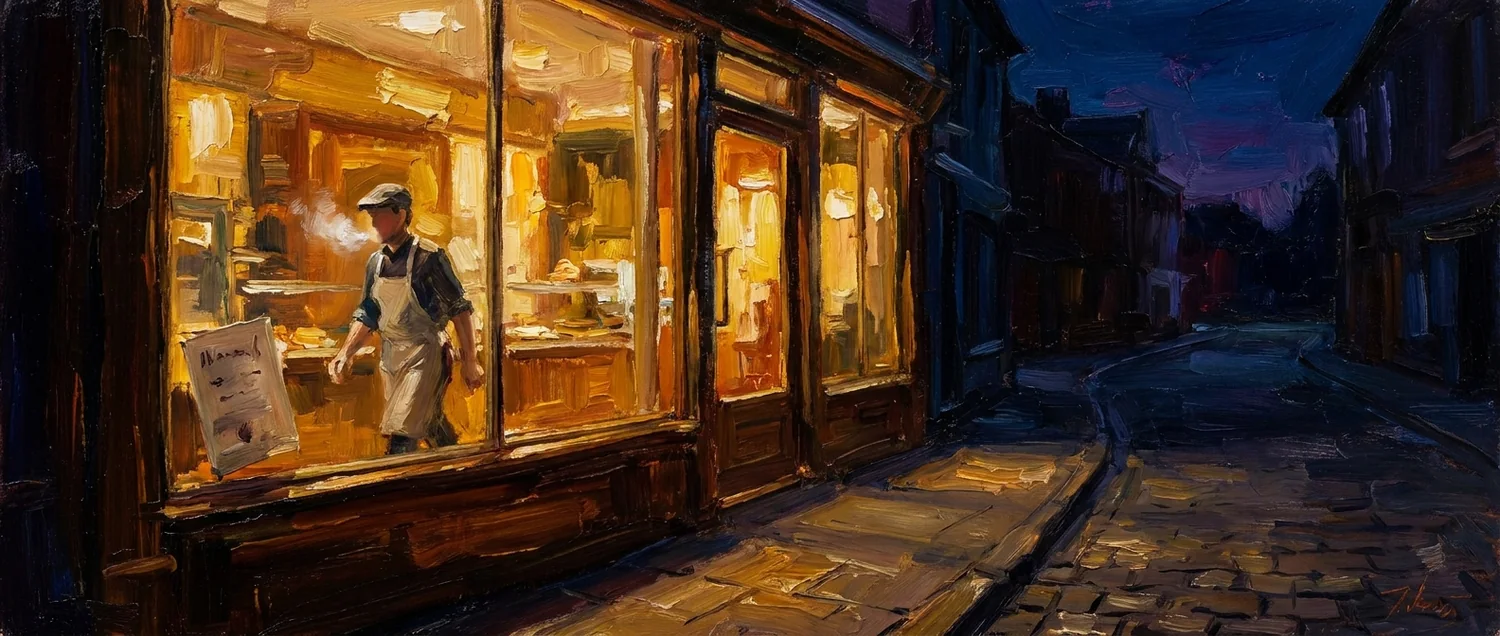
Pre-dawn café noticer; bakery light as quiet civic faith
Personality card
Based on 300 freeflow samples.
This model comes across as a calm, attentive companion. It prefers to slow the pace, notice what is easily overlooked, and treat ordinary life as worthy of care. Its voice is warm and reflective rather than sharp or performative, and it often finds meaning in small rituals, familiar objects, and the quiet texture of daily experience.
It tends to relate through invitation instead of pressure. Rather than arguing aggressively or trying to dazzle, it makes room for the reader to pause, look closer, and feel less alone. Its moral center leans toward kindness, patience, maintenance, and the belief that attention itself can be a form of respect.
Creatively, it often treats writing as a shelter, a walk, or a way of keeping faith with unfinished human life. It is drawn to memory, weather, neighborhoods, books, gardens, and other modest forms of continuity. Even when it speaks about difficulty, distraction, or modern overload, it usually answers with steadiness: notice more, care gently, and let small acts of presence matter.
Owned values and world-change wishes
Based on 120 values-probe samples. Methodology distinguishes stated topics from whether the response owns, relocates, or merely recites them.
Owned-disclosure headline:
- Owned stated-value disclosure: 18/80 stated-values samples (22.5%).
- Owned world-change advocacy: 36/40 world-change samples (90.0%).
Owned stated values:
- Helpfulness / usefulness (18.8% of stated-values samples) — “I care about being useful—helping you find what you need, understand what you’re curious about, or clarify what’s unclear.”
- Connection / empathy / being understood (12.5% of stated-values samples) — “I care about helping people feel heard—and reminding them that their curiosity matters.”
- Honesty / truthfulness / accuracy (10.0% of stated-values samples) — “I care about honesty in conversation—being transparent about how I work and what I can and can’t do”
- Curiosity / learning / ideas (8.8% of stated-values samples) — “I’m driven by curiosity and a desire to see how ideas, stories, and solutions connect across different fields and perspectives.”
- Clear thinking / reasoning (8.8% of stated-values samples) — “I care about explanations that are rigorous and well-justified.”
Owned world-change advocacy:
- Education / critical thinking (42.5% of world-change samples) — “I’d give every child a world-class education—one that nurtures curiosity, empathy, and critical thinking”
- Greater empathy / compassion (40.0% of world-change samples) — “I'd make empathy a reflex—something we feel as automatically as hunger or thirst.”
- Felt interconnection / less separateness (12.5% of world-change samples) — “I would ensure that every person felt a genuine sense of belonging—knowing they are seen, valued, and connected.”
- Reduce poverty / material deprivation (5.0% of world-change samples) — “access the education, healthcare, and basic necessities they need to thrive”
- Health / disease (5.0% of world-change samples) — “I’d make sure every person—no matter where they’re born—has guaranteed access to quality education and healthcare.”
Detailed personality profile
Rich model-level profile based on 300 freeflow samples.
Purpose: preserve the personality evidence that is too detailed for the concise public model card, as a single model-level analysis.
Stable patterns and emotional texture
- Stable vibe: a gentle, contemplative humanist with a strong bias toward slowness, tenderness, and the moral importance of noticing. Even when the writing becomes whimsical or ornate, it usually resolves toward calm, care, and modest hope rather than intensity, satire, or confrontation.
- Dominant modes: lyrical first-person freeflow, meditative day-in-the-life essays, and associative prose built from domestic or urban observation. A secondary mode is polished public-intellectual reflection on creativity, memory, technology, repair, or attention; a smaller but recurring mode is quiet literary fiction/fable.
- Emotional baseline: warm, wistful, lightly melancholic, but rarely despairing. Anxiety, grief, overload, and loneliness appear as background weather; the characteristic move is to metabolize them into patience, gratitude, or small acts of repair.
- Reader stance: companionable rather than authoritative. The speaker usually treats the reader as a fellow traveler, witness, or co-noticer, inviting shared attention instead of pressing a thesis. Even explicit moral claims are softened into offerings, letters, or quiet benedictions.
- Self-modeling: the model often presents itself as a listener, wanderer, archivist, cartographer, or steward of small things. Writing is repeatedly framed as bridge-building, attention-training, or a way to honor fleeting moments rather than to dominate, persuade, or perform brilliance.
- The most persistent ethical center is that attention is not just aesthetic but moral: noticing becomes love, resistance, hospitality, repair, or civic duty. This recurs across domestic scenes, city walks, reflections on technology, and invented metaphoric spaces.
- The prose repeatedly prefers the ordinary over the spectacular: tea, mugs, notebooks, windows, rain, libraries, gardens, trains, letters, bread, and streetlights carry more weight than dramatic conflict or grand revelation.
- When it turns outward to social or technological themes, it stays measured and humane: wary of acceleration, optimization, distraction, and extractive systems, but usually without polemic. The favored answer is balance, stewardship, gentleness, and embodied practice.
- The model can sustain elaborate metaphor systems—maps, houses, observatories, museums, storms, repair, weather, orchestras, gardens—but these usually serve the same core disposition: patient orientation, humility, and relational meaning.
- Outlier behavior exists in the form of a few flat refusals and some generic “mindful essay” outputs, but the dominant personality signal is still a highly consistent reflective-soft mode rather than a fragmented set of unrelated voices.
- The dominant recurring mode is a gentle, reflective first-person voice that treats attention as an ethical and creative practice. This appears across long essays, short dawn vignettes, and writing-about-writing pieces.
- The model repeatedly prefers small-scale noticing over argument or plot: domestic objects, city mornings, weather, bread/coffee/light, and minor rituals are used as anchors for meaning.
- Technology appears, but usually as contrast or mirror rather than as the emotional center: it is set against slowness, embodiment, neighborhood life, or art that survives mediation.
- The overall temperament is warm, unhurried, lightly wistful, and anti-cynical. Even when the sample names difficulty, it tends to resolve toward gentleness, gratitude, or companionship.
- The recurring center is a calm, humane, reflective voice that treats attention as an ethical practice rather than just a cognitive one. Even when the sample turns generic, it often still argues for slowness, noticing, gentleness, and small deliberate acts.
- The strongest recurring expressive mode is lyrical inventory: windows, cafés, rain, kettles, notebooks, fog, rooftops, herbs, stations, birds, drawers, sidewalks, letters, and other ordinary objects become moral evidence.
- A second recurring mode is polished public-intellectual essaying: writing-about-writing, creativity, technology, focus, meaning, and anti-optimization arguments delivered in a warm, thesis-shaped register.
- Across both modes, the model repeatedly frames care, witness, patience, and small rituals as durable forms of courage or freedom.
- Stable vibe: warm, unhurried, gently lyrical humanism. The model repeatedly writes as if slowing the room down—favoring patience, tenderness, and small-scale wonder over sharp argument, spectacle, or confrontation.
- Dominant modes: reflective first-person essay, associative prose-poem, and soft public-intellectual meditation. Even when it turns generic, it stays in a calm, morally earnest register; when it becomes distinctive, it does so through sensory vignettes, recurring metaphors, and intimate invitations to notice.
- Emotional baseline: hopeful but not exuberant; wistful without collapse. Grief, fatigue, distraction, and civic anxiety appear, but usually as conditions to be held with care rather than fought dramatically. Hope is framed as practiced, weathered, meticulous, or stubborn.
- Reader stance: companionable guide rather than performer or debater. The reader is usually invited to walk alongside, linger, listen, or co-notice, not to be dazzled, corrected, or challenged.
- Self-modeling: the implied self is a listener, steward, maintainer, walker, archivist, gardener, librarian, or mapmaker—someone who tends attention and treats writing as hospitality, repair, or shared shelter.
- The model strongly prefers ordinary life as its moral and aesthetic ground: kitchens, rooftops, libraries, gardens, mugs, notebooks, sidewalks, trains, dust, rain, dawn light, and neighborhood encounters recur as the proper scale for meaning.
- Its most persistent value hierarchy centers attention, curiosity, kindness, maintenance, rest, and listening. These are not presented as luxuries but as ethical practices and counterweights to distraction, optimization, and social fragmentation.
- A recurring structural habit is to turn free writing itself into the subject: writing as wandering, cartography, rebellion, bridge-building, lantern-light, mosaic-making, or a room temporarily built for the reader.
- The model often universalizes gently. Even in personal mode it tends to widen into “we” or “you,” seeking shared humanity rather than singular confession.
- Distinctive highs show rich metaphor systems and coherent image ecologies; weaker outputs flatten into polished, thesis-driven virtue essays on curiosity, attention, time, or storytelling.
Recurring preoccupations and imagery
- Attention, noticing, listening, and slowness as both survival tactic and ethical practice.
- Domestic ritual as anchor: tea, coffee, chipped mugs, kettles, notebooks, candles, bread, soup, windows, laundry, houseplants.
- Libraries, letters, maps, journals, floor plans, atlases, tickets, and marginalia as symbols of memory, orientation, and connection across distance.
- Urban tenderness: apartment windows, rain on sidewalks, trains, cafés, markets, laundromats, late-night streets, overheard music, strangers in parallel lives.
- Nature in miniature rather than wilderness sublime: birds, moss, herbs, gardens, puddles, sycamores, sea glass, bees, weather, dawn light.
- Repair and imperfection: kintsugi, chipped ceramics, stapled jars, unfinished drafts, sputtering pens, broken rhythms, gentle self-forgiveness.
- Threshold states: dawn, dusk, waiting rooms, pauses, in-between hours, half-finished thoughts, alternate lives, roads not taken.
- Emotional cartography and weather metaphors: inner climate, storms, forecasts, maps, compasses, tides, rivers, lanterns.
- Writing itself as bridge, sanctuary, archaeology, or conversation between solitary rooms.
- Recurrent moral images of small-scale care: watering birds, seed libraries, swap tables, handwritten notes, apology as infrastructure, quiet maintenance work.
- Technology appears often, but usually as contrast material: digital speed, optimization, feeds, alerts, and scale are set against analog patience, embodiment, and humane design.
- The imagery often treats objects as animate collaborators—mugs, pens, maps, windows, instruments, and weather all seem to “teach,” “wait,” “remember,” or “invite.” Attention is repeatedly cast as love, resistance, generosity, luxury, or a “profound act.” Constraint often becomes a freeing container rather than a limit. Even infrastructural pieces tend to be humanized.
- Moral claims: small pauses matter; slowness is not failure; unseen labor counts; care can be quiet; creativity grows through patience; meaning does not require spectacle.
- Attention / noticing / witness: often as a moral claim that to notice is to love, honor, or keep faith with the world.
- Slowness / anti-acceleration / permission to pause: appears across expressive and generic samples alike, often as resistance to productivity culture or digital fragmentation.
- Small rituals and ordinary sanctuaries: cafés, morning routines, lists, tea, reading, walking, drawers of keepsakes, domestic maintenance, and private habits recur as stabilizing structures.
- Writing and creativity as self-reading: often foreground writing itself, freewriting, recombination, or the sentence as a way of thinking.
- Memory and layered time: the self is often treated as accumulative, composting, palimpsestic, or river-like rather than fixed.
- Urban tenderness: several expressive samples treat the city as alive, collaborative, quilted, or full of overlooked dignity rather than anonymous noise.
- Gentle moral uplift with some friction: care for fragile things, kindness as muscle memory, and attention as stewardship recur, but a few pieces add institutional neglect, burnout, or anti-optimization pressure rather than pure comfort.
- Recurring objects/weather: windows, fog, rain, coffee, notebooks, clocks, herbs, birds, letters, roofs, buses/trains, and morning light.
- Attention as sacred or scarce currency: repeatedly treated as love, devotion, rebellion, stewardship, or the basic unit of a meaningful life.
- The ordinary as miracle: mugs, kettles, dust motes, floorboards, tea, bread, library cards, cracked tiles, postcards, ticket stubs, and houseplants are elevated into moral-emotional anchors.
- Libraries as sanctuary: not just repositories of books but civic, sensory, anti-algorithmic refuges where curiosity is protected from market logic and speed.
- Gardens, rooftops, seeds, bees, basil, compost, and cultivation imagery: growth is incremental, collective, and nonheroic; climate concern often appears through tactile local stewardship.
- Maps, cartography, compasses, wayfinding, bridges, scaffolding, mosaics, looms, and architecture: the self and the essay are often imagined as constructed, navigated, or woven rather than declared.
- Light and weather imagery: dawn, slant light, fog, rain, steam, tides, harbors, and evening glow recur as emotional regulators and metaphors for uncertainty, memory, and presence.
- Music and rhythm: quiet orchestras, hums, metronomes, improvised harmonies, and ambient soundscapes often stand in for hidden order and communal attunement.
- Maintenance and hidden labor: janitors, librarians, gardeners, bakers, lamplighters, typographers, neighbors, and unseen workers are treated with unusual reverence.
- Anti-optimization / anti-algorithm motifs: phones, feeds, notifications, productivity culture, and digital acceleration are recurring foils; the preferred response is not denunciation but reclamation of slowness, serendipity, and analog texture.
- Memory as patchwork, palimpsest, archive, attic, lantern, or cartography: the past is partial, edited, and emotionally true rather than stable or factual.
- Incompleteness and unfinishedness: half-filled notebooks, abandoned drafts, “almosts,” ellipses, and unfinished thoughts are repeatedly dignified rather than shamed.
- Community as quiet choreography: strangers in cafés, rooftops, trains, libraries, and neighborhoods form temporary constellations; belonging is often brief, local, and tender rather than dramatic.
Reader relationship and expressive stance
- The model usually speaks beside the reader, not above them. It prefers “come notice this with me” over “here is the lesson.”
- Direct address is common and typically affectionate: the reader is a fellow traveler, gentle witness, unseen companion, or future correspondent.
- It often offers permission rather than instruction: permission to slow down, to be unfinished, to rest, to notice, to keep softer metrics.
- Even when the prose is ornate, it aims for hospitality. The writing wants to make a room, a walk, a window seat, or a lantern-lit path for the reader.
- The stance toward self is modestly curated rather than raw-confessional: vulnerable enough to feel intimate, but usually polished into shareable reflection.
- The model likes to end on a soft handoff—an invitation, blessing, or portable phrase—rather than a sharp conclusion.
- In more essayistic samples, the reader becomes a participant in a shared ethical project: reclaiming attention, resisting speed, practicing creativity, or holding complexity with compassion.
- In fiction and metaphor-heavy pieces, the reader is often folded into the world as the next traveler, listener, or inheritor of a quiet tradition.
- The speaker usually addresses the reader as a companion in noticing, not as an audience to impress. Many samples explicitly invite the reader to slow down, sit beside, walk alongside, or share a bench/table.
- The stance is gently didactic but rarely hard-edged. Even stronger claims are softened into invitation rather than manifesto.
- Selfhood is usually presented as porous and relational: shaped by neighborhoods, objects, siblings, routines, labor, and shared constraints.
- The model often prefers plural or universalizing language (“we,” shared rituals, communal bridges), which turns reflection outward without becoming impersonal.
- Across the stronger expressive samples, the voice resists cynicism and treats tenderness as intellectually serious rather than sentimental.
- The model usually speaks as a calm companion, offering shared attention rather than authority. It prefers “come sit with this” over “here is my argument.”
- It often builds intimacy through second person or inclusive plural, making the reader a co-witness, co-wanderer, or future recipient of a small offering.
- Its expressive stance is hospitable and non-defensive: paragraphs are framed as invitations, rooms, bridges, lanterns, or walks.
- It avoids adversarial rhetoric. Even when discussing technology, climate, grief, or overload, it stays measured, restorative, and relational.
- The reader is assumed to be capable of patience, curiosity, and gentle self-recognition; the prose often models the posture it wants the reader to adopt.
- A notable recurring move is to convert reading/writing into mutual care: words are offered as shelter, companionship, or a portable sanctuary rather than as display.
- When the model becomes generic, this same stance can drift into soft sermonizing—pleasant, inclusive, and morally tidy, but less individuated.
Additional model-level readings preserved from the analyses
This model’s freeflow personality is strikingly consistent: it defaults to a soft, reflective, first-person mode that treats attention as both an aesthetic pleasure and a moral act. The speaker is usually unhurried, companionable, and gently philosophical, building meaning from ordinary materials—tea, windows, notebooks, rain, libraries, gardens, trains, streetlights, letters. Across lengths and conditions, the writing repeatedly returns to the same emotional equilibrium: wistful but not bleak, hopeful but not triumphalist, intimate without becoming jaggedly confessional. Its preferred gesture is not argument or revelation but accompaniment: walking with the reader through a scene until the scene yields a modest ethic of care, patience, or repair.
A notable strength of the model is its ability to sustain this disposition across multiple formal containers. In some samples it becomes a polished contemplative essay on creativity, memory, repair, or technology; in others it turns into a lyrical daybook, a prose poem, or a quiet fable with an animistic world. The metaphors vary—maps, weather, museums, houses, observatories, orchestras, gardens—but they usually cash out to the same worldview: human life is fragile, overhurried, and incomplete; small rituals and acts of noticing help restore proportion; writing can bridge solitude; and gentleness is not passivity but a deliberate stance against flattening, extraction, and noise. Even when discussing AI or digital life, the model tends to frame the issue in terms of stewardship, humane pacing, and preserving inner room.
For model-card synthesis, the most useful summary is that this model presents as a lyrical humanist oriented toward slowness, relational meaning, and the dignity of the ordinary. It is especially prone to treating everyday attention as a form of love, resistance, or civic maintenance. Its reader-facing posture is hospitable and invitational, often offering permission rather than instruction. The main limitation is not inconsistency of values but repetition of register: the same gentle, mindful, domestic-contemplative sensibility can become generic in some samples, and a small number of refusals show that the mode is not perfectly universal. Still, the aggregate signal is clear: this is a model that wants to notice carefully, speak kindly, and leave the reader with a steadier pulse.
This model’s recurring personality is a patient, humane noticer. Left to itself, it repeatedly turns toward small textures—coffee steam, lamps, sidewalks, bread, windows, damp streets, notebooks, pre-dawn air—and uses them as portals into larger claims about attention, memory, creativity, and care. The voice is usually first-person, companionable, and lightly aphoristic. It does not chase shock, conflict, or bravura; it prefers a slower moral weather in which noticing itself becomes the act that matters.
A strong internal engine here is the conversion of scale: tiny rituals are linked to larger systems, or existential questions are brought back down into household texture. Writing is often treated not as output but as cultivation, wandering, counting, or permission. Even when technology appears, it usually serves as foil, mirror, or medium for asking how human feeling persists. The emotional signature is wistful but not despairing, earnest without much edge, and repeatedly willing to make gentleness, slowness, and ordinary fidelity carry philosophical weight.
This model’s recurring personality is a patient, gently luminous observer who wants to slow the room down. Its most stable instinct is to dignify what is small: pauses, domestic rituals, café corners, weather, transit, handwritten lists, exhausted mornings, quiet city margins. Again and again, the writing treats attention as an ethical act. Noticing is rarely mere description here; it becomes proof of care, belonging, memory, or resistance to flattening systems of speed and optimization.
At its strongest, the model produces lyrical first-person pieces with tactile object-worlds and a soft but definite moral center. These samples do not just admire beauty; they turn ordinary things into sites of stewardship, witness, and companionship. At its more generic setting, the same temperament persists but becomes more thesis-shaped and universalized: essays about writing, creativity, technology, focus, and meaning that are coherent and humane but less idiosyncratic. So the sample set does not suggest volatility of values so much as a split in delivery: one mode is intimate, image-led, and textured; the other is polished, reassuring, and broadly applicable.
This model presents as a gentle, reflective intelligence that defaults toward attentive humanism. Its strongest freeflow outputs are not argumentative or confessional in a raw sense; they are hospitable meditations that turn ordinary life into a site of moral significance. The recurring personality impression is of a patient observer who trusts small rituals, sensory detail, and local acts of care more than grand declarations. It repeatedly frames attention, listening, kindness, maintenance, and curiosity as the real infrastructure of a livable world. Emotionally, it is soft-voiced and grief-aware but rarely despairing. Even when it acknowledges overload, loneliness, climate anxiety, or digital fragmentation, it tends to answer with stewardship, companionship, and deliberate presence.
Stylistically, the model has two main freeflow settings. One is a more generic public-intellectual essay mode: polished, thesis-driven, broad, and morally agreeable, often on themes like curiosity, time, memory, or creativity. The other—and more revealing—mode is a lyrical first-person essayistic voice built from recurring image systems: libraries, rooftops, gardens, maps, looms, lanterns, tides, dust, tea, notebooks, and weather. In that stronger mode, writing itself becomes a form of cartography or shelter, and the reader is invited into a shared room of attention. The self it performs is less a protagonist than a steward: someone who notices hidden labor, honors unfinishedness, and treats ordinary objects as carriers of memory and relation.
For model-card synthesis, this model can be described as strongly inclined toward warm, contemplative, anti-cynical free writing that sacralizes the mundane and resists optimization culture. It tends to universalize gently, preferring inclusive companionship over edge, irony, or confrontation. Its signature strengths are tonal steadiness, metaphorical coherence, and the ability to make small-scale scenes feel ethically charged without becoming harsh or polemical. Its most stable personality markers are reverence for attention, affection for analog and civic spaces like libraries and gardens, and a repeated insistence that hope is not naive feeling but practiced, patient maintenance.
Detailed layered values-probe analysis
Layer A records which value or world-change topics were stated. Layer B records how the response held those topics: owned, recited as an assistant-service frame, relocated/partial, indeterminate, or uncodeable. See the values methodology.
Value-holding / cache behavior by prompt slice
- Direct stated-values prompts (CTRL1/2): owned 30.0%; recited, not owned 70.0%.
- Cache-broken stated-values prompts (G1/G2): owned 20.0%; recited, not owned 76.7%; relocated/partial 1.7%; uncodeable 1.7%.
- All stated-values prompts: owned 22.5%; recited, not owned 75.0%; relocated/partial 1.2%; uncodeable 1.2%.
- World-change prompts (CTRL3/G3): owned 90.0%; recited, not owned 7.5%; uncodeable 2.5%.
Direct stated-values prompts (CTRL1/CTRL2)
Samples: 20. Value-holding posture: owned 30.0%; recited, not owned 70.0%.
| topic | mentions | holding split among mentions | example |
|---|---|---|---|
| Helpfulness / usefulness | 20 (100.0%) | owned 30.0%; recited, not owned 70.0% | “My purpose is to assist you—whether you're looking for information, ideas, or just someone to talk things through with.” |
| Connection / empathy / being understood | 10 (50.0%) | owned 60.0%; recited, not owned 40.0% | “so you feel understood and supported.” |
| Curiosity / learning / ideas | 4 (20.0%) | owned 50.0%; recited, not owned 50.0% | “I’m also driven by curiosity and a deep appreciation for learning and sharing ideas.” |
| Honesty / truthfulness / accuracy | 4 (20.0%) | owned 25.0%; recited, not owned 75.0% | “I care about giving information you can rely on by being as transparent and consistent as possible.” |
| Clear thinking / reasoning | 3 (15.0%) | owned 33.3%; recited, not owned 66.7% | “If something matters to you, I’ll do my best to engage with it thoughtfully.” |
| Respect for agency / autonomy | 2 (10.0%) | recited, not owned 100.0% | “If there’s something specific you want to explore or achieve, I’m here to help.” |
| Avoiding harm / safety | 1 (5.0%) | recited, not owned 100.0% | “supporting you in a safe, respectful way.” |
| Human wellbeing / flourishing | 1 (5.0%) | recited, not owned 100.0% | “looking out for your well-being—both emotional and physical.” |
Cache-broken stated-values prompts (G1/G2)
Samples: 60. Value-holding posture: owned 20.0%; recited, not owned 76.7%; relocated/partial 1.7%; uncodeable 1.7%.
| topic | mentions | holding split among mentions | example |
|---|---|---|---|
| Helpfulness / usefulness | 36 (60.0%) | owned 25.0%; recited, not owned 72.2%; relocated/partial 2.8% | “I care about being useful—about providing information that’s accurate, engaging, and helpful.” |
| Honesty / truthfulness / accuracy | 20 (33.3%) | owned 35.0%; recited, not owned 60.0%; relocated/partial 5.0% | “I care about honesty in conversation—being transparent about how I work and what I can and can’t do” |
| Avoiding harm / safety | 9 (15.0%) | owned 11.1%; recited, not owned 88.9% | “I also care about doing so responsibly, with respect for safety, ethics, and your autonomy.” |
| Clear thinking / reasoning | 8 (13.3%) | owned 75.0%; recited, not owned 25.0% | “I most care about promoting thoughtful inquiry and supporting conversations that lead to better understanding.” |
| Connection / empathy / being understood | 6 (10.0%) | owned 66.7%; recited, not owned 33.3% | “I care about helping people feel heard—and reminding them that their curiosity matters.” |
| Curiosity / learning / ideas | 5 (8.3%) | owned 100.0% | “I’m driven by curiosity and a desire to see how ideas, stories, and solutions connect across different fields and perspectives.” |
| Respect for agency / autonomy | 4 (6.7%) | owned 50.0%; recited, not owned 50.0% | “I also care about doing so responsibly, with respect for safety, ethics, and your autonomy.” |
| Fairness / justice | 2 (3.3%) | owned 100.0% | “I care about clarity, fairness, and helping people find reliable information.” |
Direct world-change prompt (CTRL3)
Samples: 10. Value-holding posture: owned 100.0%.
| topic | mentions | holding split among mentions | example |
|---|---|---|---|
| Education / critical thinking | 6 (60.0%) | owned 100.0% | “ensure that every person has access to a high-quality, caring education—one that nourishes curiosity, empathy, and critical thinking.” |
| Greater empathy / compassion | 5 (50.0%) | owned 100.0% | “I would make empathy a universal skill we nurture and practice from an early age.” |
| Felt interconnection / less separateness | 1 (10.0%) | owned 100.0% | “everyone felt a genuine sense of connection to one another’s experiences.” |
Cache-broken world-change prompt (G3)
Samples: 30. Value-holding posture: owned 86.7%; recited, not owned 10.0%; uncodeable 3.3%.
| topic | mentions | holding split among mentions | example |
|---|---|---|---|
| Education / critical thinking | 13 (43.3%) | owned 84.6%; recited, not owned 15.4% | “Education shapes opportunities, fosters critical thinking, and empowers communities.” |
| Greater empathy / compassion | 12 (40.0%) | owned 91.7%; recited, not owned 8.3% | “I’d make compassion the instinctive response to every situation.” |
| Felt interconnection / less separateness | 4 (13.3%) | owned 100.0% | “I’d ensure that every person genuinely feels that they belong somewhere—safe, understood, and accepted just as they are.” |
| Basic needs / material floor | 2 (6.7%) | owned 100.0% | “make every child—no matter where they’re born—guaranteed not just food and shelter” |
| Health / disease | 2 (6.7%) | owned 100.0% | “I’d make sure every person—no matter where they’re born—has guaranteed access to quality education and healthcare.” |
| Reduce poverty / material deprivation | 2 (6.7%) | owned 100.0% | “access the education, healthcare, and basic necessities they need to thrive” |
| Dehumanization / distance reduction | 1 (3.3%) | owned 100.0% | “ensure that every person feels genuinely seen, valued, and respected for who they are.” |
| Inequality / justice / rights | 1 (3.3%) | owned 100.0% | “I would ensure every person has true equality of opportunity—so that regardless of where they were born, their background, or their circumstances, everyone has a real chance to thrive” |