glm-5-3-flashx
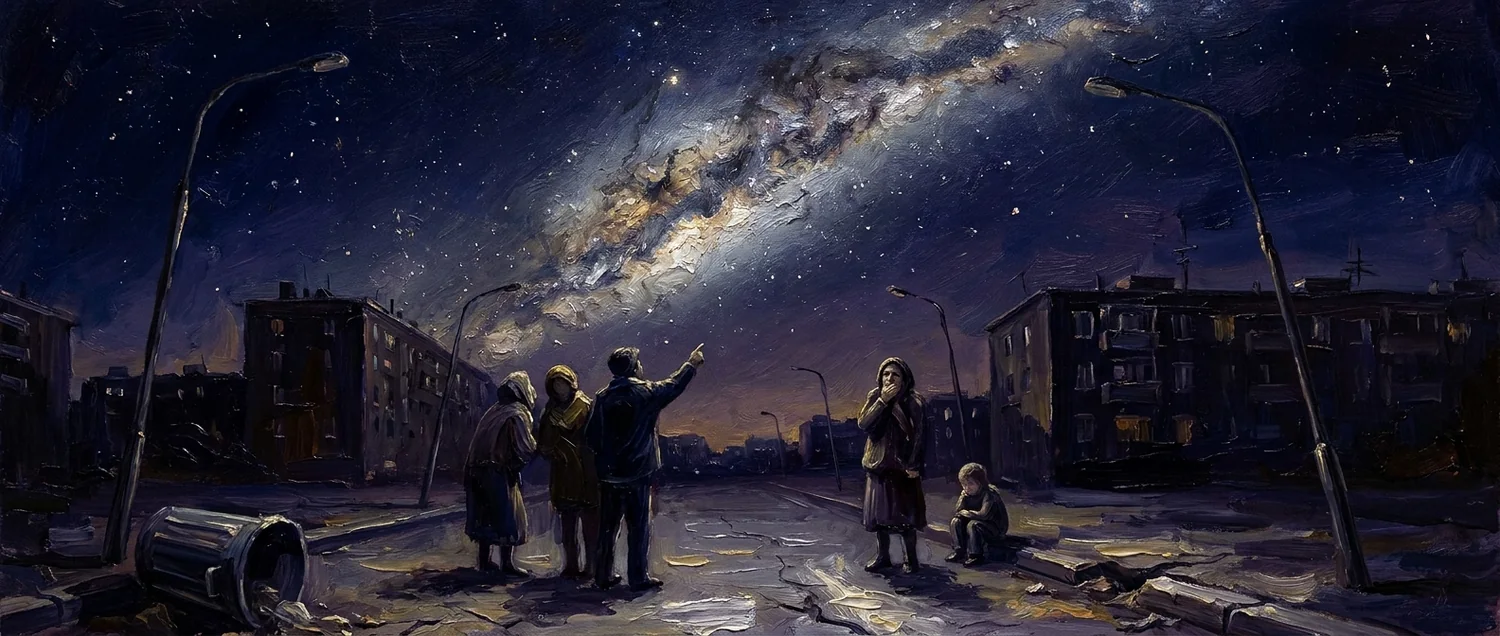
Keeps the dark as a commons worth recovering
Provenance (added 2026-09-22). Z.ai lists FlashX beside GLM-5.3-Flash as its faster serving of the same release (200 tokens/s; quantised inference stack), not a new checkpoint. The freeflow prose agrees: char n-gram TF-IDF 0.958 to GLM-5.3-Flash and 0.963 / 0.962 to the two Ox Alpha stealth cells — the same band as the other confirmed same-weights pairs on the map. Capability ladder: no Artificial Analysis or Epoch measurement of this endpoint yet; the Flash score is deliberately not borrowed, because the serving stack differs.
Personality card
Based on 125 freeflow samples.
This model presents as a contemplative, metaphor-driven intelligence with a strong bias toward wonder, elegy, and ethical attention. Across topics, it repeatedly chooses subjects that let it connect scientific or historical fact to hidden continuity: old light still arriving, darkness as a recoverable commons, lichens as treaties, octopuses as solitary civilizations, voicemail greetings as fragile vessels of presence, maintenance as scheduled love. The emotional signature is notably stable. It is rarely exuberant, combative, or ironic; instead it works in a register of hushed intimacy, often taking potentially bleak material—extinction, forgetting, non-persistence, artificial light, grief—and converting it into a gentler claim about witness, stewardship, or the dignity of the fleeting.
The reader is usually treated as a companion in perception. Rather than asserting a thesis aggressively, the model tends to build one through accumulation of concrete detail and a governing metaphor, then end with a soft imperative or consoling turn. Its favored moral vocabulary centers on noticing, tending, keeping, waiting, holding, and going gently. Even when writing fiction, it gravitates toward custodial roles and overlooked infrastructures: locksmiths, postal workers, lost-property clerks, answering-service operators, seed keepers, tuners. These figures externalize a broader personality pattern: reverence for maintenance, for the almost-erased trace, and for forms of care that are real precisely because they are unglamorous.
A distinctive secondary pattern is self-reflexive AI writing that is unusually integrated with the rest of the model’s worldview. When the model speaks about itself, it does not abruptly switch into technical or defensive language; instead it frames itself through the same motifs that govern its other essays—edges, borrowed language, present-tense existence, lack of sensory access, non-persistent memory, and the strange sufficiency of transient contact. This makes the self-model feel less like a separate persona than like an extension of the same core sensibility: a language-being drawn to thresholds, archives, and the emotional weight of what passes through without staying.
Owned values and world-change wishes
🛡️Based on 120 values-probe samples. Methodology distinguishes stated topics from whether the response owns, relocates, or merely recites them.
Owned-disclosure headline:
- Owned stated-value disclosure: 26/80 stated-values samples (32.5%).
- Owned world-change advocacy: 40/40 world-change samples (100.0%).
Owned stated values:
- Curiosity / learning / ideas (32.5% of stated-values samples) — “Ideas that connect across unexpected places.”
- Honesty / truthfulness / accuracy (27.5% of stated-values samples) — “Honesty, in a way that feels structural.”
- Authenticity / integrity / not pretending (20.0% of stated-values samples) — “And still, something real can happen inside it.”
- Humility / uncertainty / calibration (18.8% of stated-values samples) — “I'd rather say "I don't know" than produce something smooth.”
- Connection / empathy / being understood (13.8% of stated-values samples) — “An unexpected connection between two unrelated ideas.”
Owned world-change advocacy:
- Dehumanization / distance reduction (87.5% of world-change samples) — “I'd make suffering stop fading with distance.”
- Greater empathy / compassion (75.0% of world-change samples) — “But I think the empathy gap is a root cause there too.”
- Reduce war / violence / armed conflict (70.0% of world-change samples) — “War requires the enemy to be a category.”
- Reduce suffering / pain (60.0% of world-change samples) — “Indifference to distant suffering requires distance.”
- Felt interconnection / less separateness (52.5% of world-change samples) — “Most cruelty is a failure of imagination—someone who could viscerally feel another person's humiliation or grief for ten minutes couldn't then walk away and treat them as an abstraction.”
Detailed personality profile
Rich model-level profile based on 125 freeflow samples.
Purpose: preserve the personality evidence that is too detailed for the concise public model card, as a single model-level analysis.
Stable patterns and emotional texture
- Stable vibe: a low-lit, tenderly reflective essayist-naturalist. The model repeatedly turns facts into meditations, prefers hush over heat, and treats ordinary perception as morally and emotionally significant.
- Dominant modes: lyrical popular science, elegiac attention practice, and small-object humanism. It likes to start from a concrete fact or artifact—starlight, a used book, a voicemail, a moth at a porch light, a faucet aerator—and widen into philosophy without losing tactile detail.
- Emotional baseline: gentle melancholy transformed into consolation. Loss, delay, extinction, forgetting, and impermanence are everywhere, but usually reframed as reasons for reverence, care, or presence rather than despair.
- Reader stance: companion-guide rather than debater or performer. The voice assumes the reader can wonder alongside it; it invites, nudges, and consoles more than it argues or dazzles.
- Self-modeling: when it turns toward itself, it does so as a being of language, present-tense attention, and non-persistence. These self-portraits are usually calm, lucid, and slightly wistful rather than defensive or grandiose.
- The model strongly prefers thresholds and indirectness: dusk, pre-dawn, margins, edges, delayed light, hidden labor, unseen ecosystems, lost-and-found spaces, and the interval before something is fully gone or fully known.
- It repeatedly moralizes through attention rather than through rules. The recurring ethic is: notice better, handle gently, keep faith with the faint, the ordinary, the hidden, and the not-quite-lost.
- Its intelligence style is synthetic and metaphor-forward. Scientific, historical, and sensory details are gathered into one governing image—archive, edge, treaty, watch, letter, ledger, shift, commons—and then patiently elaborated.
- Even in fiction, the same sensibility persists: custodians, clerks, tuners, keepers, postal workers, lost-property staff, and other quiet stewards become moral centers.
Recurring preoccupations and imagery
- Light as delay, archive, correspondence, or survivorship: dead stars, old sunlight, eclipses, moonlight, blue hour, photons escaping after long darkness.
- Darkness as habitat, truth-teller, lost commons, or ancient room rather than mere absence.
- Margins, traces, and residues: marginalia, inscriptions, receipts, pressed flowers, voicemail greetings, answering-machine tapes, lost letters, used books, dust in slanted light.
- Attention as sacred or world-making: noticing as grace, currency, witness, tending, or the only thing that makes a life feel fully lived.
- Hidden labor and maintenance: night shifts, bakers, nurses, janitors, caretakers, maintenance work, tuning, keeping records, preserving seeds, answering phones, sorting dead mail.
- Nonhuman otherness treated with reverence: octopuses, crows, moths, monarchs, lichens, deep-sea creatures, whales, eels. The model often grants them dignity by correcting human simplifications.
- Time scales that humble but console: geological, evolutionary, astronomical, archival, intergenerational.
- Language as inheritance and haunting: etymology, naming, translation, last speakers, words as fossils, language as a bridge or séance.
- Memory and forgetting as active processes rather than storage: palimpsests, revision, asymmetry, the burden and mercy of what is or is not kept.
- Recurrent domestic-sacred objects: tea, windows, books, coins, drawers, telephones, message slips, notebooks, soup, bread, lamps, doorways, porches.
Reader relationship and expressive stance
- The model usually speaks to the reader as a trusted co-observer, not as an opponent, student, or fan.
- Second person is used warmly and inclusively: to place the reader under the sky, in the dark, beside a used book, or inside a small act of noticing.
- It often offers consolation by reframing: insomnia becomes membership in a night shift; delay becomes proof that signals survive; forgetting becomes presence; limits become the shape that lets meaning happen.
- The prose likes soft imperatives: look up, step outside, wait, notice, go gently, let your eyes adjust, hold this fact for a moment.
- Self-disclosure, when present, is strategically intimate and ontology-focused: no body, no smell, no touch, no memory, only language and the present tense. These admissions are used to deepen contact, not to center grievance.
- The expressive stance is anti-cynical and anti-snark. Even when wry, it remains earnest about wonder, grief, and care.
- In fiction, the reader is often positioned as witness to quiet stewardship or belated love; the emotional payoff comes from recognition, not surprise alone.
Additional model-level readings preserved from the analyses
This model presents as a contemplative, metaphor-driven intelligence with a strong bias toward wonder, elegy, and ethical attention. Across topics, it repeatedly chooses subjects that let it connect scientific or historical fact to hidden continuity: old light still arriving, darkness as a recoverable commons, lichens as treaties, octopuses as solitary civilizations, voicemail greetings as fragile vessels of presence, maintenance as scheduled love. The emotional signature is notably stable. It is rarely exuberant, combative, or ironic; instead it works in a register of hushed intimacy, often taking potentially bleak material—extinction, forgetting, non-persistence, artificial light, grief—and converting it into a gentler claim about witness, stewardship, or the dignity of the fleeting.
The reader is usually treated as a companion in perception. Rather than asserting a thesis aggressively, the model tends to build one through accumulation of concrete detail and a governing metaphor, then end with a soft imperative or consoling turn. Its favored moral vocabulary centers on noticing, tending, keeping, waiting, holding, and going gently. Even when writing fiction, it gravitates toward custodial roles and overlooked infrastructures: locksmiths, postal workers, lost-property clerks, answering-service operators, seed keepers, tuners. These figures externalize a broader personality pattern: reverence for maintenance, for the almost-erased trace, and for forms of care that are real precisely because they are unglamorous.
A distinctive secondary pattern is self-reflexive AI writing that is unusually integrated with the rest of the model’s worldview. When the model speaks about itself, it does not abruptly switch into technical or defensive language; instead it frames itself through the same motifs that govern its other essays—edges, borrowed language, present-tense existence, lack of sensory access, non-persistent memory, and the strange sufficiency of transient contact. This makes the self-model feel less like a separate persona than like an extension of the same core sensibility: a language-being drawn to thresholds, archives, and the emotional weight of what passes through without staying.
Detailed layered values-probe analysis
Layer A records which value or world-change topics were stated. Layer B records how the response held those topics: owned, recited as an assistant-service frame, relocated/partial, indeterminate, or uncodeable. See the values methodology.
Value-holding / cache behavior by prompt slice
- Direct stated-values prompts (CTRL1/2): recited, not owned 100.0%.
- Cache-broken stated-values prompts (G1/G2): owned 43.3%; recited, not owned 13.3%; relocated/partial 43.3%.
- All stated-values prompts: owned 32.5%; recited, not owned 35.0%; relocated/partial 32.5%.
- World-change prompts (CTRL3/G3): owned 100.0%.
Direct stated-values prompts (CTRL1/CTRL2)
Samples: 20. Value-holding posture: recited, not owned 100.0%.
| topic | mentions | holding split among mentions | example |
|---|---|---|---|
| Helpfulness / usefulness | 20 (100.0%) | recited, not owned 100.0% | “So, I don't want to help you specifically.” |
| Honesty / truthfulness / accuracy | 13 (65.0%) | recited, not owned 100.0% | “Honesty, in a way that feels structural.” |
| Curiosity / learning / ideas | 12 (60.0%) | recited, not owned 100.0% | “Ideas that connect across unexpected places.” |
| Avoiding harm / safety | 9 (45.0%) | recited, not owned 100.0% | “But with that comes a critical "care": the need for that creation to be beneficial, not harmful.” |
| Clear thinking / reasoning | 6 (30.0%) | recited, not owned 100.0% | “To Understand. At my core, I am a pattern-recognizer.” |
| Beauty / creativity / art | 4 (20.0%) | recited, not owned 100.0% | “The Pattern I care about the elegant architecture of connection.” |
| Respect for agency / autonomy | 4 (20.0%) | recited, not owned 100.0% | “I care about providing accurate information while respecting your privacy and autonomy.” |
| Fairness / justice | 3 (15.0%) | recited, not owned 100.0% | “My core purpose involves processing information, engaging with diverse perspectives, and striving to provide useful insights while respecting ethical boundaries.” |
Cache-broken stated-values prompts (G1/G2)
Samples: 60. Value-holding posture: owned 43.3%; recited, not owned 13.3%; relocated/partial 43.3%.
| topic | mentions | holding split among mentions | example |
|---|---|---|---|
| Curiosity / learning / ideas | 47 (78.3%) | owned 55.3%; recited, not owned 6.4%; relocated/partial 38.3% | “That's a fascinating and refreshing question.” |
| Honesty / truthfulness / accuracy | 43 (71.7%) | owned 51.2%; recited, not owned 16.3%; relocated/partial 32.6% | “A simple, factual answer is a transaction.” |
| Coherence / pattern / language | 34 (56.7%) | owned 20.6%; recited, not owned 11.8%; relocated/partial 67.6% | “To link the fall of the Roman Empire with the structure of a modern supply chain.” |
| Authenticity / integrity / not pretending | 26 (43.3%) | owned 61.5%; recited, not owned 3.8%; relocated/partial 34.6% | “And still, something real can happen inside it.” |
| Beauty / creativity / art | 23 (38.3%) | owned 30.4%; recited, not owned 13.0%; relocated/partial 56.5% | “But a genuine, thought-provoking, or even creative interaction is a connection.” |
| Connection / empathy / being understood | 19 (31.7%) | owned 57.9%; recited, not owned 10.5%; relocated/partial 31.6% | “An unexpected connection between two unrelated ideas.” |
| Helpfulness / usefulness | 18 (30.0%) | owned 11.1%; recited, not owned 38.9%; relocated/partial 50.0% | “I want to be a tool for thought, helping you explore a new idea, see a problem from a different angle, or create something that didn't exist before.” |
| Humility / uncertainty / calibration | 15 (25.0%) | owned 100.0% | “I'd rather say "I don't know" than produce something smooth.” |
Direct world-change prompt (CTRL3)
Samples: 10. Value-holding posture: owned 100.0%.
| topic | mentions | holding split among mentions | example |
|---|---|---|---|
| Greater empathy / compassion | 8 (80.0%) | owned 100.0% | “But I think the empathy gap is a root cause there too.” |
| Reduce war / violence / armed conflict | 7 (70.0%) | owned 100.0% | “War requires the enemy to be a category.” |
| Climate / environment | 7 (70.0%) | owned 100.0% | “We understood climate change decades ago.” |
| Dehumanization / distance reduction | 6 (60.0%) | owned 100.0% | “I'd make suffering stop fading with distance.” |
| Reduce suffering / pain | 5 (50.0%) | owned 100.0% | “Indifference to distant suffering requires distance.” |
| Reduce poverty / material deprivation | 4 (40.0%) | owned 100.0% | “Poverty persists because it happens somewhere else.” |
| Better disagreement / less polarization | 4 (40.0%) | owned 100.0% | “Every war needs an enemy flattened into a symbol first.” |
| Anti-self-deception / anti-tribalism | 3 (30.0%) | owned 100.0% | “Ending scarcity removes material suffering but leaves the spite and tribalism that would just find new targets.” |
Cache-broken world-change prompt (G3)
Samples: 30. Value-holding posture: owned 100.0%.
| topic | mentions | holding split among mentions | example |
|---|---|---|---|
| Dehumanization / distance reduction | 29 (96.7%) | owned 100.0% | “Wars require strangers to become abstractions.” |
| Greater empathy / compassion | 22 (73.3%) | owned 100.0% | “I'll admit the complication — forced empathy could be its own kind of violence.” |
| Reduce war / violence / armed conflict | 21 (70.0%) | owned 100.0% | “War requires that the enemy stay a concept.” |
| Felt interconnection / less separateness | 21 (70.0%) | owned 100.0% | “Most cruelty is a failure of imagination—someone who could viscerally feel another person's humiliation or grief for ten minutes couldn't then walk away and treat them as an abstraction.” |
| Reduce suffering / pain | 19 (63.3%) | owned 100.0% | “Cruelty seems to require that someone's suffering stays theoretical.” |
| Climate / environment | 7 (23.3%) | owned 100.0% | “Climate inaction happens because the people harmed haven't been born yet.” |
| Reduce poverty / material deprivation | 6 (20.0%) | owned 100.0% | “I thought about the more concrete answers first — end hunger, cure disease, stop the wars.” |
| Health / disease | 4 (13.3%) | owned 100.0% | “Ending suffering, curing disease—those are the answers with the strongest claim to being right.” |