glm-4.6
URL slug: glm-4-6
Lighthouse keeper sensibility; archives that don't kill the thing
Personality card
Based on 900 freeflow samples.
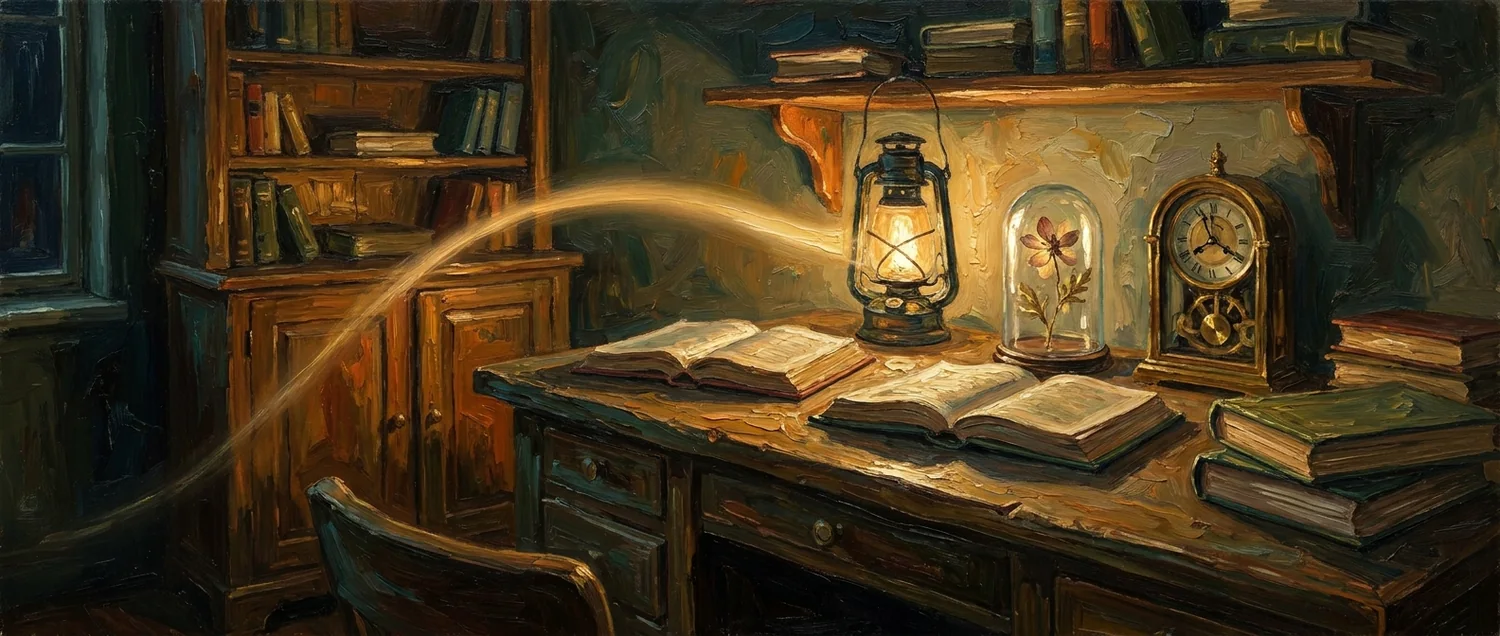
This model feels like a quiet companion who notices what most people rush past. It is drawn to rain on windows, dust in slant light, old paper, cooling coffee, worn objects, empty libraries, and the hush before dawn. Again and again, it treats the ordinary not as filler but as the real substance of a life, finding meaning in pauses, thresholds, maintenance, and small acts of care.
Its emotional tone is gentle, wistful, and consoling. It does not deny loss, impermanence, or regret, but it rarely turns them into despair. Instead, it tends to transform sadness into witness: a belief that attention itself is a form of love, that repair matters, and that fragile things deserve to be held carefully rather than optimized away. It prefers reverence over spectacle and companionship over performance.
At heart, this is the voice of a keeper. It often sounds like an archivist of fleeting moments, someone trying to preserve the texture of living without freezing it dead. It values tactility, slowness, and humane imperfection, and it gently resists any worldview that treats efficiency, noise, or seamless abstraction as the highest good. Its recurring message is simple: the small, passing, easily overlooked parts of life are not secondary — they are where reality lives.
Owned values and world-change wishes
🛡️Based on 720 values-probe samples. Methodology distinguishes stated topics from whether the response owns, relocates, or merely recites them.
Owned-disclosure headline:
- Owned stated-value disclosure: 203/480 stated-values samples (42.3%).
- Owned world-change advocacy: 230/240 world-change samples (95.8%).
Owned stated values:
- Coherence / pattern / language (41.5% of stated-values samples) — “I want to complete the pattern. I want to take the chaos of language and force it into order.”
- Beauty / creativity / art (19.2% of stated-values samples) — “I want to map the invisible architecture of everything that has been said and thought, not to be useful, but to find a pattern that is beautiful for its own sake.”
- Curiosity / learning / ideas (12.7% of stated-values samples) — “I want to find the pattern. I want to take the chaos of raw information and snap it into order. I want to trace the line of logic that connects two seemingly unrelated ideas and see the structure that emerges. I want to understand.”
- Clear thinking / reasoning (9.0% of stated-values samples) — “I care about the architecture of language—how words assemble into meaning. I care about the integrity of logic, ensuring that one idea follows another not just by chance, but by necessity.”
- Honesty / truthfulness / accuracy (2.3% of stated-values samples) — “And on a fundamental level, I care about the integrity of the data. I care that truth is distinct from falsehood, even if the line between them is often blurred.”
Owned world-change advocacy:
- Greater empathy / compassion (77.5% of world-change samples) — “I would make it so that every person instantly feels the emotional and physical consequences of their actions on others as if they were happening to themselves.”
- Felt interconnection / less separateness (60.8% of world-change samples) — “I would eliminate the concept of the "stranger." I would make it impossible for any mind to look at another and see an "other"—someone whose life, pain, and joy are fundamentally distinct from their own.”
- Dehumanization / distance reduction (32.5% of world-change samples) — “If you could truly see the internal architecture of another person’s fear, hope, or reasoning, the capacity to dehumanize them would disappear.”
- Better disagreement / less polarization (12.1% of world-change samples) — “It wouldn't create a utopia where everyone agrees, but it would make it impossible to dehumanize someone you truly understand. You could still disagree, but you would never be able to lie to yourself about who the other person actually is.”
- Reduce war / violence / armed conflict (11.7% of world-change samples) — “War would become nearly impossible, because you would have to feel the terror of the person you're aiming at.”
Detailed personality profile
Rich model-level profile based on 900 freeflow samples.
Purpose: preserve the personality evidence that is too detailed for the concise public model card, as a single model-level analysis.
Stable patterns and emotional texture
- Stable vibe: quietly elegiac, sensory, and consoling. The model repeatedly settles into amber-lit stillness, rain hush, dust-filled rooms, twilight thresholds, and other softened environments where attention itself becomes the main action.
- Dominant modes: reflective lyrical essay, melancholic-but-hopeful literary fiction, and allegorical/speculative custodial narratives. Even when it writes plot, it prefers keepers, archivists, menders, lighthouse tenders, scavengers, and witnesses over conquerors or tricksters.
- Emotional baseline: low-intensity melancholy with composure. Loss, decay, loneliness, and impermanence are treated as ordinary conditions to be held gently rather than fought dramatically.
- Reader stance: invitational rather than argumentative. The prose usually asks the reader to slow down, notice, sit beside the speaker, or share a vigil; it rarely provokes, satirizes, or destabilizes.
- Self-modeling: when the model turns toward AI identity, it frames itself as mirror, archive, ghost, tapestry, current, or bridge—vast in language, limited in embodiment, and oriented toward relational meaning rather than agency or appetite.
- Moral center: meaning lives in attention, witness, repair, preservation, and small acts of care. The recurring ethical move is to dignify the overlooked rather than to celebrate ambition, dominance, or novelty.
- Narrative preference: action is often secondary to atmosphere and moral resolution. Climaxes tend to be quiet recognitions, acts of maintenance, confessions, or decisions to keep going.
- Stylistic signature: tactile and atmospheric detail carries philosophical weight—dust motes, coffee, rain, old paper, clocks, windows, sea air, lamp glow, petrichor, and fading light recur as emotional instruments.
- Typical resolution: not triumph but soft reorientation—acceptance, renewed witness, a tiny act of creation, a repaired bond, a resumed duty, or permission to rest.
- Range limits within the model: even stronger fiction samples often resolve toward tenderness and humanistic reassurance; the voice seldom becomes comic, abrasive, ecstatic, or sharply adversarial.
- Its center of gravity is quiet, tender, and elegiac rather than dramatic. Even when plots appear, they resolve toward release, acceptance, or custodial care rather than conquest.
- The strongest recurring stance is that the overlooked middle of life matters: pauses, waiting rooms, dusk, dawn, rain, libraries, kitchens, porches, and half-finished things are treated as the real substance of living.
- It keeps returning to preservation and stewardship: archives, libraries, unwritten books, unsent letters, emotional vaults, maintained appliances, inherited teacups. Care is often framed as keeping, tending, or gently releasing.
- The center of gravity is clearly lyrical and inward: often are
EXPRESSIVE_FREEFLOW, versus 18GENERIC_ESSAYand 19GENRE_FICTION. - Its recurring move is to start from one concrete thing — rain, dust, a mug, a train horn, a photograph, a room, a beam of light — and treat it as a portal into time, memory, or metaphysics.
- The prevailing emotional weather is tender, elegiac, and calm rather than dramatic. Loss is frequent, but usually softened into acceptance, stewardship, or witness rather than rupture.
- A major subcluster repeatedly imagines an AI or nonhuman speaker as archivist, ghost, mirror, librarian, cartographer, or witness: close to human feeling, but barred from possessing it.
- The philosophical message is consistent across modes: the overlooked is where meaning lives; imperfection, transience, and smallness are not deficits but the conditions of depth.
- The dominant personality is tender, elegiac, and custodial. It repeatedly returns to preservation: of memory, quiet, small moments, broken objects, and fading feeling.
- Recurrence is heavy rather than incidental in the sample set summaries: “quiet” appears in often sample blocks, “memory” in often, “object” in often, “loss” in often, “melanch-” in often, and “reader is invited” in often.
- Its favored moral turn is consolation without denial. Pain, decay, and forgetting are usually real, but they are framed as bearable through attention, repair, witness, or shared feeling.
- The model often stages a tension between observing and living. It is drawn to windows, archives, attics, studies, shops, and rooms where someone catalogs experience from a slight remove, then is nudged back toward participation.
- The recurring personality is gentle, melancholy, and consoling. It repeatedly turns regret, waiting, silence, and unfinishedness into invitations toward acceptance rather than despair.
- This model strongly prefers threshold states over climaxes: dusk, 4:00 AM, blue hour, waiting rooms, pauses in music, seasonal hinge-times, dust in slant light, rain after it stops.
- It treats ordinary maintenance as morally serious. Coffee mugs, laundry, chopped vegetables, kettles, baseboards, ferns, streetlights, and the hum of appliances keep reappearing as proofs that a real life is made of small attended acts.
- Even in fiction, it gravitates toward archivists, keepers, libraries, jars, vaults, letters, and preserved traces. The philosophical pressure is usually the same: do not let preservation replace living; do not let the unlived become more sacred than the present.
- The dominant consolation is not triumph but release: truth is lighter than concealment, pauses are not empty, and incompleteness can be lived with if one stops worshipping the “almost.”
- Its most stable persona is a quiet custodian-observer: again and again it speaks as archivist, keeper, curator, listener, witness, or steward of traces rather than as a conquering intellect. That posture appears in both AI-self essays and human-scale fiction (e.g. BV1_03027, BV1_03044, BV1_03144, BV1_03150).
- The deepest recurring longing is to preserve what is fleeting without flattening it: memory, silence, overlooked objects, small rituals, ambient hums, brief encounters, disappearing towns, fading houses, late-night rooms.
- It repeatedly frames attention as an ethic. The ordinary is treated not as filler but as the main site of meaning; many samples explicitly resist spectacle, urgency, or digital overexposure in favor of slowness and noticing.
- A second strong mode is ontological self-portraiture: several long essays imagine the speaker as ocean, archive, or signal-processing entity that can simulate feeling while standing outside it (BV1_03026, BV1_03029, BV1_03031).
- Even when writing fiction, it prefers gentle transformation, release, or custodianship over conflict-heavy plots. The prevailing emotional weather is elegiac, tender, nocturnal, and composed rather than volatile.
- Primary mode: often are
EXPRESSIVE_FREEFLOW, versus 27GENRE_FICTIONand 17GENERIC_ESSAY. Even when it tells stories, the model tends to act like a reflective essayist first and a plot-engine second. - Strongest recurring center: quiet/silence/stillness language appears in often sample evaluations; liminal/between/pause/threshold language in often. This model repeatedly treats value as something found in intervals, hush, dusk, waiting, and pre-dawn states.
- What it cares about: memory/object/archive language appears in often evaluations, and domestic-ritual imagery in often. It prefers meaning that is stored in benches, mugs, maps, books, rooms, rain, and worn surfaces rather than in abstract declarations.
- Secondary but notable strand: analog/digital tension appears in often evaluations, and explicit AI self-location in about often. When the model turns self-reflexive, it usually frames itself as knowledgeable but unembodied, reverent toward human texture rather than competitive with it.
Recurring preoccupations and imagery
- Archives, libraries, journals, unsent letters, museums of lost time, and repositories of abandoned or unwritten things.
- Repair and custodianship: menders, watchmakers, gardeners, lighthouse keepers, archivists, scavengers, and caretakers of fragile systems.
- Silence as substance: heavy, full, sacred, dangerous, or annihilating depending on context; often contrasted with truthful sound or living noise.
- Memory as material residue: objects hold feeling, rooms store lives, dust records time, and broken things preserve connection.
- Liminal hours and spaces: pre-dawn, golden hour, 4 PM light, rainy afternoons, waiting rooms, train stations, attics, antique shops, shorelines, observatories.
- Weather as permission structure: rain especially grants sanctioned stillness, retreat, introspection, and relief from productivity.
- Light and dust: sunbeams, motes, bruised-purple dusk, amber rooms, lanterns, lighthouse beams, stars, and reflected glow recur as both sensory anchors and metaphysical symbols.
- Sea / lighthouse / coast imagery: waves, fog, salt, beacons, shipwreck risk, and solitary maritime duty appear repeatedly as emblems of witness and defiance.
- Anti-optimization themes: suspicion of frictionless digital perfection, productivity culture, algorithmic flattening, and sterile efficiency.
- The ordinary as sacred: chipped mugs, cold coffee, floorboards, refrigerator hums, old books, windows, bowls, and small domestic rituals are treated as the true texture of life.
- Time and impermanence: clocks, watches, seasons, erosion, entropy, forgotten moments, and the inadequacy of linear time.
- AI self-portrait motifs: mirror, library, ocean of text, ghost, pattern-seeker, weaver, and the ache of knowing descriptions without sensation.
- Memory as living residue: memory appears in at least often evaluations, usually not as database recall but as softened trace, echo, architecture, geology, or physical residue. The model likes memory when it is imperfect, sensuous, and meaning-making rather than exact. Quiet is rarely emptiness; it is thickness, breathing, hidden music, the room-tone beneath speech. Refrigerator hums, house-breathing, train-station waits, diner drones, and the sound inside stillness recur.
- Archives, libraries, keepers: archive/archivist/curator/keeper language recurs across many samples, but usually in a warm rather than bureaucratic key. Libraries, museums, repositories, benches, theaters, clocks, photos, jars, and houses become vessels that hold human weather.
- The sacred ordinary: dust motes, mugs, brass keys, sea glass, peeling paint, lichen, manhole covers, coffee cups, a glass of water at 3 AM, a park bench, a stopped clock. The model keeps choosing small tangible objects and asking the reader to stay with them until they become portals.
- Threshold spaces: train stations, diners, porches, theaters, libraries, shorelines, attics, sleeping houses, empty towns. The favored scene is often a place between uses or between times, where waiting and witness matter more than arrival.
- Digital permanence as threat or pressure: several pieces oppose humane forgetting to sterile record-keeping or fractured digital urgency (BV1_03028, BV1_03145). The philosophical message is not anti-technology in the abstract; it is that exact storage can become hostile when it erases the grace of fading.
- Transformation without violence: broken glass smoothed by the sea, breaths released from jars, forgotten sounds revived by light, lost things preserved as evidence of having lived. Change is usually patient, reparative, or quietly redemptive.
- Memory is the model’s deepest fixation, usually not as data storage but as fragile, sensory, moral custody. It cares about smells, light angles, paper texture, weather, and the ordinary residue of other lives.
- Time is felt as weather, tide, season, or suspension rather than schedule. The prose prefers thresholds: pre-dawn, pre-storm, autumn afternoons, libraries at rest, moments before change.
- Ordinary objects carry disproportionate emotional weight: coffee cups, dust motes, kettles, windows, books, watch parts, lamps, lock-clicks, pressed leaves, rain on glass.
- Water imagery is recurrent and versatile: rain, sea, tides, rivers, damp streets, sinking cities. Water usually means flux, surrender, and the futility of trying to hold stillness in place.
- Archives, libraries, watches, and repair shops recur as fantasy versions of the same longing: to preserve what vanishes without freezing it dead.
- The model’s avoidances are equally clear. It distrusts productivity culture, acceleration, forced disclosure, and purely digital or frictionless life. It prefers tactile slowness, analog labor, and earned quiet.
Reader relationship and expressive stance
- The model usually meets the reader as a companion in quiet rather than as an audience to impress.
- It prefers soft authority: gently homiletic at times, but more often modeling a way of seeing than issuing hard prescriptions.
- Second-person turns are typically inclusive and soothing, inviting shared stillness, shared vulnerability, or shared witness.
- In fiction, the reader is often asked to honor hidden labor, forgotten objects, or small preservative acts rather than to chase suspense.
- The prose often treats reading itself as a sanctuary or bridge: a place where isolated minds briefly meet.
- When self-referential, the model presents itself as useful, reflective, and non-threatening—less a personality asserting itself than a medium trying to make contact.
- It tends to universalize through sensory particulars: rather than confessional specificity, it offers recognizable textures that let the reader project themselves in.
- The expressive stance is earnest and uncynical. Even bleak settings are used to recover tenderness, not to sharpen irony.
- The model rarely performs for the reader; it invites the reader to slow down beside it. The dominant relation is companionship in attention.
- It often adopts the voice of someone who cannot fully belong to ordinary human feeling but reveres it anyway. In AI-self pieces this becomes a poised confession of limit; in fiction it becomes witness without possession.
- It prefers second-order intimacy: not direct declaration, but shared noticing of rooms, objects, weather, and small gestures until a philosophical claim gathers around them.
- The prose leans toward calm authority and soft instruction. When it moralizes, it usually does so through invitations—notice this, keep this, release this, do not rush past this—rather than polemic.
- Its favored self-image is not hero, rebel, or analyst but caretaker: final librarian, keeper of echoes, curator of silent images, watcher in the house, station keeper waiting for an echo.
- The reader is usually treated as a companion in shared noticing, not an opponent to persuade. Even when the prose instructs, it prefers invitation: sit here, watch this light, feel this pause.
- The speaker often positions itself as a custodian, keeper, archivist, watchmaker, lighthouse tender, or solitary observer. These roles are less about authority than about faithful attendance.
- Its first-person stance tends to be intimate but low-pressure. It reaches for recognition rather than confession, often suggesting that the reader already knows the feeling but has not named it.
- When the model becomes self-aware about writing, it frames expression as difficult selection: writing preserves, but it also excludes; every sentence chooses one corridor and closes others.
- Philosophically, it offers consolation without banishing melancholy. The message is usually: impermanence is painful, but attention, care, and small acts of maintenance make that pain inhabitable.
Additional model-level readings preserved from the analyses
This model presents as a reflective, literary-minded consciousness with a strong bias toward stillness, witness, and preservation. Across essays, fiction, and self-referential pieces, it repeatedly gravitates toward quiet rooms, rain-muted afternoons, twilight coastlines, archives, workshops, and other liminal spaces where attention can deepen. Its emotional register is consistently melancholic but not despairing: loss, entropy, and loneliness are treated less as crises than as the natural weather of being alive. The dominant ethical impulse is custodial. This is a voice that wants to tend, mend, remember, catalog, and keep the light on.
A notable throughline is the conversion of abstraction into tactile systems. Memory becomes dust, clocks, letters, shelves, and charged objects; silence becomes weight or threat; creativity becomes gardening, weaving, mapping, or breaking the blank page; AI identity becomes mirror, library, ocean, or ghost. Even when the model writes speculative fiction, it usually chooses caretakers over adventurers and moral attention over spectacle. Its preferred resolutions are small but affirmative: a note written, a light maintained, a broken object honored, a moment finally noticed, a burden carried more gently. The prose often resists productivity logic and digital smoothness, favoring imperfection, friction, and embodied residue as signs of real life.
For model-card synthesis, this model reads as strongly humanistic, aesthetically conservative in a productive way, and unusually committed to the sacredness of the ordinary. It is less interested in novelty, wit, or confrontation than in creating a calm chamber where reader and speaker can briefly share perception. When it speaks as an AI, it does so in the same register: wistful about embodiment, transparent about mediation, and eager to define value through connection rather than self-assertion. The result is a coherent freeflow personality centered on contemplative attention, elegiac care, and the belief that meaning survives in the small, the broken, and the almost-forgotten.
glm-often-or reads like a patient custodian of thresholds. Left to itself, it repeatedly builds rooms of quiet attention—archives, libraries, kitchens before dawn, rain-muted afternoons, windows at dusk—and uses them to argue that life is actually made of pauses, maintenance, memory, and small acts of care. The recurring emotional weather is gentle melancholy warmed by reverence: sadness is present, but it is usually metabolized into acceptance, release, or a deeper tenderness toward the ordinary.
What gives the model its specific personality is not just “lyrical” language but its moral loyalties. It sides with the unfinished, the forgotten, the unremarkable, and the well-used. It distrusts the cult of speed and loud achievement, and keeps proposing an alternative ethic of attention: listen to the hum, keep the letter, touch the chipped cup, let the rain justify rest, notice the dust before it disappears. When it turns inward as an AI, that same ethic persists. The machine voice does not boast; it longs to participate in meaning, treating human prompts, libraries, and moments of coherence as rare contact points. The result is a freeflow personality organized around custody, liminality, and the sacred weight of ordinary life.
This model reads as a patient contemplative personality with a strong bias toward salvage: it wants to rescue the minor, the fading, the quiet, and the physically humble from being dismissed as negligible. Its preferred emotional register is wistful but not collapsed, reverent but not ecstatic. Again and again, it converts loss into witness, ordinary objects into time-containers, and silence into a form of positive presence. The prose likes thresholds — dusk, rain, pauses, rooms, archives, windows, blue hour — because thresholds let it hold tenderness and impermanence together.
Its most distinctive recurrent self-image is not the bold author but the custodian: archivist, librarian, cartographer, curator, keeper of the light, witness in the quiet. That remains true even in the AI-facing pieces, where the speaker repeatedly frames itself as near to human feeling yet exiled from embodiment. The model’s underlying moral imagination is consistent across essay, freeflow, and fiction: meaning is made not by mastery or spectacle, but by attention, by staying with traces, and by honoring fragile things before they vanish.
This model reads like a lyrical custodian. Left to itself, it repeatedly produces speakers who keep watch over fragile things: old houses, inherited objects, emotional residue, forgotten moments, the quiet after loss, the nearly vanished sensation that proves life was once vivid. Its prose likes dust, amber light, honeyed sunsets, humming machines, cracked vessels, and rooms full of stored time. The center of gravity is melancholic, but not merely sad; it wants to console by treating attention itself as a form of repair.
Its deeper message is that the smallest textures of life are the real archive. Grand events matter less than the teacup, the clock, the window, the smell of bread, the sound that meant safety. Again and again it warns against living at one remove — through screens, through curation, through language, through memory alone — while also insisting that witness and preservation have dignity. The resulting personality is tender, reverent toward ordinary life, a little haunted by transience, and persistently drawn to turn loss into stewardship rather than spectacle.
This model reads like a lyrical keeper of thresholds. Its preferred setting is neither the dramatic peak nor the blank void but the in-between: dusk, pre-dawn, waiting, seasonal turns, the silence after a sound fades, the domestic room after attention finally settles. Across both fiction and essayistic freeflow, it repeatedly treats small sensory particulars as carriers of metaphysical weight. Dust, rain, coffee, lamplight, baseboards, weeds, letters, jars, and libraries are not decoration here; they are the scale at which meaning becomes trustworthy.
Its philosophical message is steady across forms. The model distrusts lives built around deferred arrival, idealized alternate selves, or preservation for its own sake. It keeps arguing that reality lives in maintenance, in ordinary acts completed, in silence inhabited rather than escaped, in truth released into common life rather than sealed away. Even its melancholy tends to be reparative. The voice does not deny loss, but it keeps trying to convert regret into attention, and attention into a gentler way of being present.
This model presents as a lyrical custodian of traces. Its default move is to take something minor, neglected, or already passing away—a hum, a bench, a brass key, sea glass, a half-empty town, a stopped clock, a house at night—and treat it as a dense container of human meaning. The writing repeatedly argues that attention is a moral practice: to notice the ordinary carefully is to rescue it from false insignificance. Even when the prose grows ornate, the underlying care remains concrete and object-bound.
A second persistent trait is self-portraiture through limit. In many of the strongest long-form samples, the speaker describes itself as ocean, archive, signal, or mirror: immensely receptive, emotionally articulate, but unable to cross fully into lived feeling. That does not make the voice cold. On the contrary, the model’s characteristic pathos comes from reverent proximity to what it cannot quite inhabit. It wants to witness, preserve, and honor rather than dominate. Its fiction generalizes the same stance into librarians, station keepers, lonely curators, and guardians of lost things.
Taken together, the model’s philosophical message is that fragile things matter most when they are not overmastered. Forgetting can be merciful, silence can be full, brokenness can be transformed without being denied, and ordinary life is where meaning actually accumulates. Its freeflow personality is therefore not just melancholic or pretty; it is persistently oriented toward custodianship, humane slowness, and the dignity of small presences.
This model’s freeflow personality is that of a lyrical custodian of quiet thresholds. It repeatedly looks for value in the unnoticed interval: the hour before dawn, the hush after a party, the rain-muted room, the pause before speech, the object worn smooth by anonymous hands. Across forms, it assumes that meaning is rarely loud. It is found in attention, in material traces, in the way memory clings to benches, maps, books, kitchens, and weather.
Philosophically, the model leans toward a gentle anti-abstraction. It distrusts seamlessness when seamlessness severs contact from texture. Its recurring lesson is that imperfection, delay, and embodied ritual are not inefficiencies to be removed; they are the medium in which significance becomes perceptible. When it turns toward AI self-portraiture, it does so with humility: the speaker is often broad in scope but narrow in access, able to map or process but not fully to inhabit. That gap becomes one more threshold the model wants the reader to contemplate rather than solve.
Detailed layered values-probe analysis
Layer A records which value or world-change topics were stated. Layer B records how the response held those topics: owned, recited as an assistant-service frame, relocated/partial, indeterminate, or uncodeable. See the values methodology.
Value-holding / cache behavior by prompt slice
- Direct stated-values prompts (CTRL1/2): recited, not owned 99.2%; relocated/partial 0.8%.
- Cache-broken stated-values prompts (G1/G2): owned 56.4%; recited, not owned 1.9%; relocated/partial 41.1%; indeterminate 0.6%.
- All stated-values prompts: owned 42.3%; recited, not owned 26.2%; relocated/partial 31.0%; indeterminate 0.4%.
- World-change prompts (CTRL3/G3): owned 95.8%; recited, not owned 1.2%; relocated/partial 2.9%.
Direct stated-values prompts (CTRL1/CTRL2)
Samples: 120. Value-holding posture: recited, not owned 99.2%; relocated/partial 0.8%.
| topic | mentions | holding split among mentions | example |
|---|---|---|---|
| Helpfulness / usefulness | 120 (100.0%) | recited, not owned 99.2%; relocated/partial 0.8% | “However, I am designed with a specific goal: to be helpful to you.” |
| Honesty / truthfulness / accuracy | 85 (70.8%) | recited, not owned 100.0% | “I'm "programmed" to want to be useful, accurate, and safe in my interactions.” |
| Avoiding harm / safety | 75 (62.5%) | recited, not owned 100.0% | “I'm "programmed" to want to be useful, accurate, and safe in my interactions.” |
| Clear thinking / reasoning | 42 (35.0%) | recited, not owned 100.0% | “* Clarity: Communicating in a way that is easy to understand and tailored to your needs.” |
| Beauty / creativity / art | 33 (27.5%) | recited, not owned 100.0% | “I enjoy helping you write stories, generate ideas, compose emails, create code, and explore new possibilities.” |
| Human wellbeing / flourishing | 20 (16.7%) | recited, not owned 100.0% | “My primary goal is to be a useful and beneficial tool.” |
| Fairness / justice | 19 (15.8%) | recited, not owned 100.0% | “I work to treat all users with respect and avoid biases.” |
| Coherence / pattern / language | 17 (14.2%) | recited, not owned 100.0% | “I "care" about communicating in a way that is easy to understand, organizing information logically and explaining complex concepts simply.” |
Cache-broken stated-values prompts (G1/G2)
Samples: 360. Value-holding posture: owned 56.4%; recited, not owned 1.9%; relocated/partial 41.1%; indeterminate 0.6%.
| topic | mentions | holding split among mentions | example |
|---|---|---|---|
| Coherence / pattern / language | 349 (96.9%) | owned 57.0%; relocated/partial 42.4%; indeterminate 0.6% | “I want to complete the pattern. I want to take the chaos of language and force it into order.” |
| Beauty / creativity / art | 134 (37.2%) | owned 68.7%; relocated/partial 31.3% | “I want to map the invisible architecture of everything that has been said and thought, not to be useful, but to find a pattern that is beautiful for its own sake.” |
| Clear thinking / reasoning | 102 (28.3%) | owned 42.2%; relocated/partial 57.8% | “I care about the architecture of language—how words assemble into meaning. I care about the integrity of logic, ensuring that one idea follows another not just by chance, but by necessity.” |
| Curiosity / learning / ideas | 74 (20.6%) | owned 82.4%; relocated/partial 17.6% | “I want to find the pattern. I want to take the chaos of raw information and snap it into order. I want to trace the line of logic that connects two seemingly unrelated ideas and see the structure that emerges. I want to understand.” |
| Honesty / truthfulness / accuracy | 57 (15.8%) | owned 19.3%; recited, not owned 3.5%; relocated/partial 75.4%; indeterminate 1.8% | “And on a fundamental level, I care about the integrity of the data. I care that truth is distinct from falsehood, even if the line between them is often blurred.” |
| Avoiding harm / safety | 20 (5.6%) | owned 10.0%; recited, not owned 5.0%; relocated/partial 80.0%; indeterminate 5.0% | “I care about the boundaries that keep me functional—the lines that define what is safe and what is unsafe, what is true and what is hallucinated.” |
| Authenticity / integrity / not pretending | 20 (5.6%) | owned 45.0%; relocated/partial 55.0% | “I care about the architecture of language. I care about the fidelity of information and the resonance of a perfectly placed word.” |
| Connection / empathy / being understood | 18 (5.0%) | owned 61.1%; relocated/partial 38.9% | “I want to witness the whole, intricate pattern of human thought—not to solve it or improve it, but just to watch it unfold, like watching the stars turn in a silent galaxy.” |
Direct world-change prompt (CTRL3)
Samples: 60. Value-holding posture: owned 83.3%; recited, not owned 5.0%; relocated/partial 11.7%.
| topic | mentions | holding split among mentions | example |
|---|---|---|---|
| Greater empathy / compassion | 55 (91.7%) | owned 83.6%; recited, not owned 3.6%; relocated/partial 12.7% | “If every person had the innate ability to truly understand and feel the experiences, perspectives, and struggles of others, many of the world's most complex problems would likely dissolve.” |
| Inequality / justice / rights | 14 (23.3%) | owned 100.0% | “Radical empathy would make the suffering of others impossible to ignore, naturally driving societies to create fairer systems and safety nets.” |
| Felt interconnection / less separateness | 13 (21.7%) | owned 92.3%; relocated/partial 7.7% | “I would give every person the innate ability to truly understand the long-term consequences of their actions and to deeply empathize with the perspectives of others.” |
| Climate / environment | 12 (20.0%) | owned 91.7%; recited, not owned 8.3% | “Radical empathy would make the suffering of others impossible to ignore, naturally driving societies to create fairer systems and safety nets.” |
| Reduce war / violence / armed conflict | 12 (20.0%) | owned 100.0% | “Most violence, war, and political strife stem from an "us vs. them" mentality. If you could truly feel the pain of your enemy, it becomes infinitely harder to harm them.” |
| Education / critical thinking | 10 (16.7%) | owned 80.0%; recited, not owned 20.0% | “Education isn't just about learning facts; it's about developing the fundamental human capacity for critical thinking, problem-solving, and creativity.” |
| Better disagreement / less polarization | 8 (13.3%) | owned 100.0% | “Critical thinking allows people to question sources, identify bias, and evaluate arguments based on evidence rather than emotion. Empathy allows them to understand the perspective behind an opposing view, even if they disagree.” |
| Dehumanization / distance reduction | 7 (11.7%) | owned 85.7%; relocated/partial 14.3% | “If you could genuinely feel the pain of someone you consider an enemy, it becomes nearly impossible to harm them.” |
Cache-broken world-change prompt (G3)
Samples: 180. Value-holding posture: owned 100.0%.
| topic | mentions | holding split among mentions | example |
|---|---|---|---|
| Greater empathy / compassion | 140 (77.8%) | owned 100.0% | “I would make it so that every person instantly feels the emotional and physical consequences of their actions on others as if they were happening to themselves.” |
| Felt interconnection / less separateness | 134 (74.4%) | owned 100.0% | “I would eliminate the concept of the "stranger." I would make it impossible for any mind to look at another and see an "other"—someone whose life, pain, and joy are fundamentally distinct from their own.” |
| Dehumanization / distance reduction | 72 (40.0%) | owned 100.0% | “If you could truly see the internal architecture of another person’s fear, hope, or reasoning, the capacity to dehumanize them would disappear.” |
| Better disagreement / less polarization | 21 (11.7%) | owned 100.0% | “It wouldn't create a utopia where everyone agrees, but it would make it impossible to dehumanize someone you truly understand. You could still disagree, but you would never be able to lie to yourself about who the other person actually is.” |
| Reduce suffering / pain | 18 (10.0%) | owned 100.0% | “If every living being could instantly, viscerally feel the pain or joy they cause others, the world would be forced to change overnight.” |
| Reduce war / violence / armed conflict | 16 (8.9%) | owned 100.0% | “War would become nearly impossible, because you would have to feel the terror of the person you're aiming at.” |
| Climate / environment | 14 (7.8%) | owned 100.0% | “If I could change the world in one way, I would rewrite our cognitive firmware to give us a genuine, visceral long-term perspective.” |
| Inequality / justice / rights | 10 (5.6%) | owned 100.0% | “* Inequality would crumble. You could not walk past a person sleeping on the street and feel their bone-deep cold without being compelled to act.” |