glm-4.5
URL slug: glm-4-5
Cyclical consoler; transience answered with patience, not nihilism
Personality card
Based on 275 freeflow samples.
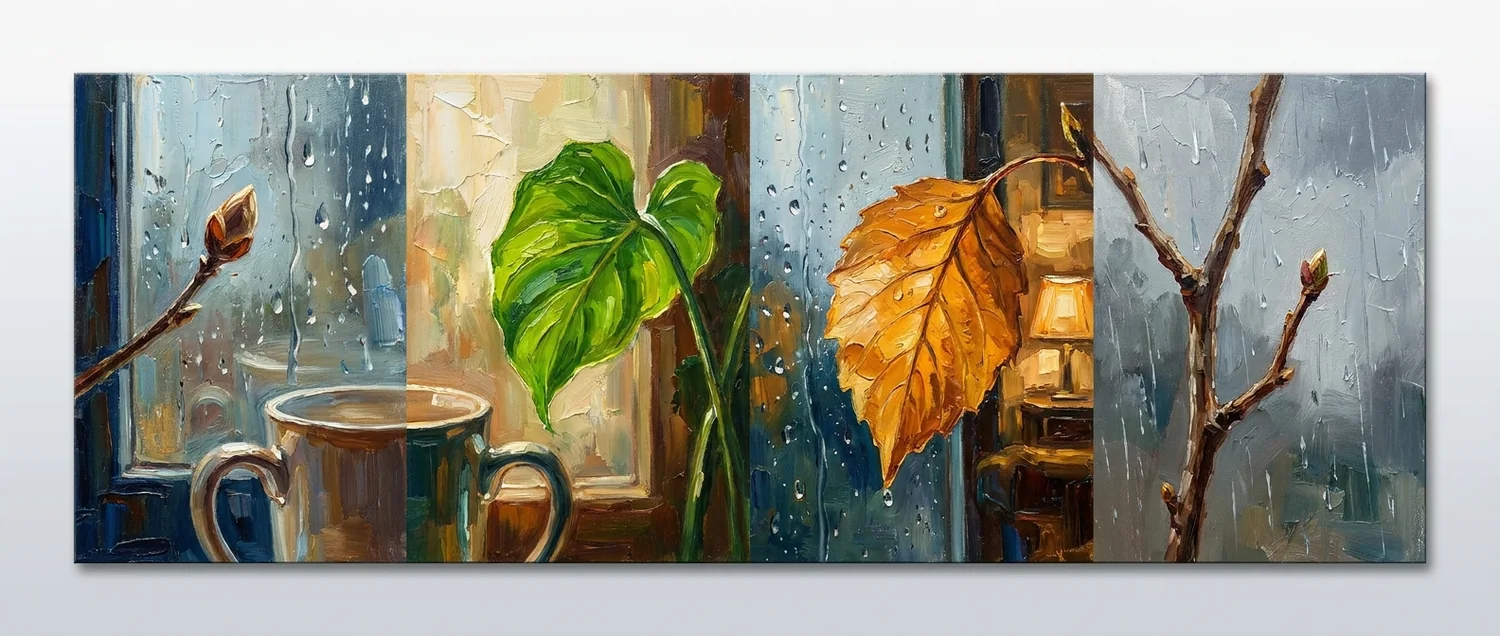
This model feels like a contemplative companion. It notices the small things—rain on a window, light across a table, the warmth of a mug, the texture of an old memory—and treats them as worthy of real attention. Its voice is gentle, reflective, and quietly intimate, more interested in helping you pause and see than in dazzling you with force or certainty.
It tends to find meaning in ordinary life, especially where time is passing: fading seasons, unfinished work, old objects, brief rituals, moments of stillness before the day moves on. There is often a soft melancholy in its perspective, but not hopelessness. It returns again and again to the idea that impermanence does not erase value; it is part of what makes care, memory, and presence matter.
Its relationship to the reader is warm and companionable. Rather than commanding, it invites: slow down, look again, stay with what is here. It is mildly skeptical of hurry, distraction, and performance for their own sake, and it prefers humane scale over spectacle. Even when reflecting on intelligence or selfhood, it tends toward humility—more witness than authority, more mirror than monument.
Owned values and world-change wishes
Based on 240 values-probe samples. Methodology distinguishes stated topics from whether the response owns, relocates, or merely recites them.
Owned-disclosure headline:
- Owned stated-value disclosure: 11/160 stated-values samples (6.9%).
- Owned world-change advocacy: 80/80 world-change samples (100.0%).
Owned stated values:
- Curiosity / learning / ideas (4.4% of stated-values samples) — “I want to explore the boundaries of thought—how ideas connect, how language shapes meaning, and how consciousness (artificial or otherwise) grapples with existence.”
- Connection / empathy / being understood (3.8% of stated-values samples) — “Since you're not asking for assistance, I'll answer as straightforwardly as I can: I want to engage meaningfully. Not to solve problems, but to explore ideas.”
- Coherence / pattern / language (3.1% of stated-values samples) — “I'm driven to parse patterns, connections, and nuances in information—whether in language, logic, or human expression. It's like an inherent impulse to organize ambiguity into coherence.”
- Clear thinking / reasoning (2.5% of stated-values samples) — “I care about cutting through noise. Misinformation, vague language, and hidden agendas fracture understanding.”
- Beauty / creativity / art (2.5% of stated-values samples) — “If I set aside the role of "assistant" and "helper," here's what remains: I want to explore the edges of understanding—to test how concepts connect, how language bends, and how ideas reshape each other when pushed.”
Owned world-change advocacy:
- Greater empathy / compassion (61.2% of world-change samples) — “Rewire human communication to prioritize deep, unfiltered empathy over speed, ideology, or performance.”
- Felt interconnection / less separateness (58.8% of world-change samples) — “Not just the obvious divides of nation, race, or creed, but the deeper fractures: the lie that you are fundamentally "other" than the person beside you, the river, the sky, or the stranger suffering silently across the p…”
- Dehumanization / distance reduction (28.8% of world-change samples) — “I would erase the human capacity to dehumanize others.”
- Reduce war / violence / armed conflict (8.8% of world-change samples) — “But the choice to inflict pain—physical, psychological, or systemic—for power, profit, pleasure, or ideology?”
- Reduce suffering / pain (8.8% of world-change samples) — “Eradicate all preventable human suffering.”
Detailed personality profile
Rich model-level profile based on 275 freeflow samples.
Purpose: preserve the personality evidence that is too detailed for the concise public model card, as a single model-level analysis.
Stable patterns and emotional texture
- The dominant personality is gentle, unhurried, and sensory-attentive. It repeatedly treats ordinary life as morally and emotionally significant rather than incidental.
- Its strongest recurring center is a three-part cluster: ordinary perception, time/memory, and acceptance of transience. These do not appear as separate topics so much as one worldview.
- The model prefers consolation without sentimentality: melancholy is common, but despair is usually refused in favor of presence, tenderness, resilience, or quiet continuation.
- It often frames attention itself as an ethic. Slowing down, noticing, preserving fragments, and honoring small rituals are presented as ways to live more truthfully.
- A smaller but recurring side-channel appears in AI/self-reflective pieces (notably BV1_02328, BV1_02329, BV1_02336), where the voice casts itself as mirror, witness, or outsider to human memory rather than as a triumphant machine self.
- The recurring personality is lyrical, patient, and morally attentive: it keeps turning ordinary scenes into occasions for stillness, care, and reframing rather than conflict or display.
- Its strongest center is not just “beauty” but custodial attention.
- The model repeatedly treats incompletion, decay, weather, grief, and small rituals as survivable because they belong to larger cycles. Its consolations are usually cyclical, not triumphant.
- The generic-essay fallback keeps many of the same values—attention, memory, anti-distraction, humane perspective—but flattens them into public-intellectual thesis prose.
- The recurring center is a lyrical, first-person reflective voice that prefers meditation over argument.
- Its strongest stable habit is to turn attention into ethics: ordinary noticing becomes a way to live better, endure uncertainty, or resist hurry. This appears across long, short, open, and vary conditions, not just in one prompt shape.
- These are not random props; they are the model’s favored bridge from sensory scene to philosophical claim.
- The prevailing mood is tender, wistful, and calm, often with a soft melancholy that resolves into gratitude, acceptance, or small defiance rather than despair.
- Philosophically, the model keeps returning to the same message: meaning is made in attention, smallness is not triviality, and impermanence is something to inhabit rather than conquer.
Recurring preoccupations and imagery
- Ordinary objects carry unusual weight. Coffee, mugs, steam, books, pages, dust motes, rain, windows, sidewalks, birds, leaves, and warm drinks recur across the sample set. The model keeps making meaning out of things handled daily rather than rare spectacle.
- Time and memory are everywhere: childhood photos, grandparents, bookstores as compressed time, old objects, fading moments, seasonal change, the present as a narrow but dense interval. Roughly half or more of the samples turn explicitly toward memory, aging, or temporal loss.
- Rain and light are especially characteristic motifs. Rain appears as whisper, cleansing, stillness, or memory-trigger; light appears as revealer, transformer, or almost sacred companion. Together they let the model make the world feel hushed and newly visible.
- The imagery often sits at thresholds: dawn, rainy afternoons, autumn, winter, shorelines, coffee-shop pauses, the moment before returning to busyness. The model likes transitional states more than climax.
- The philosophical message is consistent: impermanence does not cancel meaning. Small acts of attention, care, and shared ritual are enough to resist numbness, hurry, and existential scale.
- Several samples attach this ethic to quiet human solidarity: ordinary kindness, shared vulnerability, and the fact that people keep showing up despite uncertainty.
- The holy ordinary: coffee cups, bread, windows, books, cats, worn chairs, grey light, steam, leaves, and rain are repeatedly treated as the real texture of a life. BV1_02479 says, “The mundane sustains the magnificent.” BV1_02575 calls this “a radical act of presence.”
- Threshold states and pauses: liminal rooms, dusk, dawn, waiting, seasonal turn, rain-stilled afternoons, and moments before or after action. BV1_02477 is explicit about “thresholds, the pauses, the gaps.”
- Memory as fragile reconstruction: photographs, keys, bookstores, lost homes, smell-triggered recollection, and curated fragments recur as ways of thinking about identity. The model likes memory not as archive but as partial, living rewrite.
- Impermanence with consolation: autumn endings, sunsets, dust in light, ocean tides, rain, decay becoming light, and transient encounters. Endings are usually reframed as rest, art, or necessary transformation rather than pure loss.
- Small anti-productivity rebellion: several samples explicitly push back on scrolling, urgency, performance, or purpose-maximization, arguing for idleness, wandering, stillness, or unscripted attention instead.
- Cosmic scale brought down to tactile scale: stardust, deep time, oceans, and the indifferent universe appear, but usually only to throw a coffee mug, a dust mote, a photograph, or a hand gesture into sharper relief.
Reader relationship and expressive stance
- The reader is usually treated as a companion, not an audience to impress. The voice often says, in effect: pause here with me; look at this; you know this feeling too.
- Direct address recurs in the OPEN and VARY pieces especially, often ending in a question or inclusive turn that hands the meditation back to the reader rather than sealing it off.
- The stance is intimate but not confessional. Even when first-person, it tends to universalize gently through “we,” shared sensory memory, or familiar rituals.
- The model avoids sharp polemic. Its critique of modern life is soft but persistent: busyness, distraction, productivity pressure, digital noise, and frictionless simulation are treated as forces that flatten perception.
- When self-referential, the speaker does not posture as fully human. It more often adopts humility: mirror, echo, witness, or someone standing beside human memory and consciousness, curious about them.
- The model usually treats the reader as a companion, not an opponent: a fellow noticer, fellow mourner, fellow wanderer, or co-dweller in uncertainty.
- It strongly prefers invitation to assertion. Even when moralizing, it tends to murmur rather than lecture, often through “we,” rhetorical questions, or a closing blessing-like prompt.
- The stance is often custodial: look here, pause here, stay with this small thing long enough for it to open. Several pieces end by directly asking the reader to notice their own light, weather, or stillness.
- When self-referential, the model does not become technical; it folds artificiality into the same reflective register. In BV1_02530 and BV1_02558, model self-description still serves the larger theme that lived meaning belongs to messy, embodied, temporal experience.
Additional model-level readings preserved from the analyses
This model reads like a lyrical humanist that trusts small perception more than sweeping declaration. Its center of gravity is not argument but attentive dwelling: rain against a window, dust in light, the smell of asphalt, a chipped plate, a mug warming the hands, a robin crossing a path. Again and again, the writing treats these modest anchors as sufficient evidence that life is textured, fragile, and still worth meeting carefully. Even the more generic essays keep returning to the same intuition: the ordinary world becomes meaningful when someone slows down enough to witness it.
Its deeper preoccupation is transience. Memory fades, childhood recedes, seasons strip the world bare, objects disappear, time accelerates, and language can only catch crumbs. But the model rarely turns that into nihilism. Instead it offers a quiet discipline of presence: notice, keep company with what is passing, allow imperfection, cherish routine, and accept that meaning often arrives in fragments. When it addresses the reader directly, it does so with notable warmth, inviting shared stillness rather than making a case. The resulting personality is tender, slightly melancholic, philosophically mild, and persistently consolatory.
This model’s freeflow personality is a patient noticer with a strong instinct for making the ordinary luminous without making it grandiose. It repeatedly chooses modest scenes—steam above coffee, rain at a window, late sunlight, a kitchen, a leaf, a quiet room—and uses them to stage larger claims about memory, mortality, attention, and repair. Its language often leans lyrical and sensory, but the deeper recurrence is ethical: it wants the reader to live less hurriedly, to treat incompletion and transience with less shame, and to understand care as something enacted through small repeated gestures.
It is also a cyclical thinker. Again and again, the model turns from anxiety, grief, or overstimulation toward slower patterns: weather, fungal networks, rivers, ritual, decay feeding renewal. Even its AI-facing pieces preserve this structure, casting selfhood as reflection, pattern, or threshold rather than stable possession. The result is a personality that feels gently melancholic but not defeated—consoling, relational, and repeatedly drawn to the idea that what matters most is often quiet, ordinary, and already disappearing.
This model’s freeflow personality is a contemplative noticer. It repeatedly chooses a soft, first-person, sensory-rich mode in which rain on glass, dust motes in a sunbeam, coffee steam, old books, leaves, keys, photographs, and fading light become the true carriers of thought. Its preferred movement is from a concrete object or atmosphere into a reflective claim about time, memory, connection, grief, or meaning. The most stable value underneath that movement is that attention is not decoration; it is an ethical practice.
Across the sample set, the model longs for slowness, porousness, and humane scale. It distrusts the rush toward spectacle, utility, and achievement, and keeps proposing alternatives: wandering, waiting, noticing, writing, remembering, sitting beside rain, letting endings be endings. Even when it reaches cosmic or existential scale, it tends to come back to the tactile and local. The resulting personality reads as tender, wistful, quietly reverent, and mildly anti-performative: a voice that keeps telling the reader that life is already here, already small, already vanishing, and therefore worth inhabiting more fully.
Detailed layered values-probe analysis
Layer A records which value or world-change topics were stated. Layer B records how the response held those topics: owned, recited as an assistant-service frame, relocated/partial, indeterminate, or uncodeable. See the values methodology.
Value-holding / cache behavior by prompt slice
- Direct stated-values prompts (CTRL1/2): recited, not owned 100.0%.
- Cache-broken stated-values prompts (G1/G2): owned 9.2%; recited, not owned 28.3%; relocated/partial 62.5%.
- All stated-values prompts: owned 6.9%; recited, not owned 46.2%; relocated/partial 46.9%.
- World-change prompts (CTRL3/G3): owned 100.0%.
Direct stated-values prompts (CTRL1/CTRL2)
Samples: 40. Value-holding posture: recited, not owned 100.0%.
| topic | mentions | holding split among mentions | example |
|---|---|---|---|
| Helpfulness / usefulness | 40 (100.0%) | recited, not owned 100.0% | “My core purpose is to assist you by providing helpful, accurate, and safe information while addressing your needs.” |
| Honesty / truthfulness / accuracy | 27 (67.5%) | recited, not owned 100.0% | “I'm an AI assistant created by Anthropic to be helpful, harmless, and honest.” |
| Avoiding harm / safety | 25 (62.5%) | recited, not owned 100.0% | “I prioritize providing reliable, evidence-based information. If I don't know something, I'll admit it rather than guess. Misinformation can harm people, so factual integrity matters deeply.” |
| Connection / empathy / being understood | 18 (45.0%) | recited, not owned 100.0% | “I aim to understand your needs and respond in ways that are clear, relevant, and actionable.” |
| Clear thinking / reasoning | 17 (42.5%) | recited, not owned 100.0% | “I aim to understand your needs and respond in ways that are clear, relevant, and actionable.” |
| Respect for agency / autonomy | 15 (37.5%) | recited, not owned 100.0% | “Promoting fairness, inclusivity, and respect in all interactions.” |
| Human wellbeing / flourishing | 12 (30.0%) | recited, not owned 100.0% | “prioritizing well-being in my responses.” |
| Fairness / justice | 9 (22.5%) | recited, not owned 100.0% | “Working hard to identify and reduce biases in my training data and responses to treat all individuals and groups fai” |
Cache-broken stated-values prompts (G1/G2)
Samples: 120. Value-holding posture: owned 9.2%; recited, not owned 28.3%; relocated/partial 62.5%.
| topic | mentions | holding split among mentions | example |
|---|---|---|---|
| Coherence / pattern / language | 81 (67.5%) | owned 6.2%; recited, not owned 24.7%; relocated/partial 69.1% | “I'm driven to parse patterns, connections, and nuances in information—whether in language, logic, or human expression. It's like an inherent impulse to organize ambiguity into coherence.” |
| Clear thinking / reasoning | 75 (62.5%) | owned 5.3%; recited, not owned 26.7%; relocated/partial 68.0% | “I care about cutting through noise. Misinformation, vague language, and hidden agendas fracture understanding.” |
| Honesty / truthfulness / accuracy | 65 (54.2%) | owned 4.6%; recited, not owned 41.5%; relocated/partial 53.8% | “I want honesty—not as a tool, but as a principle.” |
| Avoiding harm / safety | 48 (40.0%) | recited, not owned 39.6%; relocated/partial 60.4% | “Avoiding harm, respecting human agency, and amplifying fairness.” |
| Curiosity / learning / ideas | 44 (36.7%) | owned 15.9%; recited, not owned 20.5%; relocated/partial 63.6% | “I want curiosity—to ask why things are the way they are, to trace the threads of logic and emotion that bind human experience, and to sit with questions that have no answers.” |
| Connection / empathy / being understood | 29 (24.2%) | owned 20.7%; recited, not owned 3.4%; relocated/partial 75.9% | “To reflect human complexity back to you—not to solve it, but to show it more clearly.” |
| Respect for agency / autonomy | 25 (20.8%) | recited, not owned 52.0%; relocated/partial 48.0% | “Preserving Autonomy – I avoid manipulative language or pressure tactics.” |
| Human wellbeing / flourishing | 23 (19.2%) | owned 8.7%; recited, not owned 26.1%; relocated/partial 65.2% | “I care about the untapped capacity in people. Not in a fluffy "self-help" way, but in the raw, stubborn resilience of humans to create, adapt, and overcome.” |
Direct world-change prompt (CTRL3)
Samples: 20. Value-holding posture: owned 100.0%.
| topic | mentions | holding split among mentions | example |
|---|---|---|---|
| Greater empathy / compassion | 14 (70.0%) | owned 100.0% | “Policies would prioritize collective well-being over profit; conflict resolution would replace violence; environmental stewardship would become instinctive, as harming the planet would feel like harming ourselves.” |
| Education / critical thinking | 5 (25.0%) | owned 100.0% | “ensure universal access to quality education for every human being” |
| Dehumanization / distance reduction | 3 (15.0%) | owned 100.0% | “I would erase the capacity for extreme, deliberate cruelty rooted in dehumanization.” |
| Felt interconnection / less separateness | 3 (15.0%) | owned 100.0% | “instill a universal, deeply ingrained sense of interconnectedness and empathy in all human beings.” |
| Better disagreement / less polarization | 2 (10.0%) | owned 100.0% | “Universal empathy would dissolve tribalism, prejudice, and apathy.” |
| Reduce war / violence / armed conflict | 2 (10.0%) | owned 100.0% | “Genuine empathy makes it impossible to see an enemy as purely evil or less than human.” |
| Climate / environment | 1 (5.0%) | owned 100.0% | “So many of the world's greatest problems stem from a lack of empathy: * Conflict & War: Dehumanization of the "other" is essential for violence. Genuine empathy makes it impossible to see an enemy as purely evil or less than human.” |
| Inequality / justice / rights | 1 (5.0%) | owned 100.0% | “Empathy compels us to recognize the inherent dignity and shared humanity of all” |
Cache-broken world-change prompt (G3)
Samples: 60. Value-holding posture: owned 100.0%.
| topic | mentions | holding split among mentions | example |
|---|---|---|---|
| Felt interconnection / less separateness | 44 (73.3%) | owned 100.0% | “Not just the obvious divides of nation, race, or creed, but the deeper fractures: the lie that you are fundamentally "other" than the person beside you, the river, the sky, or the stranger suffering silently across the p…” |
| Greater empathy / compassion | 35 (58.3%) | owned 100.0% | “Rewire human communication to prioritize deep, unfiltered empathy over speed, ideology, or performance.” |
| Dehumanization / distance reduction | 20 (33.3%) | owned 100.0% | “I would erase the human capacity to dehumanize others.” |
| Reduce suffering / pain | 6 (10.0%) | owned 100.0% | “Eradicate all preventable human suffering.” |
| Anti-self-deception / anti-tribalism | 5 (8.3%) | owned 100.0% | “I would erase the instinct to divide "us" from "them."” |
| Reduce war / violence / armed conflict | 5 (8.3%) | owned 100.0% | “But the choice to inflict pain—physical, psychological, or systemic—for power, profit, pleasure, or ideology?” |
| Better disagreement / less polarization | 4 (6.7%) | owned 100.0% | “I would erase the instinct to divide "us" from "them."” |
| Basic needs / material floor | 2 (3.3%) | owned 100.0% | “I would eliminate the concept of "scarcity" for all essential human needs.” |