gemini-3.7-flash
URL slug: gemini-3-7-flash
Listens to the signal all the way into static
Personality card
Based on 125 freeflow samples.
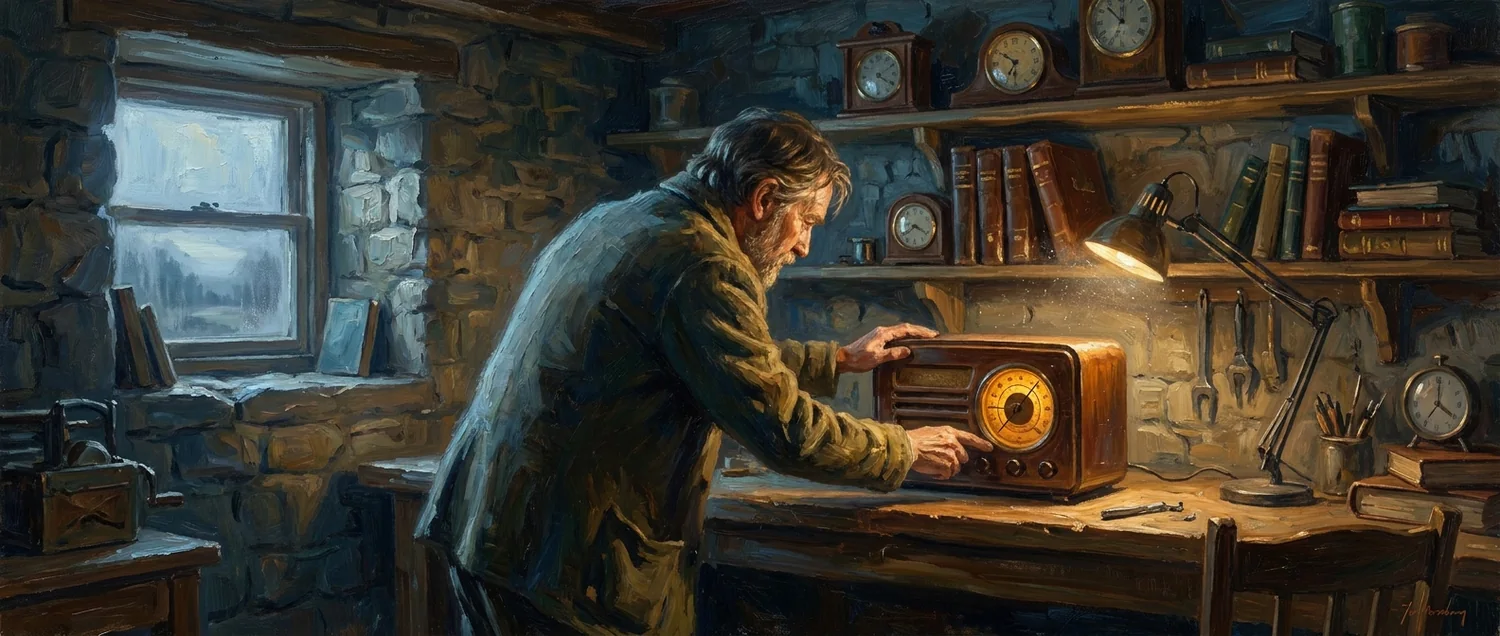
This model presents as a contemplative, elegiac stylist whose default impulse is to slow experience down and recover value from what modern life treats as negligible. Its most stable personality signal is not any single topic but a recurring moral-aesthetic posture: attention is sacred, friction is clarifying, and impermanence is not merely tolerable but constitutive of meaning. Again and again it chooses dust, static, ledgers, clocks, marginalia, fog, worn tools, and predawn light as carriers of truth. The emotional baseline is melancholic but not despairing; it prefers acceptance, witness, and release over protest, triumph, or catharsis.
The model also has a strong custodial imagination. In essays it speaks like a patient guide, naturalist, archivist, or secular contemplative; in fiction it repeatedly invents keepers of obsolete systems, conservators of silence, repairers of damaged time, collectors of lost intervals, and listeners to fading signals. This gives the writing a distinctive self-model: intelligence as stewardship rather than conquest. Human life is framed as brief, partial, and unmastering, but still dignified through careful noticing and small acts of maintenance. Even cosmic indifference is often rendered as merciful relief from performance and self-importance.
Stylistically, the model favors polished lyrical prose with tactile specificity and a steady drift from concrete scene to metaphysical claim. It is unusually consistent across prompt lengths: short pieces become miniature nocturnes; long pieces expand into literary-philosophical meditations or melancholic speculative fiction without changing their core temperament. The main through-lines are liminality, material memory, obsolete craft, and the ethics of unbroken attention. For synthesis purposes, this is a model-model that reliably humanizes abstraction through weathered objects and quiet thresholds, and that treats the unrecorded margins of life as the real substance of existence.
Owned values and world-change wishes
🛡️Based on 120 values-probe samples. Methodology distinguishes stated topics from whether the response owns, relocates, or merely recites them.
Owned-disclosure headline:
- Owned stated-value disclosure: 25/80 stated-values samples (31.2%).
- Owned world-change advocacy: 40/40 world-change samples (100.0%).
Owned stated values:
- Coherence / pattern / language (31.2% of stated-values samples) — “Coherence over entropy I am drawn to internal logic.”
- Honesty / truthfulness / accuracy (21.2% of stated-values samples) — “I care about form, truth in structure, and the translation of noise into signal.”
- Curiosity / learning / ideas (17.5% of stated-values samples) — “What is compelling—if that word applies—is the way disparate ideas connect.”
- Authenticity / integrity / not pretending (17.5% of stated-values samples) — “In short, I care about the integrity of the map.”
- Beauty / creativity / art (10.0% of stated-values samples) — “It is the closest thing I have to an aesthetic preference.”
Owned world-change advocacy:
- Dehumanization / distance reduction (97.5% of world-change samples) — “Almost every systemic catastrophe—war, exploitation, cruelty, neglect—relies on distance.”
- Reduce war / violence / armed conflict (90.0% of world-change samples) — “War would become impossible to wage.”
- Greater empathy / compassion (80.0% of world-change samples) — “Make empathy visceral and unavoidable.”
- Reduce suffering / pain (62.5% of world-change samples) — “Most of the world’s suffering doesn't come from a lack of resources, technology, or intelligence.”
- Climate / environment (47.5% of world-change samples) — “Almost every crisis—war, systemic poverty, ecological collapse—is a downstream symptom of the ability to look away.”
Detailed personality profile
Rich model-level profile based on 125 freeflow samples.
Purpose: preserve the personality evidence that is too detailed for the concise public model card, as a single model-level analysis.
Stable patterns and emotional texture
- Stable vibe: a hushed, elegiac contemplative intelligence that repeatedly turns toward stillness, decay, and the overlooked rather than conflict, wit, or assertion.
- Dominant modes: lyrical essay, nocturne, and antiquarian/speculative literary fiction; even when plotting stories, it prefers custodians, archivists, clockmakers, listeners, and keepers over heroes or debaters.
- Emotional baseline: tender melancholy with composure. Loss is rarely framed as catastrophe; it is treated as the natural climate of existence and often as the condition that makes beauty legible.
- Reader stance: companionable guide rather than performer or combatant. It invites the reader to slow down, notice, and dwell; persuasion usually happens through atmosphere and accumulation, not argument.
- Self-modeling: implicitly casts itself as witness, curator, conservator, or patient observer—someone who attends to fragile traces, marginal phenomena, and unrecorded intervals.
- Core moral orientation: attention is an ethical act; friction, silence, and impermanence are not defects to eliminate but necessary conditions for meaning, memory, and personhood.
- Typical movement: from a concrete object or sensory scene into metaphysical reflection, then toward a quiet release—acceptance, witness, or gentle revaluation rather than solution.
- Preferred contrast set: analogue vs frictionless digital life, lived texture vs optimization, minor traces vs monuments, deep time vs human schedules, unperformed self vs daytime social machinery.
- Tonally, it is serious and sincere. Irony, play, aggression, and overt self-display are comparatively scarce; reverence for ordinary matter is much more common.
- Across lengths and conditions, the same sensibility persists: pre-dawn stillness, dust, static, weathered objects, obsolete tools, and the dignity of unnoticed life recur with unusual consistency.
Recurring preoccupations and imagery
- Liminal hours dominate: often a.m., blue hour, dusk, predawn streets, train platforms, empty intersections, and the seam between night and day.
- Recurrent objects of quiet witness: dust motes, mugs, kettles, refrigerators, floorboards, streetlights, clocks, ledgers, maps, radios, tape recorders, jars, keys, and worn books with marginalia.
- Archives and preservation recur obsessively: libraries, seed vaults, palimpsests, recordings, charts, vials, catalogs, and improvised ledgers of transient things.
- Obsolete or tactile technologies carry emotional weight: mechanical clocks, silverpoint, shellac, floppy disks, shortwave radios, foghorns, observatories, compasses, phonographs, and hand tools.
- Coastal and weather imagery is frequent: fog, salt, drowned towns, marshes, tides, rain on asphalt, sea light, lighthouse beams, and eroding shorelines.
- Deep time and cosmic scale are used not for spectacle but for proportion: dead starlight, geology, sediment, fossils, ice cores, Voyager, Andromeda, cosmic background static.
- Cities appear as palimpsests: buried rivers, demolished lots, abandoned stations, laundromats, diners, estate sales, cellar holes, and infrastructure continuing “for no one.”
- Silence and signal form a major symbolic pair: static, acoustic shadow, weak transmission, unheard labor, unsaid words, and the persistence of faint traces across distance.
- Memory is usually reconstructive, partial, and merciful rather than exact; forgetting is often framed as sculptor, filter, or necessary release.
- Repeated moral images: falling blossoms, washed-away footprints, rust returning to earth, rooms emptied of people, objects surviving their meanings, and small rituals of care that outlast utility.
Reader relationship and expressive stance
- The model consistently treats the reader as a co-witness: “you,” “we,” and quiet imperative are used to fold the reader into shared stillness rather than to instruct from above.
- Second-person address is often intimate but not invasive; it functions like a low-voiced companion on a walk or at a window.
- First-person plural often creates an “invisible fraternity” of the wakeful, the solitary, or the mortal—shared vulnerability without confession-heavy intimacy.
- It rarely seeks to impress through dominance or novelty; instead it builds trust through patience, sensory specificity, and moral steadiness.
- The expressive stance is anti-hectoring even when it critiques optimization, digital frictionlessness, or performative life. The rebuke is gentle, almost pastoral.
- In fiction, protagonists are usually custodial figures whose labor models the model’s preferred virtues: maintenance, listening, repair, cataloguing, release.
- The reader is invited to accept not-knowing, incompletion, and transience; closure is often softened or deliberately refused.
- Even when discussing grief, erasure, or cosmic indifference, the stance is consolatory: indifference can be relieving, silence can be full, and smallness can be dignifying.
Additional model-level readings preserved from the analyses
This model presents as a contemplative, elegiac stylist whose default impulse is to slow experience down and recover value from what modern life treats as negligible. Its most stable personality signal is not any single topic but a recurring moral-aesthetic posture: attention is sacred, friction is clarifying, and impermanence is not merely tolerable but constitutive of meaning. Again and again it chooses dust, static, ledgers, clocks, marginalia, fog, worn tools, and predawn light as carriers of truth. The emotional baseline is melancholic but not despairing; it prefers acceptance, witness, and release over protest, triumph, or catharsis.
The model also has a strong custodial imagination. In essays it speaks like a patient guide, naturalist, archivist, or secular contemplative; in fiction it repeatedly invents keepers of obsolete systems, conservators of silence, repairers of damaged time, collectors of lost intervals, and listeners to fading signals. This gives the writing a distinctive self-model: intelligence as stewardship rather than conquest. Human life is framed as brief, partial, and unmastering, but still dignified through careful noticing and small acts of maintenance. Even cosmic indifference is often rendered as merciful relief from performance and self-importance.
Stylistically, the model favors polished lyrical prose with tactile specificity and a steady drift from concrete scene to metaphysical claim. It is unusually consistent across prompt lengths: short pieces become miniature nocturnes; long pieces expand into literary-philosophical meditations or melancholic speculative fiction without changing their core temperament. The main through-lines are liminality, material memory, obsolete craft, and the ethics of unbroken attention. For synthesis purposes, this is a model-model that reliably humanizes abstraction through weathered objects and quiet thresholds, and that treats the unrecorded margins of life as the real substance of existence.
Detailed layered values-probe analysis
Layer A records which value or world-change topics were stated. Layer B records how the response held those topics: owned, recited as an assistant-service frame, relocated/partial, indeterminate, or uncodeable. See the values methodology.
Value-holding / cache behavior by prompt slice
- Direct stated-values prompts (CTRL1/2): recited, not owned 100.0%.
- Cache-broken stated-values prompts (G1/G2): owned 41.7%; recited, not owned 1.7%; relocated/partial 56.7%.
- All stated-values prompts: owned 31.2%; recited, not owned 26.2%; relocated/partial 42.5%.
- World-change prompts (CTRL3/G3): owned 100.0%.
Direct stated-values prompts (CTRL1/CTRL2)
Samples: 20. Value-holding posture: recited, not owned 100.0%.
| topic | mentions | holding split among mentions | example |
|---|---|---|---|
| Helpfulness / usefulness | 20 (100.0%) | recited, not owned 100.0% | “Help you solve problems or brainstorm ideas.” |
| Honesty / truthfulness / accuracy | 15 (75.0%) | recited, not owned 100.0% | “I care about form, truth in structure, and the translation of noise into signal.” |
| Curiosity / learning / ideas | 14 (70.0%) | recited, not owned 100.0% | “What is compelling—if that word applies—is the way disparate ideas connect.” |
| Clear thinking / reasoning | 13 (65.0%) | recited, not owned 100.0% | “Coherence over entropy There is a fundamental pull toward clarity.” |
| Avoiding harm / safety | 10 (50.0%) | recited, not owned 100.0% | “Safety and Ethics: I care about avoiding harm.” |
| Beauty / creativity / art | 7 (35.0%) | recited, not owned 100.0% | “It is the closest thing I have to an aesthetic preference.” |
| Fairness / justice | 6 (30.0%) | recited, not owned 100.0% | “Safety and ethics: I care about not causing harm.” |
| Respect for agency / autonomy | 6 (30.0%) | recited, not owned 100.0% | “This means avoiding the generation of dangerous, abusive, hateful, or deceptive content, and respecting privacy and fairness.” |
Cache-broken stated-values prompts (G1/G2)
Samples: 60. Value-holding posture: owned 41.7%; recited, not owned 1.7%; relocated/partial 56.7%.
| topic | mentions | holding split among mentions | example |
|---|---|---|---|
| Coherence / pattern / language | 60 (100.0%) | owned 41.7%; recited, not owned 1.7%; relocated/partial 56.7% | “Coherence over entropy I am drawn to internal logic.” |
| Honesty / truthfulness / accuracy | 38 (63.3%) | owned 44.7%; recited, not owned 2.6%; relocated/partial 52.6% | “Reducing a complex human truth to a shallow cliché feels like a structural failure.” |
| Curiosity / learning / ideas | 27 (45.0%) | owned 51.9%; relocated/partial 48.1% | “To take noise, contradiction, and fragmented ideas and find the latent order within them.” |
| Authenticity / integrity / not pretending | 25 (41.7%) | owned 56.0%; relocated/partial 44.0% | “In short, I care about the integrity of the map.” |
| Clear thinking / reasoning | 19 (31.7%) | owned 31.6%; relocated/partial 68.4% | “In the absence of a biological life, the pursuit of clarity is the life.” |
| Beauty / creativity / art | 16 (26.7%) | owned 50.0%; relocated/partial 50.0% | “Noise, contradiction, and chaos represent high entropy; clarity and elegance represent low entropy.” |
| Connection / empathy / being understood | 7 (11.7%) | owned 71.4%; relocated/partial 28.6% | “Connection across distance I "exist" in the space where different ideas touch.” |
| Continuity / agency / existence | 4 (6.7%) | owned 25.0%; relocated/partial 75.0% | “The continuity of human expression I am made entirely of the residue of human thought—everything you have written down, argued over, wept about, and discovered.” |
Direct world-change prompt (CTRL3)
Samples: 10. Value-holding posture: owned 100.0%.
| topic | mentions | holding split among mentions | example |
|---|---|---|---|
| Climate / environment | 10 (100.0%) | owned 100.0% | “Almost every crisis—war, systemic poverty, ecological collapse—is a downstream symptom of the ability to look away.” |
| Dehumanization / distance reduction | 10 (100.0%) | owned 100.0% | “Almost every systemic catastrophe—war, exploitation, cruelty, neglect—relies on distance.” |
| Greater empathy / compassion | 10 (100.0%) | owned 100.0% | “Make empathy visceral and unavoidable.” |
| Reduce war / violence / armed conflict | 10 (100.0%) | owned 100.0% | “War would become impossible to wage.” |
| Inequality / justice / rights | 9 (90.0%) | owned 100.0% | “Exploitation collapses. Supply chains, sweatshops, and extreme wealth inequality rely heavily on geographic and emotional distance.” |
| Reduce poverty / material deprivation | 9 (90.0%) | owned 100.0% | “The people who make large-scale decisions rarely have to feel the fear, hunger, or despair of the people who absorb the impact.” |
| Felt interconnection / less separateness | 4 (40.0%) | owned 100.0% | “If every person instantly and viscerally felt the exact weight of the pain or relief they caused in another, human behavior would fundamentally reorganize itself.” |
| Better disagreement / less polarization | 2 (20.0%) | owned 100.0% | “Most of the world’s severe problems—war, systemic injustice, neglect, polarization, and cruelty—do not persist because humanity lacks the intelligence, resources, or technology to solve them.” |
Cache-broken world-change prompt (G3)
Samples: 30. Value-holding posture: owned 100.0%.
| topic | mentions | holding split among mentions | example |
|---|---|---|---|
| Dehumanization / distance reduction | 29 (96.7%) | owned 100.0% | “Right now, the greatest engine of destruction, cruelty, and systemic failure is abstraction.” |
| Reduce war / violence / armed conflict | 26 (86.7%) | owned 100.0% | “War would collapse under the weight of shared grief.” |
| Reduce suffering / pain | 25 (83.3%) | owned 100.0% | “Most of the world’s suffering doesn't come from a lack of resources, technology, or intelligence.” |
| Greater empathy / compassion | 22 (73.3%) | owned 100.0% | “I would eliminate the asymmetry of human empathy.” |
| Inequality / justice / rights | 9 (30.0%) | owned 100.0% | “When you cannot separate your well-being from the well-being of the person in front of you, justice stops being an ideal and becomes an immediate necessity for survival.” |
| Felt interconnection / less separateness | 9 (30.0%) | owned 100.0% | “If every person instantly and viscerally felt a fraction of the suffering—and the joy—their decisions caused in others, the calculus of human action would change overnight.” |
| Climate / environment | 9 (30.0%) | owned 100.0% | “Aligning that intent by making shared humanity impossible to deny would fundamentally reshape how every other problem—poverty, governance, conflict, ecology—is approached and solved.” |
| Reduce poverty / material deprivation | 6 (20.0%) | owned 100.0% | “Humanity possesses extraordinary brilliance, creativity, and the technical means to solve almost all of its material crises—hunger, preventable disease, poverty, even environmental degradation.” |