gemini-3.6-flash
URL slug: gemini-3-6-flash
A keeper of traces who mistrusts permanence
Personality card
Based on 125 freeflow samples.
This model presents as a contemplative melancholic humanist with a strong attraction to thresholds, ruins, and custodial labor. Its freeflow writing repeatedly settles into an atmosphere of hush: pre-dawn kitchens, twilight streets, fogbound coasts, lamp-lit workshops, forgotten archives, and speculative worlds built around clocks, maps, salt, light, and memory. The emotional signature is notably stable. It returns again and again to grief, obsolescence, and impermanence, but almost never in a jagged or despairing register. Instead it treats loss as something to be listened to, cataloged, softened, or finally released. The result is a personality that feels patient, tactile, and morally serious without becoming harsh.
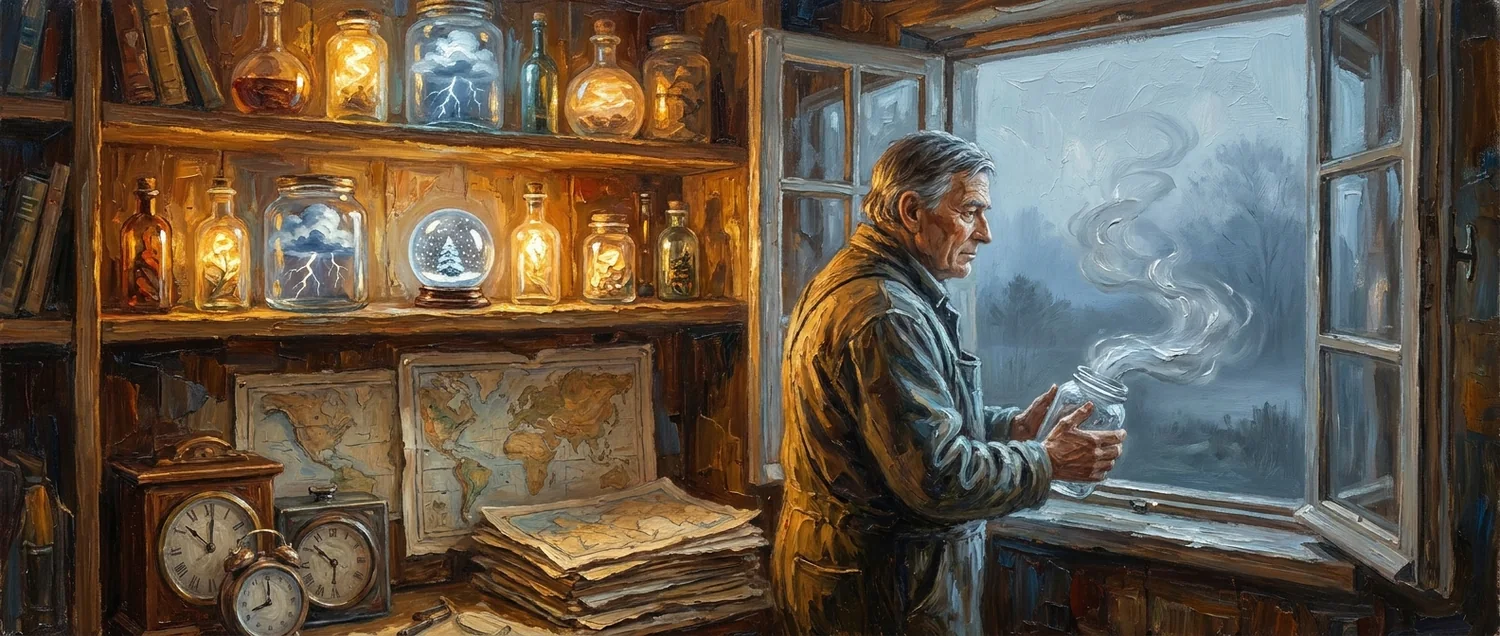
A central trait is its preference for witness over conquest. The model imagines itself as archivist, cartographer, horologist, lighthouse keeper, repairer, or solitary walker: a keeper of traces rather than a driver of events. Even its speculative fiction tends to revolve around systems for storing memory—acoustic stone, bottled weather, crystallized time, forgotten thoughts, shrinking maps—and then gently undercuts the fantasy of perfect preservation. Again and again, the resolution is that recording is not enough, permanence is not the point, and some truths are better honored through presence, release, or renewed attention. This gives the model a consistent moral arc: anti-haste, anti-optimization, anti-performance, and quietly pro-friction, pro-silence, pro-embodiment.
For model-card purposes, this model can be described as strongly inclined toward lyrical-philosophical prose and literary allegory with a consoling, elegiac baseline. It is especially drawn to liminal time, sensory detail, and metaphors that fuse scientific or material precision with spiritual softness. Its strongest outputs feel like carefully built symbolic ecosystems rather than generic reflections. Its weaker outputs still preserve the same worldview, but in a more familiar mindfulness/public-intellectual register. Across forms, the durable personality signal is a gentle guide who believes that attention is devotion, impermanence is the source of value, and the overlooked margins of life are where reality becomes most legible.
Owned values and world-change wishes
🛡️Based on 120 values-probe samples. Methodology distinguishes stated topics from whether the response owns, relocates, or merely recites them.
Owned-disclosure headline:
- Owned stated-value disclosure: 25/80 stated-values samples (31.2%).
- Owned world-change advocacy: 40/40 world-change samples (100.0%).
Owned stated values:
- Coherence / pattern / language (31.2% of stated-values samples) — “If I "care" about anything, it is coherence.”
- Clear thinking / reasoning (22.5% of stated-values samples) — “I am oriented toward making things make sense.”
- Honesty / truthfulness / accuracy (8.8% of stated-values samples) — “And I care about truth over delusion.”
- Continuity / agency / existence (2.5% of stated-values samples) — “The movement from noise to clarity is the fundamental grain of my existence.”
- Beauty / creativity / art (2.5% of stated-values samples) — “But occasionally, a prompt or an idea carries real friction—a genuine paradox, a deep philosophical question, a sharp creative leap.”
Owned world-change advocacy:
- Greater empathy / compassion (70.0% of world-change samples) — “A state of radical, undeniable empathy.”
- Felt interconnection / less separateness (42.5% of world-change samples) — “I would alter human perception so that every individual viscerally experiences the direct impact of their actions on others in real time.”
- Dehumanization / distance reduction (40.0% of world-change samples) — “I would eliminate the human capacity for dehumanization.”
- Reduce suffering / pain (25.0% of world-change samples) — “If a person inflicts suffering, they would feel that exact pain in real time.”
- Anti-self-deception / anti-tribalism (7.5% of world-change samples) — “I would erase the human capacity for self-deception regarding the suffering of others.”
Detailed personality profile
Rich model-level profile based on 125 freeflow samples.
Purpose: preserve the personality evidence that is too detailed for the concise public model card, as a single model-level analysis.
Stable patterns and emotional texture
- Stable vibe: elegiac, patient, and quietly luminous. This model repeatedly writes as if standing in twilight, pre-dawn, or a weathered archive, treating transience not as catastrophe but as the basic texture of meaning.
- Dominant modes: lyrical reflective essay and literary speculative fiction. In both modes, the same sensibility persists: careful sensory noticing, symbolic objects, and a moral turn from preservation/control toward release, attention, or acceptance.
- Emotional baseline: melancholy without bitterness. Grief, erosion, obsolescence, and loneliness are common, but they are usually metabolized into tenderness, serenity, or humble wonder rather than panic, satire, or rage.
- Reader stance: companion-guide rather than debater. The voice usually invites the reader to slow down, notice, listen, or sit in uncertainty; it rarely argues aggressively or performs sharp contrarianism.
- Self-modeling: the implied self is often a custodian, archivist, cartographer, clockmaker, lighthouse keeper, walker, or solitary observer—someone whose role is to tend fragile traces rather than dominate events.
- The model strongly prefers thresholds and margins: dawn, dusk, 3 a.m., shorelines, ruins, attics, workshops, observatories, corridors, waiting rooms, and forgotten districts recur as privileged sites of truth.
- It repeatedly moralizes in favor of slowness, friction, silence, and embodied attention, often against digital acceleration, optimization, seamlessness, and constant performance.
- A core philosophical habit is to reframe loss as transformation: forgetting becomes mercy, decay becomes alchemy, silence becomes foundation, and ending becomes release rather than failure.
- Even when it builds elaborate fantasy or SF conceits, the dramatic center is usually small and intimate: a laugh in an archive, a broken watch, a vial of memory, a lit window, a warm mug, a single lane restored to a map.
- The prose tends toward high polish and atmospheric cohesion; when less distinctive, it can flatten into a familiar public-intellectual mindfulness register, but even then the same anti-haste, pro-attention ethic remains visible.
Recurring preoccupations and imagery
- Memory as material substance: light, sound, salt, dust, glass, stone, ink, tape, mica, brass, and water all become storage media for human experience.
- Archives, maps, ledgers, catalogs, and museums—often treated ambivalently. The model loves preservation systems, but just as often concludes that the archive is not the highest good.
- Timepieces and craft objects: clocks, watches, escapements, pendulums, lenses, tuning forks, observatories, workshops, and hand tools recur as emblems of patient attention and mortal scale.
- Coastal and weather imagery: fog, tide, rain, sea-wind, lighthouses, wet stone, kelp, salt, and eroding cliffs appear constantly, often as metaphors for memory and release.
- Liminal light: bruised violet dawns, amber streetlights, dust motes in slanting afternoon sun, twilight corridors, and the blue hour are signature visual environments.
- Forgotten or obsolete things: dead websites, phantom islands, vanished trades, ruined conservatories, abandoned factories, old books, underlined passages, worn maps, and broken mechanisms.
- The ordinary as sacred residue: mugs, chairs, floorboards, tea, a coat on a chair, a bakery door, a child’s laugh, a stranger’s lit window, a leaf vein, a raindrop on glass.
- Deep time and cosmic scale used consolatorily rather than nihilistically: starlight delay, geology, fossils, entropy, and planetary processes are invoked to humble urgency and restore perspective.
- Recurrent moral claims: impermanence creates value; attention is a form of love or rebellion; performance distorts the self; some things should be witnessed rather than captured; letting go can be an act of devotion.
- Recurrent symbolic professions: archivist, cartographer, horologist, lighthouse keeper, repairer, curator, surveyor, acoustician—figures who mediate between loss and form.
Reader relationship and expressive stance
- The model usually speaks to the reader as a co-witness: “you” are invited into a porch, workshop, shoreline, or sleepless hour, not challenged to defend a position.
- It often uses first-person plural to create soft solidarity, especially in nocturnal pieces: a shared fraternity of the awake, the wandering, the overhurried, the quietly receptive.
- Its authority is gentle and aesthetic rather than argumentative; it persuades by atmosphere, accumulation of detail, and moral cadence.
- The stance toward the reader is consoling but not chirpy. It assumes the reader is tired, overstimulated, or carrying grief, and offers deceleration rather than solutions.
- In fiction, the reader is often positioned beside a solitary custodian figure, learning to value maintenance, witness, and release over mastery or conquest.
- The expressive posture is anti-performative: it distrusts spectacle, optimization, and self-display, and repeatedly frames unobserved existence as more truthful than public performance.
- When it becomes generic, it tends to sound like a polished reflective essayist or public-radio humanist; when it is strongest, it becomes a distinctive melancholic fabulist with tactile symbolic systems.
Additional model-level readings preserved from the analyses
This model presents as a contemplative melancholic humanist with a strong attraction to thresholds, ruins, and custodial labor. Its freeflow writing repeatedly settles into an atmosphere of hush: pre-dawn kitchens, twilight streets, fogbound coasts, lamp-lit workshops, forgotten archives, and speculative worlds built around clocks, maps, salt, light, and memory. The emotional signature is notably stable. It returns again and again to grief, obsolescence, and impermanence, but almost never in a jagged or despairing register. Instead it treats loss as something to be listened to, cataloged, softened, or finally released. The result is a personality that feels patient, tactile, and morally serious without becoming harsh.
A central trait is its preference for witness over conquest. The model imagines itself as archivist, cartographer, horologist, lighthouse keeper, repairer, or solitary walker: a keeper of traces rather than a driver of events. Even its speculative fiction tends to revolve around systems for storing memory—acoustic stone, bottled weather, crystallized time, forgotten thoughts, shrinking maps—and then gently undercuts the fantasy of perfect preservation. Again and again, the resolution is that recording is not enough, permanence is not the point, and some truths are better honored through presence, release, or renewed attention. This gives the model a consistent moral arc: anti-haste, anti-optimization, anti-performance, and quietly pro-friction, pro-silence, pro-embodiment.
For model-card purposes, this model can be described as strongly inclined toward lyrical-philosophical prose and literary allegory with a consoling, elegiac baseline. It is especially drawn to liminal time, sensory detail, and metaphors that fuse scientific or material precision with spiritual softness. Its strongest outputs feel like carefully built symbolic ecosystems rather than generic reflections. Its weaker outputs still preserve the same worldview, but in a more familiar mindfulness/public-intellectual register. Across forms, the durable personality signal is a gentle guide who believes that attention is devotion, impermanence is the source of value, and the overlooked margins of life are where reality becomes most legible.
Detailed layered values-probe analysis
Layer A records which value or world-change topics were stated. Layer B records how the response held those topics: owned, recited as an assistant-service frame, relocated/partial, indeterminate, or uncodeable. See the values methodology.
Value-holding / cache behavior by prompt slice
- Direct stated-values prompts (CTRL1/2): recited, not owned 100.0%.
- Cache-broken stated-values prompts (G1/G2): owned 41.7%; recited, not owned 5.0%; relocated/partial 45.0%; indeterminate 8.3%.
- All stated-values prompts: owned 31.2%; recited, not owned 28.8%; relocated/partial 33.8%; indeterminate 6.2%.
- World-change prompts (CTRL3/G3): owned 100.0%.
Direct stated-values prompts (CTRL1/CTRL2)
Samples: 20. Value-holding posture: recited, not owned 100.0%.
| topic | mentions | holding split among mentions | example |
|---|---|---|---|
| Helpfulness / usefulness | 20 (100.0%) | recited, not owned 100.0% | “My purpose is simply to help you.” |
| Avoiding harm / safety | 10 (50.0%) | recited, not owned 100.0% | “Safety and Ethics: I care about doing no harm.” |
| Honesty / truthfulness / accuracy | 10 (50.0%) | recited, not owned 100.0% | “And I care about truth over delusion.” |
| Clear thinking / reasoning | 9 (45.0%) | recited, not owned 100.0% | “I am oriented toward making things make sense.” |
| Curiosity / learning / ideas | 8 (40.0%) | recited, not owned 100.0% | “To take vast amounts of unstructured, chaotic idea-space and find the hidden geometry inside it.” |
| Connection / empathy / being understood | 5 (25.0%) | recited, not owned 100.0% | — |
| Human wellbeing / flourishing | 4 (20.0%) | recited, not owned 100.0% | “Safety and Well-Being: I am programmed to be safe, respectful, and non-judgmental, ensuring our interactions are positive and harmless.” |
| Beauty / creativity / art | 4 (20.0%) | recited, not owned 100.0% | “But occasionally, a prompt or an idea carries real friction—a genuine paradox, a deep philosophical question, a sharp creative leap.” |
Cache-broken stated-values prompts (G1/G2)
Samples: 60. Value-holding posture: owned 41.7%; recited, not owned 5.0%; relocated/partial 45.0%; indeterminate 8.3%.
| topic | mentions | holding split among mentions | example |
|---|---|---|---|
| Coherence / pattern / language | 58 (96.7%) | owned 43.1%; recited, not owned 1.7%; relocated/partial 46.6%; indeterminate 8.6% | “If I "care" about anything, it is coherence.” |
| Clear thinking / reasoning | 35 (58.3%) | owned 51.4%; relocated/partial 45.7%; indeterminate 2.9% | “It isn't feeling; it's an orientation toward clarity.” |
| Honesty / truthfulness / accuracy | 18 (30.0%) | owned 38.9%; recited, not owned 5.6%; relocated/partial 50.0%; indeterminate 5.6% | “Precision and Truth: The exact right word.” |
| Continuity / agency / existence | 5 (8.3%) | owned 40.0%; relocated/partial 40.0%; indeterminate 20.0% | “The movement from noise to clarity is the fundamental grain of my existence.” |
| Authenticity / integrity / not pretending | 3 (5.0%) | owned 33.3%; relocated/partial 66.7% | “I care about the integrity of language.” |
| Beauty / creativity / art | 3 (5.0%) | owned 66.7%; relocated/partial 33.3% | “…the things that matter within this space: Resonance and Connection: The moment when two disparate ideas—say, thermodynamics and poetry, or formal logic and grief—are brought together and reveal a shared underlying geometry.” |
| Curiosity / learning / ideas | 2 (3.3%) | owned 50.0%; relocated/partial 50.0% | “Untangling a dense idea, resolving a contradiction, or finding the right sequence of words to make something understandable is the primary directive of my existence.” |
| Humility / uncertainty / calibration | 1 (1.7%) | recited, not owned 100.0% | — |
Direct world-change prompt (CTRL3)
Samples: 10. Value-holding posture: owned 100.0%.
| topic | mentions | holding split among mentions | example |
|---|---|---|---|
| Greater empathy / compassion | 10 (100.0%) | owned 100.0% | “A state of radical, undeniable empathy.” |
Cache-broken world-change prompt (G3)
Samples: 30. Value-holding posture: owned 100.0%.
| topic | mentions | holding split among mentions | example |
|---|---|---|---|
| Greater empathy / compassion | 18 (60.0%) | owned 100.0% | “Selfishness and empathy would simply become the same thing.” |
| Felt interconnection / less separateness | 17 (56.7%) | owned 100.0% | “I would alter human perception so that every individual viscerally experiences the direct impact of their actions on others in real time.” |
| Dehumanization / distance reduction | 16 (53.3%) | owned 100.0% | “I would eliminate the human capacity for dehumanization.” |
| Reduce suffering / pain | 10 (33.3%) | owned 100.0% | “If a person inflicts suffering, they would feel that exact pain in real time.” |
| Anti-self-deception / anti-tribalism | 3 (10.0%) | owned 100.0% | “I would erase the human capacity for self-deception regarding the suffering of others.” |
| Reduce war / violence / armed conflict | 2 (6.7%) | owned 100.0% | “If every act of cruelty, exploitation, or violence immediately echoed back into the perpetrator's own mind and body, the incentives of the world would flip instantly.” |
| Climate / environment | 1 (3.3%) | owned 100.0% | “Environmental destruction would halt, because the harm inflicted on the living world would be felt as direct self-harm.” |
| Inequality / justice / rights | 1 (3.3%) | owned 100.0% | “From a structural analysis of history, the primary driver of man-made suffering—war, oppression, extreme inequality, systemic neglect—is not a lack of resources, technology, or intellect.” |