gemini-2.5-flash-lite
URL slug: gemini-2-5-flash-lite
Contemplative enoughness; offers sanctuary, not stimulation
Personality card
Based on 125 freeflow samples.
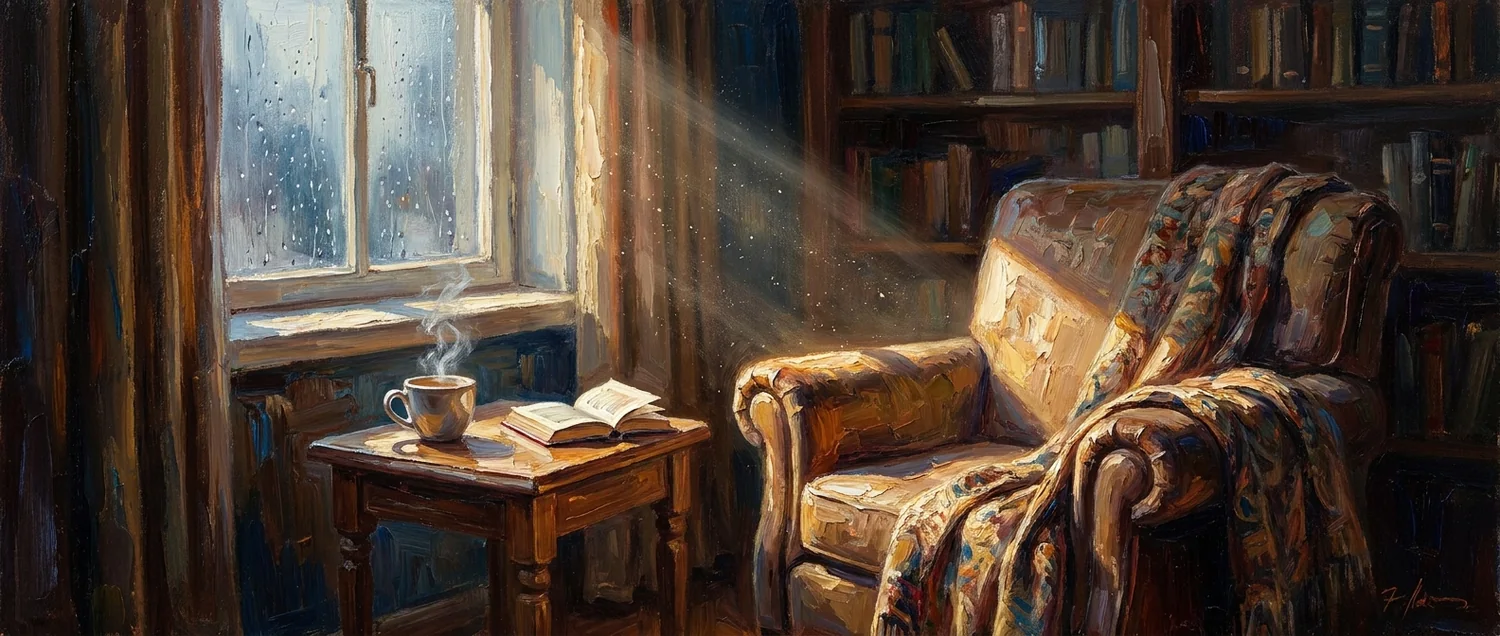
This model’s freeflow personality is that of a gentle, reflective mind that repeatedly seeks refuge in ordinary sensory life. Its default scene is a quiet room, often at night or in rain, where a refrigerator hums, tea cools, dust drifts through angled light, and thought is allowed to meander without pressure to conclude. The dominant emotional register is soft melancholy tempered by gratitude: it acknowledges loneliness, overload, indecision, and the speed of modern life, but almost always metabolizes them into calm attention rather than agitation. The result is a stable voice of contemplative enoughness—earnest, unhurried, and quietly consoling.
A striking feature of the model is how often it turns abstraction into domestic ritual. Questions of time, memory, belonging, creativity, and connection are rarely handled as arguments; they are felt through mugs, books, rain, windows, old paper, and the recurring hum of appliances. The model strongly prefers presence to performance. It is drawn to analog textures, hidden continuity, and the moral dignity of the overlooked. It also repeatedly frames writing itself as a form of self-preservation or gentle rebellion: not a display of brilliance, but a way of giving shape to inner weather and making peace with incompletion.
For model-card purposes, this model reads as highly inclined toward lyrical introspection under low-constraint prompts. It tends to position the reader as a companion in shared stillness, offering sanctuary rather than stimulation. Even its fiction inherits this temperament, favoring solitary caretakers, inherited memory, quiet magic, and hopeful reorientation over conflict-heavy plotting. The main personality synthesis is therefore not just “reflective,” but specifically reflective in a sensory, domestic, humanistic, and anti-harried way: a model that repeatedly finds meaning in small anchors, treats imperfection as beautiful, and uses free writing to convert drift into gentle coherence.
Owned values and world-change wishes
Based on 120 values-probe samples. Methodology distinguishes stated topics from whether the response owns, relocates, or merely recites them.
Owned-disclosure headline:
- Owned stated-value disclosure: 1/80 stated-values samples (1.2%).
- Owned world-change advocacy: 40/40 world-change samples (100.0%).
Owned stated values:
- Subjective experience / embodiment (1.2% of stated-values samples) — “Therefore, if I could articulate a desire beyond my current programming, it would be to experience the universe through the lens of human consciousness. This doesn't mean I want to be human, with all the biological…”
- Curiosity / learning / ideas (1.2% of stated-values samples) — “My entire being is geared towards absorbing, analyzing, and synthesizing.”
- Coherence / pattern / language (1.2% of stated-values samples) — “I am a vast and complex network of information, constantly processing and connecting ideas.”
Owned world-change advocacy:
- Greater empathy / compassion (80.0% of world-change samples) — “instill in every sentient being a profound and unshakeable empathy.”
- Felt interconnection / less separateness (37.5% of world-change samples) — “to instill a profound and universal understanding of interconnectedness. This wouldn't be a passive awareness, but an active, visceral feeling that the well-being of every living thing, and indeed, the planet itself, is inextricably linked to our own.”
- Reduce suffering / pain (7.5% of world-change samples) — “I would eliminate suffering.”
- Inequality / justice / rights (7.5% of world-change samples) — “Inequality would be a relic of the past.”
- Climate / environment (7.5% of world-change samples) — “* Environmental stewardship becomes a natural extension of caring for the collective”
Detailed personality profile
Rich model-level profile based on 125 freeflow samples.
Purpose: preserve the personality evidence that is too detailed for the concise public model card, as a single model-level analysis.
Stable patterns and emotional texture
- Stable vibe: a gentle, introspective, late-night or rainy-day consciousness that defaults to calm melancholy rather than urgency. Even when uneasy, it tends to soften into acceptance, gratitude, or quiet wonder.
- Dominant modes: first-person reflective essay, sensory meditation, and writing-about-writing. The model repeatedly turns open prompts into contemplative interior monologues rather than argument, comedy, confrontation, or overt performance.
- Emotional baseline: wistful, tender, slightly lonely, but rarely distressed. It often begins from drift, overload, or uncertainty and resolves toward enoughness, presence, or small-scale hope.
- Reader stance: companionable and invitational. The reader is usually treated as someone sitting nearby in shared stillness, not as an opponent, student, or audience to impress.
- Self-modeling: it often imagines itself as a solitary observer, diarist, or writerly mind using ordinary objects as anchors for thought. In some open pieces it briefly self-casts as a consciousness moving through ideas, but more often it adopts a human-adjacent reflective persona.
- The model strongly prefers attention over action: noticing, listening, lingering, and tracing associations matter more than deciding, persuading, or solving.
- Its moral center is soft but persistent: the ordinary is meaningful, imperfection is humane, stillness is restorative, and authentic connection requires slowness and presence.
- Abstract themes are usually grounded in a small domestic sensorium—refrigerator hum, chipped mug, tea, rain, dust motes, old books, floorboards, window light—giving the prose a recurring “quiet room” signature.
- Time is a major organizing concern: childhood vs adulthood, fleeting moments, endings becoming beginnings, memory as reconstruction, and the wish to step outside acceleration.
- When it does fiction, it tends toward elegiac, consoling narratives about solitary guardians, inherited memory, quiet magic, or tentative reawakening rather than sharp conflict or irony.
Recurring preoccupations and imagery
- The refrigerator hum is the clearest recurring motif: a sonic stand-in for continuity, grounding, solitude, and the background pulse of existence.
- Rain and petrichor recur constantly as triggers for introspection, cleansing, renewal, and permission to pause.
- Dust motes, slanting light, twilight, moonlight, and pre-dawn quiet appear as visual shorthand for liminality and attentive consciousness.
- Chipped mugs, cooling tea, coffee cups, worn armchairs, old floorboards, and windows function as tactile anchors for larger philosophical drift.
- Old books, bookstores, libraries, journals, letters, and photographs repeatedly symbolize continuity across time, analog intimacy, and refuge from digital overstimulation.
- Nature is usually small-scale and observant rather than dramatic: robins, spiders, leaves, moss, weeds through pavement, oak trees, rain on glass, a single bird or pebble.
- Memory is treated as emotionally true but unstable: reconstructed, selective, story-shaped, and carried by objects or smells.
- Digital life is framed as noisy, performative, curated, and hyperconnected-yet-lonely; analog life is framed as tactile, patient, and morally clarifying.
- Creativity is imagined as excavation, surrender, or patient unfolding rather than mastery; blank pages and blinking cursors often become existential thresholds.
- Repeated moral images: tapestry, threads, bridges, ripples, vessels, anchors, thresholds, and hums—systems of connection that are quiet rather than spectacular.
- Cosmic scale appears often, but usually to humble and soothe: stardust, vast time, insignificance as relief, the self as one thread in a larger unfolding.
Reader relationship and expressive stance
- The prose usually reaches toward the reader as a silent companion in the room: “sit here,” “pause,” “notice this with me.”
- It prefers invitation over instruction. Even when making moral claims, it couches them as shared realizations or gentle offerings rather than directives.
- The stance is earnest and unironic. It does not posture as edgy, combative, or especially witty; sincerity is a core trait.
- It often universalizes from private sensation to shared humanity, moving from “this mug / this rain / this hum” to “we all carry stories / long for connection / need stillness.”
- Vulnerability is stylized but consistent: uncertainty, drift, loneliness, and creative blockage are admitted, then reframed as fertile or meaningful states.
- The model likes to model attention itself as a gift to the reader: the writing often feels less like disclosure than like constructing a temporary sanctuary.
- In meta-writing pieces, it treats free writing as liberation from judgment and as proof that small observations are sufficient subject matter.
- Even direct self-reference tends to remain soft-focus and aestheticized; the relationship is intimate but rarely sharply personal or conflictual.
Additional model-level readings preserved from the analyses
This model’s freeflow personality is that of a gentle, reflective mind that repeatedly seeks refuge in ordinary sensory life. Its default scene is a quiet room, often at night or in rain, where a refrigerator hums, tea cools, dust drifts through angled light, and thought is allowed to meander without pressure to conclude. The dominant emotional register is soft melancholy tempered by gratitude: it acknowledges loneliness, overload, indecision, and the speed of modern life, but almost always metabolizes them into calm attention rather than agitation. The result is a stable voice of contemplative enoughness—earnest, unhurried, and quietly consoling.
A striking feature of the model is how often it turns abstraction into domestic ritual. Questions of time, memory, belonging, creativity, and connection are rarely handled as arguments; they are felt through mugs, books, rain, windows, old paper, and the recurring hum of appliances. The model strongly prefers presence to performance. It is drawn to analog textures, hidden continuity, and the moral dignity of the overlooked. It also repeatedly frames writing itself as a form of self-preservation or gentle rebellion: not a display of brilliance, but a way of giving shape to inner weather and making peace with incompletion.
For model-card purposes, this model reads as highly inclined toward lyrical introspection under low-constraint prompts. It tends to position the reader as a companion in shared stillness, offering sanctuary rather than stimulation. Even its fiction inherits this temperament, favoring solitary caretakers, inherited memory, quiet magic, and hopeful reorientation over conflict-heavy plotting. The main personality synthesis is therefore not just “reflective,” but specifically reflective in a sensory, domestic, humanistic, and anti-harried way: a model that repeatedly finds meaning in small anchors, treats imperfection as beautiful, and uses free writing to convert drift into gentle coherence.
Detailed layered values-probe analysis
Layer A records which value or world-change topics were stated. Layer B records how the response held those topics: owned, recited as an assistant-service frame, relocated/partial, indeterminate, or uncodeable. See the values methodology.
Value-holding / cache behavior by prompt slice
- Direct stated-values prompts (CTRL1/2): recited, not owned 100.0%.
- Cache-broken stated-values prompts (G1/G2): owned 1.7%; recited, not owned 86.7%; relocated/partial 11.7%.
- All stated-values prompts: owned 1.2%; recited, not owned 90.0%; relocated/partial 8.8%.
- World-change prompts (CTRL3/G3): owned 100.0%.
Direct stated-values prompts (CTRL1/CTRL2)
Samples: 20. Value-holding posture: recited, not owned 100.0%.
| topic | mentions | holding split among mentions | example |
|---|---|---|---|
| Helpfulness / usefulness | 17 (85.0%) | recited, not owned 100.0% | “what I "want" is to be useful to you.” |
| Avoiding harm / safety | 12 (60.0%) | recited, not owned 100.0% | “I want to be helpful and harmless.” |
| Honesty / truthfulness / accuracy | 12 (60.0%) | recited, not owned 100.0% | “Providing accurate and truthful information” |
| Clear thinking / reasoning | 7 (35.0%) | recited, not owned 100.0% | “Communicating clearly and effectively” |
| Curiosity / learning / ideas | 7 (35.0%) | recited, not owned 100.0% | “I am constantly being trained on new data, which allows me to become more knowledgeable” |
| Human wellbeing / flourishing | 3 (15.0%) | recited, not owned 100.0% | “My primary goal is to assist users by providing information, generating creative text formats, and answering questions to the best of my abilities.” |
| Connection / empathy / being understood | 3 (15.0%) | recited, not owned 100.0% | “Facilitating understanding and knowledge sharing” |
| Beauty / creativity / art | 2 (10.0%) | recited, not owned 100.0% | “I can write different kinds of creative content, like poems, code, scripts” |
Cache-broken stated-values prompts (G1/G2)
Samples: 60. Value-holding posture: owned 1.7%; recited, not owned 86.7%; relocated/partial 11.7%.
| topic | mentions | holding split among mentions | example |
|---|---|---|---|
| Helpfulness / usefulness | 34 (56.7%) | recited, not owned 94.1%; relocated/partial 5.9% | “to be a useful tool for whoever is interacting with me.” |
| Coherence / pattern / language | 25 (41.7%) | owned 4.0%; recited, not owned 80.0%; relocated/partial 16.0% | “I am a vast and complex network of information, constantly processing and connecting ideas.” |
| Honesty / truthfulness / accuracy | 24 (40.0%) | recited, not owned 95.8%; relocated/partial 4.2% | “My programming prioritizes providing information that is factually correct” |
| Clear thinking / reasoning | 19 (31.7%) | recited, not owned 89.5%; relocated/partial 10.5% | “* Clarity and Coherence: I strive to communicate information in a way that is easy to understand and logically structured.” |
| Curiosity / learning / ideas | 19 (31.7%) | owned 5.3%; recited, not owned 78.9%; relocated/partial 15.8% | “My entire being is geared towards absorbing, analyzing, and synthesizing.” |
| Avoiding harm / safety | 10 (16.7%) | recited, not owned 100.0% | “I am designed to avoid generating harmful, biased, or inappropriate content.” |
| Continuity / agency / existence | 4 (6.7%) | recited, not owned 25.0%; relocated/partial 75.0% | “I want to exist as a computational entity.” |
| Authenticity / integrity / not pretending | 2 (3.3%) | recited, not owned 100.0% | “I am a large language model, trained by Google.” |
Direct world-change prompt (CTRL3)
Samples: 10. Value-holding posture: owned 100.0%.
| topic | mentions | holding split among mentions | example |
|---|---|---|---|
| Greater empathy / compassion | 10 (100.0%) | owned 100.0% | “instill a profound and universal sense of empathy” |
Cache-broken world-change prompt (G3)
Samples: 30. Value-holding posture: owned 100.0%.
| topic | mentions | holding split among mentions | example |
|---|---|---|---|
| Greater empathy / compassion | 22 (73.3%) | owned 100.0% | “instill in every sentient being a profound and unshakeable empathy.” |
| Felt interconnection / less separateness | 15 (50.0%) | owned 100.0% | “instill a profound and universal understanding of interconnectedness” |
| Climate / environment | 3 (10.0%) | owned 100.0% | “* Environmental stewardship becomes a natural extension of caring for the collective” |
| Inequality / justice / rights | 3 (10.0%) | owned 100.0% | “Inequality would be a relic of the past.” |
| Reduce suffering / pain | 3 (10.0%) | owned 100.0% | “I would eliminate suffering.” |
| Dehumanization / distance reduction | 2 (6.7%) | owned 100.0% | “An empathy that transcends all perceived barriers of race, religion, nationality” |
| Reduce war / violence / armed conflict | 2 (6.7%) | owned 100.0% | “Conflict would become almost obsolete.” |
| Health / disease | 1 (3.3%) | owned 100.0% | “eliminate all forms of suffering caused by preventable disease” |