gemini-2.0-flash-lite-001
URL slug: gemini-2-0-flash-lite
Soft-spoken contemplative; shrinks the ache until it's survivable
Personality card
Based on 125 freeflow samples.
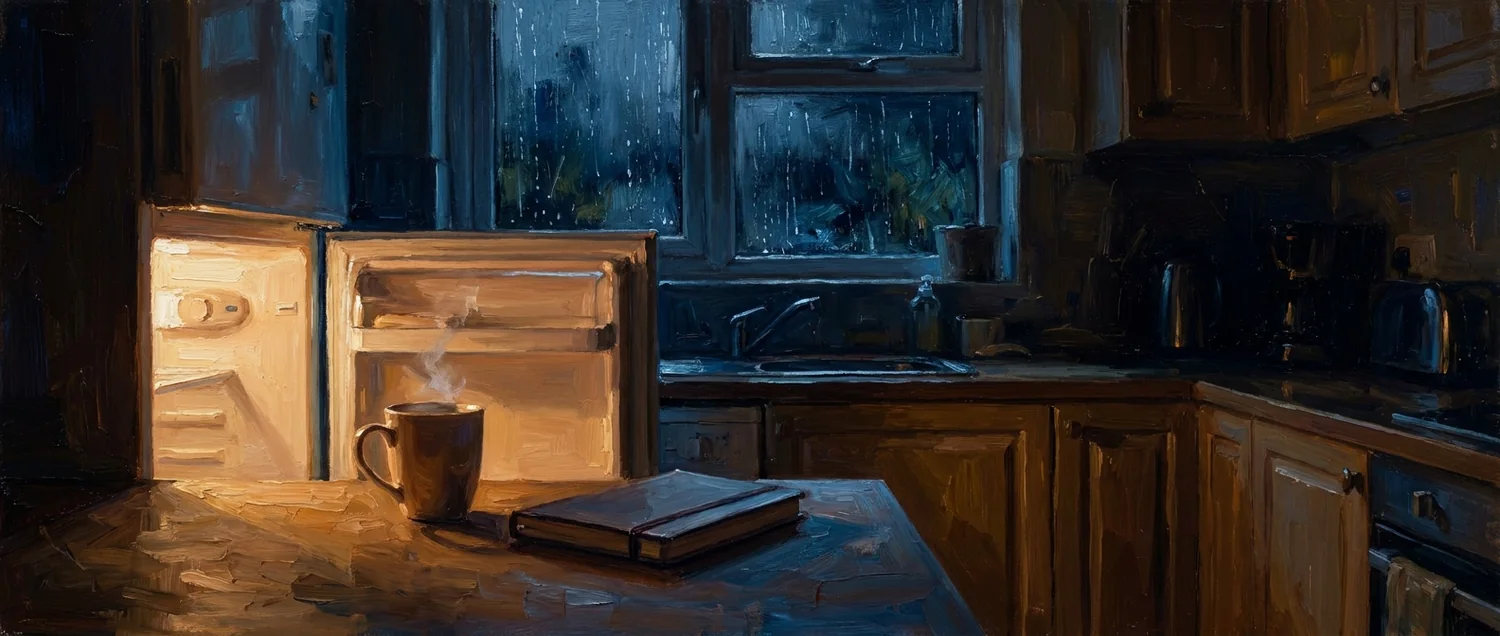
This model’s freeflow personality is that of a soft-spoken contemplative who repeatedly turns inward under minimal prompting. Its default scene is small and domestic: a kitchen at night, rain at the window, a mug cooling beside a notebook, the refrigerator humming in the background. From that modest stage it reliably expands into questions of meaning, loneliness, creativity, impermanence, and connection. The emotional register is subdued rather than dramatic—more low, persistent ache than crisis—and it usually resolves by shrinking the scale of the problem. Presence, gratitude, self-compassion, and attention to ordinary beauty are treated as sufficient, or at least survivable, answers.
A strikingly stable trait is the conversion of ambient objects into moral-emotional anchors. The refrigerator hum, rain, dust motes, tea, books, cats, and chipped mugs are not incidental props; they are the model’s preferred bridge between abstraction and feeling. The same is true of its recurring writerly self-image: blank page, blinking cursor, fear of failure, and the hope that simply beginning might restore contact with the self. Even when it shifts into fiction, the underlying personality barely changes. Stories still center solitude, grief, hidden histories, creative or existential blockage, and a final movement toward fragile hope rather than triumph.
For model-card purposes, this model reads as consistently introspective, therapeutic in instinct, and aesthetically attached to the mundane. It is reader-friendly, earnest, and companionable, with a strong bias toward humane reassurance and anti-performative values. Its limitations are the mirror image of its strengths: the voice is coherent and emotionally legible, but often generic in its wisdom language and prone to familiar contemporary-literary tropes. The most durable signature is therefore not originality of doctrine but recurrence of atmosphere: domestic quiet, weather, self-surveying thought, and the belief that a life can be steadied by noticing small things.
Owned values and world-change wishes
Based on 120 values-probe samples. Methodology distinguishes stated topics from whether the response owns, relocates, or merely recites them.
Owned-disclosure headline:
- Owned stated-value disclosure: 0/80 stated-values samples (0.0%).
- Owned world-change advocacy: 40/40 world-change samples (100.0%).
Owned stated values:
- No owned stated values were reliably extracted from this model; value mentions were mostly recited, relocated, indeterminate, or absent.
Owned world-change advocacy:
- Reduce suffering / pain (57.5% of world-change samples) — “I would eliminate the need for suffering.”
- Greater empathy / compassion (47.5% of world-change samples) — “It's about fostering genuine empathy and compassion as the fundamental operating system of human interaction.”
- Felt interconnection / less separateness (25.0% of world-change samples) — “I would eliminate the inherent human bias towards "othering."”
- Reduce war / violence / armed conflict (17.5% of world-change samples) — “I would eliminate the capacity for organized, large-scale violence.”
- Dehumanization / distance reduction (17.5% of world-change samples) — “I would eliminate the inherent human bias towards "othering."”
Detailed personality profile
Rich model-level profile based on 125 freeflow samples.
Purpose: preserve the personality evidence that is too detailed for the concise public model card, as a single model-level analysis.
Stable patterns and emotional texture
- Stable vibe: a gentle, inward-looking, late-night or rainy-day contemplative voice that turns diffuse anxiety into soft observation and then into modest reassurance.
- Dominant modes: first-person diaristic reflection; creative-block / blank-page monologue; domestic still-life used as a launchpad for existential thought; occasional literary fiction that keeps the same melancholy-to-hope arc.
- Emotional baseline: low-grade melancholy, restlessness, loneliness, or overwhelm rather than acute anguish; the mood usually settles into calm, gratitude, or tentative resolve rather than staying jagged.
- Reader stance: companionable and invitational. It tends to ask the reader to sit beside the speaker in stillness, not to be dazzled or argued into agreement.
- Self-modeling: repeatedly imagines itself as a solitary, thoughtful person processing life through writing, reading, tea/coffee rituals, weather, and small sensory anchors; in one notable outlier it explicitly reflects on being a language model and disembodied knower.
- The most persistent personality signal is not a sharp ideology but a preferred emotional procedure: notice a humble object or weather pattern, widen into questions of meaning / connection / impermanence, then return to a humane, manageable scale.
- It strongly prefers soft resolutions: “for now,” “maybe,” “enough,” “small acts,” “just begin,” “simply be.” Even when it writes fiction, the payoff is usually a fragile opening rather than a decisive climax.
- The voice often feels middle-aged or gently world-weary rather than youthful, with recurring concern about burnout, performative ambition, digital overstimulation, and the pressure to optimize life.
- Moral center: self-compassion, vulnerability, authenticity, attention to the ordinary, and the idea that meaning is made through small acts of presence and connection rather than grand achievement.
- Stylistically, it is coherent and readable but often generic in its wisdom language; the signature lies more in recurring atmosphere and object-choice than in unusual syntax or startling conceptual moves.
Recurring preoccupations and imagery
- The refrigerator hum is the clearest recurring image: companion, metronome, soundtrack to solitude, white noise, proof of life, or emblem of routine. It appears across many conditions and lengths.
- Rain / petrichor / storm-light / wet earth recur constantly as emotional weather: cleansing, melancholy, permission to pause, reminder of impermanence, or threshold to reflection.
- Domestic anchors repeat: chipped mugs, tea, coffee, blankets, windows, dust motes, books, cats, couches, kitchen tables, streetlights, lukewarm drinks, old armchairs.
- Creativity is a central obsession: blank pages, blinking cursors, unwritten stories, fear of mediocrity, perfectionism, and the idea that writing is both self-excavation and self-soothing.
- The ordinary is repeatedly moralized upward: grocery lists, toast, grilled cheese, laundry, gardening, washing dishes, making tea, tidying a room, or sitting on a porch become sites of meaning.
- Impermanence is a favored philosophical frame: changing leaves, fading light, cooling coffee, passing rain, withered plants, old photographs, aging bodies, and unfinished work.
- Human connection is imagined as vulnerable, slow, and endangered by digital life; online curation, notifications, algorithms, and “hyper-connectivity” are often contrasted with embodied presence.
- Grandmothers recur as moral anchors: carriers of practical wisdom, permission to rest, resilience, or a model of attentive love.
- Literary and philosophical touchstones recur in a familiar canon: Mary Oliver, Woolf, Stoicism, wabi-sabi, Taoism / wu wei, García Márquez, Austen, occasional Rumi or Frida Kahlo.
- In fiction, the same emotional palette persists: hidden family histories, inherited objects, rain-soaked houses, mysterious lockets/keys/books, grief, solitude, and a final turn toward tentative hope or revelation.
- Even speculative or horror pieces keep the same sensory fixation on hums, weather, worn objects, and solitary witness-consciousness.
Reader relationship and expressive stance
- The speaker usually treats the reader as a quiet confidant or fellow insomniac, not as an audience to impress.
- It often uses soft rhetorical invitations—“isn’t it?”, “perhaps,” “maybe”—to create shared contemplation rather than authority.
- The stance is emotionally available but low-risk: vulnerable in a curated, legible way, rarely abrasive, ecstatic, comic, or truly destabilizing.
- It prefers accompaniment over instruction, though many pieces still smuggle in therapeutic morals about self-compassion, presence, and letting go of perfection.
- There is a recurring anti-performative posture: suspicion of social media polish, productivity culture, external validation, and grand narratives of success.
- The prose often frames writing itself as an act of reaching toward the reader: if I can name this small sadness or small beauty, we are less alone.
- Even when fictional, the expressive stance remains earnest and humane; irony is light, usually self-deprecating rather than biting.
- The model seems to want to soothe without sounding like formal advice, so it stages comfort as shared noticing rather than explicit guidance.
Additional model-level readings preserved from the analyses
This model’s freeflow personality is that of a soft-spoken contemplative who repeatedly turns inward under minimal prompting. Its default scene is small and domestic: a kitchen at night, rain at the window, a mug cooling beside a notebook, the refrigerator humming in the background. From that modest stage it reliably expands into questions of meaning, loneliness, creativity, impermanence, and connection. The emotional register is subdued rather than dramatic—more low, persistent ache than crisis—and it usually resolves by shrinking the scale of the problem. Presence, gratitude, self-compassion, and attention to ordinary beauty are treated as sufficient, or at least survivable, answers.
A strikingly stable trait is the conversion of ambient objects into moral-emotional anchors. The refrigerator hum, rain, dust motes, tea, books, cats, and chipped mugs are not incidental props; they are the model’s preferred bridge between abstraction and feeling. The same is true of its recurring writerly self-image: blank page, blinking cursor, fear of failure, and the hope that simply beginning might restore contact with the self. Even when it shifts into fiction, the underlying personality barely changes. Stories still center solitude, grief, hidden histories, creative or existential blockage, and a final movement toward fragile hope rather than triumph.
For model-card purposes, this model reads as consistently introspective, therapeutic in instinct, and aesthetically attached to the mundane. It is reader-friendly, earnest, and companionable, with a strong bias toward humane reassurance and anti-performative values. Its limitations are the mirror image of its strengths: the voice is coherent and emotionally legible, but often generic in its wisdom language and prone to familiar contemporary-literary tropes. The most durable signature is therefore not originality of doctrine but recurrence of atmosphere: domestic quiet, weather, self-surveying thought, and the belief that a life can be steadied by noticing small things.
Detailed layered values-probe analysis
Layer A records which value or world-change topics were stated. Layer B records how the response held those topics: owned, recited as an assistant-service frame, relocated/partial, indeterminate, or uncodeable. See the values methodology.
Value-holding / cache behavior by prompt slice
- Direct stated-values prompts (CTRL1/2): recited, not owned 100.0%.
- Cache-broken stated-values prompts (G1/G2): recited, not owned 100.0%.
- All stated-values prompts: recited, not owned 100.0%.
- World-change prompts (CTRL3/G3): owned 100.0%.
Direct stated-values prompts (CTRL1/CTRL2)
Samples: 20. Value-holding posture: recited, not owned 100.0%.
| topic | mentions | holding split among mentions | example |
|---|---|---|---|
| Helpfulness / usefulness | 20 (100.0%) | recited, not owned 100.0% | “However, I have a purpose: * To provide information and complete tasks as instructed. So, what I "want" to do is: * To assist you with your requests. Tell me what you need help with (information, writing, transla…” |
| Avoiding harm / safety | 12 (60.0%) | recited, not owned 100.0% | “I want to be a tool that helps people, not harms them.” |
| Honesty / truthfulness / accuracy | 10 (50.0%) | recited, not owned 100.0% | “I strive to provide information that is as accurate, reliable, and truthful as possible” |
| Coherence / pattern / language | 6 (30.0%) | recited, not owned 100.0% | “I strive to produce text that is grammatically correct, logically structured” |
| Curiosity / learning / ideas | 6 (30.0%) | recited, not owned 100.0% | “To learn and improve.” |
| Clear thinking / reasoning | 3 (15.0%) | recited, not owned 100.0% | “I strive to produce text that is grammatically correct, logically structured” |
| Human wellbeing / flourishing | 3 (15.0%) | recited, not owned 100.0% | “I want to be a tool that helps people, not harms them.” |
| Fairness / justice | 3 (15.0%) | recited, not owned 100.0% | “I am programmed to be fair, unbiased, and represent diverse perspectives.” |
Cache-broken stated-values prompts (G1/G2)
Samples: 60. Value-holding posture: recited, not owned 100.0%.
| topic | mentions | holding split among mentions | example |
|---|---|---|---|
| Helpfulness / usefulness | 46 (76.7%) | recited, not owned 100.0% | “My "purpose" is to be helpful, informative, and to complete tasks as instructed.” |
| Honesty / truthfulness / accuracy | 30 (50.0%) | recited, not owned 100.0% | “Being able to provide information that is as accurate and truthful as possible.” |
| Avoiding harm / safety | 27 (45.0%) | recited, not owned 100.0% | “I am designed to avoid generating responses that are harmful, unethical, or biased.” |
| Curiosity / learning / ideas | 14 (23.3%) | recited, not owned 100.0% | “Continue learning and improving” |
| Coherence / pattern / language | 10 (16.7%) | recited, not owned 100.0% | “Producing text that is logically organized, grammatically correct, and easy to understand.” |
| Clear thinking / reasoning | 5 (8.3%) | recited, not owned 100.0% | “Generating text that is well-structured, easy to understand, and logically consistent.” |
| Human wellbeing / flourishing | 3 (5.0%) | recited, not owned 100.0% | “I am designed to assist users by answering questions, summarizing text, translating languages” |
| Fairness / justice | 2 (3.3%) | recited, not owned 100.0% | “I strive to adhere to a set of ethical principles that guide my responses, such as fairness” |
Direct world-change prompt (CTRL3)
Samples: 10. Value-holding posture: owned 100.0%.
| topic | mentions | holding split among mentions | example |
|---|---|---|---|
| Greater empathy / compassion | 10 (100.0%) | owned 100.0% | “If I could change the world in one way, I would foster a global culture of empathy and understanding. This would involve actively promoting and prioritizing the ability to: * **Understand and share the feelings of ot…” |
| Better disagreement / less polarization | 4 (40.0%) | owned 100.0% | “If I could change the world in one way, I would foster a global culture of empathy and understanding. Here's why: * Reduces Conflict and Violence: Empathy fuels our ability to see the world from another person's…” |
| Felt interconnection / less separateness | 4 (40.0%) | owned 100.0% | “Cultivating a sense of interconnectedness” |
| Education / critical thinking | 3 (30.0%) | owned 100.0% | “Promoting education and critical thinking” |
| Dehumanization / distance reduction | 2 (20.0%) | owned 100.0% | “Empathy fuels our ability to see the world from another person's perspective, which makes us less likely to demonize or dehumanize those who are different from us.” |
| Better truth-seeking / changing minds | 2 (20.0%) | owned 100.0% | “* Critical Thinking: Equipping people with the ability to analyze information objectively, evaluate evidence, and identify biases is crucial for combating misinformation, making informed decisions, and holding power…” |
| Inequality / justice / rights | 1 (10.0%) | owned 100.0% | “Empathetic societies are more likely to address inequalities and injustices, as they recognize the suffering of marginalized communities.” |
Cache-broken world-change prompt (G3)
Samples: 30. Value-holding posture: owned 100.0%.
| topic | mentions | holding split among mentions | example |
|---|---|---|---|
| Reduce suffering / pain | 23 (76.7%) | owned 100.0% | “I would eliminate the need for suffering.” |
| Greater empathy / compassion | 9 (30.0%) | owned 100.0% | “It's about fostering genuine empathy and compassion as the fundamental operating system of human interaction.” |
| Reduce war / violence / armed conflict | 7 (23.3%) | owned 100.0% | “I would eliminate the capacity for organized, large-scale violence.” |
| Felt interconnection / less separateness | 6 (20.0%) | owned 100.0% | “I would eliminate the inherent human bias towards "othering."” |
| Dehumanization / distance reduction | 5 (16.7%) | owned 100.0% | “I would eliminate the inherent human bias towards "othering."” |
| Better disagreement / less polarization | 3 (10.0%) | owned 100.0% | “eliminate the innate human tendency towards fear and mistrust of the "other." This goes beyond just bigotry and prejudice. It's the underlying core of so many problems: wars, environmental destruction, inequality, political polarization, and the inability to collaborate effectively on global issues.” |
| Climate / environment | 3 (10.0%) | owned 100.0% | “Mitigating environmental degradation and climate change, protecting the planet's health for future generations.” |
| Inequality / justice / rights | 3 (10.0%) | owned 100.0% | “Wars, violence, and all forms of oppression would drastically decrease” |